
 Excavator
294 models
Excavator
294 models  Backhoe Loader
51 models
Backhoe Loader
51 models  Crane
68 models
Crane
68 models  Concrete Mixer
79 models
Concrete Mixer
79 models  Wheel Loader
54 models
Wheel Loader
54 models  Compactor / Roller
45 models
Compactor / Roller
45 models  Motor Grader
42 models
Motor Grader
42 models  Dozer
41 models
Dozer
41 models  Concrete Pump
66 models
Concrete Pump
66 models  Skid Steer Loader
11 models
Skid Steer Loader
11 models  Telehandler
13 models
Telehandler
13 models 


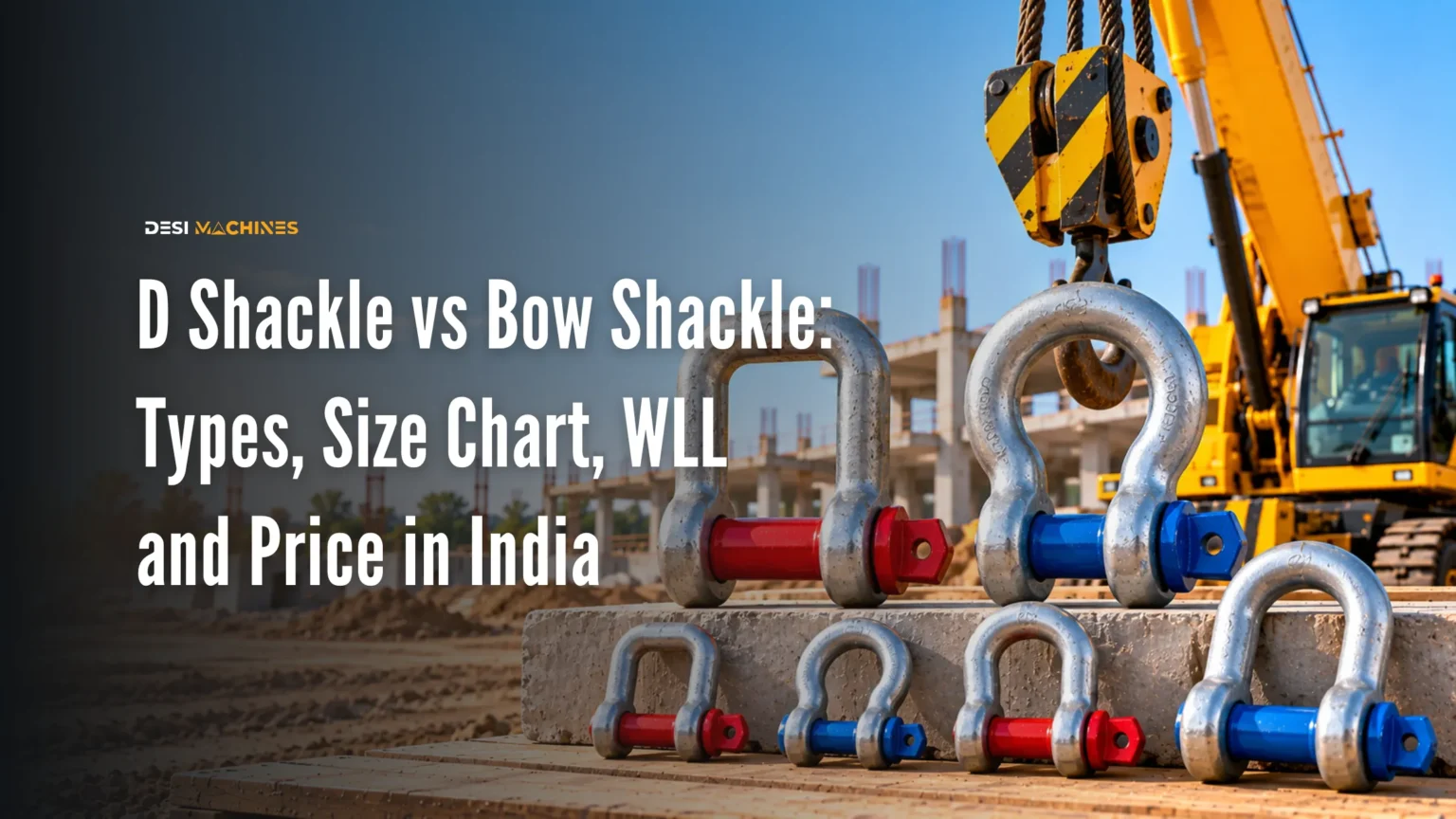
A D shackle is a U-shaped steel link with straight, parallel sides, closed by a removable pin, that joins a sling, chain or wire rope to the load or to the crane hook. It takes a straight, in-line pull. A bow shackle (also called an anchor shackle) has a rounder, wider loop, so it can gather two sling legs and take some pull from the side. In India a new alloy-steel screw-pin shackle is listed at about ₹80 to ₹90 for a 1-ton size, ₹240 to ₹340 for the common “5 ton” size and ₹3,200 to ₹5,300 for 25 ton, in Moglix seller listings we checked on 29 September 2026.
On a hydra or truck-mounted crane, the shackle is the small part between the hook and the load, and often the one nobody reads before the lift. This guide covers which shape to use, the markings, size and load, and when to throw one away.
What is the difference between a D shackle and a bow shackle?
Both are a forged steel body and a pin. The shape of the body decides how the shackle may be loaded.
| Point | D shackle (dee or chain shackle) | Bow shackle (anchor shackle) |
|---|---|---|
| Shape | Narrow, straight sides like the letter D | Wider, rounded loop |
| Best use | One sling or chain, pulled in a straight line | Two sling legs on one shackle, or a pull that may come at an angle |
| Side load | Keep the pull in line with the shackle | Can take some side load, at a reduced rating |
So “d shackle vs bow shackle” comes down to one question: will the pull be straight? If a single leg hangs straight below the hook, a D shackle is fine. If two legs meet at the shackle, or the load may swing, use a bow shackle and put the legs in the bow, not on the pin.
Screw pin or bolt type: which shackle pin should you use?
The pin matters as much as the body. Kito Crosby, one of the largest shackle makers, gives this guidance in its application sheet:
- Screw pin. The pin screws into one ear. Use it for pick-and-place lifts, where you fit it, lift, set the load down and take it off. Tighten the pin before every lift and make sure it is screwed fully home.
- Bolt type (nut and cotter pin). A bolt passes through both ears and is held by a nut and a split cotter pin. Use it for connections that stay in place for a long time, or where the sling may slide on the pin and turn it.
- Round pin with cotter. Only for a strictly in-line pull. Never side-load it and never use it to gather several sling legs.
A screw pin can loosen when a moving sling rolls over it, as in a choker hitch. If a screw-pin shackle stays on for long, tie the pin off with soft wire through its collar hole, which riggers call mousing.
How do you read the WLL and grade stamped on a shackle?
A proper lifting shackle carries its rating forged or stamped into the body. Look for:
- The working load limit (WLL), for example “WLL 4¾ T” or “4.75 t”. This is the most weight the shackle may carry in a straight pull.
- The grade, such as “6” or “8”. EN 13889, the European standard for forged D and bow shackles, covers grade 6 shackles from 0.5 t to 25 t WLL.
- The maker’s name or mark, and usually a size and a batch or traceability code. The pin should carry its own mark too.
Two points trip people up. First, the WLL is not the breaking load. Makers build in a design factor: Crosby rates its screw-pin bow shackles at 6 to 1, so a 4.75 t shackle should not break below about 28.5 t. That margin is for shock, wear and small mistakes, not for extra load. Second, a shackle with no readable WLL has no rating at all. Under ASME B30.26, the US rigging hardware standard that many Indian riggers follow, a missing or unreadable rating mark is itself a reason to remove the shackle from service.
Many sellers call the 4.75 t size a “5 ton shackle”. If you search for a “d shackle 5 ton”, this is usually what you will get, so read the stamp and plan the lift at 4.75 t.
What size shackle do you need for a given load?
Shackle sizes are named by the thickness of the body, in inches, and each size carries a rated load. The table below is taken from the published chart for the Crosby G-209 screw-pin anchor (bow) shackle, grade 6. The millimetre figures are converted from the chart’s inch dimensions. Indian listings use the same load steps: 1, 2, 3.25, 4.75, 6.5, 8.5, 9.5, 12, 13.5, 17 and 25 ton.
| Nominal size (inch) | Body thickness (mm) | Pin diameter (mm) | WLL (tonne) |
|---|---|---|---|
| 3/8 | 10 | 11 | 1 |
| 1/2 | 13 | 16 | 2 |
| 5/8 | 16 | 19 | 3.25 |
| 3/4 | 19 | 22 | 4.75 |
| 7/8 | 22 | 25 | 6.5 |
| 1 | 25 | 28 | 8.5 |
| 1-1/8 | 29 | 32 | 9.5 |
| 1-1/4 | 33 | 35 | 12 |
| 1-3/8 | 36 | 39 | 13.5 |
| 1-1/2 | 39 | 41 | 17 |
| 1-3/4 | 47 | 51 | 25 |
| 2 | 53 | 57 | 35 |
This is a general guide based on machine size class. Always confirm the fit with your machine’s operator manual or the manufacturer before buying or fitting.
This chart belongs to one maker and one grade; another make or grade can carry a different rating at the same size, so the stamp on your shackle always wins. Pick a shackle whose WLL is at least the total weight it will carry: the load, plus the slings and any lifting beam below it. The crane load chart guide explains how rigging weight is taken off the crane’s rated capacity as well.
How much does side loading reduce a shackle’s capacity?
A shackle is rated for a pull straight along its centre line. When the pull comes from the side, the rating drops. Crosby’s side-loading chart for its screw-pin and bolt-type shackles (sizes up to 3 inch) gives these limits:
| Angle of pull away from in-line | Usable share of the rated WLL |
|---|---|
| 0° to 10° | 100% |
| 11° to 20° | 85% |
| 21° to 30° | 75% |
| 31° to 45° | 70% |
| 46° to 55° | 60% |
| 56° to 70° | 55% |
| 71° to 90° | 50% |
So a 4.75 t shackle pulled at 90° to its line is good for about 2.4 t. Two more rules from the same sheet: never side-load a round-pin shackle, and when two sling legs share one bow shackle, keep the angle between them at 120° or less. Centre the load on the pin; a load that slides to one ear overloads that ear.
When should a shackle be thrown away?
Check every shackle before each lift. ASME B30.26 lists the signs that take a shackle out of service:
- Missing or unreadable maker’s mark or load rating
- Wear that has reduced the body or pin by 10% of its original size at any point
- A bent, twisted, stretched or cracked body or pin
- Deep nicks, gouges, heavy pitting or rust
- Signs of heat, weld spatter or arc strikes, or any welding on the shackle
- A pin that will not screw fully home, or damaged threads
Do not heat, weld, bend back or grind a shackle to make it fit, and do not swap in a bolt from the workshop for a lost pin. A shackle is cheap next to what it holds. Indian law also expects lifting tackle to be examined by a competent person at least once every twelve months, and the crane safety rules guide sets out what the Factories Act and the BOCW rules ask for. For using slings and shackles on an excavator instead of a crane, see lifting with an excavator.
How much does a D shackle or bow shackle cost?
These are listed prices for new alloy-steel screw-pin shackles, per piece, from seller listings on Moglix checked on 29 September 2026. We also read the IndiaMART listings but left them out: most quote one “starting” price for a whole range of sizes, so the figure does not belong to any one rating. Stainless steel and mild steel shackles were left out too.
| Rated WLL | D shackle, listed price | Bow shackle, listed price | Makes in the listings |
|---|---|---|---|
| 1 t | ₹88 (one listing) | ₹80 (one listing) | Wellworth |
| 2 t | ₹110 – ₹145 | ₹106 – ₹138 | Safelift, Wellworth, Kepro |
| 3.25 – 3.5 t | ₹218 – ₹240 | ₹223 – ₹233 | Wellworth, Boltz, Kepro |
| 4.75 t (“5 ton”) | ₹249 – ₹337 | ₹240 – ₹332 | Safelift, Boltz, Wellworth, Kepro |
| 6.5 t | ₹378 – ₹548 | ₹360 – ₹537 | Safelift, Boltz, Wellworth, Kepro |
| 8.5 t | ₹560 – ₹875 | ₹713 – ₹793 | Safelift, Boltz, Wellworth, Kepro |
| 9.5 t | ₹806 – ₹1,180 | ₹1,030 – ₹1,194 | Safelift, Boltz, Wellworth, Kepro |
| 12 t | ₹1,708 (one listing) | ₹1,379 – ₹1,682 | Wellworth, Kepro |
| 17 t | ₹1,861 – ₹2,149 | ₹2,356 – ₹2,966 | Safelift, Wellworth, Kepro |
| 25 t | ₹3,187 – ₹3,511 | ₹3,872 – ₹5,300 | Safelift, Wellworth, Kepro |
Ask the seller for a test certificate with the shackle; the price does not tell you whether one comes with it.
For the machines that do the lifting, see hydra cranes, the truck-mounted crane guide and the full crane guide. How the hook block and rope on a hydra work is covered in hydra crane parts explained.
The shackle is one part of the rigging; the lifting slings guide covers the belt or rope it connects to.
Prices, specifications and fitments are indicative, vary by maker, model, city and date, and should be confirmed with the manufacturer or an authorised dealer before buying. DesiMachines is not liable for decisions taken on the basis of information that may have changed after publication.