
 Excavator
294 models
Excavator
294 models  Backhoe Loader
51 models
Backhoe Loader
51 models  Crane
68 models
Crane
68 models  Concrete Mixer
79 models
Concrete Mixer
79 models  Wheel Loader
54 models
Wheel Loader
54 models  Compactor / Roller
45 models
Compactor / Roller
45 models  Motor Grader
42 models
Motor Grader
42 models  Concrete Pump
66 models
Concrete Pump
66 models  Skid Steer Loader
11 models
Skid Steer Loader
11 models  Telehandler
13 models
Telehandler
13 models 


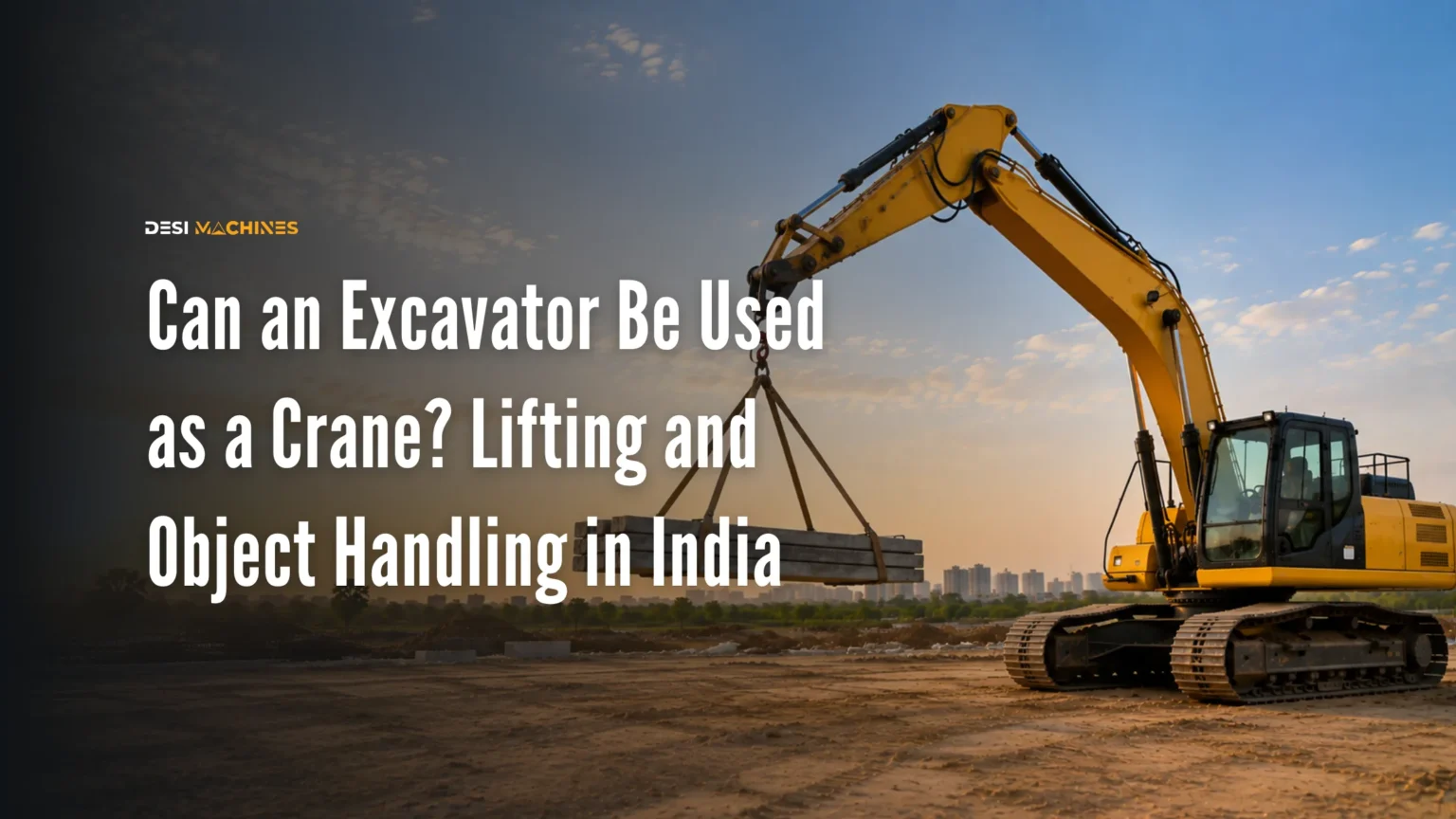
An excavator can be used to lift and place loads, and on Indian sites it does this every day — pipes, culvert rings, precast slabs, road barriers, shuttering. But it only counts as a proper lifting machine when it is set up for object handling: a certified lifting point, hose-burst check valves on the boom and stick, an overload warning, and the manufacturer’s lift chart in the cab. A bare machine with a chain looped over the bucket teeth is not lifting. It is improvising, and it is where most excavator lifting accidents start.
This guide covers what an excavator needs before it may lift, how much it can actually pick up, how that compares with a crane, and when you should stop and hire a crane instead.
Can an excavator legally lift loads?
Yes, provided the machine is equipped and rated for it. The industry term is object handling, and it means the excavator has been built or fitted to lift a suspended load rather than only to dig.
Digging and lifting put very different demands on a machine. When you dig, the load is pressed against the ground and the machine is pushing down. When you lift, the load hangs free, the machine’s centre of gravity moves out with it, and a hydraulic failure means the load drops rather than settles. That is the whole reason object handling has its own equipment and its own rating.
A machine used for lifting also needs the paperwork behind it: the OEM lift chart for that model and boom configuration, tested and certified slings and shackles, and an operator who has been trained to lift rather than only to dig. Ask the dealer what the object-handling package covers on the model you are buying, because it is not standard on every machine sold here.
What does an excavator need to be used for lifting?
Five things, and a machine missing any of them should not be lifting.
A certified lifting point. A proper lifting eye or hook, either welded into the bucket linkage by the manufacturer or supplied as an approved attachment. A sling wrapped around the bucket teeth or the stick is not a lifting point. Teeth are wear parts designed to be knocked about and replaced, and they can shed a load sideways without warning.
Hose-burst check valves. Small valves fitted at the boom and stick cylinders. If a hydraulic hose splits while a load is in the air, the valve locks the oil in the cylinder so the boom holds instead of collapsing. On a digging machine a burst hose is an expensive stoppage; on a lifting machine it is what stands between a hanging load and the men below it.
An overload warning device. A sensor and alarm that warns the operator as the load approaches the rated limit for the current position. It is the excavator equivalent of the safe load indicator on a crane.
The lift chart. The manufacturer’s table of what the machine may lift at each reach and each height, over the front and over the side. Without it, the operator is guessing.
Tested slings, shackles and a trained signaller. The rigging carries the same load as the machine and needs the same certification. One person, and only one, gives signals.
The excavator attachments guide covers how approved attachments are specified and fitted, and the excavator boom guide explains the cylinders and pins that carry the load.
How much can an excavator actually lift?
Far less than its own weight, and the figure changes every time the operator moves.
Two limits apply at once, and the machine is rated on whichever is lower. The first is stability: how far the load can go before the machine starts to tip. The second is hydraulic capacity: how much the cylinders can hold up. Close to the machine the hydraulics usually run out first; far out at full reach, stability does.
The international standard manufacturers use for this, ISO 10567, sets rated lift capacity at the lower of 75% of the static tipping load or 87% of the hydraulic lifting capacity. Those margins are the safety factor, and they are the reason a 20 Tonne (20,000 kg) machine cannot casually pick up 20 Tonne.
Three things change the number in practice:
Radius. Capacity drops sharply as the load moves away from the machine. A load that is safe at 3 m can be well over the limit at 7 m without anything else changing.
Direction. Most tracked excavators lift more over the front or the rear, where the tracks give the longest stability base, than over the side. Some charts give separate over-side figures for exactly this reason.
Ground. A lift chart assumes firm, level ground. Soft fill, a trench edge or a slope reduces the real capacity and nothing on the machine will tell you so.
The way capacity falls off with reach works the same way on cranes, and the crane load charts guide walks through reading one line by line. If you are still sizing the machine itself, the excavator size classes guide and the operating weight guide set out what each class weighs and handles.
Excavator or crane: which should do the lift?
The honest answer is that an excavator is a digging machine that can lift, and a crane is a lifting machine that cannot dig. Each is right for a different kind of job.
| Point of comparison | Excavator (object handling) | Pick and carry crane (Hydra / Farana) | Mobile telescopic crane |
|---|---|---|---|
| Built to lift | Secondary role, needs the object-handling kit | Yes | Yes |
| Typical use | Placing pipes and culverts in the trench it just dug | Yard, factory and site loads moved short distances | Planned heavy or high lifts |
| Height and reach | Limited to boom and stick geometry | Modest | High, with long telescopic boom |
| Travelling with the load | Short shuffles only | Designed for it | Not with the load suspended |
| Setup time | None, it is already there | Minimal | Outriggers, matting, planning |
| Best fit | Trench and pipeline work | Repetitive short moves | Erection and heavy lifting |
On an Indian pipeline or drain job the excavator usually wins on plain logic. It has already dug the trench, it is standing beside it, and calling in a separate machine to lower a pipe it can lower itself makes no sense. On a structural erection job the crane wins just as clearly.
Where the pick and carry machine fits between the two is set out in the Hydra and Farana crane guide, and the mobile crane guide covers the larger telescopic machines.
What goes wrong when an excavator lifts?
Almost every incident traces back to one of five causes, and all five are avoidable.
Slinging off the bucket or the teeth. The sling slips along the tooth, the load swings, and the machine is now holding an uncontrolled weight. Use the certified lifting point.
Swinging over the limit. The operator picks a load safely over the front, then swings it out to the side where the rated capacity is lower. Nothing changed except the direction, and the machine is now overloaded.
Soft or sloping ground. Track pressure that is fine for digging can sink an edge when a load hangs out over it. Check the ground the tracks are on, not the ground the load is going to.
A hose failure without check valves. The boom drops at the speed the oil can escape. This is precisely the failure the check valves exist to catch, and it is the reason they are not optional on a lifting machine.
People under or near the load. The swing radius of an excavator is a full circle and the counterweight sweeps through it. Nobody stands inside it while a load is in the air.
The operator-side routine, covering pre-lift checks, signals and the habits that prevent all of this, is set out in the excavator lifting and loading safety guide, and the lifting safety, checks and operator training guide covers the rules and certification side.
When should you hire a crane instead?
Stop and call a crane when any one of these is true.
The load is close to the excavator’s rated capacity at the reach you need. “Close to the chart” means over it once the ground, the rigging weight and a bit of wind are counted.
The lift needs height rather than reach — putting something on a roof, a tank top or an upper floor. An excavator’s geometry runs out of height quickly, and a telescopic boom does not.
The load has to travel any real distance. An excavator shuffling on its tracks with a load hanging is slow and unstable; a pick and carry crane is built for exactly that trip.
The lift is repetitive and it is holding up the digging. A machine parked on lifting duty is a digging machine earning nothing.
The load is a person or anything overhead where a failure is unrecoverable. Excavators do not lift people.
If the answer is a hired machine, the crane buying and rental guide covers what to ask for and what the rates depend on, and you can compare the current range of cranes against what the job actually needs.
Excavator lifting, in short
An excavator can be used as a lifting machine, and on trench and pipeline work it usually should be. What makes it legitimate is the object-handling setup: a certified lifting point, hose-burst check valves, an overload warning, the OEM lift chart, and tested rigging.
Rated capacity is the lower of 75% of tipping load or 87% of hydraulic capacity under ISO 10567, it falls fast with reach, and it is usually lower over the side than over the front. Read the chart for the machine in front of you rather than the one you remember.
And know the point where the excavator stops being the right tool. Height, distance, repetition or a load near the limit all say the same thing: hire the crane.
Browse the current range of excavators and ask the dealer what the object-handling package includes, or read the excavator applications guide to match a machine to the work you do. New to the machine itself? The excavator joystick controls guide explains what every lever in the cab does.
The same question for a backhoe loader is answered in backhoe loader lifting capacity, which gives the front shovel and rear bucket figures separately.
Prices, specifications and features are indicative, vary by variant, location and date, and should always be confirmed with the official OEM or authorised dealer before any purchase decision. DesiMachines is not liable for decisions taken on the basis of information that may have changed after publication.