
 Excavator
316 models
 Backhoe Loader
54 models
 Crane
68 models
 Concrete Mixer
79 models
 Wheel Loader
54 models
 Compactor / Roller
45 models
 Motor Grader
42 models

 Concrete Pump
66 models
 Skid Steer Loader
11 models


An electric drive dump truck is still a diesel truck. Its engine turns a large alternator, and the electricity from that alternator drives motors built into the rear wheels, so there is no multi-speed gearbox and no driveshaft to the back axle. Mines call it a diesel-electric haul truck, and it is how most of the biggest mining dump trucks are built.
Look at the trucks Komatsu sells in India. Its 91-tonne HD785-7 drives the wheels through a torque converter and a seven-speed automatic gearbox. Its 186-tonne 730E-10 and 227-tonne 830E-5 are electric drive. India’s BEML lists one too, the 186-tonne BH205E-AC, with a Cummins diesel engine and an electric drive by GE.
Because the wheels already run on electricity, an electric drive truck can also take power from an overhead line on the steepest loaded climb out of a pit. That is called trolley assist. This guide explains how the drive works, how it brakes downhill, where trolley assist pays and what a mine should check. For the battery tippers and dumpers that carry no engine at all, see the electric dumper and tipper guide.
How does an electric drive dump truck work?
The power goes from the engine to the wheels as electricity, not through gears and shafts. Follow it in the figure below.
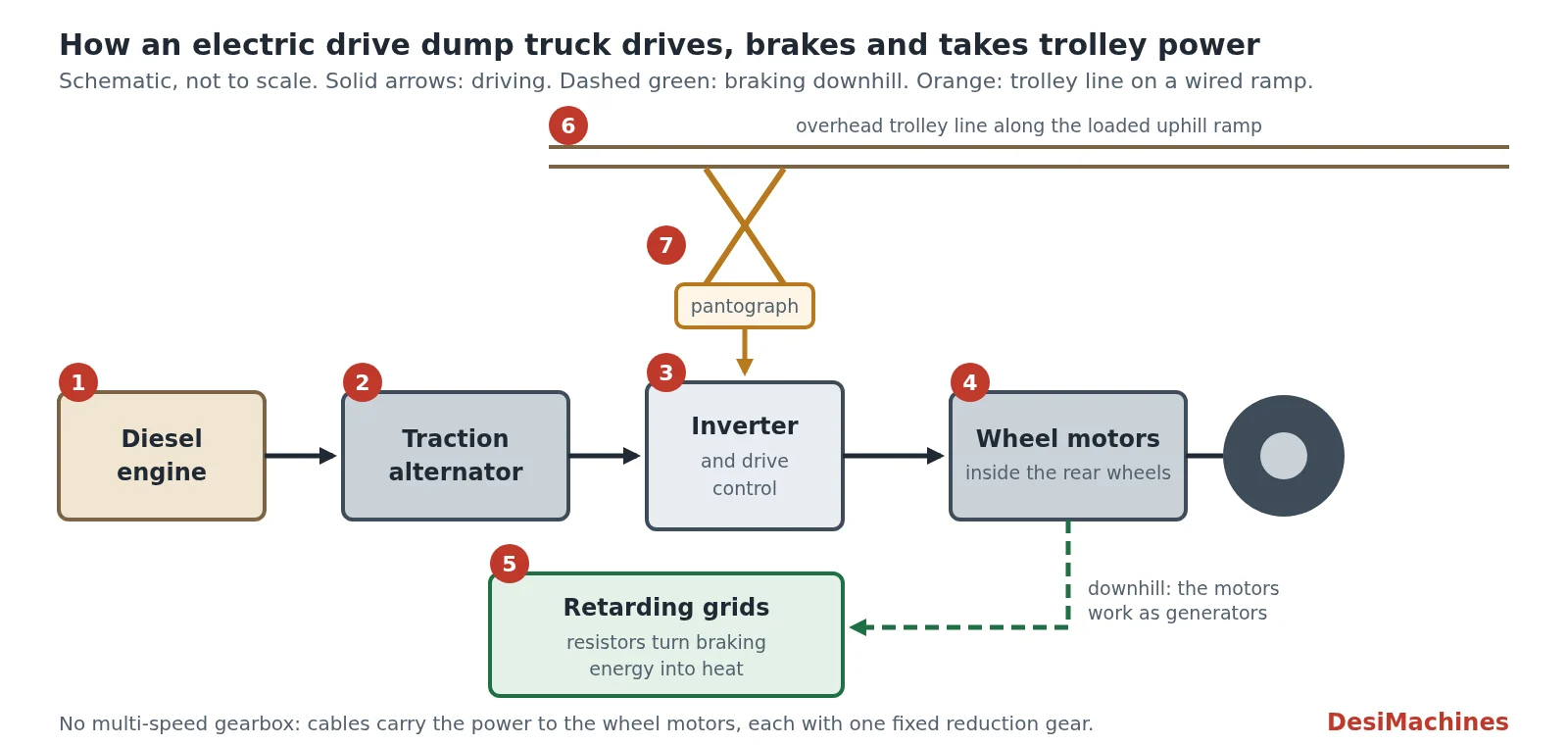
On Komatsu’s 730E-10, the sheet names each part. A 1,492 kW (2,000 HP) diesel engine turns a GTA49 traction alternator. An inverter changes that power into the form the motors need and controls each rear wheel motor on its own. The wheel motors are GEB35 units, and each one has a fixed 30.8 to 1 reduction gear inside the wheel. The truck has no gear changes. The drive control sets how hard the motors pull and how fast they turn, up to 64.5 km/h.
Because each rear wheel has its own motor, the control system can see when one wheel spins on a wet haul road and cut its power. Komatsu calls this spin-slide control. It works on its own, without touching the service brakes.
For how the same parts (motor, inverter, cooling) work on battery and cable-fed machines, read how electric construction machines work.
How does an electric drive truck brake on a long downhill?
It brakes mostly with its wheel motors. When the operator presses the brake-retarder pedal, the motors are switched to work as generators. Turning them now takes effort, and that effort slows the truck. The electricity they make goes to the retarding grids, where resistors turn it into heat and a blower carries the heat away.
Holding a loaded truck back on a long ramp takes more power than driving it up, which is why the retarder ratings below are bigger than the engines:
| Truck (maker’s sheet) | Drive | Engine power | Downhill braking (retarder) | Retarder vs engine |
|---|---|---|---|---|
| Komatsu HD785-7, 91 t | Mechanical: torque converter, 7 forward and 2 reverse gears | 895 kW (1,200 HP) | Oil-cooled multiple-disc retarder, 1,092 kW continuous | About 1.2 times |
| Komatsu 730E-10, 186 t | Electric: GTA49 alternator, GEB35 wheel motors | 1,492 kW (2,000 HP) | Electric dynamic retarder, 2,535 kW | About 1.7 times |
| Komatsu 830E-5, 227 t | Electric: GTA-41 alternator, GEB25 wheel motors | 1,865 kW (2,500 HP) | Electric dynamic retarder, up to 2,983 kW | About 1.6 times |
| BEML BH205E-AC, 186 t | Electric drive by GE, Cummins engine | 1,716 kW (2,300 HP) | Not stated on BEML’s page | Not stated |
The service brakes are still there: hydraulically applied dry discs on the 730E-10, used to stop fully and to hold the truck. The retarder does the long, steady work of holding speed down a ramp. The 830E-5 sheet adds two details a mine will like: it can retard with the engine at idle, and it can retard in reverse.
Keep the road in mind too. DGMS guidance keeps an opencast haul road to 1 in 16, with 1 in 10 allowed only on short ramps with permission, as the bench height and haul road guide explains. A strong retarder makes a truck safer on a grade. It does not make a steeper grade safe.
Electric drive or mechanical drive: which suits a mine?
Electric drive is the usual choice in the biggest size classes, and mechanical drive is common below them. Wikipedia’s haul truck article notes that most large haul trucks use traction motors for driving, braking or both. Komatsu India’s range shows the split: its 91-tonne HD785-7 is mechanical, and its two largest trucks are electric drive.
Here is the trade-off, side by side:
| Point | Electric drive (diesel-electric) | Mechanical drive |
|---|---|---|
| Power to the wheels | Alternator and cables to wheel motors; no gear shifts | Torque converter, gearbox, driveshaft and axle |
| Downhill braking | Strong electric retarding, about 1.6 to 1.7 times engine power on the Komatsu sheets | Oil-cooled disc retarder, about 1.2 times engine power on the HD785-7 |
| Wheel spin on wet roads | Each rear motor controlled on its own | Handled by brakes and differential |
| Can use trolley assist | Yes, the wheels already run on electricity | No |
| Where you meet it | Most large and ultra class trucks | Most small and mid-size mining trucks, and some large ones |
| Workshop skills | High-voltage electrical and power electronics, plus diesel | Diesel, gearbox and hydraulics: skills most Indian workshops have |
| Runtime per shift | Same as any diesel truck: refuel and keep going | Same |
So an electric drive truck is best suited to a large opencast mine with long, deep haul roads, heavy loads coming down ramps and enough trucks to keep a trained electrical team busy. A quarry running 35- to 60-tonne dumpers on short hauls has little to gain from it.
What is trolley assist on haul trucks?
Trolley assist is an overhead power line built along the loaded uphill ramp of a pit. A truck with electric drive raises a pantograph, touches the line and takes its drive power from the line for that climb. At the top it lowers the pantograph and drives on as a normal diesel-electric truck.
Two wires are needed, one to feed the current and one to return it, because rubber tyres do not let the current return through the ground the way a railway uses its rails. Heavy mining trucks can draw more power than trolley poles carry, so they use pantographs. Both points come from the trolleytruck entry on Wikipedia.
Trolley assist works only on electric drive trucks. Wikipedia’s entry on Liebherr’s T 282 series puts it plainly: trolley assist is only available for trucks with electric drive systems. A mechanical truck has no motor for the line to feed.
Why the uphill ramp? That is where a loaded truck works hardest, so it is where the engine burns fuel fastest. Moving that climb onto grid power cuts diesel on the hardest part of every trip, and the mine pays for electricity on that stretch.
Where does trolley assist pay, and where has it failed?
It pays in a deep pit with one long, fixed ramp, cheap power and many trucks using the same line. The record shows both sides.
- South Africa: ISCOR built a 7.7 km trolley-assist line at its Sishen mine in 1982 and later added one at Grootegeluk coal mine, and Wikipedia describes the company as the world’s largest user of trolley assist.
- Zambia: Nchanga copper mine ran 120-ton diesel trucks on trolley assist from 1983, on cheap hydroelectric power from the Kariba Dam.
- Canada: Copper Mountain mine in British Columbia was converting its haul trucks to trolley assist for the climb out of the pit as of 2022, powered by BC Hydro.
- United States: the Chino mine in New Mexico added trolley assist on its steep ramp in 1967. Barrick’s Goldstrike mine in Nevada used it from 1994 and removed it in 2001 when the mine layout changed.
Two older lessons explain the failures. A 1952 Soviet trial with an electric MAZ-525 dump truck saved fuel, but moving the overhead wires every time the quarry face moved proved impractical. BelAZ trials in 1965 found the system paid only in pits at least 300 metres deep with stable haul routes. All of these come from the same Wikipedia entry.
The pattern is simple. Trolley lines suit a mine whose main ramp will stay put for many years. A mine whose benches and ramps move every few months will spend its time moving poles.
What is a diesel-electric dozer?
A diesel-electric dozer uses the same idea as the truck: the engine turns a generator, and electric motors drive the tracks. It has no torque converter and no powershift gearbox.
Caterpillar showed one in 2008, the D7E. Its C9.3 engine powers a generator that feeds a pair of AC drive motors. Caterpillar projected 25 percent more material moved per gallon of fuel than the older D7R Series II, according to Wikipedia’s Caterpillar D7 entry. Treat that as the maker’s projection, not a field result.
Three of the large mining dozers listed in India show the mechanical layout. The Komatsu D375A-6 (455 kW, 71,640 kg) has Komatsu’s TORQFLOW powershift with a lock-up torque converter. The BEML BD475-2 (634 kW, 100,000 kg) uses a planetary powershift with a lock-up torque converter, and the Cat D11 (634 kW, 104,236 kg) a three-speed planetary powershift. See all mining dozers listed in India.
Where do battery haul trucks take over?
A battery truck goes one step further and drops the diesel engine. It carries its energy in a battery pack and charges between shifts or swaps the pack. That suits shorter, fixed routes and smaller trucks, as the electric dumper and tipper guide and the battery swapping guide explain. Underground, where exhaust is the biggest problem, battery loaders and trucks are already at work; see the electric underground mining equipment guide.
Diesel-electric and trolley assist are the step in between. They keep the diesel for range and flexibility, and use electricity where it does the most good: at the wheels, on the brakes and on the climb. A mine that already runs electric drive trucks has much of the know-how a battery or trolley-battery truck will need. For the Indian mines and fleets already running electric machines, read electric fleets working in Indian mines.
What should a mine check before choosing electric drive or trolley assist?
Start with the haul road, because the truck is sized to it. Komatsu’s own 730E-10 sheet says wheel motor choice depends on the truck’s weight, road grade, road length and rolling resistance, and that Komatsu and Wabtec must study each job before they confirm it.
- Get the haul profile on paper: loaded climb, empty return, longest downhill, grades and distances. Ask the maker to run it for both drive types.
- Compare retarder capacity, not just engine power, if the loaded trucks come downhill. That is where electric drive earns its keep.
- Ask who services the electric drive in India. The drive system often comes from a separate supplier (GE on the BEML truck; Komatsu names Wabtec on the 730E-10 sheet), so check where the trained engineers and the spare motors and inverters are.
- Plan the workshop. High-voltage work needs trained electricians, safe isolation procedures and test equipment on site.
- For trolley assist, check how long the main ramp will stay in one place, the power the line and substation need, and who will build and maintain the line.
- Keep the fleet on one drive type where you can. Mixing drives doubles the spares and training.
- Ask how drive overhauls work and how long the drive parts will be supported. Resale depends on the next owner being able to get them.
Running costs follow the same method as any machine, set out in the electric machine ownership cost guide. To place large haul trucks among the rest of the family, see the types of tipper and dumper, and the biggest dump trucks in India for the size classes at work here.
Which electric machines load these trucks in Indian mines?
Some of the loading tools in a large pit are electric already, fed by cable from the mine’s own supply. The BEML BE1800E runs on two 300 kW induction motors at 1,500 rpm, with a 10.5 to 12.0 m³ bucket on a 175,000 kg machine. The BEML BE1000E-1 uses one 400 kW motor and a 3.1 to 5.55 m³ bucket. In the largest class, the Liebherr R 9250 G6 carries a 1,050 kW motor and a 15 m³ bucket.
Below them sit the Liebherr R 992 E and Liebherr R 998 SME-E, both with a 400 kW motor, and the Volvo EC500 Electric at 250 kW. The difference between these cable-fed machines and rope shovels is covered in power shovel vs hydraulic excavator.
A mine that already brings high-voltage power to its shovels has done part of the work a trolley line needs. Compare the full range of electric excavators and the diesel mining excavators, see the whole sector on the mining machinery page, and talk to a lender about construction equipment finance for a fleet. The rest of the series sits in the electric construction machines guide.
Sources: Komatsu India’s dump truck range page and its 730E-10 and 830E-5 specification sheets, and the HD785-7 sheet (drive, power, retarder and speed figures, read November 2026); BEML’s BH205E-AC and BH100 product pages on bemlindia.in (payload, power and drive supplier, read November 2026); Wikipedia’s Trolleytruck, Haul truck, Liebherr T 282 series and Caterpillar D7 entries (trolley-assist history and the D7E). Indian machine figures are from their DesiMachines product listings.
Prices, specifications and features are indicative, vary by variant, location and date, and should always be confirmed with the official OEM or authorised dealer before any purchase decision. DesiMachines is not liable for decisions taken on the basis of information that may have changed after publication.