
 Excavator
294 models
Excavator
294 models  Backhoe Loader
51 models
Backhoe Loader
51 models  Crane
68 models
Crane
68 models  Concrete Mixer
79 models
Concrete Mixer
79 models  Wheel Loader
54 models
Wheel Loader
54 models  Compactor / Roller
45 models
Compactor / Roller
45 models  Motor Grader
42 models
Motor Grader
42 models  Concrete Pump
66 models
Concrete Pump
66 models  Skid Steer Loader
11 models
Skid Steer Loader
11 models  Telehandler
13 models
Telehandler
13 models  Dozer
Dozer 


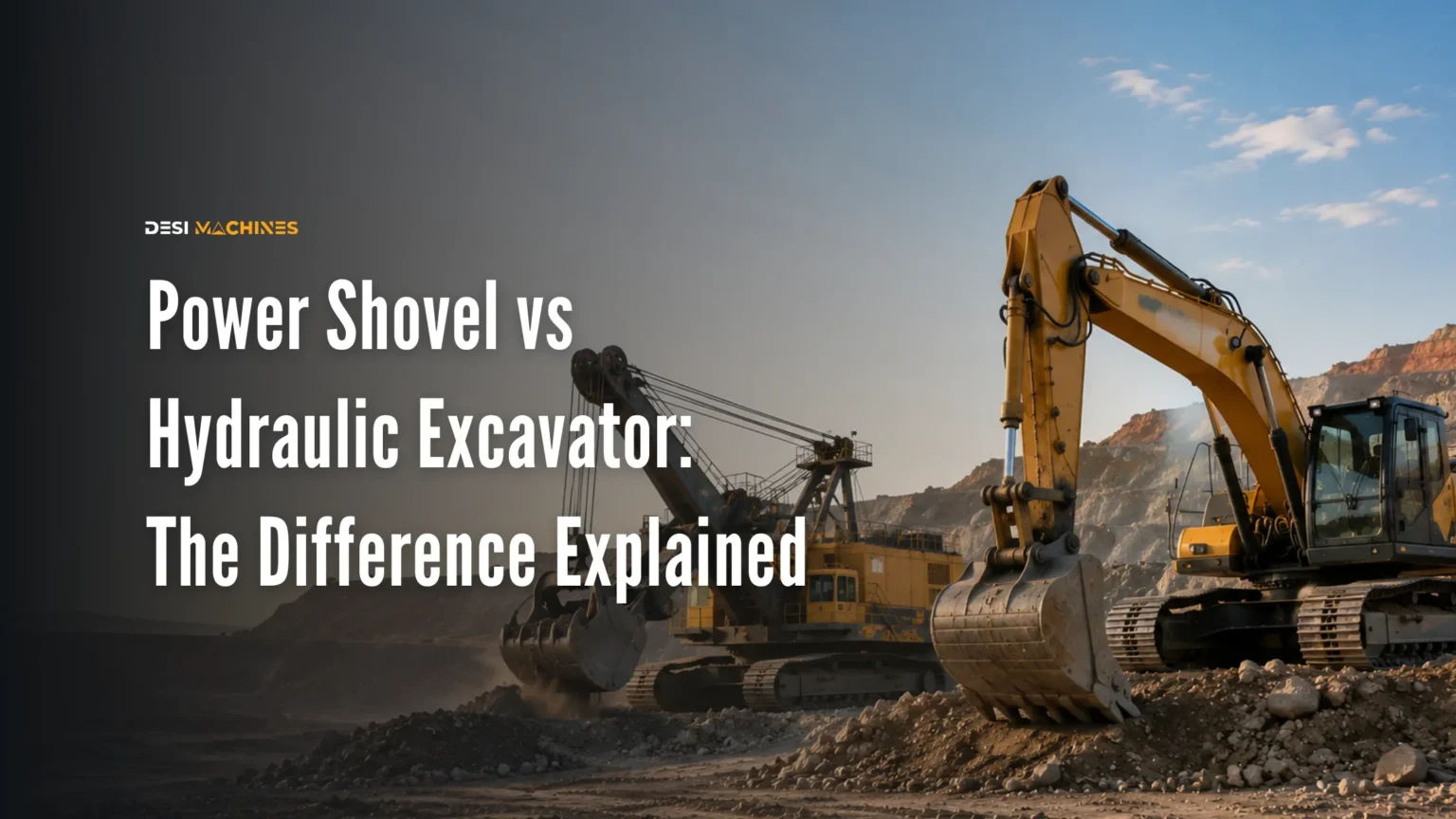
A power shovel is a digging machine that moves its bucket with steel wire ropes and winch drums, and digs by pushing the bucket forward and upward into the face of the ground. A hydraulic excavator does the same job with oil pressure moving steel rams, and in its normal form digs by pulling the bucket back towards itself. Both machines fill a bucket and swing it into a tipper. The way they move that bucket is what separates them.
Almost every digging machine working on an Indian site today is the hydraulic kind. The rope-operated power shovel survives only at the very top of the size range, in large opencast mines, and even there the hydraulic machine has taken most of the work. So this is partly a question about machines and partly a question about words, because a lot of Indian buyers searching for a “shovel machine” are actually looking at a hydraulic excavator.
This guide explains what a power shovel is, how it differs from the machine you would actually buy, what people mean by shovel on an Indian site, and where each one still earns its keep.
What is a power shovel?
A power shovel is a tracked machine with a bucket carried on a stiff arm at the front, moved by wire ropes running over pulleys and wound on drums. One rope lifts the bucket, another pushes the arm out. The bucket faces away from the machine, so it digs by driving forward and up into a vertical wall of earth or rock. That wall is called the face, which is why the machine is also called a face shovel.
You will also see it called a rope shovel, a cable shovel or a mining shovel. These are all the same machine. The very large ones in mines run on electricity from a trailing cable rather than diesel, which is where the name electric rope shovel comes from.
Three things follow from the rope design, and they explain everything else about how the machine is used.
- It is built to dig upward, not downward. A rope can pull, but it cannot push down. So a power shovel works material that sits above the level of its tracks.
- It is built to stay in one place. These machines are heavy and slow, and they are designed to sit at one face for months while dumpers come to them.
- It is built around one job. The bucket is not swapped for a breaker or a grab. A power shovel loads rock and earth, and that is the whole list.
The design is old. The rope shovel is the direct descendant of the steam shovel that dug canals and railway cuttings a century ago, and the mechanism has not changed in principle since then. What changed is that a competing idea arrived and took over the middle of the market.
What is a hydraulic excavator?
A hydraulic excavator moves its boom, arm and bucket with hydraulic cylinders, which are steel rams pushed by oil under pressure. The engine drives a pump, the pump sends oil where the operator’s joysticks tell it to go, and the cylinders extend or retract. There are no ropes and no winch drums.
In its standard form the bucket faces back towards the operator, so the machine digs by curling the bucket in and pulling it towards itself. This is called the backhoe configuration, and it is what lets the machine dig below its own tracks: trenches, foundations, pond work, canal sides. The excavator components guide walks through each part in turn.
Oil pressure buys three things that ropes cannot.
- Force in any direction. A cylinder pushes as hard as it pulls, so the machine can dig down, press the bucket into hard ground, and even lift the tracks off the floor on its own boom.
- Attachments. Take the bucket off and the same machine runs a hydraulic rock breaker, a grab, a compaction wheel or a ripper. The attachments guide covers the common ones in India.
- Size choice. The same design scales from a 1 tonne mini machine up to a 200 tonne mining machine, which is why the excavator size classes run so wide.
That flexibility is the reason the hydraulic excavator won. A contractor who buys one machine wants it to dig footings in the morning and break concrete in the afternoon, and a rope shovel cannot do that.
Power shovel vs hydraulic excavator: what is the difference?
The short answer is that a power shovel uses ropes and digs away from itself, while a hydraulic excavator uses oil pressure and normally digs towards itself. Everything in the table below follows from those two facts.
| Point of difference | Power shovel (rope shovel) | Hydraulic excavator |
|---|---|---|
| How the bucket moves | Steel wire ropes on winch drums | Hydraulic cylinders driven by oil pressure |
| Direction of digging | Forward and up, into a face above track level | Back towards the machine, including below track level |
| Power source | Diesel on smaller units; electric supply by trailing cable on large mining units | Diesel engine on effectively every machine sold in India |
| Usual size | Very large only; the class starts where most contractors stop | 1 tonne (1,000 kg) to over 200 tonne (200,000 kg) |
| Moving between sites | Rare. Set up at one face and left there | Routine. Walked onto a trailer and shifted |
| Attachments | Bucket only | Bucket, breaker, grab, compaction wheel, ripper and more |
| Where you see it in India | Large opencast coal and iron ore mines | Roads, canals, metro work, buildings, quarries, farms |
| Who buys one | Mining companies with a decade-long pit plan | Contractors of every size, from one machine upward |
There is one more practical difference worth knowing. A rope shovel loads a dumper from the side at a height, so the trucks have to be matched to it and the pit floor has to be kept clean for them. A hydraulic excavator can dig a hole, load from inside that hole, and drive itself out. On a normal Indian job, that alone decides the question.
When people in India say “shovel machine”, what do they mean?
On an Indian site, shovel is usually not a technical term at all. It is a general word for a machine with a bucket, and which machine it points to depends on who is speaking.
- A tracked hydraulic excavator. This is the most common meaning. The same machine gets called a Poclain in much of north and east India, after the French brand that arrived early, and the name stuck to the whole class long after the brand faded. The crawler excavator guide covers this machine in detail.
- A wheel loader. A wheeled machine with a wide bucket at the front is often called a loading shovel, and older operators use the English word directly. It loads loose material rather than digging it, and it is a different machine with a different job. Compare the wheel loader range if that is what you have in mind.
- The front bucket of a backhoe loader. On a JCB-type machine, the loader bucket at the front is sometimes called the shovel and the digging arm at the back the backhoe. The tractor-loader-backhoe explainer sets out which end is which.
So if a dealer or a broker offers you a “shovel”, ask two questions before anything else: does it run on tracks or wheels, and does the bucket face towards the operator or away from him. The answers tell you which machine is actually being sold.
Are power shovels still used in India?
Yes, but only at the top of the size range, and their share of the work keeps shrinking. Rope shovels belong to very large opencast mining, where a machine sits at one face for years, runs on an electric supply, and is served by a fleet of dumpers. That kind of operation exists in India’s big coal and iron ore pits, and nowhere else.
Below that, the large hydraulic excavator has taken over the same work. These are enormous machines by contractor standards, and they show what the hydraulic design can do once it is scaled up. The table sets three of them against a common 20 tonne site machine, using the figures published for each model.
| Model | Operating weight | Bucket capacity | Engine power | Typical work |
|---|---|---|---|---|
| CAT 320D3 | 19,800 kg (19.8 Ton) | 0.92 m³ | 134 HP (100 kW) | General contracting |
| Tata Hitachi ZAXIS 220LC | 21,700 kg (21.7 Ton) | 0.9 – 1.17 m³ | 168 HP (125.3 kW) | General contracting |
| BEML BE1800D | 175,000 kg (175 Ton) | 10.5 – 12.0 m³ | 2 x 475 HP (2 x 354 kW) | Opencast mining |
| Liebherr R 9200 G7 | 205,000 kg (205 Ton) | 12.5 m³ | 1,086 HP (810 kW) | Opencast mining |
Specifications are as published for these models in Aug 2026 and vary by variant and configuration. The point of the table is the gap: a mining hydraulic excavator carries a bucket more than ten times the size of the one on a 20 tonne machine, and weighs roughly eight times as much. That is the size band where a rope shovel would once have been the only option.
For anything smaller than this, the question does not arise. No one is choosing between a rope shovel and an excavator for a road job or a housing plot.
What is a front shovel excavator?
A front shovel excavator is a hydraulic excavator fitted with a shorter boom and a bucket that faces away from the machine, so it digs forward and up like a power shovel instead of pulling towards itself. It is the rope shovel’s job done with cylinders, and it is how the hydraulic machine moved into face-loading work.
The front shovel arrangement is worth having when three things are true at once: the material sits above track level in a proper face, the machine will load trucks all day rather than dig trenches, and the site is a quarry or a mine rather than a general job. Outside that, the standard backhoe arrangement is more useful, because it can do face work reasonably well and everything else besides.
Bucket choice matters more than most first-time buyers expect, whichever way it faces. The excavator bucket types guide explains which shape suits rock, which suits clay, and why a bucket that is too big slows the machine down instead of speeding it up. The boom guide covers the arm it hangs from.
Which machine should you actually buy?
For any Indian contractor who is not running an opencast mine, the answer is a hydraulic excavator, and the real decision is which size and which configuration.
Start with the work. Trench and foundation work, canal sides and pond digging all need a machine that digs below itself, which means the standard backhoe arrangement. Loading loose stock from a heap is loader work, not excavator work. Face loading in a quarry is the one case where a front shovel earns its price.
Then pick the size honestly. Most Indian contracting work lands in the 20 tonne (20,000 kg) class because it fits a standard trailer, handles a 10 to 12 wheeler tipper without strain, and finds a buyer easily when you sell it. Going bigger only pays if you have the volume to keep it busy. The size classes guide sets out what each bracket is good for, and the operating weight guide explains how the tonnage figures are arrived at.
Then decide tracks or wheels. Tracks suit soft ground and stay put while digging; wheels suit road and utility work where the machine moves between sites all day. The wheeled versus crawler comparison lays out the trade-off, and for small plots and farm work the mini excavator guide is the better starting point.
When you have a shortlist, browse the current range of excavators, check the models in your tonnage band and ask a dealer for a price on the exact variant. Configurations differ between variants of the same model, so confirm the bucket, boom and undercarriage on the machine you are quoted for.
Power shovel or excavator: the short version
A power shovel digs with ropes, faces forward, works a mine face and stays where it is put. A hydraulic excavator digs with oil pressure, faces back towards the operator, changes attachments, moves between sites and comes in every size from one tonne upward. The first is a mining machine. The second is the machine an Indian contractor buys.
If someone offers you a “shovel machine”, they almost certainly mean a hydraulic excavator, and the questions to ask are about tonnage, hours and bucket size rather than about the word. The types of excavators guide and the excavator guide hub carry the rest of this series, and the applications guide matches machine to job.
Prices, specifications and features are indicative, vary by variant, location and date, and should always be confirmed with the official OEM or authorised dealer before any purchase decision. DesiMachines is not liable for decisions taken on the basis of information that may have changed after publication. Specifications are taken from our listings at the time of writing.