
 Excavator
316 models
 Backhoe Loader
54 models
 Crane
68 models
 Concrete Mixer
79 models
 Wheel Loader
65 models
 Compactor / Roller
45 models
 Motor Grader
42 models

 Concrete Pump
66 models
 Skid Steer Loader
11 models


Four techniques make up controlled blasting: line drilling, pre-splitting, smooth blasting and cushion blasting. All four stop a blast from cracking the rock beyond the line where a road cut, quarry wall or foundation pit is meant to end. They do it with a row of closely spaced holes along that line, either left empty or loaded with a very light charge, so the rock breaks cleanly along the row and the wall behind it is left sound.
A normal production blast is designed to break rock into pieces an excavator can load. It does that job well, but some of its energy runs on past the last row of holes and opens cracks in the rock that is supposed to stay. Those cracks are called overbreak (rock broken beyond the planned line) and backbreak (cracking behind the last row). They weaken the face that is left, so a hill road cut or a quarry wall sheds loose rock and stands less safely.
This guide explains how each technique works, the hole sizes, spacing and charges used for each, and what India’s road specification from the Ministry of Road Transport and Highways (MoRTH) asks for when a rock slope is pre-split. How the main blast holes are drilled is covered in the guide to blast hole drilling, and how much explosive goes into them in the guide to powder factor in blasting.
What is controlled blasting?
Controlled blasting is any blasting method used to limit overbreak and leave a firm, stable final wall at the edge of an excavation. The US Bureau of Mines manual on explosives defines it in exactly those terms and lists the same four methods.
The idea is simple. The main blast still breaks the bulk of the rock. Along the final line, though, the holes are drilled closer together and are loaded far more lightly than a production hole, or not loaded at all. The rock then splits along that line, the way a sheet of paper tears along a row of perforations.
Most of the light loading comes from decoupling. A decoupled charge is a cartridge much thinner than the hole, so a ring of air sits between the explosive and the rock. That air gap softens the shock. The rock between two holes still cracks, but the wall is not crushed.
A few terms come up throughout:
- Burden is the distance from a row of holes to the open face the rock will move towards.
- Spacing is the distance between two holes in the same row.
- Stemming is crushed stone or chips packed into the top of a hole to keep the blast gas in.
- A delay is the short gap, counted in milliseconds (thousandths of a second), between one hole or row firing and the next.
What are the four controlled blasting techniques?
The four techniques differ in two things: whether the line holes carry any explosive, and whether they fire before or after the main blast. Everything else follows from that.
Table 1: The four controlled blasting techniques compared
| Technique | Line holes loaded? | When the line holes fire | Usual hole size | Where it is mostly used |
|---|---|---|---|---|
| Line drilling | No, holes left empty | Never; they only guide the crack | 51 to 76 mm (2 to 3 inches) | Small jobs where even a light charge would do too much damage |
| Pre-splitting | Yes, very light decoupled charge | Before the main blast, or on its first delay | 38 to 102 mm (1½ to 4 inches) | Rock slopes in road cuts, quarry and pit final walls |
| Smooth blasting | Yes, light charge | Last, one delay after the final main hole | 38 to 51 mm (1½ to 2 inches) | Tunnels and underground openings |
| Cushion blasting | Yes, light decoupled charge with stemming around it | After the main excavation has been dug out | 51 to 165 mm (2 to 6½ inches) | Surface slopes, including weaker or broken rock |
Source: US Bureau of Mines Information Circular 8925 (1983), Tables 7 to 10, which are based on Du Pont’s 1964 booklet on the four methods. Sizes converted from inches.
Pre-splitting is the one written into Indian road work: the MoRTH road specification has a whole clause on it. The other three are tools for particular conditions.
How does pre-splitting work?
Pre-splitting cracks the final wall first, before the main blast has moved any rock. A single row of closely spaced holes is drilled along the planned slope, loaded with a very light charge and fired together. The charges are too small to break the rock into pieces. Exactly why the method works is still argued over, the Bureau of Mines manual notes, but the light charges open a sheared zone between the holes, ideally a single crack. When the main blast fires, its cracks run up to that line and stop there.
There are three common ways to get such a light charge into the hole, all described in the Bureau of Mines manual. Short cartridges can be taped at intervals to a detonating cord (a plastic cord filled with explosive that carries the detonation down the hole). Slender cartridges made for the purpose can be joined end to end with plastic couplers. Or a continuous reel of thin explosive can be lowered in. In all three, a heavier charge of tamped cartridges goes into the bottom few feet of the hole, the toe.
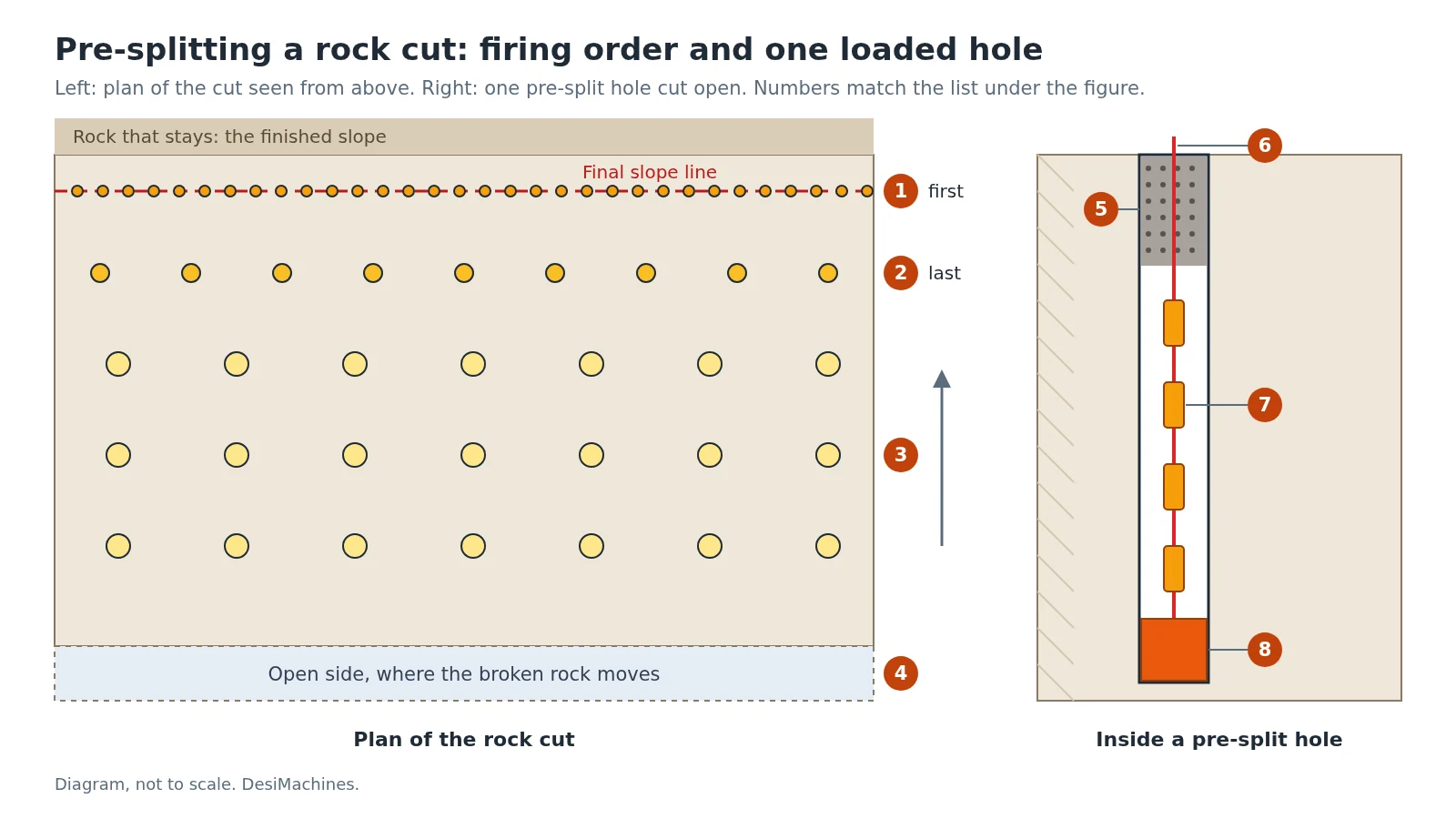
How to read Figure 1
- Pre-split holes along the final slope line, closely spaced and lightly loaded. They fire first, all together.
- Buffer row, the production row nearest the slope. It is drilled parallel to the slope, kept back from the pre-split line and fires last of the main blast.
- Production rows, which break the bulk of the rock. The row farthest from the slope fires first.
- Free face, the open side the broken rock moves towards.
- Stemming at the top of the pre-split hole.
- Detonating cord running down the hole.
- Small cartridges spaced along the cord, with an air gap between explosive and rock.
- Heavier charge at the toe, the bottom of the hole.
Smooth blasting and cushion blasting use the same kind of light line, but fire it last. That is the one difference between them and pre-splitting, and it decides where each method works best.
What hole size and spacing are used for pre-splitting?
Pre-split holes are spaced about 0.3 to 1.2 m (1 to 4 feet) apart, depending on the hole size, and carry roughly 0.12 to 1.12 kg of explosive per metre of hole. The bigger the hole, the wider the spacing and the heavier the charge it can take.
Table 2: Average pre-splitting specifications
| Hole diameter | Spacing between holes | Explosive per metre of hole |
|---|---|---|
| 38 to 44 mm (1.50 to 1.75 in) | 0.30 to 0.46 m (1.0 to 1.5 ft) | 0.12 to 0.37 kg/m (0.08 to 0.25 lb/ft) |
| 51 to 64 mm (2.0 to 2.5 in) | 0.46 to 0.61 m (1.5 to 2.0 ft) | 0.12 to 0.37 kg/m (0.08 to 0.25 lb/ft) |
| 76 to 89 mm (3.0 to 3.5 in) | 0.46 to 0.91 m (1.5 to 3.0 ft) | 0.19 to 0.74 kg/m (0.13 to 0.50 lb/ft) |
| 102 mm (4.0 in) | 0.61 to 1.22 m (2.0 to 4.0 ft) | 0.37 to 1.12 kg/m (0.25 to 0.75 lb/ft) |
Source: US Bureau of Mines Information Circular 8925 (1983), Table 8. Metric figures are our conversion.
Two limits from the same manual matter on site. A single pre-split is usually drilled no deeper than about 15 m (50 feet), because holes wander as they go deeper. And a hole that strays more than about 150 mm (6 inches) from the planned plane gives a poor face. The manual also warns against pre-splitting far ahead of the main blast: split a short length, dig it out, look at the face and adjust the next one.
Across the four rows, spacing works out at roughly 5 to 12 times the hole diameter. Use that only as a sense check. The rock decides the final figure, and badly jointed rock may need extra unloaded guide holes drilled between the loaded ones.
What does MoRTH say about pre-splitting rock slopes?
MoRTH’s Specifications for Road and Bridge Works (fifth revision), clause 303, makes pre-splitting a defined, paid item on Indian road jobs. It defines pre-splitting as forming a specified rock slope by the controlled use of explosives in properly aligned and spaced drill holes, used wherever the drawings or the Engineer call for it.
The main requirements in clause 303.2 and 303.3:
- Before drilling, the contractor gives the Engineer a plan of every hole, its depth, the explosive, the loading pattern and the firing sequence.
- Work starts with a short test section that is pre-split, blasted and dug out, so the Engineer can see whether the method gives an acceptable slope.
- Soil and weathered rock are stripped for about 5 to 15 m beyond the drilling line, so the holes start in fresh rock.
- Holes are 60 to 75 mm across, no more than 9 m deep in any one lift, and spaced no more than 900 mm apart.
- No hole may stray more than 300 mm from the planned slope plane, or drift out of parallel with its neighbour by more than two-thirds of the spacing.
- The explosive is no wider than half the hole diameter. Only factory-packed cartridge explosives are allowed; ammonium nitrate blasting agents are not.
- Stemming, where used, is dry free-running chips that all pass an 11.2 mm sieve with 90 percent held on a 2.80 mm sieve, filled right to the collar.
- All charges in one pre-split pattern fire at the same moment.
- No production hole is drilled within 2.5 m of the pre-split plane, and none goes deeper than the pre-split holes.
- A bench of up to 600 mm is allowed at the foot of each lift to set up the drill for the next one.
The finished face may not be more than 300 mm off the planned slope at any point, measured square to the slope. If the pre-split and the main blast are fired together, the pre-split holes fire with zero delay, the production rows fire from the farthest row inwards, and the row nearest the slope waits at least 50 milliseconds. Either way, the pre-split holes run to the end of the excavation or at least 15 m beyond the last production holes. Payment is by the square metre of acceptable pre-split face.
Clause 302.4, on blasting in general, adds the rule that matters most near villages: only controlled blasting may be used where houses, huts or other buildings in use lie within 200 m, and hard rock must be dug out without blasting at all where people live within 20 m.
What is smooth blasting, and how is it different from pre-splitting?
Smooth blasting fires the light perimeter holes last instead of first. The whole round is loaded and connected, and the perimeter holes go off one delay after the final hole of the main blast. By then the rock in front of them has already moved, so they only have to trim the last slab off the wall.
It is the most widely used way of controlling overbreak in tunnels and other underground openings. A smoother tunnel roof needs less support, and the Bureau of Mines manual notes that the saving usually outweighs the cost of the extra holes. It also goes by contour blasting, perimeter blasting or sculpture blasting.
As a first approximation, the burden on a smooth-blasting hole is about 1.5 times its spacing. Pre-split holes work the other way: they fire with no open face in front of them, which is why they can crack the rock but not move it. Slender cartridges are “string loaded” one after another, and the top of the charge is sealed with a tamping plug or clay so the earlier holes in the round cannot pull it out of the hole.
Table 3: Average smooth blasting and cushion blasting specifications
| Technique | Hole diameter | Spacing | Burden | Explosive per metre of hole |
|---|---|---|---|---|
| Smooth | 38 to 44 mm (1.50 to 1.75 in) | 0.61 m (2.0 ft) | 0.91 m (3.0 ft) | 0.18 to 0.37 kg/m |
| Smooth | 51 mm (2.0 in) | 0.76 m (2.5 ft) | 1.07 m (3.5 ft) | 0.18 to 0.37 kg/m |
| Cushion | 51 to 64 mm (2.0 to 2.5 in) | 0.91 m (3.0 ft) | 1.22 m (4.0 ft) | 0.12 to 0.37 kg/m |
| Cushion | 76 to 89 mm (3.0 to 3.5 in) | 1.22 m (4.0 ft) | 1.52 m (5.0 ft) | 0.19 to 0.74 kg/m |
| Cushion | 102 to 114 mm (4.0 to 4.5 in) | 1.52 m (5.0 ft) | 1.83 m (6.0 ft) | 0.37 to 1.12 kg/m |
| Cushion | 127 to 140 mm (5.0 to 5.5 in) | 1.83 m (6.0 ft) | 2.13 m (7.0 ft) | 1.12 to 1.49 kg/m |
| Cushion | 152 to 165 mm (6.0 to 6.5 in) | 2.13 m (7.0 ft) | 2.74 m (9.0 ft) | 1.49 to 2.23 kg/m |
Source: US Bureau of Mines Information Circular 8925 (1983), Tables 9 and 10. Metric figures are our conversion from feet and pounds per foot.
What is cushion blasting?
Cushion blasting is the surface version of smooth blasting. A row of closely spaced, lightly loaded holes is drilled along the final slope, but they are fired only after the main blast has been fired and the broken rock dug away. Stemming is usually packed into the space left around the charges.
The holes can be much bigger than pre-split holes, up to about 165 mm (6½ inches), and bigger holes stay straight for longer, so cushion holes can go down as far as about 27 m (90 feet). Wider holes also mean wider spacing and fewer holes to drill. The burden on a cushion hole should always be larger than the spacing between holes.
The Bureau of Mines manual says cushion blasting gives better results than pre-splitting in unconsolidated ground, meaning rock that is weak, broken or loosely bound. The cost is time: the slope cannot be finished until the main blast has been mucked out, which means the excavator has to work twice along the same face.
What is line drilling in blasting?
Line drilling is a row of holes drilled very close together along the final line and left empty. Strictly speaking it is not blasting at all. The empty holes give the last row of the main blast a line of weakness to break to, and they reflect part of the shock wave back.
The holes are small, about 51 to 76 mm (2 to 3 inches), and only two to four diameters apart, centre to centre: roughly 100 to 300 mm (4 to 12 inches). They are seldom drilled deeper than about 9 m (30 feet), because hole alignment cannot be held further down. The blast holes next to the line are usually drilled closer and loaded more lightly than the rest.
Line drilling is slow, costly in drilling and less predictable than the other three methods. It is kept for jobs where even a light charge in the perimeter holes would cause unacceptable damage, and it works best in solid rock with few joints.
Which controlled blasting method suits a quarry, a road cut or a site near houses?
The right method depends on what the wall has to do afterwards, what the rock is like and what stands nearby. Table 4 sums up the usual choice.
Table 4: Choosing a controlled blasting method
| Situation | Usual method | Why |
|---|---|---|
| Rock slope on a highway or hill road cut | Pre-splitting | MoRTH clause 303 specifies it and pays for it by the square metre of face |
| Final wall of a quarry or opencast pit | Pre-splitting, or cushion blasting in broken rock | The wall has to stand for years beside a working bench |
| Tunnel, adit or underground chamber | Smooth blasting | The light perimeter holes fire last and trim the profile, so less roof support is needed |
| Weak, broken or loosely bound rock | Cushion blasting | It gives better results than pre-splitting in such ground |
| Small job where even a light charge is too much | Line drilling | No explosive in the line holes at all |
| Buildings in use within 200 m | Controlled blasting only (MoRTH clause 302.4) | Normal production blasting is not allowed |
| People living within 20 m | No blasting; rock broken by machine | MoRTH clause 302.4 makes rock excavation without blasting mandatory |
Controlled blasting protects the wall. It does not by itself keep ground vibration within the safe limit for nearby houses, which depends on how much explosive fires within each delay and how far away the house is. Those limits, and how they are measured, are in the guide to blasting vibration limits as per DGMS.
Inside 20 m, the usual answer is a hydraulic rock breaker on an excavator, which breaks rock by hammering it with no explosive at all. Breakers sized for each excavator class are listed under rock breaker attachments.
Which machines does a controlled blast need?
A controlled blast is only as good as its drilling. MoRTH allows no more than 300 mm of drift from the slope plane and the Bureau of Mines manual puts poor results at about 150 mm, so the drill has to hold its line hole after hole. Small crawler drills with a top hammer cover most pre-split and smooth-blasting sizes; DTH (down-the-hole) rigs suit the larger cushion holes and stay straighter in deep holes. How each type works is in the guide to types of drilling rigs, and the hammer itself in the guide to the DTH hammer. A DTH hammer runs on compressed air, and sizing the compressor is covered in the guide to air compressors for construction.
Breaking rock along a road cut or quarry face? Compare excavators for loading the blasted rock and talk to a dealer near your site.
Once the rock is down, an excavator digs it out and loads the tippers. On a road cut or small quarry that can be a 20-tonne class machine such as the Tata Hitachi EX 210 Infra (operating weight 20,300 kg, bucket 0.86 to 1.5 m³) or the Tata Hitachi EX 200 Infra (19,800 to 20,000 kg, bucket 0.86 to 0.91 m³). With cushion blasting it comes back along the face a second time, after the cushion holes are fired. The operator digs out to the pre-split line and leaves the face alone.
Charging and firing the holes is the blaster’s job: IS 4081:2013, the Indian blasting safety code, defines the blaster as the person who holds statutory approval or a licence to handle explosives. More on who may do it is in the guide to powder factor in blasting.
How do you know a controlled blast has worked?
A good pre-split or cushion blast leaves a clean, even face along the line of holes, with little loose rock hanging on it and no deep cracks running back behind it. On a MoRTH job the test is measurable: no point on the finished face more than 300 mm off the planned slope, measured square to the face, and the slope must not encroach on the side drains at its foot.
Three habits from the specification and the manual keep a job on track:
- Prove the method on a short test section first, dig it out and inspect the face before blasting the full length.
- Do not let the pre-split run far ahead of the main blast. Split, dig, check, then adjust spacing or charge for the next length.
- Stop any blasting practice that damages the pre-split face at once, as clause 303.2 requires, and change the design before the next blast.
A blast record helps more than memory when something goes wrong. The Bureau of Mines manual gives a one-page form: number of holes, burden, spacing, depth and diameter, explosive type, the most explosive fired within any 9-millisecond window, stemming, delays used and the distance to the nearest house. Keeping it for every controlled blast shows which change fixed a bad face.
The companies that make the explosives and cartridges used here are listed in the post on explosives companies in India, and more guides are on the mining guide hub.
Need a rock breaker where blasting is not allowed? Browse rock breakers and the excavators that carry them, and connect with a dealer near your site.
Where the figures in this guide come from. The pre-splitting rules, tolerances and the 200 m and 20 m blasting distances are from the MoRTH Specifications for Road and Bridge Works, fifth revision, clauses 302.4 and 303. Definitions, the four methods and Tables 1 to 3 are from the US Bureau of Mines Explosives and Blasting Procedures Manual (Information Circular 8925, 1983), chapter 4 and its glossary; its tables are based on Du Pont’s 1964 booklet and give average starting values, not site designs. Metric conversions and the spacing-to-diameter ratio are our own arithmetic. Excavator weights and bucket sizes are from the machines’ own spec sheets as of November 2026.
Prices, specifications and features are indicative, vary by variant, location and date, and should always be confirmed with the official OEM or authorised dealer before any purchase decision. DesiMachines is not liable for decisions taken on the basis of information that may have changed after publication.
Machines, tenders and news for this industry: Mining · Quarry
