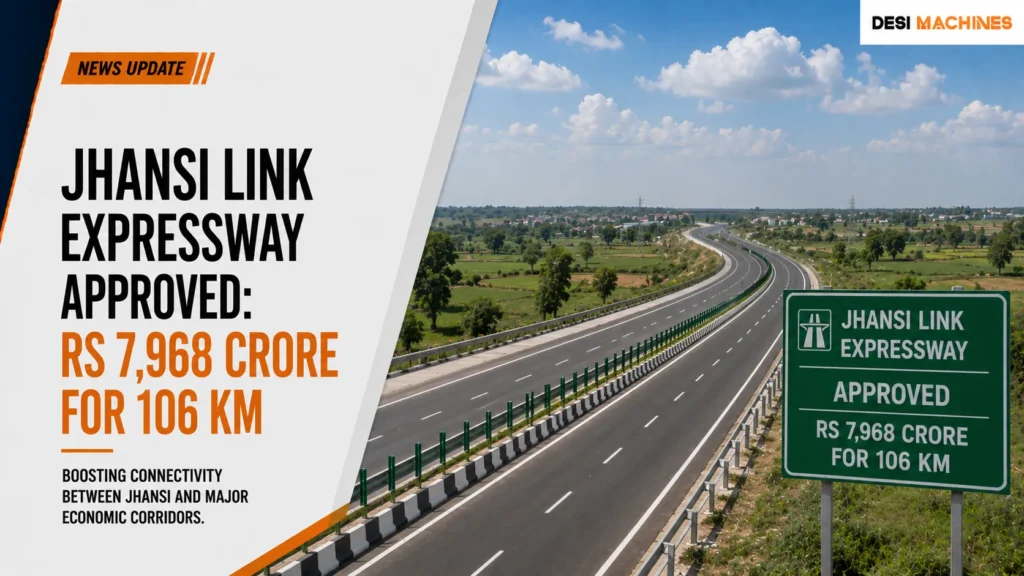
Uttar Pradesh sanctioned a second greenfield expressway this week, and it costs less per kilometre than anything the state has cleared in a month. The cabinet approved the Jhansi Link Expressway on 25 August at Rs 7,968.30 crore: 106.3 km of six-lane road tying Jhansi into the Bundelkhand Expressway.
The quick facts
- Rs 7,968.30 crore, borne entirely by the Uttar Pradesh government, with no central share recorded.
- 106.3 km, from near Phoolpura village in Jalaun, leaving the Bundelkhand Expressway at chainage 170+300, north to Ambabai in Jhansi on NH-44.
- Six lanes at the start, widenable to eight, on a 110-metre right of way; design speed 120 kmph.
- EPC mode, split into two packages, with global bids to be invited for the construction agency.
What the cabinet cleared
The decision came out of the 25 August sitting in Lucknow, the same meeting that extended the Ganga Expressway to Haridwar. Prabhat Khabar carried the fullest version of the note: the alignment runs north from Jalaun’s Urai region across the Garautha, Tahrauli, Moth and Jhansi tehsils before meeting NH-44, and serving the Bundelkhand Industrial Development Authority area and the defence corridor is the stated purpose. Carriers split on length. Most desks reproducing the note put it at 106.30 km; at least one ran 130 km. We have used 106.30 km, because that figure arrives with the chainage, the right of way and the design speed, and because a June 2026 report on the same alignment used it too.
What does Rs 75 crore a kilometre tell a machine owner?
Divide the sanction by the length and you get Rs 74.96 crore per km. Set that against the two Uttar Pradesh expressway approvals we have costed this month: the Jewar Link Expressway ran about Rs 115 crore per km, and the Ganga Expressway’s Haridwar extension lands between Rs 77 crore and Rs 98 crore per km depending on which length its carriers used. Jhansi is the cheapest of the three, for two reasons that both help a contractor. Land in Jalaun and Jhansi costs a fraction of land in Gautam Buddha Nagar, and a flat Bundelkhand alignment carries far fewer major structures. More of the money reaches earthwork and pavement, which is machine hours, and less goes to compensation cheques and fabricated steel.
The right of way sets the scale. A 110-metre corridor across 106.3 km is roughly 1,170 hectares to strip, fill and compact, and on the Bundelkhand plateau most of that is embankment building, not cutting. Expect borrow areas feeding 20-tonne excavators, tippers on medium hauls, dozers spreading, and single-drum soil compactors working layer by layer, with motor graders trimming the formation ahead of the paving train. Structures look short-span and scattered, so piling rigs and heavy cranes stay a minor line here.
The two-package split is what fleet owners should read closely. Roughly 53 km apiece puts this in large-contractor territory, concentrating mobilisation into two camps instead of eight mid-tier sites, so open-hire demand near Urai and Garautha arrives in two waves behind whoever wins. The calendar matters as much: embankment compaction in Bundelkhand realistically runs October to May, so a tender awarded late this year buys one clean earthwork season before the next monsoon. EPC terms also shorten the path from sanction to site, with no concessionaire to select and no financial closure to wait on, unlike the Seoni-Balaghat four-lane that Madhya Pradesh cleared the same week on hybrid annuity.
Our take: the cost history deserves a flag. A June 2026 report on this same 106.3 km put the project at Rs 5,001.74 crore, roughly Rs 47 crore per km, against the sanctioned Rs 7,968.30 crore. The note as carried does not explain the gap, and earlier reporting described the road as four-lane, so a move up a lane tier is the likeliest driver, though nobody has said so on the record. If the bid documents come back at four lanes, the arithmetic above shifts.
What to watch
- The tender for the two EPC packages, and whether 106.3 km stays split two ways.
- Whether six lanes survives into the bid documents; the gap against the June estimate turns on it.
- Land acquisition notifications across the Urai, Garautha, Tahrauli, Moth and Jhansi tehsils.
Sizing a fleet for this corridor? Compare earthmoving and compaction classes on DesiMachines, and check the monthly outgo before you commit with our equipment finance guide.
FAQ
When was the Jhansi Link Expressway approved?
The Uttar Pradesh cabinet cleared it on 25 August 2026 at an estimated Rs 7,968.30 crore, funded entirely by the state.
How long is the Jhansi Link Expressway and where does it run?
About 106.3 km. It leaves the Bundelkhand Expressway near Phoolpura village in Jalaun district at chainage 170+300 and runs north to Ambabai in Jhansi on NH-44. One carrier reported 130 km; most reproduced 106.30 km.
Which machines will the project need?
Mass earthwork kit first: 20-tonne excavators, tippers, dozers and single-drum soil compactors for the embankment, then graders and a paving train. Structures are short-span, so piling and heavy lifting take a small share.
Related on DesiMachines: Ganga Expressway Haridwar approval: UP clears Rs 10,761 crore
Source: Prabhat Khabar
Machines, tenders and news for this industry: Road Construction

 Excavator
294 models
Excavator
294 models  Backhoe Loader
51 models
Backhoe Loader
51 models  Crane
68 models
Crane
68 models  Concrete Mixer
79 models
Concrete Mixer
79 models  Wheel Loader
54 models
Wheel Loader
54 models  Compactor / Roller
45 models
Compactor / Roller
45 models  Motor Grader
42 models
Motor Grader
42 models  Dozer
41 models
Dozer
41 models  Concrete Pump
66 models
Concrete Pump
66 models  Skid Steer Loader
11 models
Skid Steer Loader
11 models  Telehandler
13 models
Telehandler
13 models