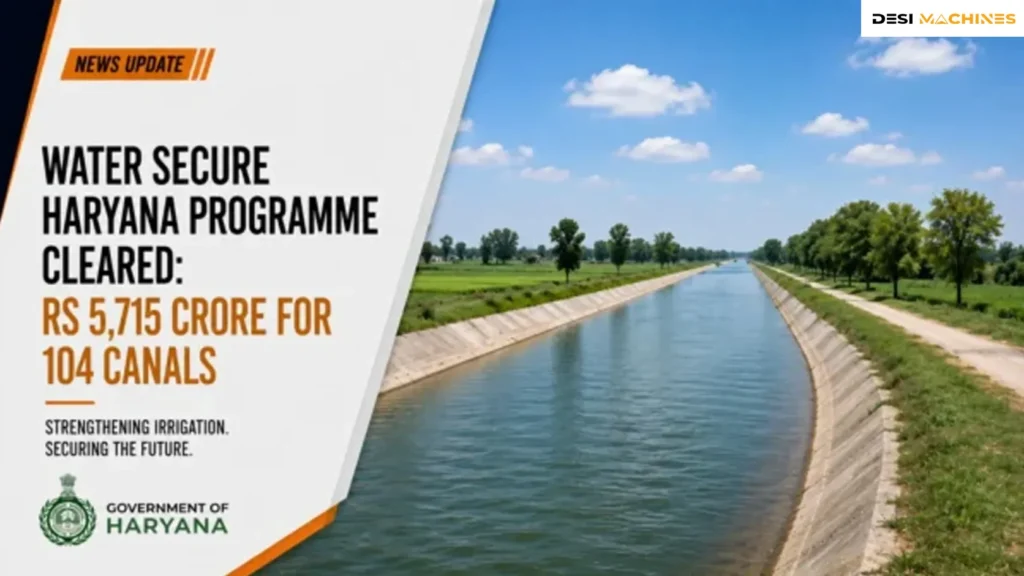
Haryana’s cabinet has cleared a Rs 5,714.80 crore water programme that spends most of its money rehabilitating irrigation assets the state already owns. For a fleet owner in the Hisar or Sirsa belt, that word matters more than the headline number. Rehabilitating a canal pulls a very different machine list from digging a new one, and it runs on a calendar nobody in the supply chain controls.
The quick facts
- The Haryana cabinet, chaired by Chief Minister Nayab Singh Saini, approved the Water Secure Haryana Programme on Thursday 13 August 2026 at an estimated Rs 5,714.80 crore, with World Bank assistance.
- Scope: renovate 104 canals and 620 watercourses, build 131 new water structures, develop 120 micro-irrigation projects and improve 2 lakh acres of waterlogged land.
- Coverage is 15 irrigation clusters across 48.94 lakh acres, with around 45 lakh people counted as beneficiaries. Work is phased over six years, to 2032.
- The Tribune, reporting the World Bank’s own sign-off a week earlier, put the funding split at Rs 4,000 crore of Bank loan and Rs 1,714.80 crore from state funds, with Rs 2,484.87 crore of the total going to canal rehabilitation.
What Haryana approved
The clearance came at a cabinet meeting that ran through eight proposals, and Punjab Newsline and the Times of India both carried it on Thursday evening alongside the same meeting’s decisions on startup incentives and an assembly monsoon session from 27 August. This was the state-level clearance, and it is not the first approval in the chain. The World Bank had already signed off on the same Rs 5,714.80 crore programme the week before, reported by The Tribune on 8 August. Two stages of one programme, five days apart, and the second is the one that puts state money behind it.
What does it mean for equipment buyers?
Divide the number before reading anything into it. Rs 5,714.80 crore over six years is roughly Rs 950 crore a year, spread across 15 clusters. That is about Rs 63 crore of work per cluster per year. The canal component alone, Rs 2,484.87 crore across 104 canals, averages under Rs 24 crore a canal. Nothing about that shape says mobilisation. It says a long run of small, dispersed packages that a regional contractor with four or five machines can actually bid for.
The bigger point is what “renovate” does to the fleet. Desilting and relining a live canal is not mass earthmoving. The machine works from the bank rather than the bed, so the class that earns is the long-reach excavator, not the standard 20-tonne unit, with tippers shuttling silt to spoil ground. Embankment repair brings in rollers and plate compactors, and lining work brings transit mixers off small batching setups rather than a fixed concrete plant on site. There is no dozer, scraper or grader front here, and no piling.
The 620 watercourses are the widest-reach item and the one nobody will headline. Khal rehabilitation is village-scale trench, line and backfill work, which is backhoe loader territory, and it is the component a single-machine owner in Haryana can realistically win. The 2 lakh acres of waterlogged land point the same way: subsurface drainage across the south-western districts is trenching work, not bulk excavation.
Our take: the constraint that decides whether any of this pays is the canal closure calendar. Rehabilitation on a working irrigation system can only happen when the canal is shut, which compresses a year’s work into defined weeks and puts every contractor in the state chasing the same window with the same machines. Long-reach attachments get scarce and hire rates firm inside that window, then go quiet. Quote on utilisation across the closure period rather than on the contract term, and price the idle months in. One honest caveat: a real share of this programme is pipes, pumps, sprinkler sets and agronomy work under the micro-irrigation and crop-diversification heads, and none of that reaches a fleet owner at all.
What to watch
- Which cluster gets tendered first, and whether the irrigation department packages canals singly or in belts. Consecutive canals in one belt is what makes a small fleet viable.
- The canal closure notification for the coming season, which sets the actual working window for the first tranche.
- Whether watercourse work is routed through MICADA at village scale or bundled into larger contracts, since that decides who can bid.
Planning for canal and drainage work? Compare long-reach excavators, backhoe loaders and compaction machines on DesiMachines, and check what is already out for bid on our opportunities desk before you commit to a purchase.
FAQ
What is the Water Secure Haryana Programme?
It is a World Bank assisted integrated water resources programme approved by the Haryana cabinet on 13 August 2026 at an estimated Rs 5,714.80 crore, covering canal and watercourse renovation, new water structures, micro-irrigation and waterlogged land improvement across 15 irrigation clusters, phased to 2032.
Which machines does canal rehabilitation actually need?
Mostly long-reach excavators working from the bank for desilting, tippers for spoil haulage, rollers and plate compactors on embankments, transit mixers for lining, and backhoe loaders on the smaller watercourse packages. Rehabilitation of an existing canal does not pull the dozer and grader fleet that new alignment work does.
When will tenders start coming out?
No tender calendar has been published with the approval. The programme runs over six years to 2032, and the practical trigger for each package is the irrigation department’s canal closure window, so watch the department’s notifications rather than the cabinet date.
Related on DesiMachines: Parbati Giri megalift irrigation project gets Rs 12,458 crore nod
Source: Punjab Newsline

 Excavator
294 models
Excavator
294 models  Backhoe Loader
51 models
Backhoe Loader
51 models  Crane
68 models
Crane
68 models  Concrete Mixer
79 models
Concrete Mixer
79 models  Wheel Loader
54 models
Wheel Loader
54 models  Compactor / Roller
45 models
Compactor / Roller
45 models  Motor Grader
42 models
Motor Grader
42 models  Concrete Pump
66 models
Concrete Pump
66 models  Skid Steer Loader
11 models
Skid Steer Loader
11 models  Telehandler
13 models
Telehandler
13 models  Dozer
Dozer