
 Excavator
294 models
 Backhoe Loader
51 models
 Crane
68 models
 Concrete Mixer
79 models
 Wheel Loader
54 models
 Compactor / Roller
45 models
 Motor Grader
42 models

 Concrete Pump
66 models
 Skid Steer Loader
11 models


A rock breaker that has gone soft, with the chisel bouncing on the rock instead of biting into it and the high-pressure hose shaking at every blow, has usually lost nitrogen gas. Nitrogen does two separate jobs inside a hydraulic breaker. A charge in the back head, the closed chamber above the piston, works like a spring that throws the piston down onto the chisel. A charge in the accumulator, a small gas chamber on the oil inlet, stops the pressure pulses of the hammer from travelling back up the hose to the machine.
Both charges are fixed by the breaker’s maker, both are read with a gauge against the temperature of the metal, and both are topped up from a nitrogen cylinder through a charging kit. Neither is ever filled with air or oxygen. This guide covers what each chamber does, the pressures two makers publish for their own breakers, what sits inside a charging kit, how the gas is checked, what low gas feels like in the seat, and how often it needs looking at. Which breaker suits which machine is a different question, answered in rock breaker sizes by machine weight.
What does the nitrogen gas in a rock breaker do?
The gas is what makes a hydraulic breaker a hammer instead of a press. Oil from the machine lifts the piston. Oil alone could push it back down, but not fast enough to crack stone, so the piston rises against a sealed charge of nitrogen above it and that compressed gas drives it down again. The piston hits the top of the chisel, the chisel passes the shock into the rock, and the cycle repeats a few hundred times a minute.

The tall sealed section at the top of the breaker in the picture is the back head. Its charging valve sits under a screwed plug on that housing, usually behind a sticker showing the correct pressure.
The accumulator does a different job. Inside it a rubber diaphragm, or on larger breakers a small floating piston, separates nitrogen from hydraulic oil. Every blow sends a shock back into the supply line. The gas side squeezes, takes that shock, and pushes the oil back out as the piston lifts again. Without it the hose jumps, fittings loosen, and the machine’s own pump and valves take punishment they were never built for. How much flow and pressure that circuit carries is covered in the guide to excavator hydraulic pressure and flow.
Where the two gas chambers sit
The back head holds a low charge that works every single blow. The accumulator holds a much higher charge that protects the oil line. Two chambers, two pressures, two charging valves.
Why nitrogen, and never air or oxygen?
Because nitrogen does not burn and does not feed a fire. The gas chamber of a working breaker is hot, it is full of fine oil mist from the seals, and it is squeezed hard several hundred times a minute. Compress oxygen into that and you have the three things a fire needs in one sealed steel chamber. The manuals are blunt about it. Soosan’s SB-series operation manual repeats “Use nitrogen gas only” as a warning above both the back head and the accumulator procedure. Epiroc’s instructions for its SB 702 and SB 1102 breakers say to fill the integrated piston accumulator with nitrogen only, and label the accumulator itself with the same instruction.
Shop air is wrong for a second reason as well. It carries water, and water inside a sealed chamber rusts the bore the piston slides in and shortens the life of the seals.
Two safety points from the same manuals are worth reading twice, because they are the ones that hurt people. Epiroc warns that the accumulator stays pressurised even when the machine’s hydraulics are switched off, so taking one apart without releasing the nitrogen first can cause serious injury or death, and says only trained, authorised people should work on it. Soosan says to discharge the nitrogen before changing the through bolts or opening the breaker body, and to keep clear of the chisel while charging, because a loaded piston can throw the chisel out of the front head.
What pressure should the nitrogen gas be?
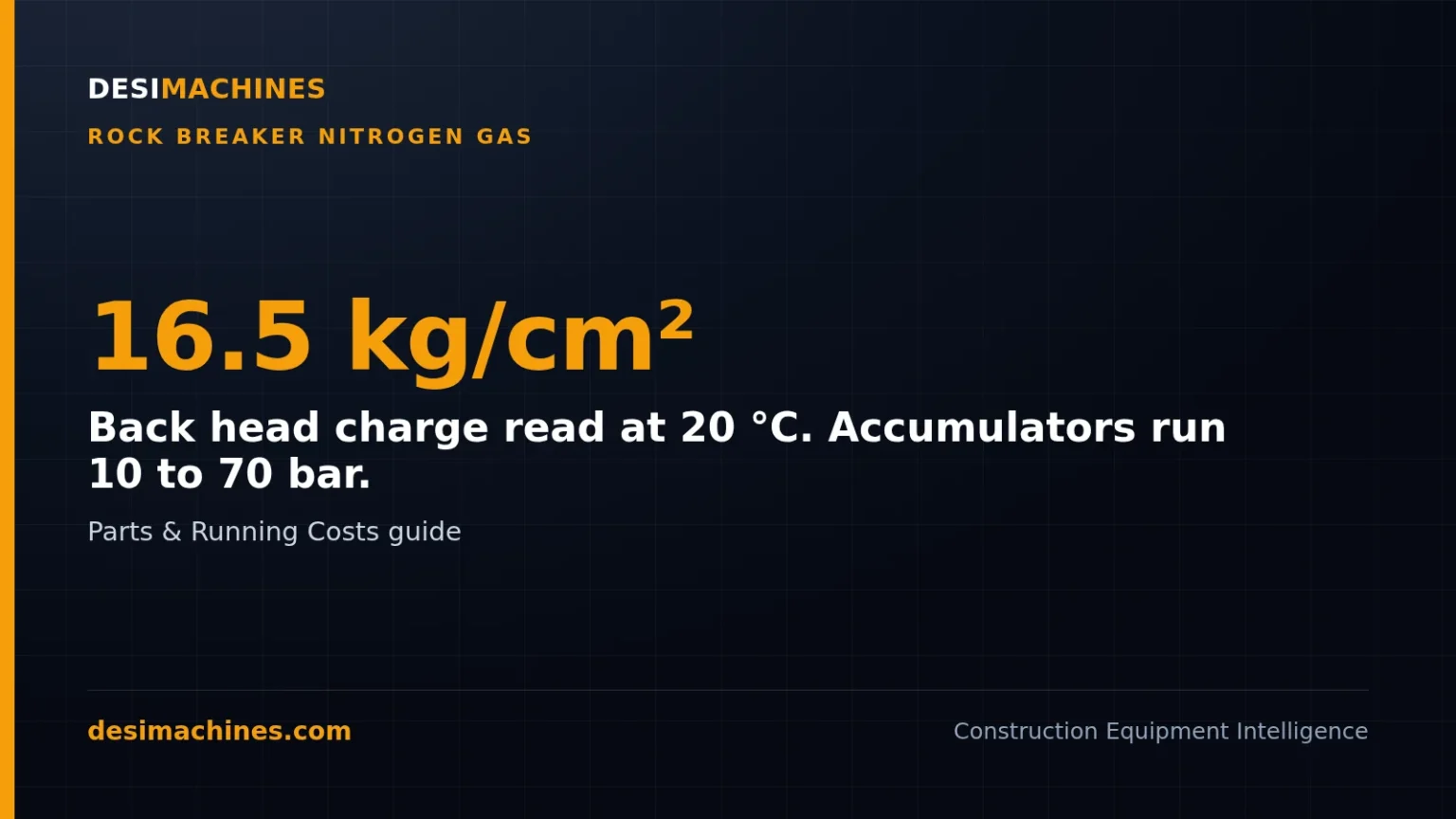
There is no single figure. The back head of a mid-size breaker sits near 16 kg/cm², about 16 bar, while accumulators on the same class of machine run anywhere from 10 to 70 bar depending on the model. Only the maker’s own figure for your model is right, and it is printed on a sticker next to the charging valve as well as in the manual. The table below shows what two makers publish for their own breakers, so you can see the pattern.
| Maker and model | Carrier class | Back head nitrogen | Accumulator nitrogen | Read at |
|---|---|---|---|---|
| Soosan SB10 II to SB177 (SB series) | About 1 to 70 tonnes across the range | 16.5 kg/cm² (235 psi, about 16 bar) | 55 kg/cm² (783 psi) on models that carry one | Surface temperature of the part, 20 °C (68 °F) |
| Soosan SB43 II and SB43B | 6 to 9 tonnes (SB43B) | 16.5 kg/cm² (235 psi) | 10 kg/cm² (142 psi), chamber volume 0.25 litre | Surface temperature of the part, 20 °C (68 °F) |
| Epiroc SB 702 | 10 to 17 tonnes (10,000 to 17,000 kg) | Not stated in the published table | 60 bar (870 psi), integrated piston accumulator | Maker’s instruction for that breaker |
| Epiroc SB 1102 | 13 to 24 tonnes (13,000 to 24,000 kg) | Not stated in the published table | 70 bar (1015 psi), integrated piston accumulator | Maker’s instruction for that breaker |
This is a general guide based on machine size class. Always confirm the fit with your machine’s operator manual or the manufacturer before buying or fitting.
The detail most people on site miss is temperature. Gas pressure rises as the metal warms, so the correct reading changes through the day and a gauge is only telling you the truth if you know how warm the housing is. Soosan prints a conversion table for exactly this, and it is worth copying into the toolbox.
| Surface temperature | Correct back head pressure | Correct accumulator pressure |
|---|---|---|
| 0 °C (32 °F) | 15.5 kg/cm² (220 psi) | 51 kg/cm² (730 psi) |
| 10 °C (50 °F) | 16 kg/cm² (228 psi) | 53 kg/cm² (755 psi) |
| 20 °C (68 °F) | 16.5 kg/cm² (235 psi) | 55 kg/cm² (780 psi) |
| 30 °C (86 °F) | 17 kg/cm² (242 psi) | 57 kg/cm² (815 psi) |
| 40 °C (104 °F) | 17.5 kg/cm² (249 psi) | 59 kg/cm² (830 psi) |
Figures as published for the Soosan SB series. On a summer afternoon in Rajasthan a back head reading 17.5 kg/cm² is correct, and the same reading on a December morning in Punjab means the chamber is overfilled. Read the housing temperature, not the air temperature.
What is in a nitrogen charging kit, and how is the gas checked?
A back head charging kit is five parts, and Soosan lists them by name in its own parts book:
- A nitrogen gas cylinder, the tall bottle the gas comes in.
- A bombe adapter and adapter nut. Bombe is the cylinder, and the adapter is the threaded piece that joins the hose to its outlet.
- A flexible charging hose rated for the pressure.
- A three-way valve assembly. This is the working end: a gauge, a handle that opens the breaker’s charging valve, and a relief valve to bleed gas off.
Checking the gas needs only the three-way valve, not the cylinder. The handle is kept up so nothing escapes, the valve body is screwed into the charging valve after the plug comes out, and then the handle is pushed in fully so the chamber’s pressure shows on the gauge. If the reading matches the figure for that temperature, the gas inside the valve body is bled off and the plug goes back in.
Topping up follows the same path with the cylinder connected, and Soosan’s procedure has three details that separate a clean job from an expensive one. Lay the breaker down and let the chisel slide out to its full extension first, because the reading changes with where the piston is sitting. Open the cylinder slowly. And if the pressure overshoots, stop at ten percent above the figure, shut the cylinder, and bleed back down to the exact pressure rather than leaving it high.
The accumulator has its own rule. Charge it only through the three-way valve, never straight from the cylinder, because the full blast of a cylinder against a rubber diaphragm can tear it. Tighten the accumulator body and cover fully before you start, and check that its mounting and cover bolts are torqued. Epiroc asks for the accumulator screws to be checked every week for the same reason.
If the breaker is hitting weakly and the gas turns out to be correct, the fault is usually in the oil circuit rather than the hammer. That side is covered in the guide to the breaker piping kit, which walks through shut-off valves, relief settings and return filters.
What are the signs of low or high nitrogen gas?
Low gas does not stop a breaker. It makes it weak, and weak is easy to blame on the rock, the operator or the machine. The signs below are the ones named in the makers’ own troubleshooting sections.
| What you notice | What it usually means | What to do |
|---|---|---|
| Blow has lost its force, chisel bounces, work takes longer than it used to | Low nitrogen pressure in the back head is one of the listed causes | Check the back head against the temperature table and reset it |
| Force drops suddenly and the high-pressure hose shakes hard while hammering | Gas leaking from the back head, or a flat accumulator charge | Stop. Soosan sends this one to a service station rather than a site top-up |
| Hammering is irregular, or the blow sounds different from normal | Listed as a during-operation warning sign, gas pressure among the causes | Stop and check gas before carrying on |
| Gas needs topping up again within days of the last charge | A seal or diaphragm is passing, not a gas problem | Seal kit and accumulator diaphragm are scheduled service items |
| Piston works but the breaker does not hammer at all | Usually a stuck chisel or a hydraulic fault, not the gas | Check the front end and the oil circuit first |
Too much gas is a real fault too, which is why the manuals tell you to bleed back to the figure instead of leaving a high reading alone. An overcharged back head fights the oil trying to lift the piston, and Epiroc warns that running a breaker above its stated operating pressure can overcharge the accumulator, with damage and injury as the result. More gas is not more power.
One more habit worth keeping: watch the oil temperature. Soosan’s manual keeps the working fluid below 80 °C (176 °F), and hot thin oil makes a breaker feel soft in a way no amount of nitrogen will fix.
How often should the nitrogen gas be checked?
More often than most owners in India check it. Soosan’s maintenance schedule puts “check the gas pressure and refill” in the weekly column, which it counts as every 50 operating hours, and it lists both the back head and the accumulator there. The accumulator diaphragm and the seal kit are replacement items every three months, or every 500 to 1,000 hours of work.
Daily, the makers ask for less but it still matters. Epiroc’s every-day list is hoses, couplings and the accumulator checked for condition, bolts and connections checked for damage and tightness. A loose accumulator cover bolt or a weeping charging valve is how a charge disappears over a fortnight.
There is also a rule for a breaker going into the shed. If the breaker will sit unused for more than a month, Soosan says to remove the nitrogen from the back head and the accumulator, grease the chisel, chisel pin, front cover and bushes, and lubricate the piston surface. A charged chamber left standing for a season loads the seals the whole time for no return. Chisel and bush wear while a breaker stands or works is covered in the breaker chisel guide, and the pins and bushes that mount the attachment in the pins and bushes guide.
Does the machine under the breaker change the gas setting?
No. The gas pressure belongs to the breaker model, not to the carrier. What the machine decides is which breaker you are allowed to hang on it, and that in turn decides which gas figure applies. A 20-tonne class excavator takes a bigger breaker than a backhoe loader, the machine most buyers in India simply call a JCB, so the two end up with different charging pressures even on the same site.
| Machine class | Example from our catalogue | Breaker class that suits it | Gas figure to use |
|---|---|---|---|
| Backhoe loader, about 7 to 8 tonnes | JCB 3DX (7,200 kg) | Small breaker, Soosan SB43B class is rated for 6 to 9 tonne carriers | That breaker’s own back head and accumulator figures |
| Excavator, about 20 tonnes | Tata Hitachi EX 200 Infra, EX 210 Infra | Mid-size breaker, Epiroc SB 1102 is rated for 13 to 24 tonne carriers | 70 bar accumulator on that model, per Epiroc |
| Excavator, 10 to 17 tonnes | Machines in the excavator range at that weight | Epiroc SB 702 class | 60 bar accumulator on that model, per Epiroc |
This is a general guide based on machine size class. Always confirm the fit with your machine’s operator manual or the manufacturer before buying or fitting.
The makes sold in India sit side by side on this, and the charging method is the same across all of them: Epiroc, Montabert, Indeco, Rammer, Furukawa, Soosan, Daemo, Toku, Everdigm, Indus Rock Tool, Dynamite Duro, along with the breakers JCB and Tata Hitachi list for their own machines. Only the numbers change. If you are still working out which size to hang on the machine, start with how to choose a rock breaker size, then check the fit against breakers listed by machine weight. For hard rock on a mining bench, where breaking follows drilling, the sequence is explained in the guide to blast hole drilling.
Where the figures in this guide come from
Every pressure above is taken from a maker’s own published document, not from a market average. The back head and accumulator figures, the temperature conversion tables, the charging procedure, the kit part list and the maintenance intervals are from the Soosan SB-series operation manual and parts book. The 60 and 70 bar accumulator figures, the carrier weight classes and the accumulator safety instructions are from the Epiroc SB 702 and SB 1102 safety and operating instructions. Your breaker’s own manual overrides both.
Nitrogen work also has a line past which it stops being an owner’s job. Checking a pressure and topping it up with the right kit is routine maintenance. Opening a back head, replacing an accumulator diaphragm, or chasing a leak that comes back is workshop work, and both makers restrict accumulator service to trained people. More parts for the machine under the breaker are listed in the guide to construction equipment spare parts. If you are matching an attachment to a machine, browse the range of excavators and backhoe loaders and talk to a dealer about what the machine’s hydraulics can feed.
Prices, specifications and features are indicative, vary by variant, location and date, and should always be confirmed with the official OEM or authorised dealer before any purchase decision. DesiMachines is not liable for decisions taken on the basis of information that may have changed after publication.
Get a breaker nitrogen charging kit price from a dealer near you
Tell us your machine and what you need, and we will ask the nearest dealer to reach out to you with a price.