
 Excavator
294 models
 Backhoe Loader
51 models
 Crane
68 models
 Concrete Mixer
79 models
 Wheel Loader
54 models
 Compactor / Roller
45 models
 Motor Grader
42 models

 Concrete Pump
66 models
 Skid Steer Loader
11 models


If you are buying a rock breaker for an excavator or a backhoe loader, check first whether the machine has a breaker piping kit, because without one the breaker cannot work. The kit is the valve, steel pipes, shut-off valves and hoses that carry oil from the machine’s pump to the breaker and back to the tank, set to the flow and pressure that breaker asks for.
Most people in India call a backhoe loader a JCB and ask for a “JCB breaker pipe line”. It is the same idea on every make. This guide explains what is in the kit, one-way and two-way piping, how the kit is matched to the size of the machine, how it is set up and checked, the faults that start in the piping, and what moves the price. It gives no prices. The breaker itself is covered in the rock breaker price guide, and how to choose its size in the hydraulic rock breaker guide.
What is a breaker piping kit?
It is a separate oil circuit built only for the breaker. A bucket is moved by the machine’s own cylinders, so it needs no extra lines. A breaker is a hammer with its own piston inside, and it has to be fed with oil from outside. As the Wikipedia article on hydraulic breakers puts it, the breaker is powered by an auxiliary hydraulic system on the excavator, worked by a foot-operated valve. Auxiliary simply means extra.
A complete kit has these parts:
- A control in the cab. On most excavators and backhoes this is a foot pedal. Some compact machines use a switch on the joystick instead; the Bull AV490 and L&T S315R skid steer loaders both list one for their auxiliary hydraulics.
- The breaker valve. When you press the pedal, it sends pump oil into the breaker line. The line has its own relief setting, which is the pressure at which oil is let off so the breaker is never pushed past its limit.
- A pressure line. Steel pipe clamped along the boom and the arm carries the oil out to the breaker.
- A return line. A second pipe brings the used oil back to the tank, often through a filter of its own. Kobelco, for example, fits a filter in the breaker line of its SK140 and SK145XDLC.
- Two shut-off valves, also called stop valves, at the end of the arm, one on each line. They are closed whenever the breaker is off the machine, so the hoses can be uncoupled without draining the line.
- Two short flexible hoses from the shut-off valves to the breaker ports, with fittings that suit those ports. The Indeco MES 150, a small breaker, uses half-inch BSPP fittings on both sides. BSPP is a common thread standard for pipe fittings.
- Clamps and brackets that hold the pipes to the boom and arm.
The breaker’s mounting bracket and its chisel are not part of the piping kit. Sellers bundle things differently: JCB lists its breakers as supplied with hoses, a hanger bracket and a moil tool. Ask what each quote includes so you compare like with like.
How the oil travels through a breaker line
2 Breaker valve, worked by the pedal→
3 Pressure line along boom and arm→
4 Shut-off valve at arm end→
5 Breaker→
6 Shut-off valve on return side→
7 Return line and filter→
8 Tank
Blue boxes carry oil under pressure, the red box is the breaker, and green boxes are the return side, where the oil should meet as little resistance as possible.
What is the difference between one-way and two-way breaker piping?
A breaker needs oil to flow one way only. Oil goes in through the pressure hose, works the piston, and leaves through the return hose to the tank. That is one-way piping, which some people call single acting.
Crushers, shears and pulverisers are different. Their jaws open and close, so each hose carries pressure in turn and the oil changes direction. That needs two-way piping, also called double acting. Spec sheets keep the two apart: the Tata Hitachi ZAXIS 220LC lists breaker and crusher piping as separate options, and the Volvo EC120D and EC140D list breaker and shear piping.
So the first question is what you will hang on the arm. A breaker only needs one-way piping. If you also plan to run a crusher or a shear, ask the dealer whether the kit on offer is one-way, two-way, or can be switched between the two, and match it to the attachments you will actually use.
Can a rock breaker run without a piping kit?
No. Even on a machine that already has spare lines, the breaker still needs a circuit set to its own flow and pressure, and that is what the kit does. There are three reasons.
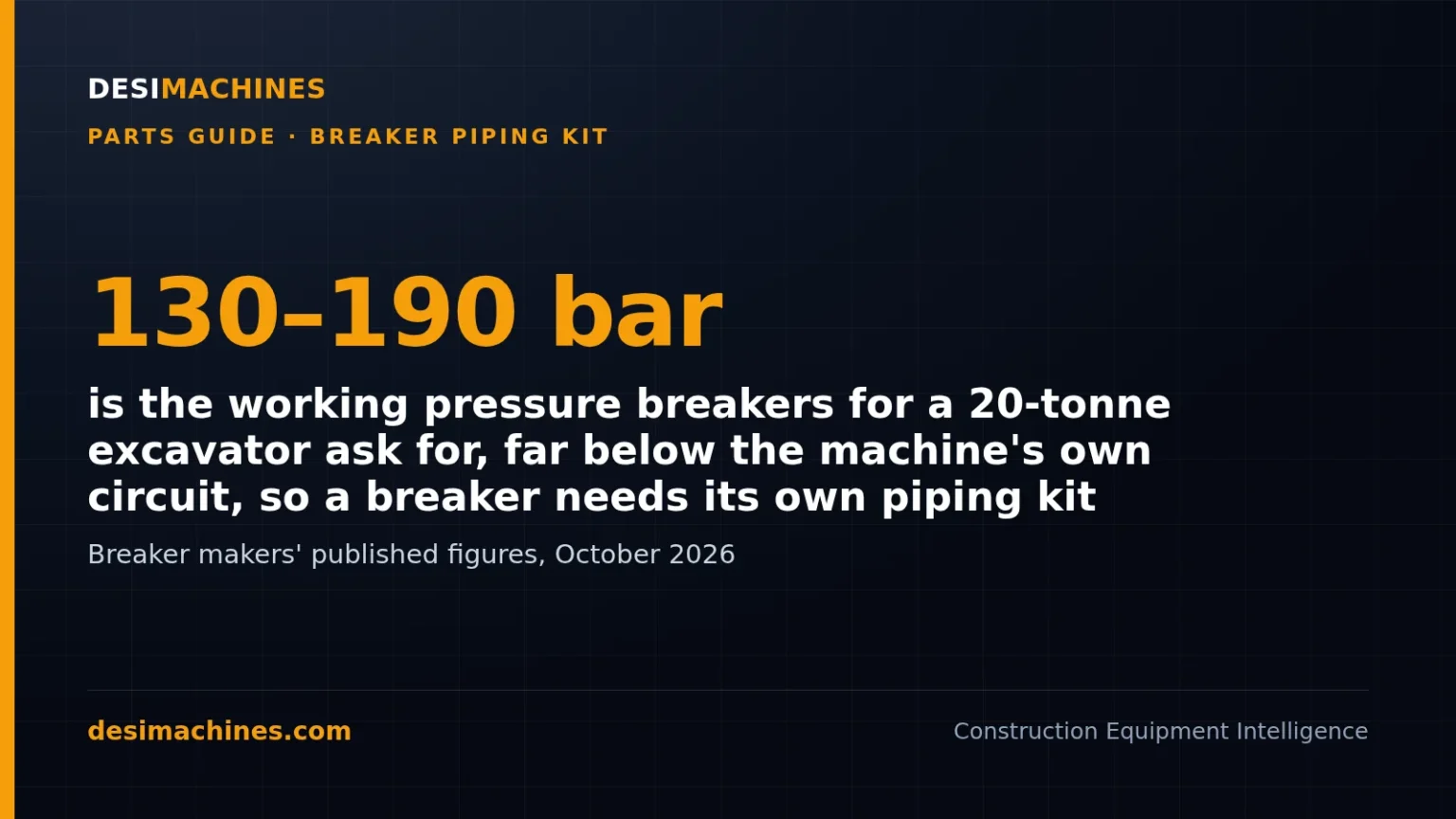
Pressure is the first. Excavators in the 15 to 25-tonne class publish a working pressure of 279 to 373 bar, typically 343 bar, in their implement circuits, and full-size backhoe loaders publish 180 to 270 bar (figures from the machines listed in the guide to excavator hydraulic hoses). Breakers made for a 20-tonne machine ask for 130 to 190 bar. The kit’s relief setting keeps the breaker inside its own figure. Indeco’s service manual sets the attachment relief at least 500 psi (about 35 bar) above the breaker’s working pressure. The manual for the Soosan-built SB40 and SB43 breakers says the relief setting is not fixed and depends on the pump, and gives 2,420 psi (about 167 bar) for the SB40 and 2,560 psi (about 177 bar) for the SB43.
Flow is the second. Too little oil and the breaker hits slowly. Too much and it runs too fast, heats the oil and wears out sooner. Indeco’s manual says it is better to be 5 to 10 percent under the required flow than over it.
Back pressure is the third. This is the pressure left in the return line, and breakers want it low. The Indeco MES 150 prefers 188 psi (about 13 bar) and allows 260 psi (about 18 bar) at most. The SB40 and SB43 manual gives 230 psi (about 16 bar). A return line that is too narrow, too long or blocked raises back pressure and robs the breaker of power, which is why many kits send return oil to the tank through their own line and filter. How the machine’s own valve block shares out oil is explained in the guide to the excavator main control valve.
Which breaker piping suits which machine size?
The piping has to carry the oil the breaker needs, and breakers are made for machines of a set weight. So the size of the machine decides the size of the breaker, and the breaker decides the flow and pressure the kit must deliver. The table puts the machine class first, then the oil flow and pressure that makers ask for in breakers listed for that weight.
| Machine class (operating weight) | Machines in our catalogue that list breaker piping | Breaker models listed for this weight | Oil flow the breakers ask for | Working pressure |
|---|---|---|---|---|
| Mini excavator, about 3 tonnes | Tata Hitachi NX30 (2,900 kg) | 12 | 15–70 L/min, middle band 28–50 | 80–150 bar |
| About 5 tonnes | Tata Hitachi NX 50 (5,190 kg) | 13 | 35–120 L/min, middle band 45–80 | 90–150 bar |
| 7 to 8 tonnes | Tata Hitachi EX 70 Prime (7,200 kg), NX 80 (7,500 kg) | 13 | 35–120 L/min, middle band 50–90 | 90–160 bar |
| Backhoe loader, any make (about 7 to 10 tonnes) | Mahindra EarthMaster SX and SXE, ACE AX 124 (breaker kit optional) | 4 named by their makers for backhoes | 35–120 L/min | 90–150 bar |
| 13 to 15 tonnes | Kobelco SK145XDLC (13,800 kg), Volvo EC140D (13,130–13,710 kg), SANY SY140C-9/9S Tunnel (14,260 kg) | 12 | 65–135 L/min, middle band 85–120 | 100–180 bar |
| 20 to 22 tonnes | Tata Hitachi EX 210 Infra (20,300 kg), ZAXIS 220LC (21,700 kg) | 16 | 85–200 L/min, middle band 120–165 | 130–190 bar |
| 34 to 36 tonnes | Komatsu PC350LC-8M0 (34,350 kg), Tata Hitachi ZAXIS 370LCH Ultra (35,700 kg) | 11 | 150–350 L/min, middle band 180–250 | 140–190 bar |
This is a general guide based on machine size class. Always confirm the fit with your machine’s operator manual or the manufacturer before buying or fitting.
Breaker figures are from 77 breaker models whose makers, Epiroc, Dozco and Tata Hitachi, publish oil flow and working pressure on their own sites, as listed on the rock breaker pages in October 2026. A model is counted for a class when its maker lists it for a machine of that weight. The middle band runs from the typical low figure to the typical high figure, so it shows where most breakers sit. The four backhoe breakers are the Dozco D75 and the Tata Hitachi Alicon B60 Super, Alicon B70 Super and BR777i.
Read the backhoe row with care. Full-size backhoe loaders publish pump flows of roughly 100 to 150 L/min, listed make by make in the rock breaker price guide, so most can feed a medium breaker. The compact JCB 2DX publishes 70.4 L/min and needs a lighter one. Pump flow by excavator class is in the guide to excavator hydraulic pressure and pump flow.
Which machines come with breaker piping already fitted?
Several makers fit the piping in the factory, as standard or as an option, so check the spec sheet before you pay for a kit to be added later. This is what the machines in our catalogue say, as of October 2026:
| Machine | Operating weight | What the spec sheet says |
|---|---|---|
| Tata Hitachi NX 50 | 5,190 kg | Includes a factory-fitted rock breaker piping kit |
| Tata Hitachi EX 70 Prime | 7,200 kg | Factory-fitted rock breaker piping kit as an option |
| Tata Hitachi NX 80 | 7,500 kg | Factory-fitted rock breaker piping kit as an option |
| Kobelco SK145XDLC | 13,800 kg | Filter for breaker piping fitted with the breaker hydraulic line |
| SANY SY140C-9/9S Tunnel | 14,260 kg | Breaker piping is standard |
| Volvo EC140D | 13,130–13,710 kg | Breaker and shear piping, and quick coupler piping, as an option |
| Tata Hitachi EX 210 Infra | 20,300 kg | Factory-fitted rock breaker piping |
| Tata Hitachi ZAXIS 220LC | 21,700 kg | Breaker and crusher piping options |
| Tata Hitachi ZAXIS 370LCH Ultra | 35,700 kg | Factory-fitted rock breaker piping kit |
| Mahindra EarthMaster SX and SXE | Backhoe loader | Optional rock breaker kits |
| ACE AX 124 | Backhoe loader | Rock breaker in the optional equipment |
“Factory-fitted” means the maker has routed and clamped the pipes for that machine. A kit added later can work just as well, but it has to be routed, clamped and set by someone who knows that machine. Whichever way it comes, ask the dealer to show you the shut-off valves at the end of the arm before you sign; if they are there, the line is there.
Want to see which models list breaker piping in your size? Compare the excavators on sale in India, with their specifications side by side.
How is a breaker piping kit set up and checked?
Setting up the line matters as much as fitting it. The manual for the SB40 and SB43 breakers asks the service engineer to check the machine’s hydraulic pressure, oil capacity and pressure loss before the pipes go on, because every machine is different. Indeco’s manual sets out the test that follows, and in plain steps it runs like this:
- Warm the hydraulic oil to working temperature first, so the readings are real.
- Connect a flow meter, which measures how many litres a minute pass, between the pressure line and the return line in place of the breaker, with a pressure gauge on the return side.
- Start the engine and raise the rpm slowly, reading the flow and the back pressure as it rises. If back pressure goes over the breaker’s limit, the return side is reworked before going further.
- Set the flow to the breaker’s figure, a little under rather than over.
- Load the meter up to the breaker’s working pressure, check the flow holds, then set the relief at least 35 bar above that working pressure.
- Fit the breaker, open the shut-off valves, run it at low rpm on hard ground, then bring the rpm up while watching the gauges.
Keep the test sheet. It is the only record of how the line was set, and it is the first thing a mechanic will ask for when the breaker starts to feel weak.
Why is my breaker hitting weak, or not hitting at all?
A breaker that loses its punch is often blamed on the breaker when the cause sits in the piping. The checks below come from the troubleshooting sections of the Indeco and SB40/SB43 manuals, starting with the ones you can do yourself.
| What you notice | Piping-side causes to check |
|---|---|
| Breaker does not hit at all | Shut-off valves at the arm end still closed; pedal or breaker valve not working; machine not giving its flow or pressure |
| Breaker hits weakly or slowly | Shut-off valves only part open; relief setting too low; flow below the breaker’s figure; clogged filter in the return line; leaking or blocked pipes |
| Hoses shake hard while hammering | Low gas charge in the breaker’s accumulator, the gas-filled chamber that smooths the oil pulses. Stop and call the dealer |
| Hydraulic oil runs hot | Relief valve opening during work; flow or engine rpm higher than needed; pedal valve sticking |
| Return pressure reads above the limit | Return filter blocked, or return lines too small or restricted |
Two habits prevent many of these. Run the breaker at the engine speed its maker specifies, because more rpm does not hit harder; it only heats the oil. And keep an eye on oil temperature: the SB40 and SB43 manual keeps working oil below 80 °C. What high oil temperature does to a machine is covered in the guide to excavator hydraulic oil temperature.
How do you look after the breaker line?
The SB40 and SB43 manual sets a simple routine for the machine side of the circuit:
- Before and after each shift, look over the breaker hoses and pipes for leaks, rubbing and loose clamps, and check that the breaker valve is still firmly mounted.
- Every week, or 50 hours, check the hydraulic oil level and how dirty the oil is.
- Every month, or 200 hours, check the breaker’s working pressure, the relief setting and the supply flow, and change the machine’s hydraulic oil filter.
Close both shut-off valves and cap the hose ends whenever the breaker comes off, so dirt cannot get into the line. Hose sizes, pressure ratings and fittings are explained in the hydraulic hose guide, the filters in the guide to excavator filters, and the wider routine in hydraulic system maintenance. The chisel, the part of a breaker that wears fastest, has its own rock breaker chisel guide.
What decides the price of a breaker piping kit?
No two quotes are built the same, so it helps to know what moves the figure:
- One-way or two-way. A two-way or switchable kit has more valving than a breaker-only line.
- Machine size. A 35-tonne machine needs larger pipes, hoses and fittings than a 5-tonne one, and longer runs along a longer boom and arm.
- Factory-fitted or added later. A factory option is priced with the machine. A kit added later needs brackets and routing made for that make and model.
- What is in the quote. The valve, pedal, filter, pipes, hoses, shut-off valves, fitting labour and the flow-meter setting can each be in or out.
- Who sets it up. A kit fitted without a flow and pressure test is cheaper on the day and can cost far more in breaker repairs later.
For a quote, give the dealer the make, model and operating weight of your machine, the breaker you plan to run, and whether you will ever add a crusher or shear. To weigh up a machine that comes with the line already fitted, compare the backhoe loaders on sale in India, including the JCB 3DX, and the full range of excavators.
Where the facts in this guide come from
Machine weights and the piping notes are from the specification sheets of machines in the DesiMachines catalogue in October 2026. Breaker oil flow and pressure are from the 77 Epiroc, Dozco and Tata Hitachi breaker models on our rock breaker pages, which carry the makers’ own published figures. The setting-up steps, relief, flow and back-pressure figures and the fault list are from Indeco’s MES-series breaker service manual and the operating manual for the Soosan-built SB40 and SB43 breakers. Other tools a backhoe can carry are in the backhoe loader attachments guide, and the full set of parts guides is in the parts and running costs guide.
Prices, specifications and features are indicative, vary by variant, location and date, and should always be confirmed with the official OEM or authorised dealer before any purchase decision. DesiMachines is not liable for decisions taken on the basis of information that may have changed after publication.
Get a breaker piping kit price from a dealer near you
Tell us your machine and what you need, and we will ask the nearest dealer to reach out to you with a price.