
 Excavator
294 models
Excavator
294 models  Backhoe Loader
51 models
Backhoe Loader
51 models  Crane
68 models
Crane
68 models  Concrete Mixer
79 models
Concrete Mixer
79 models  Wheel Loader
54 models
Wheel Loader
54 models  Compactor / Roller
45 models
Compactor / Roller
45 models  Motor Grader
42 models
Motor Grader
42 models  Concrete Pump
66 models
Concrete Pump
66 models  Skid Steer Loader
11 models
Skid Steer Loader
11 models  Telehandler
13 models
Telehandler
13 models 


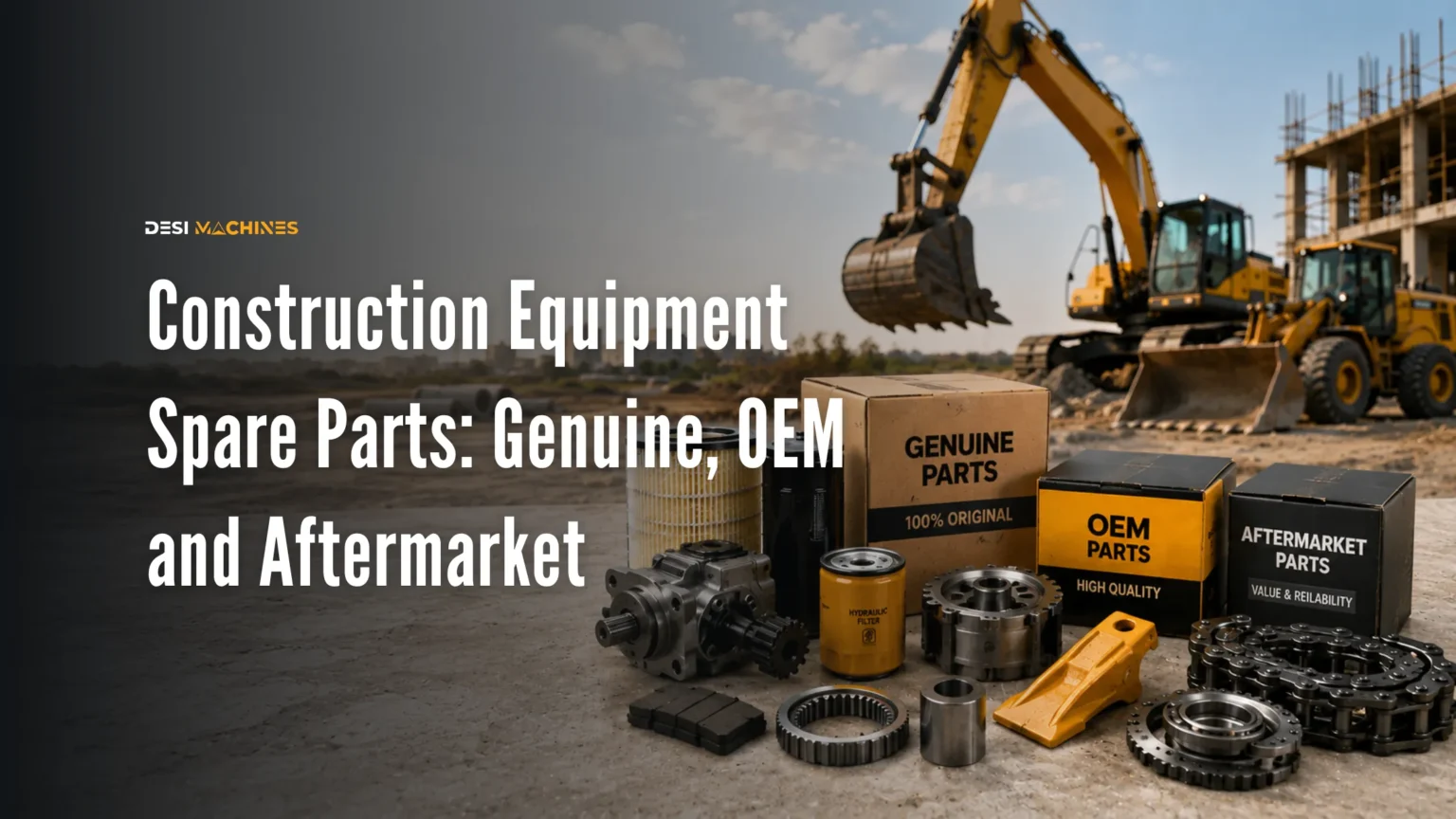
Construction equipment spare parts in India come in four grades, and the difference between them decides both what you pay and how long the repair lasts. A genuine part carries the machine maker’s brand and comes through the authorised dealer. An OEM part is made in the same factory by the same supplier but sold without that brand on the box. An aftermarket part is made by an independent manufacturer to fit the machine. A spurious part is a copy sold as though it were genuine, and it is the one that costs owners real money.
Most owners do not need to buy everything genuine, and paying dealer rates for every nut is how a small contractor prices himself out of a job. The skill is knowing which parts must be genuine, which can safely be aftermarket, and how to tell a spurious part before it goes into the machine.
What is the difference between genuine, OEM and aftermarket parts?
All three can be good parts. The difference is who made them, who stands behind them, and what you can prove if something goes wrong.
| Grade | Who makes it | Warranty | Typical use |
|---|---|---|---|
| Genuine | The machine maker’s approved supplier, sold in the maker’s packaging through the authorised dealer | Backed by the dealer, and covered under machine warranty | Anything inside the engine, hydraulics or driveline; any machine still under warranty |
| OEM (unbranded) | The same supplier that makes the genuine part, sold under its own name | Supplier warranty, not dealer warranty | Filters, bearings, seals, electricals where the supplier brand is known |
| Aftermarket | An independent manufacturer making a part to fit | Varies widely; some reputable makers give a written warranty, many give none | Wear parts, hoses, glass, body panels, older machines out of warranty |
| Spurious | A copy passed off as genuine, with fake packaging | None, and no recourse | Never |
The useful thing to understand is that “genuine” is a supply chain, not a manufacturing process. Machine makers rarely manufacture their own filters, bearings, seals or electricals. They buy them from specialists, put them in branded boxes, and sell them through the dealer network with a warranty attached. That is why an OEM-branded bearing from the same supplier is often the identical part at a lower price, and why an unknown aftermarket bearing at a third of the price is genuinely a different part.
Batteries are the clearest example, since the machine maker never makes them: what matters is matching the system voltage and the Ah rating, which are listed by machine type in the guide to 12V and 24V machine batteries.
Which parts should you always buy genuine?
The rule that holds up on Indian sites is simple: if the part failing can damage something far more expensive than itself, buy it genuine.
- Anything inside the hydraulic pump or motors. Pump internals, valve spools and swing motor components are machined to tolerances that a copy part will not hold. A failure here sends metal through the whole hydraulic circuit.
- Engine internals. Pistons, liners, bearings, injectors, the turbocharger. A cheap injector can burn a piston, and the piston costs many times the injector.
- Filters, when the machine is under warranty. This is the one most owners get wrong. A non-genuine filter is often the reason a warranty claim is refused, and filters are cheap enough that the saving never justifies the risk.
- Slew bearings and final drives. Large, expensive, and a job you do not want to do twice. The hardness of the raceway is exactly what a cheap copy compromises, and the excavator components guide shows where the slew bearing and final drives sit in the machine.
- Safety-related parts. Brake components, steering parts, hoses carrying high-pressure oil near the operator.
The hydraulic system maintenance guide covers what the hydraulic circuit needs and how contamination gets in, which is the fastest way to understand why parts quality matters more there than anywhere else on the machine.
When is an aftermarket part the sensible choice?
On a machine out of warranty, aftermarket parts are normal practice and there is nothing wrong with them. They make sense where the part is simple, the failure is visible, and a failure does not take anything else with it.
- Ground engaging tools. Bucket teeth, adapters, cutting edges and side cutters are consumables that wear out by design. Reputable aftermarket teeth are widely used, and the excavator bucket guide covers how the choice of bucket and teeth affects wear rates.
- Hoses and fittings. Made up locally to the correct pressure rating, these are standard practice. Insist on the rating stamped on the hose; that is the specification, not the price.
- Undercarriage wear parts on an older machine, where the whole set is being replaced together rather than mixing old and new.
- Glass, mirrors, lights, body panels and cab trim. Nothing here can damage the machine.
- Batteries and tyres, where the independent brands in India are strong and widely serviced.
Two cautions. Do not mix grades within a matched set, because a hard aftermarket sprocket against a soft chain wears the chain out early. And with wear parts, judge on hours delivered rather than purchase price. A tooth at half the price that lasts a third as long is more expensive, and it costs you the downtime to change it twice. The same judgement applies to rock breaker chisels, where steel that is too soft mushrooms within days and steel that is too hard cracks.
How do you spot a fake spare part?
Spurious parts are sold as genuine, which means the packaging is the first thing you check and the price is the second. A part offered well below the dealer rate but presented in the machine maker’s own box is the classic sign.
Practical checks before you accept a part:
- Ask for the part number and match it. Every genuine part has a number that ties to your machine model. If the seller cannot produce it, or produces one that does not match the parts book, stop there.
- Take a proper GST invoice that names the part number. A seller unwilling to give one is telling you something. It is also what you need for a warranty claim later.
- Look at the printing and the finish. Genuine packaging has consistent print quality, an intact seal and, on most brands, a hologram or scratch code. Blurred logos, spelling errors and loose boxes are the common tells.
- Check the weight and the machining. Copy castings are often lighter, with rougher machining marks and casting flash left on. Put the new part beside the old one before fitting it.
- Buy from a known counter. The authorised dealer, the machine maker’s own parts channel, or a distributor you have used before.
Our blog covers the failure side of this in more detail in why you should avoid fake excavator parts, including what happens to the machine when a copy part lets go.
Where do you buy construction equipment spare parts in India?
There are four routes, and most owners end up using more than one:
The authorised dealer. Highest price, full warranty, correct part guaranteed, and the only route that keeps a machine warranty intact. For a machine still under warranty this is not really a choice.
The manufacturer’s parts channel. Most large makers now run their own parts ordering, and for common items the dealer counter and this channel are the same stock.
Independent parts distributors. Established businesses carrying OEM-branded and quality aftermarket stock for multiple machine makes. This is where most out-of-warranty maintenance is bought, and a distributor who has been in the district for years is worth more than a marginally lower price.
The local parts market. Every major city has one, and they are fast and cheap. They are also where spurious stock circulates. Buy consumables and simple items here if you must, use the checks above, and do not buy hydraulic or engine internals here.
Whichever route you take, know the machine before you order. Have the model, the serial number and the parts book reference ready; the single most common cause of a wrong part arriving is a machine described by nickname rather than model number. The parts and running costs guide hub covers the machine-by-machine breakdowns, including backhoe loader parts and components.
Does using aftermarket parts void your warranty?
Not automatically, but it can void a specific claim. The practical position on almost every machine warranty in India is that the maker will not pay for a failure caused by a part it did not supply. Fit an aftermarket filter, suffer an engine failure traced to filtration, and the claim is refused; fit the same filter and have an unrelated electrical fault, and it should not matter.
The consequence is straightforward. While the machine is in warranty, keep the serviceable items genuine and keep the invoices. Service records with dealer part numbers on them are also what a buyer will ask for when you sell the machine, and a complete file is worth real money at resale, as the used construction equipment buying guide sets out from the buyer’s side.
Keeping to the maker’s service intervals is the other half of that. The backhoe loader maintenance schedule shows how the daily, 250-hour and 500-hour checks are structured, and the excavator oil and hydraulic capacities reference gives the quantities so you are not guessing at a top-up.
How do you plan a spare parts stock for your machine?
A machine waiting for a part earns nothing, and on a site far from a dealer that wait is measured in days. Holding a small stock of the right items is usually cheaper than the downtime it prevents.
What is worth keeping on the shelf for one machine:
- A full filter set for the next service, so a service is never delayed waiting on stock.
- A spare set of bucket teeth and pins if the ground is abrasive.
- Common hoses for the boom and arm circuits, which chafe and fail with little warning.
- Belts, a spare battery in older machines, and the fuses and bulbs that strand a machine for trivial reasons.
- The parts book and the machine’s service history, kept together.
What is not worth stocking: anything large, expensive and slow-moving. A pump or a final drive sitting on your shelf is money doing nothing, and the dealer can usually get one faster than you can justify the capital.
Match the stock to your distance from support. A contractor working within an hour of a dealer needs very little on the shelf. One working a canal job three hours from the nearest town needs a proper kit, and should agree the list with the dealer before mobilising.
Browse machines and connect with a dealer for parts support in your area through the range of excavators and backhoe loaders, and read the construction equipment operations guide for how parts, servicing and fleet management fit together.
Prices, specifications and features are indicative, vary by variant, location and date, and should always be confirmed with the official OEM or authorised dealer before any purchase decision. DesiMachines is not liable for decisions taken on the basis of information that may have changed after publication.