
 Excavator
294 models
 Backhoe Loader
51 models
 Crane
68 models
 Concrete Mixer
79 models
 Wheel Loader
54 models
 Compactor / Roller
45 models
 Motor Grader
42 models
 Dozer
41 models
 Concrete Pump
66 models
 Skid Steer Loader
11 models
 Telehandler
13 models


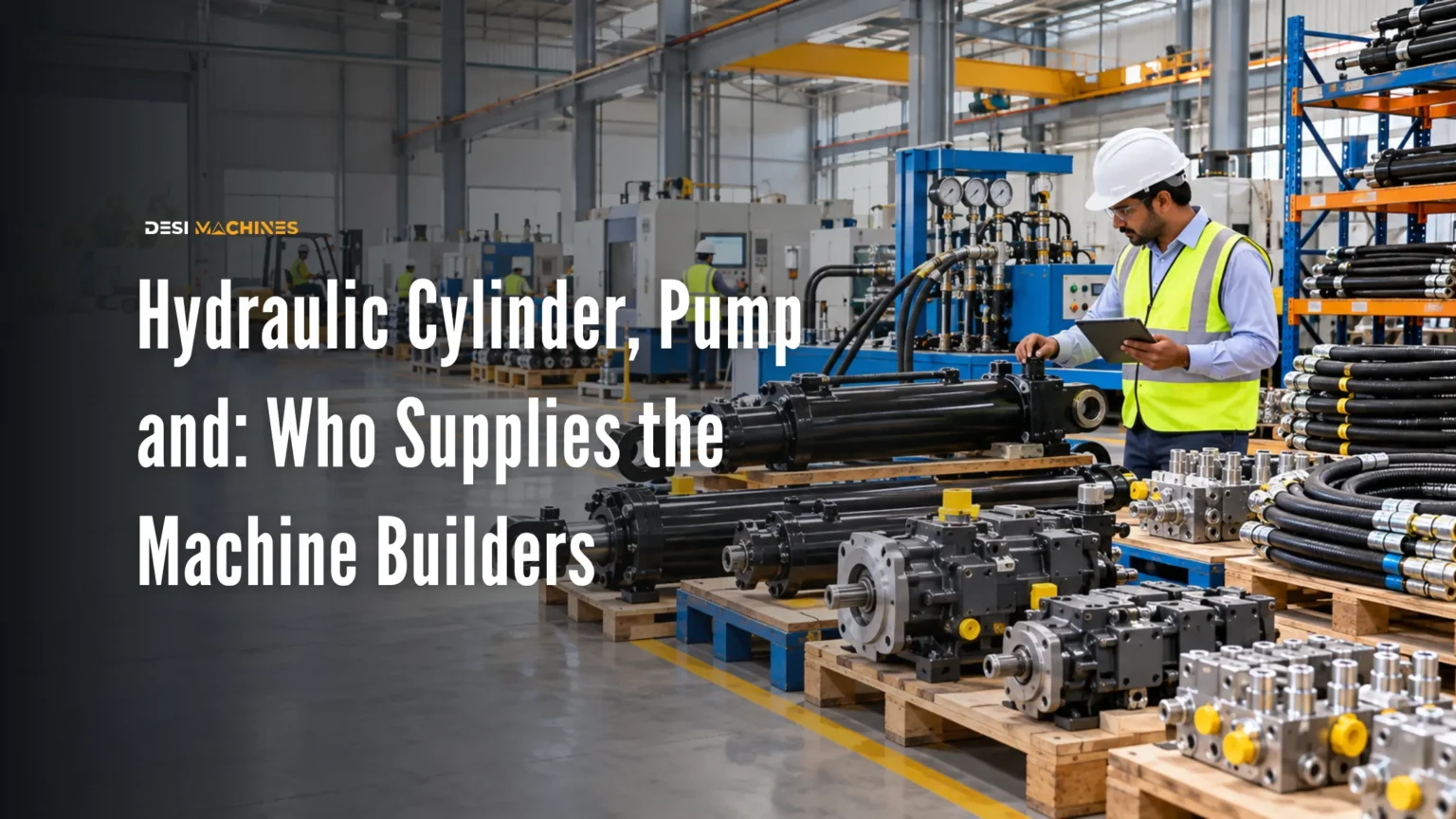
A hydraulic system on a construction machine has four working parts. The pump makes the oil flow. The control valve decides where that oil goes. The cylinder turns the flow into a straight push or pull, and the hoses carry oil between all of them. On a travel or slew drive a hydraulic motor takes the cylinder’s place and gives rotation instead of a push.
Hydraulics means using oil under pressure to do work. Oil does not squash. Push it into a closed tube and it has to move something, so a pump driven by the engine can lift a loaded bucket. When your boom rises or your bucket curls, that is hydraulics doing the job.
Hydraulic cylinder manufacturers in India usually build to a machine builder’s own drawing rather than to a catalogue, which is why the cylinder on your machine carries a part number and not just a size. This page explains what each part does, how it is rated, and what has to match when you replace one. For what a part costs and how to order it, start from the parts and running costs guide.
How the oil path works, part by part
Oil leaves the tank, the pump pressurises it, the valve directs it, the cylinder or motor does the work, and the return line brings it back through a filter. Each of those parts is built by a specialist in that part, which is why one machine usually carries hydraulic components from several different suppliers.
Table: the four hydraulic parts on a construction machine, what rates each one and what wears out first.
| Part | What it does | Rated by | What usually goes first |
|---|---|---|---|
| Pump | Turns engine power into oil flow | Displacement in cc per revolution, flow in litres per minute | Worn gears or plates, so flow drops and the machine slows down |
| Control valve | Sends oil to the boom, arm, bucket or tracks | Number of spools, flow it can pass, relief pressure in bar | Spool seals, and a relief valve that drifts off its setting |
| Cylinder | Turns oil pressure into a straight push or pull | Bore, rod diameter and stroke | Rod seals, then a scored rod |
| Hydraulic motor | Turns oil pressure into rotation | Displacement and torque | Bearings and the shaft seal |
| Hose | Carries oil between the other parts | Inside diameter and working pressure | The outer cover where it rubs, then the crimped end |
Pressure in the system is not set by the pump. It is set by a relief valve, which opens when the load needs more pressure than the system is allowed to make. That is the sound you hear when you hold a function at the end of its travel.
What is a hydraulic cylinder and how is it built?
A cylinder is a steel tube with a piston inside it and a rod fixed to that piston. Oil pushed into one end moves the piston, and the rod moves with it. The end the rod slides through is called the gland, and the seals sit in the gland and on the piston. The rod is usually chrome plated, because the plating is what lets a seal run against it for years without leaking.
A single-acting cylinder takes oil on one side only. Something else brings it back, usually the weight of the load. A tipper body ram works this way. A double-acting cylinder takes oil on either side, so it is powered in both directions. Boom, arm and bucket cylinders are double-acting, which is why you can curl a bucket as firmly as you can open it.
A telescopic cylinder is several tubes nested inside one another. It gives a long stroke from a short closed length, which is the only way to lift a tipper body that has to sit flat when it is down.
Four measurements define a cylinder: the bore (the inside diameter of the tube), the rod diameter, the stroke (how far the rod travels), and the closed length measured pin to pin. Add the mount type at each end and the port thread, and you have described the part completely.
A cylinder always pushes harder than it pulls. Force is pressure multiplied by the area the oil acts on, and on the rod side the rod itself takes up part of that area. Same pressure, smaller area, less force. This is why digging towards the machine feels stronger than pushing away from it.
To go deeper on seal kits, bore sizes and what goes wrong, see the guide to the hydraulic cylinder on a backhoe loader and excavator.
What are the types of hydraulic pump?
A gear pump has two meshing gears in a close-fitting housing. It is simple, it is cheap to make, and it puts up with oil that is not perfectly clean. Steering circuits, loader hydraulics and tractor hydraulics mostly run gear pumps.
A vane pump uses sliding vanes in a rotor. It runs quieter than a gear pump at the same flow.
A piston pump has pistons in a rotating barrel pressed against an angled plate. It handles the highest pressures, and because that plate can be tilted it can change its own output. Excavator main pumps are piston pumps.
That difference matters more than the names. A fixed displacement pump moves the same oil every single turn, and whatever the machine is not using goes back to tank as heat. A variable displacement pump changes its own stroke so it makes only the flow being asked for. On a load-sensing system the pump reads the pressure the work actually needs and trims itself to suit. Less waste means less fuel burnt and a cooler system.
Flow is displacement multiplied by engine speed, so the same pump gives less flow at idle than at full revs. A machine that has gone slow is usually a pump losing flow past worn internals, not a pump that has stopped. The guide to excavator hydraulic pressure and pump flow sets out bar, MPa and litres per minute by machine class.
Where a hydraulic motor replaces a cylinder
A cylinder gives a limited straight stroke. A motor turns for as long as you feed it oil. Anything on a machine that has to rotate continuously runs on a hydraulic motor, which is really a pump working in reverse.
Orbital motors give high torque at low speed from a compact body, so they suit augers, sweeper brushes and small drives. Gear motors spin faster and pull less torque. Axial piston motors handle the real work: the two final drives that move a tracked excavator and the slew motor that swings the upper structure are all piston motors.
The practical point for an owner is that a travel or slew problem is a motor, a brake or a valve problem, and it is diagnosed differently from a boom that has gone weak.
What does the control valve do?
The main control valve sits between the pump and everything the pump feeds. Inside it are spools, one for each function. Moving a lever shifts a spool, which opens a path for oil to one side of a cylinder and a path back to tank from the other side. Centre the lever and both paths close.
A mobile valve is built for a machine that moves and that asks for several functions at once, so it has to share a single pump’s flow between a boom coming up and a bucket curling in. An industrial valve on a fixed press has an easier job and is built differently. They are not interchangeable.
The relief valve is the part that protects everything else. It caps the pressure the system can reach, and a relief valve set too high will find the weakest component and break it. For how the valve works on your own machine, see the guide to the excavator main control valve.
How do you read a hydraulic hose?
A hydraulic hose is three layers. The inner tube carries the oil. The reinforcement around it, either wire braid or wire spiral, is the layer that actually holds the pressure. The outer cover protects the reinforcement from rubbing and weather.
Braided hose suits medium pressure. Spiral-wound hose takes higher pressure and copes better with the pulsing flow a breaker produces. That is why a breaker line is a heavier hose than a bucket line on the same machine.
The markings printed along the cover are the specification. SAE J517 defines the 100R hose types used worldwide, and the European equivalents are EN 853, EN 856 and EN 857. Hose made in India is tested and certified against those same numbers, so the marks mean the same thing wherever the hose was built.
Inside diameter is quoted in dash sizes, in sixteenths of an inch: a -06 hose is 6/16, which is 3/8 inch. Working pressure is the figure you must respect, and burst pressure is tested far above it, normally at a four-to-one ratio. Never fit a hose with a lower working pressure than the one you removed, even if it is the same diameter and the ends match.
Two more things decide whether a hose lasts. Bend radius: a hose bent tighter than its stated minimum fails early, no matter how good it is. And the fitting: BSP, JIC and ORFS ends look similar and seal completely differently, so the thread, the seat and the angle all have to match. The crimp is part of the pressure rating, which is why a properly pressed end matters as much as the hose. The guide to hydraulic hose sizes, pressure ratings and fittings covers how to read the one you are replacing.
What specs and fitment actually mean
Fitment is never one number. A cylinder with the right bore and the wrong closed length will not go on. One with every dimension right and the wrong port thread will leak from the day it is fitted.
Table: what has to match when you replace a hydraulic component, and why each one matters.
| What to match | Why it matters |
|---|---|
| Bore and rod diameter | They set push and pull force; a different bore changes how the machine digs |
| Stroke and closed length, pin to pin | The part has to fit between its mounting pins at both ends of its travel |
| Mount type at each end | Pin eye, clevis and trunnion are not interchangeable |
| Port size and thread form | A mismatched thread can screw together and still weep oil |
| Working pressure | Must be at least the machine’s relief setting, never below it |
| Flow range, for pumps and motors | Too little flow is slow; too much makes heat and shortens seal life |
| Shaft, spline and mounting flange | A pump has to match the drive it bolts to, not just the circuit |
| Seal material and temperature range | Nitrile, polyurethane and fluoroelastomer seals suit different oils and heats |
| Direction of rotation, for pumps | Many pumps are handed and will not build pressure turning the wrong way |
Measure, do not assume. Bore and rod diameter are read with a vernier, stroke by extending the old part fully, and closed length between pin centres with the part off the machine.
How machine builders source hydraulic components
Almost no machine builder makes its own hydraulics from end to end. The pump, the valve, the cylinders and the hose assemblies come from component makers who do nothing else, and the builder assembles them into a circuit it has designed. That is normal across the industry and it is not a sign of a cheaper machine.
There are two kinds of part in that circuit. A catalogue part is a standard pump, valve or motor chosen from a supplier’s published range. A drawing-controlled part is made to the machine builder’s own drawing, carries the builder’s part number, and is not sold as a standard item. Most cylinders are drawing-controlled, which is exactly why you cannot order one by machine name alone.
Getting onto a machine builder’s vendor list follows a settled sequence. A quality management system certificate comes first, and IATF 16949 is the standard most vehicle and machine builders expect a component supplier to hold before they will take a quotation seriously. Proven capacity comes next, because a builder planning a production line has to know the supplier can hold the rate month after month. Then come sample parts, measured and approved, before any series supply begins.
Knowing all this changes how you buy a replacement. The part the builder specified is the OE part. That same part in the builder’s own box is the genuine part. An aftermarket part is built by somebody else to fit the same place. For hoses, seal kits and filters, a known aftermarket maker is usually sound. For a pump or a main valve, the difference in internal tolerances is where you feel it. The excavator parts guide and the backhoe loader parts guide set out what sits where on each machine, and spare parts enquiries go through the same route.
For the current picture of which companies supply what today, see our blog on hydraulic pump, cylinder and hose manufacturers in India.
What to ask before you order a hydraulic part
Read the number off the old part before you call anybody. A cylinder, pump or valve carries a part number on a plate or stamped into the body, and that number is worth more than the machine’s name and year together.
Then ask six things. Is this the OE part, the genuine part in the maker’s box, or an aftermarket equivalent? What is its working pressure? What seal material is in it, and what oil temperature does that suit? What are the measured bore, stroke and pin-to-pin length? What warranty comes with it, and does that warranty survive a workshop fitting it rather than a dealer? And what is the real lead time, not the hoped-for one?
On a backhoe loader such as the JCB 3DX, or an excavator such as the Tata Hitachi EX 210 Infra, that part number is what decides whether the replacement arrives in two days or two weeks. Keep the old part until the new one is fitted and tested, because it is your only proof of what you actually need if the wrong item turns up.
Machines working on road construction and in mining run their hydraulics harder and dirtier than a machine on a building site, and they wear the same parts faster. Browse the full range of excavators and backhoe loaders to see which models these components are built into.
Why clean oil decides how long any of it lasts
Most hydraulic failures begin as contamination rather than as a broken part. Fine grit circulating in the oil wears the close-fitting faces inside a pump until flow drops away, and it scores the cylinder rod. Once a rod is scored it will cut a brand-new seal within hours, which is why a cylinder that leaks again a week after a reseal usually needs the rod attended to, not another seal kit.
Oil cleanliness has its own code. ISO 4406 describes how dirty the oil is using three numbers that count particles at four, six and fourteen microns. Filter ratings and a pump’s cleanliness requirement are both quoted against that code, so the figures on a filter box and in a service manual can be compared directly.
Three habits do most of the work. Change the return filter on schedule, and change the tank breather with it, because the breather is the part everybody forgets and it is how dust gets in. Walk the hose runs looking for rubbing, and replace a hose that is weeping rather than waiting for it to burst. And after any burst, flush the system before running the machine, because the debris from that failure is still in the oil.
The guides to hydraulic system maintenance and the backhoe loader filter kit cover the service side in detail. Specifications, part numbers and seal materials vary by variant and by year of manufacture, so confirm the exact part with your dealer or the OEM before you order.
Get a hydraulic parts price from a dealer near you
Tell us your machine and what you need, and we will ask the nearest dealer to reach out to you with a price.