
 Excavator
294 models
Excavator
294 models  Backhoe Loader
51 models
Backhoe Loader
51 models  Crane
68 models
Crane
68 models  Concrete Mixer
79 models
Concrete Mixer
79 models  Wheel Loader
54 models
Wheel Loader
54 models  Compactor / Roller
45 models
Compactor / Roller
45 models  Motor Grader
42 models
Motor Grader
42 models  Concrete Pump
66 models
Concrete Pump
66 models  Skid Steer Loader
11 models
Skid Steer Loader
11 models  Telehandler
13 models
Telehandler
13 models  Dozer
Dozer 


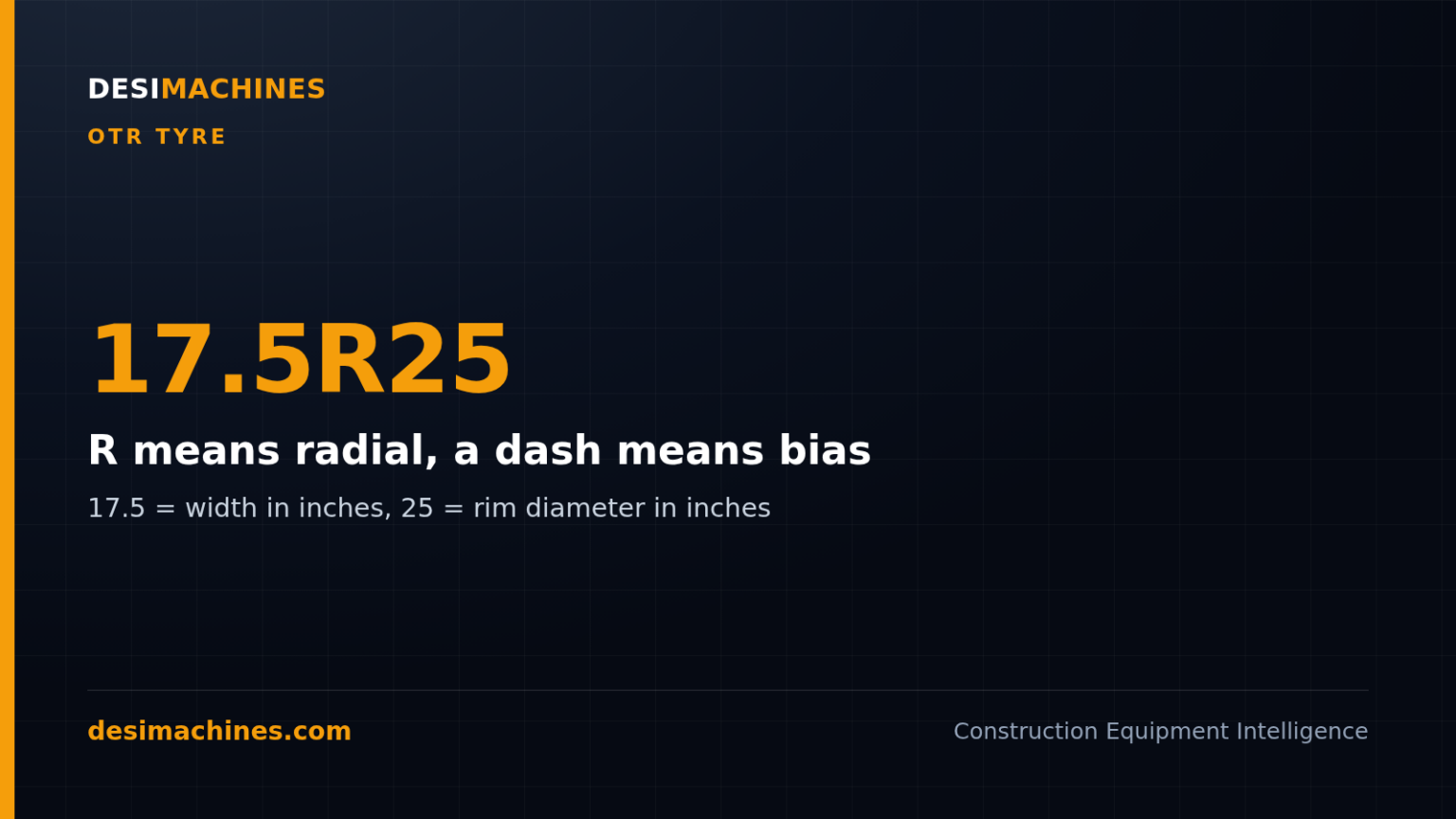
OTR stands for off-the-road. An OTR tyre is built for machines that work on earth, rock and site roads rather than on a highway: wheel loaders, motor graders, dumpers, hydra cranes, soil compactors and, in a lighter industrial form, backhoe loaders. Its size code, such as 17.5-25 or 17.5R25, gives the width of the tyre in inches, how it is built (a dash for bias, an R for radial) and the rim diameter in inches.
This guide explains how to read everything moulded on the sidewall of a construction machine tyre: the size, the ply or star rating, the tread code and the tube marking. It does not list sizes by model or prices. For those, use the tyre size guide for your machine, linked below, and the construction machine tyre price guide.
What is the full form of OTR in tyres?
OTR means off-the-road. Tyre makers use it for every tyre that is not meant for cars, buses, trucks or farm tractors on public roads. Some makers say OHT, off-highway tyre, for the same group.
An OTR casing is built to carry very heavy loads at slow speed, often under 10 km/h while working, and its tread is thicker and cut to resist stones, steel and sharp rock. The same size is sold in several strengths and tread depths, which is why the sidewall carries more than a size.
How do you read an OTR tyre size?
Construction tyres use three kinds of size code. All of them end with the rim diameter in inches, and that number never changes: a 25 tyre fits only a 25-inch rim.
| Code style | Example | How to read it | Where you see it |
|---|---|---|---|
| Conventional (narrow base) | 14.00-24, 11.00-20 | 14.00 = section width in inches; the tyre is about as tall as it is wide; 24 = rim in inches | Motor graders, hydra cranes |
| Wide base | 17.5-25, 23.5-25 | 17.5 = width in inches; a lower, wider shape than a conventional tyre; 25 = rim | Wheel loaders, large graders |
| Low profile (with aspect ratio) | 12.5/80-18, 405/70-20 | 12.5 = width in inches, 80 = sidewall height as a percentage of width, 18 = rim; a three-figure width such as 405 is in millimetres | Backhoe front tyres, self-loading mixers, compact loaders |
| Tractor-style industrial | 16.9-28, 12-16.5 | 16.9 = width in inches, 28 = rim | Backhoe rear tyres, skid steer loaders |
Goodyear’s OTR data book puts numbers on the shapes: sidewall height is about 0.95 of the width on a conventional tyre, 0.83 on a wide-base tyre and 0.65 on a 65-series tyre. That is why a 17.5-25 and a 14.00-25 fit the same rim but cannot replace each other.
A metric code and an inch code can describe one tyre. A 405/70-20 and a 16/70-20 are the same size on a self-loading mixer, as the self-loading concrete mixer tyre size guide explains.
What is the difference between 17.5-25 and 17.5R25?
The dash means bias construction, also called cross-ply. The R means radial. Both tyres fit the same 25-inch rim and are about 17.5 inches wide, but they are built differently.
- Bias (17.5-25): the fabric cords run diagonally, crossing each other in layers. The sidewall is stiff and resists cuts. It costs less and is the common fitment on Indian backhoes, hydras and most graders.
- Radial (17.5R25): the cords run straight across from one bead to the other, with steel belts under the tread. The footprint stays flat, the tyre runs cooler over distance and usually wears more slowly. It suits machines that travel with a load, such as bigger loaders.
Some sellers write 17.5 x 25; that is the same bias tyre. Never mix bias and radial tyres on one axle, because they flex differently under load and wear each other out.
What do ply rating and star rating mean?
Both describe how much load the tyre can carry at a given pressure. Bias tyres use a ply rating, written 12 PR, 16 PR, 20 PR and so on. It began as a count of fabric layers; today it is only a strength grade, so a 16 PR tyre does not contain 16 layers. A higher ply rating in the same size carries more weight.
Radial OTR tyres use stars instead: one, two or three stars on the sidewall. Goodyear’s data book describes the star as a marking of the inflation a radial tyre needs for a given load. Yokohama publishes a conversion table: a one-star 17.5R25 loader tyre is equal to up to 16 PR, and a two-star 17.5R25 earthmover tyre is equal to up to 22 PR.
Some radial tyres also carry a load index and speed symbol, such as 202A2/180B in Goodyear’s example. It means the tyre can carry 15,000 kg at 10 km/h or 8,000 kg at 50 km/h. The slower the machine works, the more the same tyre can carry.
What do the tread codes L3, G2, E3 and R4 mean?
Most OTR tyres carry a tread code set by the Tire and Rim Association (TRA) of the United States, which makers worldwide use. The letter names the service the tyre is designed for, and the number names the tread type and depth. The table below is the TRA code list as printed in Goodyear’s OTR data book, with tread depth shown against a standard tread of 100.
| Code | Service | Tread type | Tread depth |
|---|---|---|---|
| C-1, C-2 | Compactor | Smooth; grooved | 100 |
| E-1, E-2, E-3 | Earthmover (dumpers, haulers) | Rib; traction; rock | 100 |
| E-4 | Earthmover | Rock, deep tread | 150 |
| E-7 | Earthmover | Flotation, for sand and soft ground | 80 |
| G-1, G-2, G-3 | Grader | Rib; traction; rock | 100 |
| G-4 | Grader | Rock, deep tread | 150 |
| L-2, L-3 | Loader and dozer | Traction; rock | 100 |
| L-4 | Loader and dozer | Rock, deep tread | 150 |
| L-5 | Loader and dozer | Rock, extra deep tread | 250 |
| L-3S, L-4S, L-5S | Loader and dozer | Smooth, no lugs | 100 / 150 / 250 |
A tyre marked with two codes, such as E3/L3, is rated for both services. The Hindustan 2021E wheel loader lists exactly that marking.
R-4 is a different family. It is the industrial tractor tread used on backhoe loaders: wider, shallower lugs than a farm tyre and a tougher casing for hard ground. TVS Eurogrip, for one, lists R-4 tyres in the 16.9-28 backhoe rear size. A farm R-1 tyre in the same size looks similar but is made for soil, not for broken concrete and side loads.
Which tread pattern suits which job?
| Machine | Usual tread code | When to move up |
|---|---|---|
| Backhoe loader | R-4 industrial | Stay with R-4; a farm-pattern tyre is the wrong swap |
| Wheel loader | L-3 on mixed ground | L-4 in aggregate yards; L-5 at quarry faces and on blasted rock |
| Motor grader | G-2 on road and canal work | G-3 or L-3 on rock and mine roads |
| Dumper or hauler | E-3 | E-4 on rough haul roads; E-7 on sand |
| Pneumatic tyre roller | C-1 smooth | Smooth is the point: it kneads the surface without marking it |
This is a general guide based on machine size class. Always confirm the fit with your machine’s operator manual or the manufacturer before buying or fitting.
A deeper tread is not always better. A thick tread on a machine that travels far heats up, and heat is what ends most loader tyres early. The wheel loader tyre types and sizes guide covers that trade-off, and the motor grader tyre size guide shows which graders sold in India run G-2, G-3 or L-3.
What do TT, TL and the other sidewall markings mean?
- TT means tube type: the tyre runs with an inner tube and a flap. TL means tubeless. Fit what the rim is designed for.
- NHS means not for highway service. It is common on loader and grader tyres, and it is a reason not to drive such a machine long distances on a public road.
- Direction arrow: traction treads such as R-4, L-2 and G-2 have a set rolling direction. A tyre fitted the wrong way round grips badly and wears fast.
When you ask for a replacement, give the seller the full line off the old tyre, for example 17.5-25 12 PR L-3 TT, not just the size. A tyre shop can match that exactly.
Which companies make OTR tyres in India?
MRF, Apollo Tyres, JK Tyre, BKT (Balkrishna Industries), CEAT and TVS Eurogrip all make construction and industrial tyres for the Indian market, and Michelin sells here through its Camso brand. BKT concentrates on off-highway tyres, which is why its name appears on so many loader and grader tyres. Each maker sells several tread codes and ply ratings in the same size, so compare the full sidewall line, not only the name.
To find the size your machine takes, use the guide for its type:
- Backhoe loader tyre sizes, front and rear by model
- Hydra crane tyre sizes by tonnage
- Road roller and soil compactor tyre sizes
For current listed prices by size, see the tyre price guide. To compare the machines themselves, browse backhoe loaders and the other parts and running cost guides.
Specifications and fitments are indicative, vary by maker, model, city and date, and should be confirmed with the manufacturer or an authorised dealer before buying. DesiMachines is not liable for decisions taken on the basis of information that may have changed after publication.