
 Excavator
294 models
Excavator
294 models  Backhoe Loader
51 models
Backhoe Loader
51 models  Crane
68 models
Crane
68 models  Concrete Mixer
79 models
Concrete Mixer
79 models  Wheel Loader
54 models
Wheel Loader
54 models  Compactor / Roller
45 models
Compactor / Roller
45 models  Motor Grader
42 models
Motor Grader
42 models  Concrete Pump
66 models
Concrete Pump
66 models  Skid Steer Loader
11 models
Skid Steer Loader
11 models  Telehandler
13 models
Telehandler
13 models  Dozer
Dozer 


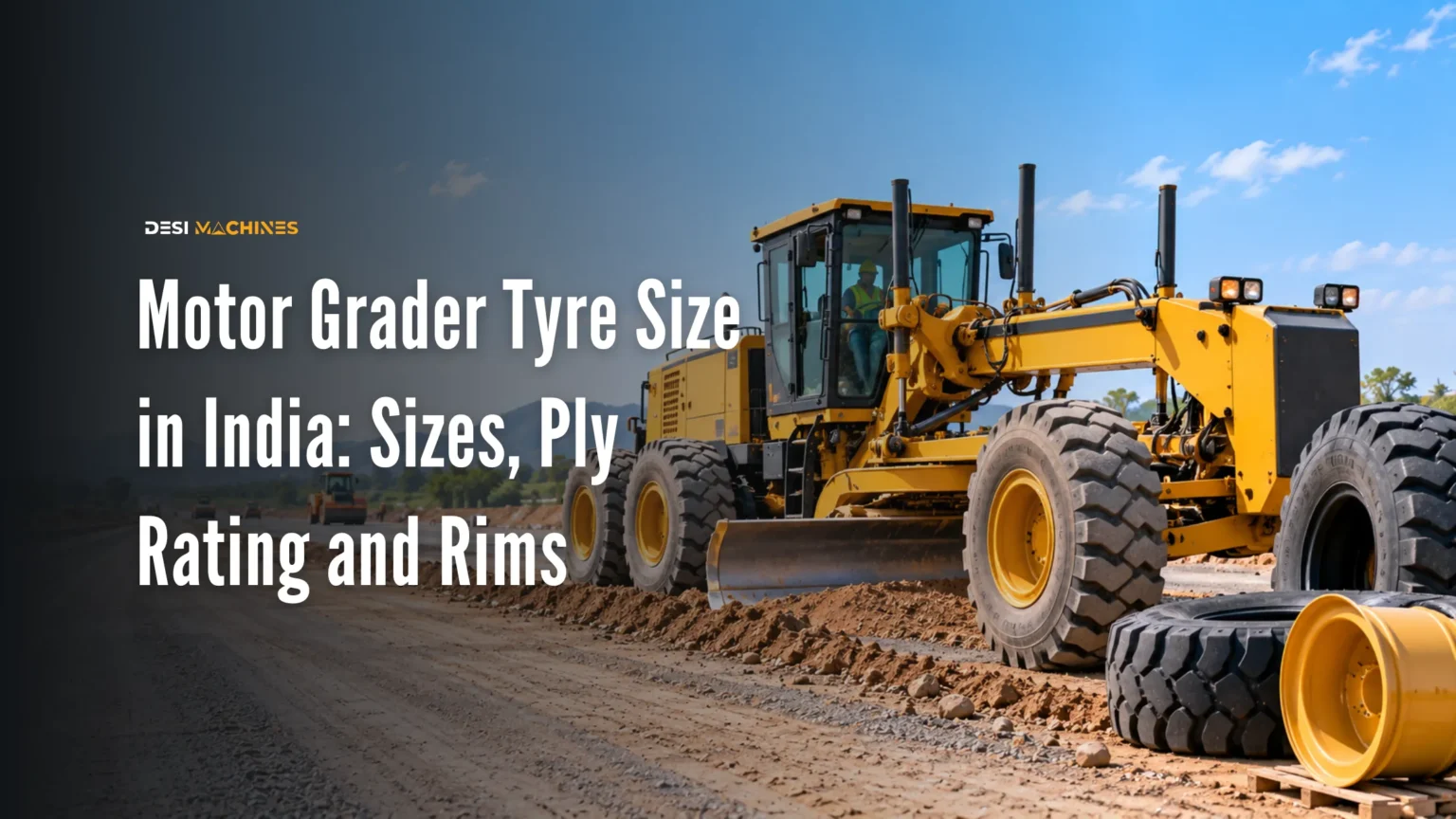
Indian motor graders run on just three rim sizes: 20 inch, 24 inch and 25 inch. The rim is what decides which tyre fits, and it is set by the axle the machine was built on, not by its horsepower. Of the 42 motor graders listed on DesiMachines, 41 publish a tyre size on their spec sheets, and the commonest sizes by a distance are 14.00-24 and 17.5-25.
One listing carries a size we could not read cleanly, so every figure below is built from the 40 machines whose tyre size is unambiguous, as per the current September 2026 spec sheets. Where a machine is missing from a count, it is named.
This guide sets out what motor grader tyre size each class takes, what the numbers in a size like 14.00-24 actually mean, what the ply rating tells you, and the one thing about ply ratings that surprises most first-time buyers.
What tyre size does a motor grader take in India?
It depends on the rim, and there are only three. A rim is the steel wheel the rubber tyre is fitted onto, and its diameter in inches is the second number in every tyre size. Here is how the 40 machines break down.
| Rim | Tyre size | Machines | Engine power | Blade width |
|---|---|---|---|---|
| 20 inch | 11.00-20 | 3 | 125–150 HP (93–112 kW) | 2,970–3,050 mm |
| 24 inch | 13.00-24 | 7 | 74–160 HP (55–118 kW) | 2,600–3,669 mm |
| 24 inch | 14.00-24 | 14 | 148–225 HP (110–168 kW) | 3,658–3,962 mm |
| 24 inch | 16.00-24 | 2 | 260–290 HP (194–216 kW) | 4,320 mm |
| 25 inch | 14.00-25 | 1 | 180 HP (134 kW) | 3,650 mm |
| 25 inch | 17.5-25 | 6 | 180–250 HP (134–186 kW) | 3,360–4,270 mm |
| 25 inch | 18.00-25 | 1 | 280 HP (209 kW) | 4,928 mm |
| 25 inch | 20.5-25 | 1 | 239 HP (178 kW) | 4,200 mm |
| 25 inch | 23.5-25 | 2 | 280–290 HP (209–216 kW) | 4,878–4,900 mm |
| 25 inch | 26.5-25 | 1 | 426 HP (318 kW) | 5,489 mm |
| 24 front, 25 rear | 13.00-24 front, 17.5-25 rear | 2 | 74 HP (55 kW) | 3,000 mm |
Two sizes carry most of the market. Fourteen machines take a 14.00-24 and eight take a 17.5-25, so between them they cover more than half the graders on sale here. If you run a mainstream 150 to 250 HP grader, one of those two is almost certainly what is on it.
The 20-inch rim is the odd one out. Only three machines use it, and two of them are BEML: the BEML BG405A at 125 HP and the BEML BG605I at 150 HP, both on 11.00-20 tyres. That is a truck rim rather than an earthmoving rim, and it means a BEML owner in a small town can often get a tyre from a lorry tyre shop instead of ordering one in.
What do the numbers in 14.00-24 mean?
The first number is the width of the tyre in inches, and the second is the diameter of the rim it fits, also in inches. So a 14.00-24 tyre is about 14 inches (356 mm) wide and goes on a 24 inch (610 mm) rim. Nothing else in that code is a measurement.
The character between the two numbers tells you how the tyre is built. A dash or a cross means the tyre is cross-ply, where the fabric layers inside run diagonally across each other. An R means radial, where the layers run straight across from one side to the other. A 14.00 R24 and a 14.00-24 fit the same rim and are not the same tyre.
You will see the same size written several ways on different spec sheets. A 14.00-24, a 14 x 24 and a 14.00 x 24 are all the same tyre. The manufacturer’s house style changes; the tyre does not. The full code system, including how the ply rating maps to a load range letter, is set out on the tyre code reference.
Does a bigger motor grader need a higher ply rating?
No, and this is the part that catches most buyers out. The ply rating is a strength rating for the tyre casing, written as a number followed by PR. It once meant the actual number of fabric layers inside the tyre. Today it is only a strength grade, and a modern 12 PR tyre has far fewer than twelve layers.
Twenty-nine of the 40 machines publish a ply rating. Here is how those ratings sit against engine power.
| Ply rating | Machines | Engine power range | Examples |
|---|---|---|---|
| 12 PR | 16 | 74–280 HP (55–209 kW) | Mahindra G9075, CASE 845B, BEML BG825 |
| 16 PR | 9 | 148–240 HP (110–178 kW) | Sany STG210C-10, SDLG G9240F, LiuGong 4180D |
| 18 PR | 2 | 125–150 HP (93–112 kW) | BEML BG405A, BEML BG605I |
| 20 PR | 2 | 180–250 HP (134–186 kW) | ACE AG 176, Sany SMG200C-8 |
Read that table again and the pattern is missing on purpose. The 12 PR band runs from a 74 HP Mahindra all the way to a 280 HP BEML BG825. The highest rating on the list, 20 PR, sits on a 180 HP ACE. And the two 18 PR machines are among the smaller graders here.
The reason is that ply rating answers a different question than machine size does. It grades how much load that tyre carries at a given air pressure. A narrow 11.00-20 tyre has a small footprint, so it needs a stronger casing to carry the same weight that a fat 23.5-25 spreads over much more rubber. The big rock machines can drop to 12 PR precisely because their tyres are enormous.
What this means for you is simple. Never pick a replacement tyre by guessing that a heavier machine wants more plies. Match the rating on your own machine’s spec sheet, or ask the dealer for the rating that goes with your axle load.
Do all six wheels take the same size?
On 38 of the 40 machines, yes. A motor grader has six wheels, two at the front and four on the rear tandem, and almost every manufacturer specifies one size for all six.
Two do not. The Mahindra G75 Smart and the Mahindra Roadmaster G80, both 74 HP machines, list a 13.00-24 at 12 PR on the front and a bigger 17.5-25 at 16 PR on the rear. That is a deliberate design choice: the rear tandem carries the drive and most of the weight, so it gets the larger tyre, while the smaller front wheels help the machine steer and lean.
Four other Mahindra graders on the list specify one size for all six. So even inside one brand you cannot assume. Check the spec sheet for your exact model before you order a set.
Worth knowing when buying second-hand: if the six tyres on a used machine do not match the spec sheet, somebody has fitted whatever was available. The used motor grader buying checks cover what else to look at.
Do Indian motor graders use bias or radial tyres?
Cross-ply, overwhelmingly. Only 5 of the 40 machines specify a radial tyre, and four of those five are Caterpillar: the Cat 120 and Cat 120 GC on 14.00 R24, the Cat 14M3 on 20.5 R25, and the Cat 16M3 on 23.5 R25. The fifth is the Komatsu GD955-7, the largest grader on the list at 426 HP.
The Cat 140 GC is the interesting one. Its sheet lists a cross-ply 17.5-25 as standard with a 17.5R25 radial as an alternative, which is exactly how the two constructions compete on a grader.
A radial rides softer, runs cooler on long hauls and usually lasts longer per rupee of tyre. A cross-ply has a stiffer sidewall, which resists cuts from sharp aggregate and side loads when the blade is angled hard. On Indian road and canal work, where graders spend their life pushing material sideways over broken stone, the stiffer sidewall is the more forgiving choice, and the price gap is real. That is why the cross-ply is still the default here.
What do G-2, G-3 and L-3 mean on a grader tyre?
They are service codes that tell you what job the tread was cut for. The letter is the machine class and the number is the tread pattern and depth. G is a grader tyre, L is a loader or dozer tyre, and E is an earthmover tyre, as the off-highway tyre classes set out. A 2 is a traction tread at normal depth and a 3 is a deeper rock tread.
Eleven of the 40 machines print a code.
| Code | What it is | Machines | Which ones |
|---|---|---|---|
| G-2 | Grader tyre, traction tread, normal depth | 6 | BEML BG605A, CASE 845B, 845C, 865B, 865C, Komatsu GD755-5R |
| G-3 | Grader tyre, deeper rock tread | 2 | Sany STG170C-10, Sany STG210C-10 |
| L-3 | Loader rock tread, fitted to heavy graders | 3 | BEML BG825, Komatsu GD825A-2, Komatsu GD955-7 |
The three L-3 machines are the heaviest graders here, and all three listings describe them in the same words: rock-type tyres. These are mining and quarry graders, working on blasted stone that would cut an ordinary grader tread to pieces. If your work is district roads and village approach roads, a G-2 is the tread you want, and paying for a rock tread buys you nothing.
The other 29 machines simply do not print a code. That does not mean the tyre has no classification. It means the manufacturer left it off the published sheet, so ask the dealer.
Tube or tubeless, and what pressure should you run?
Seven machines specify tubeless tyres and two specify tube type, out of the 40. The remaining 31 sheets say nothing either way. Among the ones that do state it, CASE lists all four of its graders as tubeless, and Komatsu splits its own range: the Komatsu GD705-5 runs with a tube and the GD755-5R is tubeless.
A tubeless tyre loses air slowly through a puncture instead of going flat at once, which matters on a machine working 40 km from the nearest tyre shop. A tube-type tyre is cheaper to repair in a village workshop. Both arguments are genuine and both are still in the market.
On pressure, no motor grader on the list publishes a recommended tyre pressure, and we will not invent one. That figure belongs to the tyre, not the machine: it changes with the make of tyre fitted, the ply rating and the load on that axle. The two places to find it are the sidewall of the tyre itself and the operator’s manual for your machine. If you have lost both, a tyre dealer can look up the load and inflation table for that exact size and rating.
The one rule that holds everywhere is to check pressure cold, before the machine has worked. A grader’s tyres heat up over a shift and a hot reading will always look higher than the truth. Road roller tyre sizes and pressures follow the same logic on a machine where the tyres do the compacting.
Buying a replacement motor grader tyre in India
Start by writing down four things off your own machine: the size, the ply rating, the construction and the tread code. A tyre shop can work with 14.00-24 16 PR cross-ply, G-2. It cannot work with “a grader tyre”.
Then think about the set rather than the tyre. Because most graders take one size on all six wheels, a worn set is a six-tyre bill, and a grader that has been running mismatched sizes will have been fighting itself on the tandem drive for months. Budget for the set when you buy a used machine with tired rubber.
Size also travels between machine types, which helps in a small market. A 17.5-25 is a common wheel loader size as well as a grader size, so a dealer stocking loader rubber may already have yours. The wheel loader tyre sizes and backhoe loader tyre sizes are worth a look if you run a mixed fleet.
Comparing machines before you buy? Browse the full range of motor graders with specs and current availability, and talk to a dealer about what the set of six costs on the model you are considering.
Which figures should you check on your own machine?
Four, and all four are on the spec sheet or the tyre itself.
| What to check | Where to find it | Why it matters |
|---|---|---|
| Tyre size, e.g. 14.00-24 | Tyre sidewall, spec sheet | Wrong size will not seat on the rim |
| Ply rating, e.g. 16 PR | Tyre sidewall | Sets the load the tyre can carry |
| Cross-ply or radial | Dash or R in the code | Never mix the two on one axle |
| Front and rear the same? | Spec sheet for your model | Two machines here use different sizes front and rear |
If the tyres on a machine you are inspecting do not match its own sheet, that is not automatically a problem to walk away from. It is a question to ask. The answer tells you something about how the previous owner maintained it.
The rest of the machine’s numbers sit alongside this one: weight and dimensions (tyre size changes the overall height), engine power by class, travel speed and the parts that wear first.
Motor grader tyre size: the short version
Indian motor graders sit on 20, 24 or 25 inch rims. A 14.00-24 and a 17.5-25 between them cover more than half the machines on sale. The first number is the tyre width in inches, the second is the rim diameter, and the letters after it grade the casing and the tread.
The ply rating does not climb with machine size, so match your own spec sheet instead of reasoning from horsepower. Nearly every grader takes one size on all six wheels, with two Mahindra models the exception. Cross-ply is the Indian default and radial is mostly a Caterpillar option.
If you are still choosing a machine, the motor grader buying guide works through size, blade and dealer support, and how motor graders work explains the circle and moldboard that all this rubber is carrying. For hire rather than purchase, see motor grader rental terms.
Specifications are taken from our listings at the time of writing. Prices, specifications and features are indicative, vary by variant, location and date, and should always be confirmed with the official OEM or authorised dealer before any purchase decision. DesiMachines is not liable for decisions taken on the basis of information that may have changed after publication.