
 Excavator
294 models
Excavator
294 models  Backhoe Loader
51 models
Backhoe Loader
51 models  Crane
68 models
Crane
68 models  Concrete Mixer
79 models
Concrete Mixer
79 models  Wheel Loader
54 models
Wheel Loader
54 models  Compactor / Roller
45 models
Compactor / Roller
45 models  Motor Grader
42 models
Motor Grader
42 models  Dozer
41 models
Dozer
41 models  Concrete Pump
66 models
Concrete Pump
66 models  Skid Steer Loader
11 models
Skid Steer Loader
11 models  Telehandler
13 models
Telehandler
13 models 


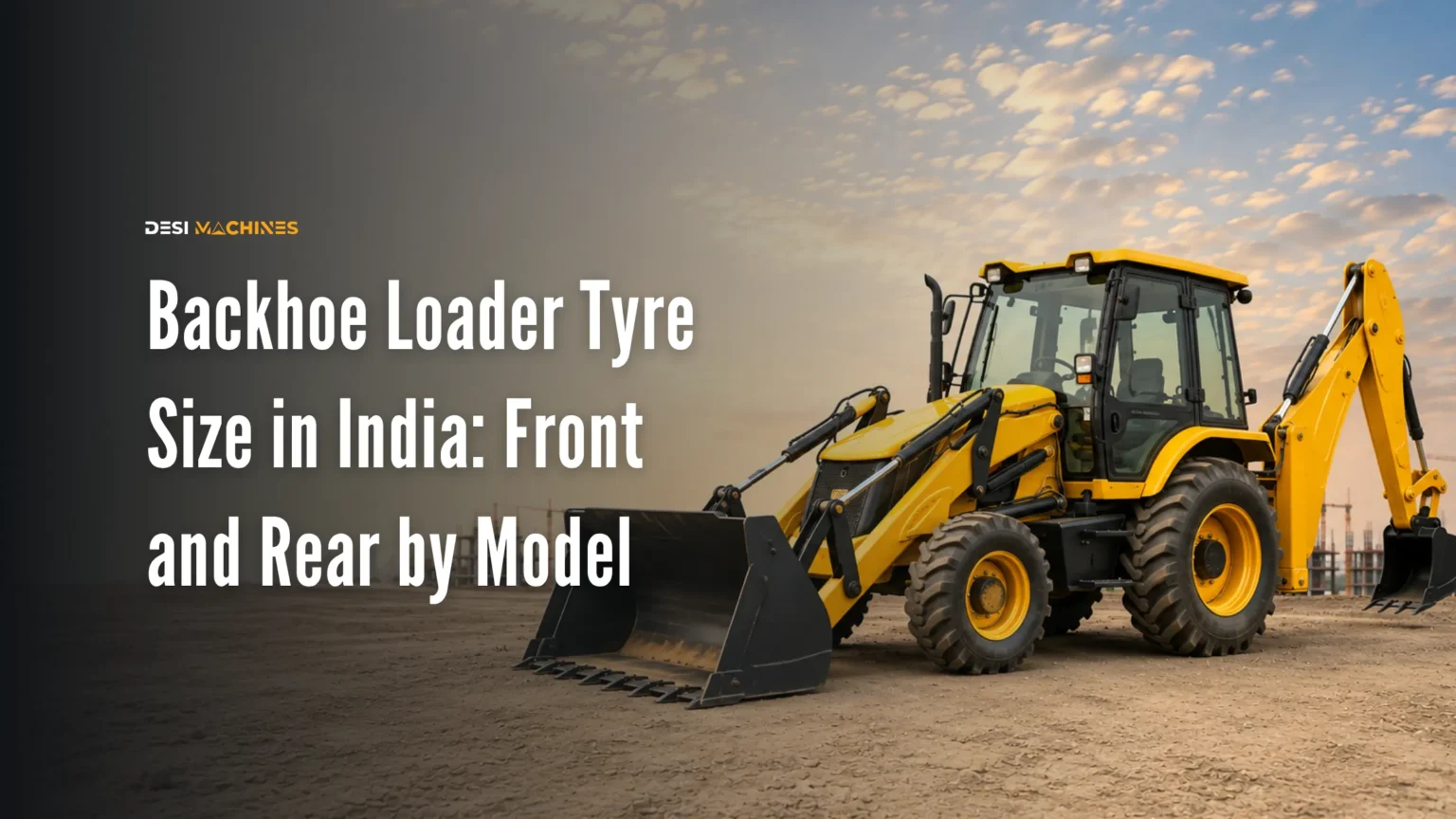
A backhoe loader tyre size is the code moulded into the sidewall, such as 16.9 x 28 – 12 PR, that tells you how wide the tyre is, what size wheel it fits, and how much load its casing is built to carry. A backhoe loader is the one machine on an Indian site that almost always runs two different tyre sizes at once: a small tyre at the front and a much larger one at the back. Get the code wrong when you order a replacement and the tyre will not fit the rim.
All 51 backhoe loaders listed on DesiMachines publish both their front and rear tyre specification, so the pattern across the class can be read off the machines themselves rather than guessed. This guide sets out what those sizes are, what each number means, and the one thing that catches most first-time buyers out: on a machine sold in both two-wheel and four-wheel drive, the front tyre is not the same part.
What tyre size does a backhoe loader use?
Almost every backhoe loader in India runs 16.9 x 28 – 12 PR at the rear and 9 x 16 – 16 PR at the front. Those two sizes cover the bulk of the class.
At the back, the agreement is close to total. Of the 51 machines listed, 49 run a 16.9 x 28 rear tyre: the standard fitment from ACE, Bull, CASE, Escorts, JCB, Mahindra, Manitou and Tata Hitachi alike. That is good news for an owner, because the same tyre is stocked in almost every district, so a damaged rear does not strand a machine for a week.
Only two sit outside it. The JCB 2DX runs a 12 x 24 – 20 PR rear, and it is the smallest backhoe listed at 5,220 kg (5.2 tonnes) and 49 HP (36.4 kW). The BEML BL9H 4×4 runs a 14.0 x 25, 12 PR. Two more, the BULL CH76 Challenger and the Bull SD76 BS5 Super Smart, publish a choice: the standard 16.9 x 28 – 12 PR industrial tyre, or a 14 x 25 – 20 PR heavy-duty option.
The front is where machines genuinely differ.
| Position | Size | Machines | Fitted to |
|---|---|---|---|
| Rear | 16.9 x 28 – 12 PR | 49 of 51 | The class standard, nearly every brand |
| Rear | 14 x 25 – 20 PR | 3 | BEML BL9H 4×4; heavy-duty option on two Bull machines |
| Rear | 12 x 24 – 20 PR | 1 | JCB 2DX, the smallest machine on the list |
| Front | 9 x 16 – 16 PR | 38 | The two-wheel-drive fitment |
| Front | 12.5 x 18 – 12 PR | 17 | The four-wheel-drive fitment, also written 12.5/80-18 |
| Front | 7.5 x 16 – 16 PR | 1 | JCB 2DX |
For what these sizes cost to replace, the JCB tyre price guide lists current prices for the front and rear sizes.
The front counts add up to more than 51 because six machines publish both front sizes, one for each drive type. Those six are covered further down.
What do the numbers in 16.9 x 28 – 12 PR mean?
Three separate pieces of information sit in that one code, and only the first two decide whether the tyre physically fits.
16.9 is the section width — how wide the tyre is across the fattest part of the sidewall, in inches. That is about 429 mm. A wider tyre spreads the machine’s weight over more ground, so it sinks less in soft soil.
28 is the rim diameter in inches, roughly 711 mm, and this number is not negotiable. A 28 inch tyre fits a 28 inch wheel and nothing else. If a dealer offers a size with a different second number, he is offering a different wheel as well, whether he says so or not.
12 PR is the ply rating. It began as a literal count of the fabric layers inside the tyre, but modern materials are far stronger than the old cotton plies, so today it works as a strength grade: a 16 PR tyre carries more load than a 12 PR tyre of the same size. Some makers print PLY instead of PR, which means the same thing.
You will also see a word in brackets on many listings — Industrial, IDT, or Heavy Duty. That describes the tread pattern and rubber compound, not the size. Industrial is the general-purpose tread most Indian backhoes leave the factory on. The longer explanation of tyre codes, including radial sizes written like 23.5R25, is in the guide to wheel loader tyre sizes and types.
Why are the rear tyres bigger than the front?
Because the two ends of a backhoe loader do completely different jobs, and 50 of the 51 machines listed are built that way.
The rear axle carries the digging end. When the backhoe swings out and pulls a bucket of wet clay towards the machine, that load goes down through the back into the rear tyres and the stabiliser legs. The rear tyres also do the driving on a two-wheel-drive machine, so they need a big footprint for grip (traction, the ability to push without the wheels spinning).
The front tyres mostly steer. A narrow front tyre turns more easily and lets the loader shovel get closer to a heap. That is why the front is small and the back is large on nearly every backhoe on an Indian site.
One machine breaks the pattern. The Bull Grandia publishes 16.9 x 28 – 12 PR at both ends. It is also the heaviest backhoe listed at 9,700 kg (9.7 tonnes) on 100 HP (74.5 kW), and the only one whose steering specification lists four-wheel power steering with a crab mode. If you are shortlisting it, confirm the fitment with the dealer, because it is the one backhoe here where a front tyre and a rear tyre are the same part.
How that load moves through the machine is covered part by part in the guide to backhoe loader parts and components.
Does the front tyre tell you if a backhoe is 2WD or 4WD?
Yes, and on most machines it is the quickest visual check you can make. The front tyre grows when the front axle is driven.
A two-wheel-drive backhoe has a plain steering axle at the front, so it wears a narrow 9 x 16 – 16 PR tyre — about 229 mm wide on a 406 mm rim. A four-wheel-drive machine drives through the front axle too, so it needs a wider, taller 12.5 x 18 – 12 PR — about 318 mm on a 457 mm rim. That extra rubber is what puts engine power into the ground at the front instead of letting the wheel just roll.
This is not an inference. Six machines publish both fitments in a single line, labelled by drive type:
| Machine | Front tyre as published |
|---|---|
| E-Kubota BLX75 | 9.00 x 16 – 16 PR (2WD) / 12.5 x 18 – 12 PR (4WD) |
| CASE 770 NX Magnum | 9 x 16 – 16 PR (2WD) / 12.5 x 18 – 12 PR (4WD) |
| CASE 851 NX | 9 x 16 – 16 PR (2WD) / 12.5 x 18 – 12 PR (4WD) |
| Mahindra Earthmaster SX | 9 x 16 – 16 PR (2WD) / 12.5 x 18 – 12 PR (4WD) |
| Mahindra Earthmaster VX | 9 x 16 – 16 PR (2WD) / 12.5 x 18 – 12 PR (4WD) |
| Bull SD76 BS5 Super Smart | 9.00 x 16 – 16 PR (2WD) / 12.5/80 x 18 – 12 PR (4WD) |
The pattern holds across the rest of the list, with a few exceptions. Of the 16 machines sold only as two-wheel drive, 13 run the 9 x 16 front; of the 9 sold only as four-wheel drive, 7 run the 12.5 x 18. The rest are ones to ask the dealer about rather than assume.
This matters twice over. When you buy a used machine advertised as 4WD, the front tyre is a thirty-second check on whether it really is one. And converting between drive types is not a tyre swap — it is an axle. Which one suits your ground is worked through in 2WD vs 4WD backhoe loader, and you can browse the ranges separately as 2WD backhoe loaders and 4WD backhoe loaders.
What is the tyre size of a JCB 3DX?
The JCB 3DX runs 9 x 16 – 16 PR at the front and 16.9 x 28 – 12 PR (industrial) at the rear. The same fitment carries across the 3DX Plus, the 3DX Xtra, the 3DX Super and the larger 4DX. It is the most common tyre pairing on any construction machine in India, which is why those sizes are easy to find.
The JCB 2DX is the exception in the range. At 5,220 kg (5.2 tonnes) it runs a 7.5 x 16 – 16 PR front and a 12 x 24 – 20 PR rear. Anyone who has run 3DX machines for years and adds a 2DX to the yard should note that: the spare on the shelf will not fit the new machine at either end.
Compare the full range of backhoe loaders and check the standard fitment listed against the model you are considering.
Why is the small front tyre a 16 PR and the big rear only 12 PR?
This looks wrong the first time you see it, and it is the most misread number on the sidewall. Across the class the 9 x 16 front carries a 16 PR rating while the much larger 16.9 x 28 rear carries 12 PR, and the 12.5 x 18 four-wheel-drive front is 12 PR too. Read as plain numbers, the small tyre looks stronger than the big one.
It is not. Ply rating grades the strength of that casing at that size, and it is not a scale you can carry across sizes. A narrow tyre puts a small patch of rubber on the ground, so every square inch takes more weight and the casing has to be stiffer. A wide tyre spreads the same load over far more ground. Both ratings are correct for the loads they see.
So compare ply ratings only between tyres of the same size, and never fit a lower rating than the machine specifies. A 12 PR tyre in a size the machine wants at 16 PR will run hot, wear unevenly and fail early.
What tyre pressure should a backhoe loader run?
The machine specification does not publish an inflation pressure, and that is correct: pressure belongs to the tyre, not the machine. The same size from two makers, or in two ply ratings, can want different pressures.
Take the figure from one of three places, in this order: the plate or decal on the machine, the operator’s manual, or the tyre maker’s load-and-inflation table for that exact size and ply rating. Your dealer can pull the last one in a minute. Do not copy a number off another machine in the yard, even an identical model, because a replacement tyre may not be the size that left the factory.
What matters more than the figure is checking it. A soft front tyre becomes a steering problem at road speed, and under-inflated tyres drag, which shows up as diesel. Both checks are part of the daily routine in the backhoe loader maintenance schedule, and soft tyres are one of the causes listed in what fuel a backhoe loader really uses.
What makes backhoe loader tyres wear out early?
Most tyres on Indian sites are replaced before their tread is used up, and the reasons are almost always about how the machine is worked rather than the rubber.
| What happens on site | What it does to the tyre | What to do instead |
|---|---|---|
| Digging without lowering the stabilisers | Load transfers into the rear tyres; uneven wear | Set the stabilisers every time, even for a short trench |
| Spinning the rear wheels into a heap | Fast, even tread loss on the drive tyres | Enter the heap lower and let the shovel do the work |
| Long road moves between sites | Heat build-up, sidewall fatigue | Trailer the machine beyond about 40 to 50 km |
| Running under-inflated | Sidewall flexing, cracking, higher fuel burn | Check pressure weekly against the correct table |
| Mixing brands or tread patterns on one axle | The two tyres flex differently and fight each other | Replace in pairs, same size and rating |
Tyres also tell you about a machine’s history, which is why they sit on every used-machine checklist. Uneven wear across a pair usually points to an alignment or axle problem the seller has not mentioned. The rest of that inspection is in the used backhoe loader buying guide; if you are hiring, tyre condition is part of the handover check in backhoe loader rental in India.
What should you check before ordering replacement tyres?
Five things, in this order. Read the sidewall on the machine, not the brochure — a machine already on its second set may not be on the factory fitment. Check the drive type: if it is four-wheel drive the front is a 12.5 x 18, not a 9 x 16, and ordering the wrong one is the commonest mistake in this class. Match the ply rating the machine specifies; higher runs harder, lower is unsafe. Order in pairs per axle, because one new tyre against one worn tyre puts the drivetrain in a permanent fight with itself. And ask what your dealer actually stocks — a tyre that is ideal on paper but three weeks away is worse than a good tyre available tomorrow.
Comparing machines rather than tyres? Browse the full range of backhoe loaders and send an enquiry to a dealer near you. If you are still weighing sizes, the backhoe loader dimensions guide covers what fits through your site gate, bucket capacity and dig depth covers what it moves, and backhoe loader speed explains why industrial tyres set a road-travel limit no gearbox gets around.
Backhoe loader tyre sizes: the short version
The rear is 16.9 x 28 – 12 PR on 49 of the 51 backhoe loaders listed, so the back of the machine is effectively one standard size. The front is 9 x 16 – 16 PR on a two-wheel-drive machine and 12.5 x 18 – 12 PR on a four-wheel-drive one, which makes it the fastest way to tell the two apart. The JCB 2DX runs its own smaller pair at both ends, and the Bull Grandia is the only machine here running the same size front and back. Read the sidewall, match the ply rating, replace in pairs, check the pressure weekly.
The same reference exists for the neighbouring families: wheel loader tyre sizes and types goes deeper into the code notation, and hydra crane tyre size by tonnage covers the class where the tyres are part of the lifting system. The self-loading concrete mixer tyre size guide covers the mixer range, where the same tyre is published in both metric and inch codes.
A note on the figures in this guide
Every tyre size here is taken from the published specifications of the 51 backhoe loaders listed on DesiMachines at the time of writing (August 2026), and describes standard factory fitment. All 51 publish both a front and a rear size. Fitments vary by variant, dealer and model year, and a machine supplied with optional wheels may take a different size.
Prices, specifications and features are indicative, vary by variant, location and date, and should always be confirmed with the official OEM or authorised dealer before any purchase decision. DesiMachines is not liable for decisions taken on the basis of information that may have changed after publication.
