
 Excavator
294 models
Excavator
294 models  Backhoe Loader
51 models
Backhoe Loader
51 models  Crane
68 models
Crane
68 models  Concrete Mixer
79 models
Concrete Mixer
79 models  Wheel Loader
54 models
Wheel Loader
54 models  Compactor / Roller
45 models
Compactor / Roller
45 models  Motor Grader
42 models
Motor Grader
42 models  Dozer
41 models
Dozer
41 models  Concrete Pump
66 models
Concrete Pump
66 models  Skid Steer Loader
11 models
Skid Steer Loader
11 models  Telehandler
13 models
Telehandler
13 models 


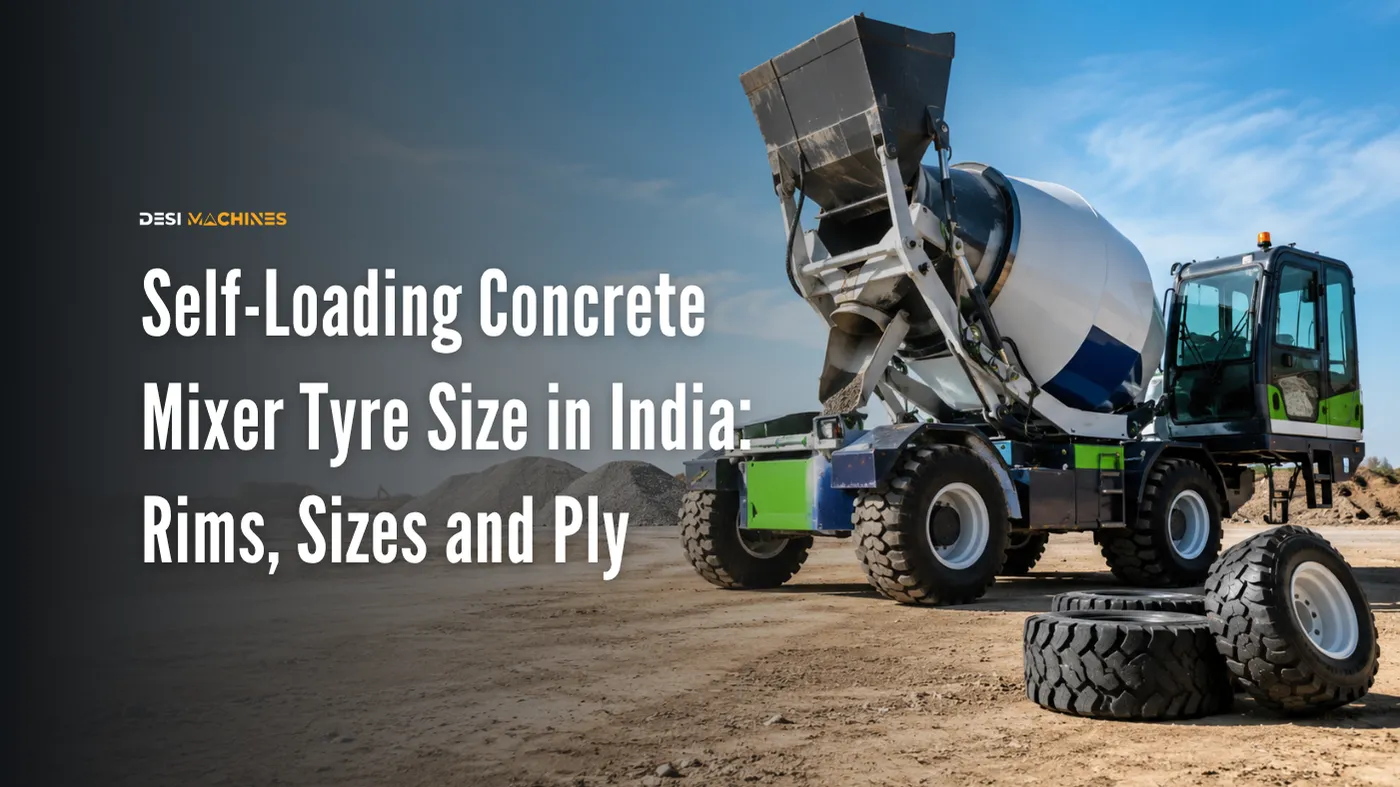
A self loading concrete mixer tyre size is the code moulded into the sidewall, such as 12.5/80-18 – 16 PR, that tells you how wide the tyre is, which wheel rim it fits, and how much load its casing is built to carry. A self-loading concrete mixer is a wheeled machine that loads its own aggregate, mixes concrete on the move and drives the load to the pour, so its tyres carry a full drum of wet concrete over broken ground all day. Order the wrong code and the tyre will not seat on the rim.
Of the 38 self-loading mixers listed on DesiMachines, 32 publish a tyre size, so the pattern across the class can be read from the machines themselves instead of guessed. This guide sets out those sizes, explains what every number in the code means, and clears up the one thing that confuses most buyers ordering a replacement: two of the sizes on the list look completely different but are the same tyre.
What tyre size does a self-loading concrete mixer use?
Self-loading concrete mixers in India run one of two rim sizes: an 18-inch rim on the smaller machines and a 20-inch rim on the larger ones. Fifteen of the 32 machines that publish a size use an 18-inch rim, sixteen use a 20-inch rim, and one uses a 19.5-inch rim.
The tyre that goes on those rims is where the codes start to vary. On the 18-inch machines the tyre is between 12.0 and 12.5 inches wide, written as 12.0/75-18, 12.5/80-18 or simply 12.5-18. On the 20-inch machines the common fitment is a wide tyre written either as 405/70-20 or as 16.0/70-20 — and those two codes describe the same tyre, which is explained further down.
| Rim | Tyre size as published | Machines | Typically fitted to |
|---|---|---|---|
| 18-inch | 12.0/75-18, 12.5/80-18, 12.5-18 | 15 | Drums of about 2.0 to 3.8 m³ |
| 20-inch | 405/70-20 (metric code) | 7 | Drums of about 4.0 m³ and above |
| 20-inch | 16.0/70-20 or 16/70-20 (inch code) | 7 | The same tyre as above, written differently |
| 20-inch | 12.5-20 | 2 | Apollo Carmix 23 FX and 30 FX only |
| 19.5-inch | 18-19.5 – 18 PR | 1 | Fiori DBS 4300 only |
The practical read for an owner is that the class is well standardised. Fourteen of the sixteen 20-inch machines take one tyre, and the 18-inch machines take a tyre that is close to a standard backhoe front fitment, so neither is an unusual part to source in a district town.
What do the numbers in 12.5/80-18 – 16 PR mean?
Each number in a tyre code describes one measurement, and reading them in order tells you everything you need to order the right part.
| Part of the code | In 12.5/80-18 – 16 PR | What it means |
|---|---|---|
| First number | 12.5 | Section width, the widest point of the tyre — here 12.5 inches (about 318 mm) |
| Second number | 80 | Aspect ratio: sidewall height as a percentage of width. 80 means the sidewall is 80% as tall as the tyre is wide |
| Third number | 18 | Rim diameter in inches. This must match your wheel exactly |
| PR figure | 16 PR | Ply rating, the strength of the casing. Higher means it carries more load |
The rim diameter is the number that has to be right. Section width and ply rating have some tolerance, and a dealer may offer a near equivalent, but an 18-inch tyre will not go on a 20-inch wheel at any price.
A short note on how the codes are written. Some spec sheets separate the numbers with a dash, some with a slash and some with an “x”, so 12.5/80-18, 12.5 x 80-18 and 12.5-18 all appear on machines that take the same tyre. Where the aspect ratio is left out entirely, as in 12.5-18, it is because the maker has quoted only the width and the rim.
Why do 405/70-20 and 16.0/70-20 mean the same tyre?
They are the same tyre written in two different measuring systems: 405 is the width in millimetres and 16.0 is the same width in inches. Divide 405 by 25.4, the number of millimetres in an inch, and you get 15.94 inches, which the trade rounds to 16.0.
This matters more than it sounds, because the split is even. Seven of the machines publish the width in millimetres and seven publish it in inches, so a buyer comparing two brochures side by side sees 405/70-20 on one and 16.0/70-20 on the other and reasonably assumes they need different tyres. They do not. The aspect ratio (70) and the rim (20) are identical in both, and only the units of the first number change.
| Written as | Machines using this notation |
|---|---|
| 405 width (metric) | AJAX ARGO 4500, Bull VMP 4000, MACONS MST 4, MACONS MST 4.5, Tarle SLM 2200, VENUS ULTRA 4800, Universal SLM 4 |
| 16.0 or 16 width (inch) | AJAX ARGO 4800, Apollo Carmix 46 FX, CONMAT CSLM 4200L, CONMAT CSLM 4300, CONMAT CSLM 4800, JOHN SLCM 4.3, VENUS ULTRA 4.0 |
If a dealer quotes you one and your machine’s plate shows the other, that is not a mistake and it is not a substitute part. Read the rim number first, then check the width in whichever unit is in front of you.
Does a bigger drum always mean a bigger tyre?
Mostly, but not always, and the exceptions are worth knowing before you assume a machine’s fitment from its size. The general pattern is that mixers with a drum up to about 3.8 m³ run the 18-inch tyre, and mixers of 4.0 m³ and above run the 20-inch tyre. That holds for 28 of the 32 machines.
Four machines sit outside it, and all four are worth checking with the dealer rather than assuming:
- The Apollo Carmix 23 FX (2.3 m³) and Apollo Carmix 30 FX (3.0 m³) both run a 12.5-20. That is a 20-inch rim carrying a narrower tyre than the class-standard wide 20-inch fitment, which is a design choice rather than an error.
- The Tarle SLM 4300 carries a 4.3 m³ drum on the smaller 12.5-18 tyre.
- The Tarle SLM 2200 does the reverse, carrying a 2.2 m³ drum on the wide 405-70-20. The two figures run against each other and against the rest of the Tarle range, so confirm both with the dealer before ordering for either machine.
The reason the pattern exists at all is load, not drum size directly. A cubic metre of wet concrete weighs roughly 2.4 tonnes, so a 4.8 m³ drum adds around 11.5 tonnes over the axles when full, on top of the machine’s own weight. A wider tyre on a bigger rim spreads that load over more ground, which is what keeps the machine from sinking on a soft site.
What does the ply rating (PR) mean on a mixer tyre?
The ply rating is a measure of casing strength — how much load the tyre is built to carry — and on self-loading mixers it runs from 12 PR to 20 PR, with 16 PR the most common by some distance.
The name is historical. Early tyres were built from stacked layers, or plies, of fabric, and the count described the strength directly. Modern tyres reach the same strength with fewer, stronger layers, so a 16 PR tyre today does not contain sixteen physical plies. The number is a load rating, not a layer count.
| Ply rating | Machines | Where it appears |
|---|---|---|
| 12 PR | 6 | Smaller 18-inch machines and the two Apollo Carmix models |
| 14 PR | 9 | Mostly the 20-inch wide fitment |
| 16 PR | 13 | The most common rating, across both rim sizes |
| 18 PR | 1 | Fiori DBS 4300 |
| 20 PR | 1 | AJAX ARGO 4800 |
Thirty-one of the 32 machines state a rating; Bull VMP 4000 publishes the size without one. The VENUS ULTRA 4800 publishes a range of 14 to 20 PR rather than a single figure, which usually means the maker offers more than one casing on the same size.
Fitting a lower ply rating than the machine was specified for is a false economy. The casing is what carries a full drum over a rutted approach road, and an under-rated tyre on a loaded mixer heats up, flexes more than it should and fails early.
Which self-loading mixers do not publish a tyre size?
Six of the 38 machines listed do not publish a tyre specification at all. Five of them are the Schwing Stetter machines — the SLM 2100, SLM 2600, SLM 4300, SLM 4600 and SLM BEE 2.1 — and the sixth is the VENUS ULTRA 4500.
This is a gap in the published specification, not a sign that anything is unusual about those machines. For any of them, the tyre size is on the sidewall of the fitted tyre and on the machine’s own plate, and the dealer can confirm it before you order. It is worth asking at the point of purchase rather than at the point of a puncture.
Several machines also name a tread pattern code alongside the size — MT54, MT63 and MT45 appear across ten of the listed mixers. These identify the tread design the maker specified. Quote the code along with the size when ordering, because two tyres of identical size can carry different tread patterns and wear differently on the same site.
What should you check before ordering replacement tyres?
Work from the machine, not from a brochure or a model number, because fitments change between variants and model years.
- Read the sidewall of the tyre already fitted. This is the only fully reliable source for what is on your machine right now, and it takes a minute.
- Match the rim diameter exactly. The last number in the code — 18, 19.5 or 20 — is not negotiable.
- Match or exceed the ply rating. Never go below what the machine was specified for.
- Quote the tread pattern code if your spec sheet names one.
- Buy in pairs or fours where you can. Mismatched tyre diameters on one axle make the machine pull to one side and wear both tyres faster.
- Check whether the fitment is tube or tubeless before ordering, as the rim and valve differ.
If the machine is second-hand, tyres are one of the fastest checks of how it was treated. Even wear across all four suggests a machine that was loaded properly and driven sensibly; deep uneven wear on one side usually means it was run overloaded or on a bad alignment. The checks in the used self-loading mixer buying guide cover what else to look at before paying.
Compare live self-loading concrete mixer models and specifications and talk to a dealer about the exact fitment for the variant you are considering.
Self-loading mixer tyre sizes: the short version
Thirty-two of the 38 self-loading concrete mixers listed publish a tyre size. Machines with a drum up to about 3.8 m³ run an 18-inch rim with a 12.0 to 12.5 inch wide tyre; machines of 4.0 m³ and above run a 20-inch rim with a wide tyre published as either 405/70-20 or 16.0/70-20, which are the same tyre in metric and inch units. Ply ratings run from 12 PR to 20 PR, and 16 PR is the most common.
If you remember one thing from this guide, make it the rim number. Width and ply rating have alternatives; rim diameter does not.
For the rest of the machine’s measurements, the self-loading concrete mixer dimensions guide covers width, height and ground clearance, and the fuel and water tank capacities guide covers what it carries. If you are still choosing between machine types, start with self-loading mixer versus transit mixer or the wider guide to concrete mixer types. Hiring first is often the cheaper way to find out what suits your work, and the self-loading mixer rental guide covers rates and handover checks.
The same sidewall code turns up across every wheeled machine on a site. The backhoe loader tyre size guide covers the front-and-rear split, wheel loader tyre sizes and types explains the L2 to L5 grades, and hydra crane tyre size sets out fitments by tonnage.
For the other markings on the sidewall, from star ratings on radial tyres to tread codes and TT or TL, see how to read an OTR tyre.
A note on the figures in this guide
Every tyre size, ply rating and drum capacity quoted here is taken from the published specification of the self-loading concrete mixers listed on DesiMachines at the time of writing, counted across the 38 machines in that range. Where a machine publishes no tyre size, it is counted as not published rather than estimated.
One published code is not quoted above. The Universal SLM 4 publishes an aspect ratio that no other 405-width tyre on the list carries, which looks like a typing error in a specification sheet rather than a real fitment, so that machine is counted as a 20-inch metric fitment without its full code being repeated here. It has been passed to the team to confirm with the manufacturer. No figure in this guide has been corrected or filled in by us.
Prices, specifications and features are indicative, vary by variant, location and date, and should always be confirmed with the official OEM or authorised dealer before any purchase decision. DesiMachines is not liable for decisions taken on the basis of information that may have changed after publication.
Machines, tenders and news for this industry: Ready-Mix Concrete