Excavator
294 models
Excavator
294 models  Backhoe Loader
51 models
Backhoe Loader
51 models  Crane
68 models
Crane
68 models  Concrete Mixer
79 models
Concrete Mixer
79 models  Wheel Loader
54 models
Wheel Loader
54 models  Compactor / Roller
45 models
Compactor / Roller
45 models  Motor Grader
42 models
Motor Grader
42 models  Dozer
41 models
Dozer
41 models  Concrete Pump
66 models
Concrete Pump
66 models  Skid Steer Loader
11 models
Skid Steer Loader
11 models  Telehandler
13 models
Telehandler
13 models 


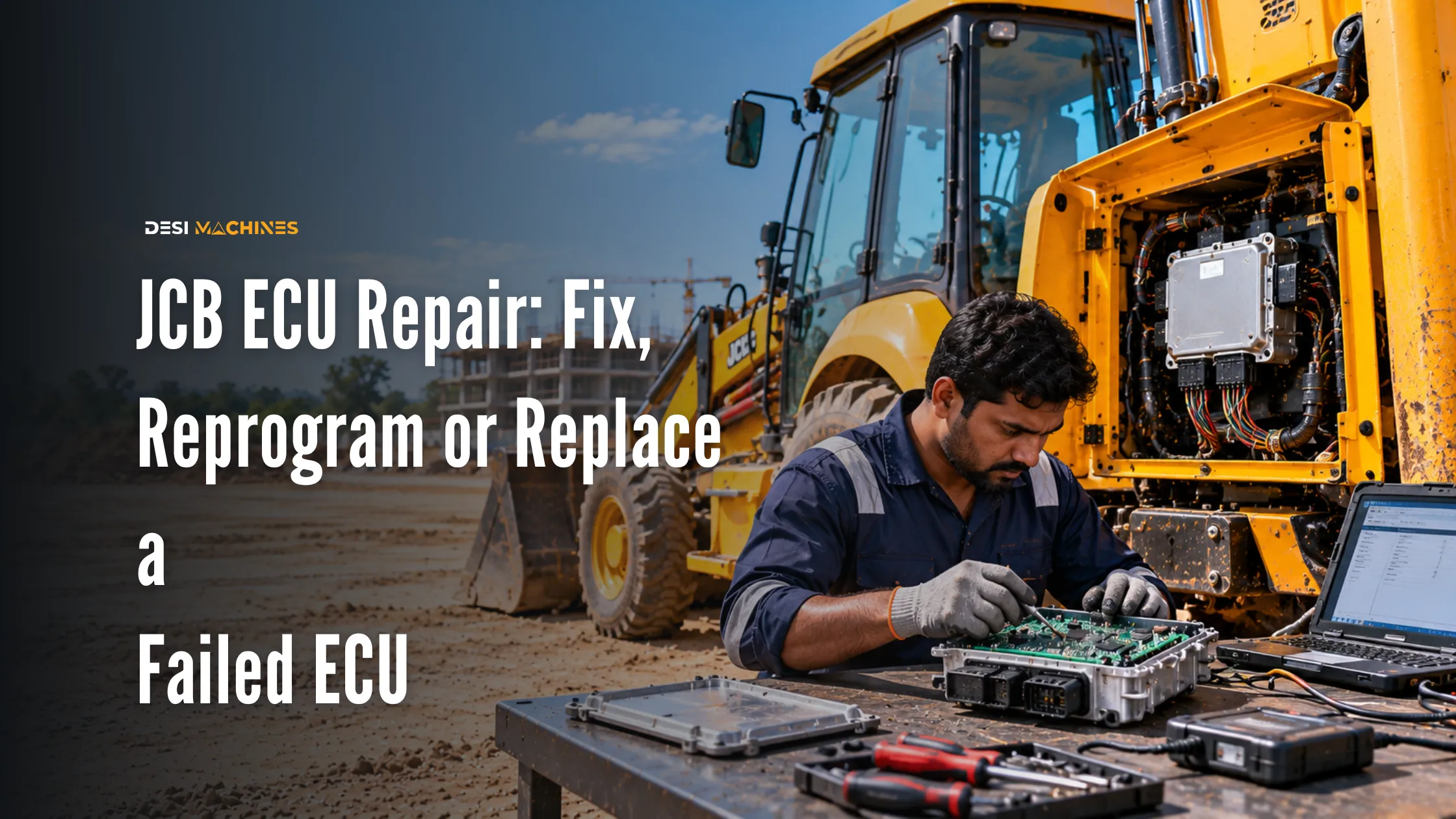
Most backhoes that “have an ECU problem” do not. Before paying for a JCB ECU repair, rule out the battery voltage, the earth connections, water in the connectors, the wiring harness and the sensors, because engine makers’ manuals name those as the common causes of electronic faults. If the controller has only locked up, a power cycle or a dealer software update can fix it. A new ECU has to be programmed with the dealer’s service tool, so a loose second-hand unit rarely works. Never weld on the machine without disconnecting the battery and the ECU, and never accept a “remap” that changes the emission settings: it breaks the warranty and the Motor Vehicles Act.
The machine was fine at lunch. After the afternoon wash it will not start, or it starts and drops into a low-power mode with a warning on the dash. A mechanic plugs in a reader, sees a string of codes, and says the ECU has gone. The quote that follows is for a part most owners have never seen.
Sometimes he is right. More often the controller is reporting a problem somewhere else, and replacing it changes nothing.
Why your backhoe has an ECU at all
Backhoes built to the construction equipment emission norms, now called CEV Stage IV and CEV Stage V, use electronically controlled engines. The government’s October 2020 release proposed 1 April 2021 for the Stage IV phase for construction equipment, and JCB describes Stage 5 as effective from 1 January 2025. On these engines the ECU (also called the ECM) controls the fuel injection, which is why a fault in it, or in anything it reads, can stop the machine.
You will find it across the backhoe market. JCB describes the engine in the JCB 3DX Plus as an ecoMAX unit with common-rail (CRDI) injection. Tata Hitachi’s brochure for the Shinrai Prime lists an engine control unit with CRDI and fault codes displayed on the cluster. CASE describes the CASE 770 EX engine as electronic common rail, and Mahindra describes a CRDI engine on the EarthMaster SX.
Before a JCB ECU repair, rule out the cheap faults
The ECU sits at the centre of the wiring, so almost every electrical fault on the machine shows up as a code it reports. The engine makers’ own manuals point to the same short list of causes. Check them in roughly this order, from cheapest to dearest:
| Check | Why it matters |
|---|---|
| Battery voltage and terminals | Low or interrupted supply to the ECM causes faults and lock-ups |
| Earth (ground) connections | Perkins’ manual: ground connections “should be tight and free of corrosion” |
| Connectors after washing | Pressure washers should not be aimed at electrical connectors or the ECM |
| Wiring harness | Chafed or rodent-bitten wires give intermittent, confusing codes |
| Sensors and injectors | A failed sensor reports through the ECU; the ECU itself may be fine |
A harness repair or a sensor costs a fraction of a controller, which is why the order matters. Our guides to wiring kit prices and fuel injectors cover those parts, and the guide to backhoe warning lights explains what the dash is telling you.
Use the maker’s diagnostics where you have them. JCB lists remote diagnostics for faster error-code identification on its current 3DX and 4DX, and says its engineers use Intelli-Diagnostic technology to find and fix software problems. A dealer who can read the machine’s stored history can often see what a roadside code reader cannot.
What a “JCB ECU reset” can and cannot do
Owners search for a reset because it sounds free. Sometimes it is. One engine maker’s manual (Cummins) lists a locked-up ECM as a fault and gives the remedy as disconnecting the battery cables for 30 seconds, then reconnecting and starting the engine. Clearing stored codes after a real fault has been fixed is also routine.
A reset cannot repair a burnt circuit, a damaged harness or a failed sensor. If the code returns within a day, the cause is still there. And how you cut power matters: Komatsu’s excavator brochure notes a lamp that tells the operator when it is safe to open the battery isolator switch, to prevent controller failures. Wait for the machine’s own shutdown before you isolate the battery.
Repair, reprogram or replace
Once the cheaper causes are ruled out and the ECU itself is suspect, there are three routes.
| Route | What it involves | Watch out for |
|---|---|---|
| Software reflash or update | The dealer reloads the correct calibration with the service tool | Needs the right file for your engine; the cheapest fix when it works |
| Board-level repair | An electronics shop repairs the circuit board | No maker warranty; calibration may not be restored correctly |
| New or exchange unit | A replacement ECU, programmed to your machine | Must be programmed with the dealer’s tool and passwords |
The programming step is the one that catches owners out. Perkins’ manual says the system configuration parameters must be reprogrammed when an ECM is replaced, that factory passwords are needed to change them, and that the electronic service tool is required. Cummins warns in its diagnostic software notes that incorrect calibrations can cause permanent damage. A second-hand ECU bought loose, or a board repair that loses the calibration, can leave you with a machine that runs badly or not at all.
We are not printing a repair price, because no maker publishes one and the spread between a reflash and a new programmed unit is too wide for one number to help. Ask for the quote in lines: diagnosis, the part, programming, any harness or sensor work, and the days off work. Our breakdown of equipment downtime cost shows why the days often outweigh the part.
The remap trap
Some workshops offer to “remap” the ECU for more power, or to switch off emission controls that keep throwing faults. It is a bad trade on two counts.
First, the warranty. JCB India’s parts warranty excludes failure attributable to “alteration of specification”, and says no claim is considered if parts other than genuine ones are used. Kirloskar’s warranty terms say an unauthorised change of part makes the warranty null and void.
Second, the law. The Motor Vehicles Act bars an owner from altering a vehicle so that its particulars differ from those originally specified by the manufacturer, and the Act provides for imprisonment of up to six months or a fine of five thousand rupees per alteration for altering a vehicle in a manner not permitted. Driving a vehicle that breaks air-pollution standards in a public place is a separate offence. A backhoe that travels between sites on public roads is exposed to both. More on why genuine parts matter is in our piece on genuine vs aftermarket parts.
The welding mistake that kills ECUs
A common self-inflicted ECU failure on a site starts with a welder. A cracked bucket or a broken bracket gets welded on the machine with the battery connected and the earth clamp wherever it reaches. The Perkins 904J operation and maintenance manual sets out the procedure: disconnect the negative battery cable, disconnect the ECM and the sensors from the wiring harness, and never ground the welder to electrical components such as the ECM or sensors. Caterpillar’s toolbox talk on welding adds that you should not weld in wet areas or in the rain.
Make it a site rule: no welding on any electronic machine until the battery and the ECU are disconnected and the earth clamp is on the part being welded. The cost of a bucket repair is set out in our piece on excavator bucket repair cost; the cost of skipping this step is a controller.
Two more habits from the same manuals: jump-start only from an equal voltage, because a higher voltage damages the electrical system, and keep pressure washers away from connectors.
The bottom line
Treat “the ECU has gone” as a hypothesis. Check the battery, the earths, the connectors, the harness and the sensors first, and let the dealer read the machine’s own diagnostics. If the controller is at fault, try a software update before a replacement, insist that any new unit is programmed with the maker’s tool, and refuse any remap that changes the emission settings. Disconnect the battery and the ECU before anyone welds.
If electronics faults are piling up on an older machine, compare what a newer one costs before you spend more. The JCB 3DX and JCB 4DX are the most asked-about models; browse all live backhoe loader models and prices and check equipment finance options before you decide.
Repair procedures, warranty terms and legal provisions vary by model, maker and date, and change over time. Confirm the correct procedure and your warranty position with your OEM dealer or an authorised workshop before any electronic repair.