
 Excavator
294 models
Excavator
294 models  Backhoe Loader
51 models
Backhoe Loader
51 models  Crane
68 models
Crane
68 models  Concrete Mixer
79 models
Concrete Mixer
79 models  Wheel Loader
54 models
Wheel Loader
54 models  Compactor / Roller
45 models
Compactor / Roller
45 models  Motor Grader
42 models
Motor Grader
42 models  Concrete Pump
66 models
Concrete Pump
66 models  Skid Steer Loader
11 models
Skid Steer Loader
11 models  Telehandler
13 models
Telehandler
13 models  Dozer
Dozer 


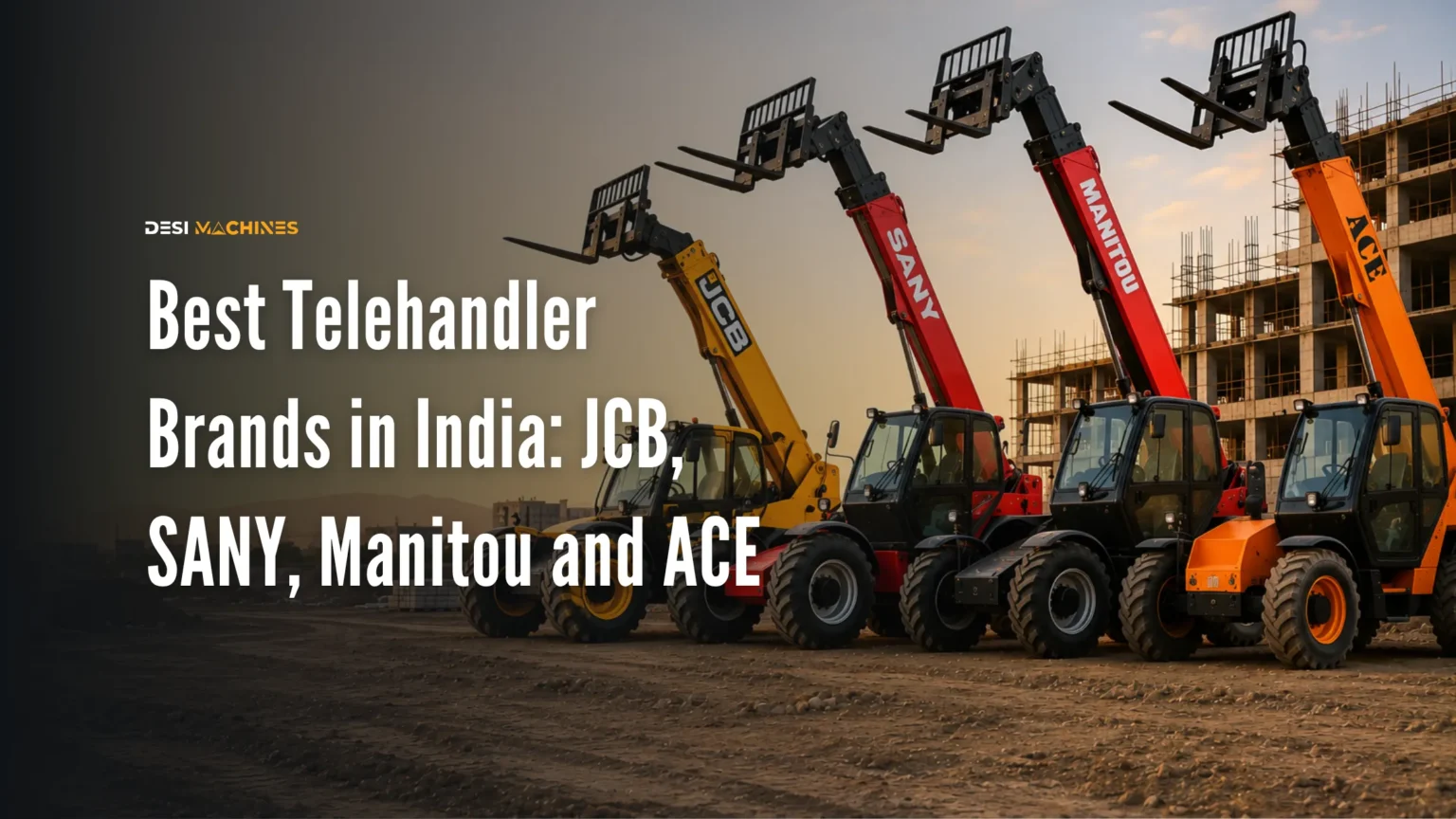
On most Indian sites people still call it a boom wala forklift. The difference matters: a forklift lifts straight up and works only right next to the load, while a telehandler reaches out over a wall, a trench or a stack of material. This guide compares the four brands on the machines they actually sell here, the capacity and height each one gives you, and what they cost.
Which telehandler brands are available in India?
Four brands are available: JCB, SANY, Manitou and ACE. That is a much shorter list than backhoe loaders or excavators, because the telehandler is still a young machine in India. The brands that have committed to it are the ones with either a global telehandler business (JCB, Manitou, SANY) or a strong Indian material-handling base (ACE).
The 13 machines split into two families:
- Fixed boom (10 machines) — the boom goes up and out, but the body does not turn. You reposition the machine to reach a different spot. Simpler, cheaper, and what most buyers need.
- Rotating (3 machines) — the whole upper body turns on a turret, like a crane, so the machine parks once and works all around itself. Far more expensive, and worth it only on tight or high work.
Browse the live telehandler models and prices, or go straight to the fixed boom telehandlers and rotating telehandlers if you already know which family suits your work. If you are still deciding between machine types altogether, the telescopic handler guide starts from the beginning, and the telehandler guide hub lists every piece in this series.
JCB telehandlers: what the 530 and 540 range gives you
JCB sells three telehandlers in India, and the model numbers tell you the machine. In JCB’s naming, the first two digits are the lift capacity in tonnes and the last number is the maximum lift height in metres. So a 530-70 lifts 3 Ton to 7 metres, and a 530-110 lifts the same 3 Ton but reaches 11 metres.
- JCB 530-70: 3,000 kg (3 Ton) to 7.0 m (7,000 mm), 74 HP (54 kW), operating weight 7,220 kg. ₹40 – ₹48 Lakh (indicative, as of Aug 2026).
- JCB 540-70: 4,000 kg (4 Ton) to 7.0 m, same 74 HP engine, operating weight 8,498 kg. ₹48 – ₹58 Lakh (indicative, as of Aug 2026).
- JCB 530-110: 3,000 kg (3 Ton) to 11.0 m, 74 HP, operating weight 9,272 kg. ₹50 – ₹60 Lakh (indicative, as of Aug 2026).
All three run the same JCB 430 engine, a 3.0 litre four-cylinder rated 74 HP (54 kW) at 2,200 rpm. The gearbox is JCB’s own 4WD synchro shuttle, a four-speed box with a torque converter and an electric forward-reverse shuttle, which means the operator changes direction with a lever near the steering wheel instead of stopping and shifting. Anyone who has run a JCB 3DX backhoe will find the controls familiar, and that familiarity is the real JCB advantage in India. So is the dealer network: parts and a mechanic are rarely more than a district away.
The trade-off is steering. The JCB machines use rear-wheel steer only. Manitou and SANY offer four-wheel and crab steer, which turn tighter and let the machine move sideways into a gap. On an open yard that does not matter. Inside a crowded shed it does.
SANY telehandlers: STH634A, STH844A and STH1056A
SANY sells three fixed-boom telehandlers here, and its pitch is reach for the money. The middle machine, the STH844A, lifts 3,629 kg to 13.4 metres for ₹42 – ₹52 Lakh (indicative, as of Aug 2026). That is more than 2 metres higher than the JCB 530-110, at a lower entry price.
- SANY STH634A: 2,721 kg (2.7 Ton) to 10.4 m, Deutz TD 2.9 engine at 74 HP (55 kW), operating weight 6,972 kg. ₹35 – ₹42 Lakh (indicative, as of Aug 2026).
- SANY STH844A: 3,629 kg (3.6 Ton) to 13.4 m, Deutz TCD 3.6, 74 HP, operating weight 11,633 kg. ₹42 – ₹52 Lakh (indicative, as of Aug 2026).
- SANY STH1056A: 4,540 kg (4.5 Ton) to 17.1 m, Deutz TCD3.6L4 at 120 HP (90 kW), operating weight 15,300 kg. ₹95 Lakh – ₹1.20 Crore (indicative, as of Aug 2026).
Two things stand out on the SANY machines. The first is the engine: all three use a Deutz, a German diesel widely used in Indian construction and mining equipment. The second is steering. Every SANY telehandler here offers three modes the driver picks with a switch: two-wheel, four-wheel circle, and four-wheel crab. Crab steer turns all four wheels the same way, so the machine slides diagonally without changing the direction the boom faces. On a narrow warehouse aisle that saves several minutes on every pick.
The gap in the SANY range is at the top. The jump from the STH844A to the STH1056A is roughly ₹50 Lakh for less than 4 metres of extra height, because the bigger machine is a different class of build. Most buyers stop at the STH844A.
Manitou telehandlers: the widest range, and the only rotating machines
Manitou is a French manufacturer with a long line in rough-terrain material handling, and it lists six machines in India, more than any other brand here. Three are fixed boom, and three are rotating, which no other brand on the list offers at all.
The fixed-boom machines all lift 4,000 kg (4 Ton) and run a Kirloskar 4R1190THT BSV engine, an Indian-built diesel rated 74.5 HP (54.8 kW), which is good news for parts:
- Manitou MXT 840 K IND: 4,000 kg to 7.6 m (7,600 mm), operating weight 12,525 kg. ₹42 – ₹50 Lakh (indicative, as of Aug 2026).
- Manitou MXT 840 K: 4,000 kg to 7.6 m, operating weight 12,525 kg. ₹45 – ₹55 Lakh (indicative, as of Aug 2026).
- Manitou MXT 1740 K: 4,000 kg to 17.4 m (17,400 mm), operating weight 15,530 kg. ₹90 Lakh – ₹1.15 Crore (indicative, as of Aug 2026).
The three rotating machines are the MRT-X series, and they are a different animal. The upper body turns a full 360 degrees (400 degrees on the smallest), the drive is hydrostatic, meaning a pump-and-motor system with no gears, so speed changes smoothly under load, and all four wheels steer.
- Manitou MRT-X 1645: 4,500 kg (4.5 Ton) to 15.8 m, 116 HP (85 kW) Deutz, 400-degree turret. Price on request.
- Manitou MRT-X 2570: 7,000 kg (7 Ton) to 24.8 m, 173 HP (127 kW) Yanmar, 360-degree turret. Price on request.
- Manitou MRT-X 3570: 7,000 kg (7 Ton) to 34.7 m with 28 m of outreach, 211 HP (155 kW) Yanmar, operating weight 23,800 kg. Price on request.
Outreach is the horizontal distance the boom can place a load away from the machine, and it is the number that separates a telehandler from a crane. The MRT-X 3570 reaches 28 metres out. No fixed-boom machine on this list gets past 13.5 metres.
Manitou does not publish a price for the MRT-X machines, so these are on enquiry rather than a listed figure. That is normal for low-volume imported machines and it usually means the final number depends on the attachments and the delivery location.
ACE AT 30: the Indian-made option
Action Construction Equipment (ACE) is the Faridabad manufacturer most Indian contractors know for Hydra pick-and-carry cranes. Its single telehandler, the ACE AT 30, is the cheapest way into the category: 3,000 kg (3 Ton) to 11.2 m (11,200 mm) for ₹30 – ₹38 Lakh (indicative, as of Aug 2026).
Compare that with the JCB 530-110, which lifts the same 3 Ton to a similar 11 metres for roughly ₹20 Lakh more at the entry end. The ACE runs a TATA 497TC59 engine rated 74.5 HP (55 kW) at 2,200 rpm, weighs 9,730 kg, and carries a torque-converter gearbox with four forward and four reverse gears.
Where it gives ground is steering and refinement. The AT 30 is two-wheel steer, against four-wheel on the Manitou and SANY machines. It also gives ground on resale, where JCB’s second-hand demand in India is hard to match. For a contractor doing steady, predictable work on his own site, that is a fair trade. For a rental fleet that has to sell the machine at four years, it may not be.
ACE also has the service argument. For a first-time buyer in a smaller town, a mechanic who can source a TATA engine part locally is worth more than a specification sheet.
Telehandler price in India: what each brand costs
Every figure below is the listed range for that machine. These are ex-factory prices with GST included. A telehandler is a wheeled machine and has to be registered, so the on-road cost adds transportation, RTO registration, TCS, warranty, insurance and FOC charges where applicable. Budget above the listed band.
| Brand | Model | Max lift capacity | Max lift height | Engine power | Price (indicative, Aug 2026) |
|---|---|---|---|---|---|
| ACE | AT 30 | 3,000 kg (3 Ton) | 11.2 m | 74.5 HP (55 kW) | ₹30 – ₹38 Lakh |
| SANY | STH634A | 2,721 kg (2.7 Ton) | 10.4 m | 74 HP (55 kW) | ₹35 – ₹42 Lakh |
| JCB | 530-70 | 3,000 kg (3 Ton) | 7.0 m | 74 HP (54 kW) | ₹40 – ₹48 Lakh |
| Manitou | MXT 840 K IND | 4,000 kg (4 Ton) | 7.6 m | 74.5 HP (54.8 kW) | ₹42 – ₹50 Lakh |
| SANY | STH844A | 3,629 kg (3.6 Ton) | 13.4 m | 74 HP (55 kW) | ₹42 – ₹52 Lakh |
| Manitou | MXT 840 K | 4,000 kg (4 Ton) | 7.6 m | 74.5 HP (54.8 kW) | ₹45 – ₹55 Lakh |
| JCB | 540-70 | 4,000 kg (4 Ton) | 7.0 m | 74 HP (54 kW) | ₹48 – ₹58 Lakh |
| JCB | 530-110 | 3,000 kg (3 Ton) | 11.0 m | 74 HP (54 kW) | ₹50 – ₹60 Lakh |
| Manitou | MXT 1740 K | 4,000 kg (4 Ton) | 17.4 m | 74.5 HP (54.8 kW) | ₹90 Lakh – ₹1.15 Crore |
| SANY | STH1056A | 4,540 kg (4.5 Ton) | 17.1 m | 120 HP (90 kW) | ₹95 Lakh – ₹1.20 Crore |
| Manitou | MRT-X 1645 (rotating) | 4,500 kg (4.5 Ton) | 15.8 m | 116 HP (85 kW) | Price on request |
| Manitou | MRT-X 2570 (rotating) | 7,000 kg (7 Ton) | 24.8 m | 173 HP (127 kW) | Price on request |
| Manitou | MRT-X 3570 (rotating) | 7,000 kg (7 Ton) | 34.7 m | 211 HP (155 kW) | Price on request |
Read the table by height, not by brand. At around 7 metres the money buys capacity; at 11 metres and above it buys reach. The cheapest 11-metre machine here is the ACE AT 30 and the dearest is the JCB 530-110, and they lift the same 3 Ton.
Most telehandlers in India are bought on finance rather than cash. Work out the monthly outgo before you fix the model. The equipment finance options page sets out how loan tenure and down payment change the instalment, and a ₹10 Lakh difference in machine price is a real difference in EMI for five years. Ready to shortlist? Compare live telehandler models and prices and talk to a dealer.
Fixed boom or rotating: which one do you need?
A fixed boom telehandler suits almost every Indian buyer, and a rotating machine is a specialist purchase. The test is simple: can you drive the machine to the load, or must the machine stand still and reach around itself?
On a warehouse yard, a precast casting bed, a farm, or a shed under construction, you can drive to the load. A fixed-boom machine does the job for a third of the money. On a congested urban site, a building facade, or anywhere you must set up on outriggers and cannot reposition, the 360-degree turret pays. That is the same argument that puts a Hydra on some sites and a crawler crane on others.
Two more differences matter in practice. Rotating machines run hydrostatic drive, which gives finer control at low speed but costs more to repair. And they weigh far more: 23,800 kg for the MRT-X 3570 against 7,220 kg for a JCB 530-70, so transport, ground bearing and tyre costs all rise with it.
The telehandler applications guide works through the job types in more detail, and the telehandler attachments guide covers the forks, buckets, platforms and jibs that decide what the machine can actually pick up.
Which telehandler brand is best for your work?
There is no single best brand. There is a best brand for a given job, a given budget and a given district, and the four here sort out cleanly:
- Buying your first telehandler, tight budget, own site work: the ACE AT 30. Lowest entry price in the category, Indian engine, 11.2 m of height.
- Resale and dealer cover matter most: JCB. The network is the deepest in India and the operator already knows the controls. Pick the 530-70 for capacity work and the 530-110 when you need height.
- Maximum reach per rupee: SANY. The STH844A gives 13.4 m and 3,629 kg for a price the others charge for 11 m.
- Tight sites, mixed work, or genuine height: Manitou. The widest range on offer, and the only rotating machines available here.
One warning about the model numbers. Brands do not name machines the same way. JCB’s 530-110 means 3 Ton and 11 metres; SANY’s STH844A and Manitou’s MXT 840 K follow their own systems. Compare the capacity and height figures in the table, never the model names.
If you have not settled on a telehandler at all, two comparisons are worth reading first: telehandler vs backhoe loader for the everyday earthmoving-and-lifting choice, and telehandler vs crane if the work is mostly lifting.
What to check before you buy a telehandler
Whichever brand you pick, five checks decide whether the machine earns money or sits idle:
- Read the load chart, not the headline capacity. A machine rated 4,000 kg lifts that with the boom retracted and low. Fully extended at height it may lift a quarter of it. Ask the dealer for the chart and find the weight at the reach you actually work at.
- Match the attachment to the job before you sign. Forks, a bucket, a jib and a work platform all change the rated capacity. Deciding the attachment after the machine arrives is how buyers end up short.
- Check the steering modes against your site. Two-wheel steer is fine on an open yard. Four-wheel and crab steer earn their premium in a shed or a narrow lane.
- Confirm dealer distance and parts stock. A machine idle for a fortnight waiting on a boom-wear pad costs more than the price gap between two brands.
- Plan for registration. A telehandler is a wheeled machine, so it needs RTO registration and insurance before it goes on a public road, and those costs sit on top of the listed price.
Start with the shortlist, then get the numbers for your own site. Browse the full range of telehandlers, compare the fixed boom and rotating machines side by side, and connect with a dealer for a quote.
Whichever brand you shortlist, the rated capacity in the table is the figure at minimum reach, not at full extension. The guide to the telehandler load chart and lift capacity shows how much a telehandler actually lifts once the boom is out.
Prices, specifications and features are indicative, vary by variant, location and date, and should always be confirmed with the official OEM or authorised dealer before any purchase decision. DesiMachines is not liable for decisions taken on the basis of information that may have changed after publication. Prices and specifications are taken from our listings at the time of writing.
Weight and size differ as much between these brands as price does, and they decide what it costs you to move each machine: the model-by-model figures are in telehandler weight and dimensions in India.

