
 Excavator
294 models
Excavator
294 models  Backhoe Loader
51 models
Backhoe Loader
51 models  Crane
68 models
Crane
68 models  Concrete Mixer
79 models
Concrete Mixer
79 models  Wheel Loader
54 models
Wheel Loader
54 models  Compactor / Roller
45 models
Compactor / Roller
45 models  Motor Grader
42 models
Motor Grader
42 models  Concrete Pump
66 models
Concrete Pump
66 models  Skid Steer Loader
11 models
Skid Steer Loader
11 models  Telehandler
13 models
Telehandler
13 models  Dozer
Dozer 


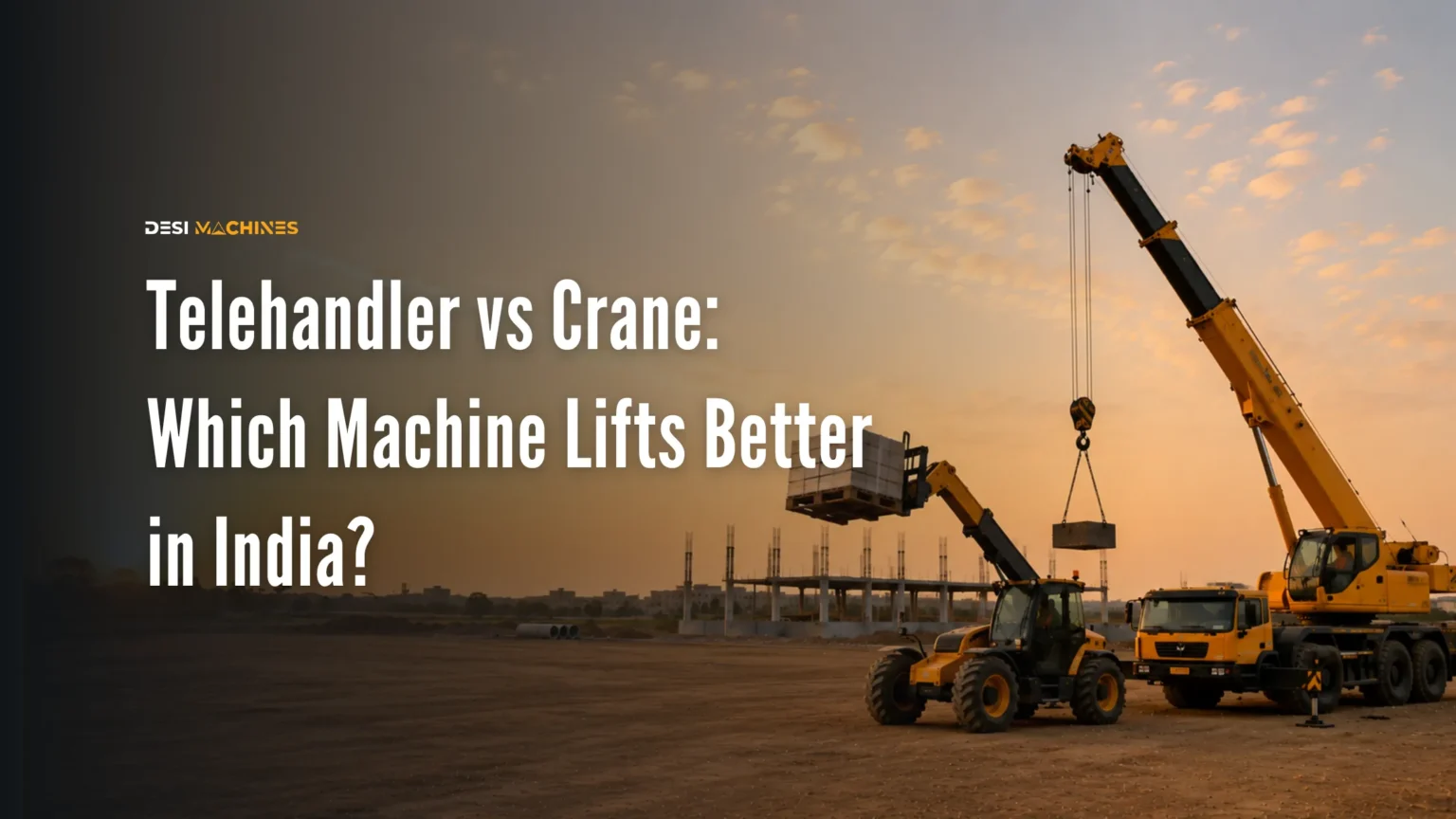
They are not competitors across the whole job. A telehandler places pallets, blocks and bundles onto a slab or a scaffold, and it can drive them there itself. A crane picks a heavy, awkward item off a truck and swings it into position. Where the two overlap is the middle of that range, and that is where buyers get it wrong and pay for the wrong machine.
What is the difference between a telehandler and a crane?
The difference is how the load is held. A telehandler holds it rigidly on forks or in an attachment at the end of the boom, so the load goes where the boom goes. A crane hangs the load on a rope, so the load swings and has to be controlled.
That single difference drives everything else.
| Telehandler | Pick and carry crane (hydra) | |
|---|---|---|
| How it holds the load | Rigid, on forks or an attachment | Hanging, on a rope and hook |
| Typical rated capacity | 2.7 to 4.5 Ton (2,700–4,500 kg) | 12 to 25 Ton (12,000–25,000 kg) |
| Typical lift height | 7 to 17 m | Boom height roughly 13 to 23 m |
| Moves with the load | Yes, that is the point of it | Yes, within site limits |
| Changes tools | Forks, bucket, jib, man platform | Hook only |
| New price band | ₹30–60 Lakh | ₹16–34 Lakh |
| Best at | Placing material at height, repeatedly | Lifting heavy items off and onto vehicles |
Two things in that table surprise first-time buyers. The first is that a telehandler costs more than a hydra of far greater tonnage. The second is that the hydra’s tonnage is not usable at height, which the next two sections explain.
Which lifts higher, a telehandler or a crane?
The crane, on paper. The telehandler, in the way you will actually use it on a building.
Telehandlers sold in India cover a clear ladder of lift heights.
| Model | Rated capacity | Max lift height | New price (indicative, as of Aug 2026) |
|---|---|---|---|
| JCB 530-70 | 3,000 kg (3 Ton) | 7.0 m | ₹40–48 Lakh |
| MANITOU MXT 840 K IND | 4,000 kg (4 Ton) | 7.6 m | ₹42–50 Lakh |
| JCB 540-70 | 4,000 kg (4 Ton) | 7.0 m | ₹48–58 Lakh |
| SANY STH634A | 2,721 kg (2.7 Ton) | 10.4 m | ₹35–42 Lakh |
| JCB 530-110 | 3,000 kg (3 Ton) | 11.0 m | ₹50–60 Lakh |
| SANY STH844A | 3,629 kg (3.6 Ton) | 13.4 m | ₹42–52 Lakh |
But height alone is the wrong test. A crane puts the hook high; it does not put your material on the fifth-floor slab, because the load hangs below the hook and has to be swung in and landed by a team. A telehandler drives to the building, extends the boom over the edge and sets the pallet down on the slab, and one operator does it. For repetitive material handling on a building, the telehandler wins at heights it can actually reach. For anything above about 13 metres, the crane is the only one of the two still in the conversation.
Which lifts more weight?
The crane, by a wide margin on the rating plate — and by much less than you would think at working reach.
A hydra in the common sizes is rated at 12 to 25 tonnes against a telehandler’s 2.7 to 4.5 tonnes. That is a four-to-one gap or more. The catch is that both machines lose capacity as the load moves away from them, and they lose it fast.
On a crane this is set out in the load chart, and every operator should be able to read one before the machine leaves the yard. A 14 tonne pick and carry crane does not lift 14 tonnes at 10 metres of radius; it lifts 14 tonnes close in, at minimum radius, and a fraction of that out at reach. Telehandlers have exactly the same chart on the boom, for the same reason.
So the honest comparison is at the reach you will work at, not at the rating. In practice: if you are lifting single items above four or five tonnes at any distance, you need a crane and a telehandler will not do it at any price. If your loads are pallets, blocks, shuttering, bundles of rod and bags of cement at two to three tonnes a time, the telehandler carries them all day and the crane is the expensive way to do the same work.
What does each machine cost in India?
A pick and carry crane is the cheaper machine to buy, and it is not close.
| Machine | Class | New price (indicative, as of Aug 2026) |
|---|---|---|
| ACE 12XW | 12 Ton pick and carry crane | ₹16–18 Lakh |
| ACE 14XW | 14 Ton pick and carry crane | ₹18–20 Lakh |
| ACE 20XW | 20 Ton pick and carry crane | ₹28–30 Lakh |
| ACE AT 30 | Fixed boom telehandler | ₹30–38 Lakh |
| SANY STH634A | Fixed boom telehandler | ₹35–42 Lakh |
| JCB 530-110 | Fixed boom telehandler | ₹50–60 Lakh |
Rotating telehandlers, which turn the whole boom through 360° without moving the machine, sit above this again. Prices are as listed at the time of writing.
Purchase price is not the whole cost on either machine. A hydra is a registered road vehicle, so it carries insurance, fitness, road tax and tyres that wear on the road as well as on site. A telehandler is usually a site machine with lower running costs but a higher entry price, and its attachments (a bucket, a jib, a man platform) are bought separately. Put both through the same arithmetic before deciding, and if either is going on finance, work out the full outgo with the equipment finance options rather than comparing sticker prices.
Which one should you choose for your work?
Choose by what you lift most often, not by the heaviest thing you have ever lifted.
Choose a telehandler if your work is building construction, warehousing, precast panel handling, a plant or factory yard, or farm and grain work. Anything where the same two-tonne load goes up or across dozens of times a day, and where one operator without a lifting team is the whole point. The range of telehandler attachments is what makes it earn its price, because the same machine becomes a loader, a lifting jib or an access platform in ten minutes.
Choose a pick and carry crane if your work is unloading and placing heavy single items: transformers, precast segments, machinery, steel structures, pipes, water tanks. Anything where the load is too heavy for forks and needs to hang from a hook and be set down precisely.
Look past both if the lifts are heavy and high together, or the ground is rough. A mobile crane is the right machine above the pick and carry range, and on unmade ground a 2WD hydra struggles where a Farana-type machine keeps working.
If the work is occasional, hire rather than buy either one. Both machines only pay when they are working, and the crane buying and rental guide works through the numbers on that decision.
Can a telehandler do a crane’s job?
Within its rated capacity and with the right attachment, yes — and that is a real reason buyers choose one.
Fit a lifting jib and hook to a telehandler and it becomes a small crane, hanging the load on a rope instead of holding it on forks. That is a genuine capability and it is why one telehandler often replaces both a small crane and a loader on a building site. It is limited by the machine’s chart, which is well below what even a 12 tonne hydra will lift.
Two limits are worth knowing before you plan around it. First, a lift with a suspended load off a telehandler is a crane operation, and it needs an operator trained for it and the same care about ground conditions, radius and chart that a crane needs — the crane safety and operator training rules apply in spirit whatever the machine is called. Second, a pick and carry crane cannot go the other way. There is no fork attachment that turns a hydra into a material handler, so a site that mostly moves pallets and buys a hydra for the tonnage has bought the wrong machine and will feel it every day.
The related comparison many buyers are also weighing is the telehandler against a backhoe loader, which is the other machine that gets asked to do everything.
Telehandler or crane, in short
Buy a telehandler if you move material to height repeatedly and your loads are under about four tonnes. Buy a pick and carry crane if you lift heavy single items off vehicles and set them down, and you need real tonnage. Never compare the two on rated capacity alone, because both machines derate sharply with reach and the rating is measured where you will rarely work.
To see what is available and what it costs, compare telehandler models and prices against pick and carry crane models and prices, and read the complete telehandler guide if the telehandler is new to you as a machine.
Prices, specifications and features are indicative, vary by variant, location and date, and should always be confirmed with the official OEM or authorised dealer before any purchase decision. DesiMachines is not liable for decisions taken on the basis of information that may have changed after publication.