
 Excavator
294 models
Excavator
294 models  Backhoe Loader
51 models
Backhoe Loader
51 models  Crane
68 models
Crane
68 models  Concrete Mixer
79 models
Concrete Mixer
79 models  Wheel Loader
54 models
Wheel Loader
54 models  Compactor / Roller
45 models
Compactor / Roller
45 models  Motor Grader
42 models
Motor Grader
42 models  Concrete Pump
66 models
Concrete Pump
66 models  Skid Steer Loader
11 models
Skid Steer Loader
11 models  Telehandler
13 models
Telehandler
13 models 


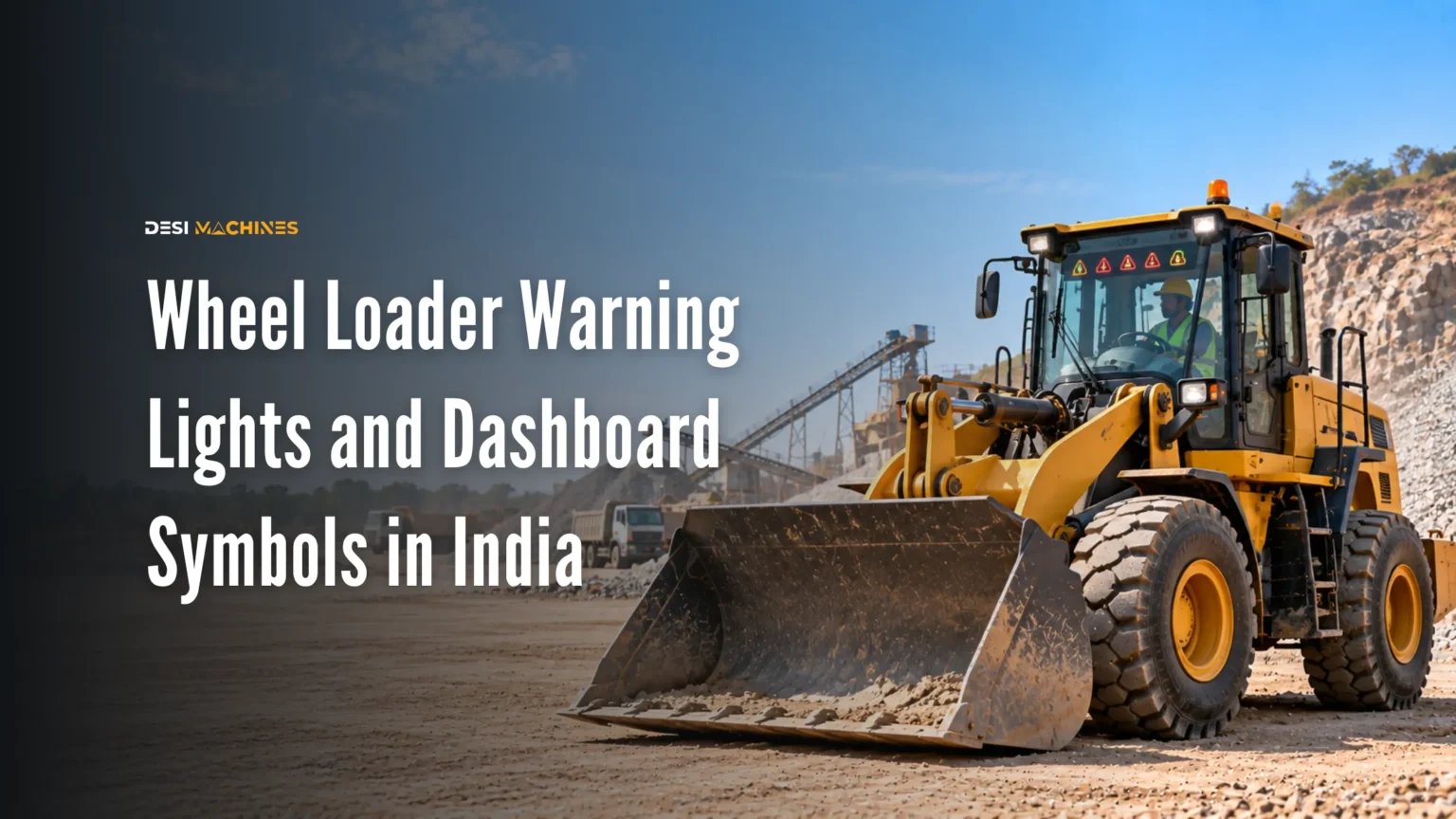
Wheel loader warning lights use the same three colours as any other earth-moving machine. Red means stop the machine. Amber or yellow means something is outside its normal range and needs attention soon. Green means a function is simply switched on. Which lamps your loader actually carries is a separate question, and the clearest example is the brake warning. Of the 54 wheel loaders listed on DesiMachines, 10 are braked through compressed air and carry a low-air-pressure lamp with a buzzer, while 11 run nitrogen-charged accumulators and warn you about brake pressure instead. An owner who moves from one brand to another meets a lamp he has never seen before, and that is usually the lamp that gets ignored.
The symbols themselves are not invented by each manufacturer. They come from an international standard, ISO 6405-1, which fixes the common symbols for operator controls and displays on earth-moving machines. India has adopted it as IS/ISO 6405-1 through the Bureau of Indian Standards. That is why the coolant temperature lamp on a Liugong looks much like the one on a JCB or a Tata Hitachi machine. What is not standard is the fault code some machines display beside the lamp, and the dashboard layout on a loader is set by the drivetrain underneath it.
What do red, amber and green mean on a wheel loader?
The colour tells you how much time you have. It does not tell you what is wrong.
| Colour | What it means | What to do |
|---|---|---|
| Red | A system has failed or is about to be damaged | Park safely, lower the bucket to the ground, idle down and shut off. Do not drive it back to the yard. |
| Amber / yellow | A reading is outside its normal band, or a service is due | Finish the cycle, then check the fluid, filter or sensor the lamp points at before the next shift. |
| Green / blue | A function is switched on and working | Nothing. A green differential-lock or ride-control lamp is telling you the feature is engaged. |
One habit is worth building on a loader in particular. A red lamp on a machine that is carrying a full bucket at height is not the same emergency as a red lamp on an empty machine. Get the load down first, then deal with the lamp. A raised bucket that loses hydraulic pressure is a much bigger problem than a stalled engine.
Which brake warning light does your wheel loader have?
This is where wheel loaders differ most from every other machine on a site, and it is the part no generic dashboard chart covers. A wheel loader does not have one standard brake design. It has three, and each one warns you in a different way.
| Brake design | How many | Example machines | What lights up |
|---|---|---|---|
| Air-over-hydraulic (compressed air assists the brakes) | 10 of 54 | XCMG ZL33FV, ACE ALN 100, plus the Liugong 818N to 856H MAX range and the Hindustan 2021E | A low air pressure lamp, almost always with a buzzer. Below the set pressure the brakes lose assistance. Wait for the compressor to build pressure before moving. |
| Nitrogen accumulator (pressure stored in a gas-charged vessel) | 11 of 54 | Volvo L150H, Liebherr L550, plus the rest of the Volvo L-series and the Hyundai HL650I-V | A brake pressure lamp. The accumulator holds enough pressure for a few stops after the engine dies, which is why this lamp must never be driven on. |
| Direct hydraulic (pump pressure straight to the brakes) | The remainder | Tata Hitachi ZW 370-5A, Hyundai HL930I | A brake oil pressure lamp, and on wet-brake machines a rising axle oil temperature. |
Cutting across all three is the disc itself. 37 of the 54 machines run wet discs — brake plates that sit inside the axle housing, running in oil. Wet discs last far longer in dust and water, which is why they suit Indian quarry and crusher work. The catch is that the brakes now share their oil with the axle, so 52 of the 54 loaders publish a separate front axle oil and rear axle oil capacity. If the axle oil temperature lamp comes on, that is a brake warning as much as a driveline one. Riding the brakes down a long ramp is what usually causes it.
The parking brake is a separate lamp again, and on most loaders it is spring-applied: springs clamp it shut and hydraulic pressure holds it open. So a parking brake lamp that will not clear often means the release pressure has fallen, not that the brake is faulty.
What does the transmission or torque converter light mean?
A wheel loader works its transmission harder than almost any other machine on site, because the loading cycle drives the bucket into a pile at full engine power while the wheels barely turn. That is exactly the condition that heats a torque converter, which is the fluid coupling that lets the engine keep running while the machine is held still against the pile.
48 of the 54 wheel loaders publish a torque converter. The six that do not are worth understanding, because they explain the lamp. Three of them are the Liebherr L550, L566 and L580, which use a hydrostatic drive, meaning pumps and motors instead of gears and a converter. A hydrostatic machine has no converter to overheat, so it has no converter temperature lamp; what it has instead is a hydraulic oil temperature warning doing the same job. On the other three the field is simply not filled in, so check the machine’s own operator manual rather than assuming.
If the converter or transmission temperature lamp comes on mid-shift, the usual causes are a blocked cooler core packed with dust, low transmission oil, or an operator holding the machine against the pile for too long on each pass. Shorten the crowd into the pile and let the machine idle in neutral for a minute to cool. The difference between the two transmission designs, and which suits your work, is covered in our guide to powershift and hydrostatic wheel loader transmissions.
What does the steering light mean on an articulated loader?
Treat this one as a red lamp even if it is amber. A wheel loader does not steer its front wheels. It bends in the middle, on a hinge between the front and rear halves of the frame. 42 of the 54 machines name articulated steering in their specification, and all 54 publish a steering angle, which is how far the two halves can fold. Across the catalogue that angle runs from 35 to 43 degrees either side of centre.
The important consequence is that the folding is done entirely by hydraulic rams. There is no mechanical linkage from the steering wheel to the wheels as a backup. If steering pressure fails, the machine keeps rolling and stops answering the wheel. That is why a steering warning on a loader means stop where you are, not finish the pass. Larger machines carry a secondary steering pump that gives you just enough control to get off the haul road, and its lamp tells you the backup has taken over — not that everything is fine.
How the articulation works, and why loaders are built this way, is explained in how a wheel loader works.
Why does the hydraulic oil temperature light come on?
Hot hydraulic oil goes thin, and thin oil leaks past seals inside the pump and rams instead of doing work. The first thing an operator notices is not the lamp. It is the bucket lifting more slowly at the end of a hot afternoon than it did in the morning.
On a loader the common causes are a radiator and oil-cooler face blinded by dust, a low oil level, or relief valves dumping pressure because the machine is being asked to lift more than its rated load. Blowing the cooler pack out with compressed air at the end of each shift fixes more overheating complaints than any workshop visit. If the lamp keeps returning with a clean cooler, the fault-finding order is set out in our guide to wheel loader hydraulic problems, and the tank and oil volumes for your machine are in the wheel loader fuel and oil capacities reference.
Which extra lights appear on a CEV Stage IV or Stage V loader?
Newer emission norms add lamps that older machines never had, and they confuse buyers more than any other group. The most common is the DEF or AdBlue lamp. DEF is diesel exhaust fluid, a urea solution injected into the exhaust to cut nitrogen oxides. It sits in its own small tank, entirely separate from the diesel tank, and it is consumed as you work.
Here is the fact worth knowing before you buy: only 16 of the 54 wheel loaders carry a DEF tank at all. So this is a minority-of-the-fleet lamp, not a universal one. The machines that have it include the JCB 455-5N and the Tata Hitachi ZW225 CEV 5, along with the JCB 433-5 and the Tata Hitachi TL340H Prime.
Two rules matter with a DEF lamp. Let the tank run dry and the machine will derate itself — it drops engine power deliberately, which is designed behaviour, not a breakdown. And DEF must be kept clean; a funnel used for diesel will contaminate the tank and block the injector. Which norm a given machine meets is listed in our reference on wheel loader engine power and emission norms.
The charging lamp is the other one owners misread. A wheel loader is not a car: most run two batteries, and whether the system is 12 volt or 24 volt changes what a dim start actually means. That is covered in 12V or 24V batteries on construction machines.
Is there a universal wheel loader warning light chart?
No, and it is worth being honest about why. The symbols are standardised under IS/ISO 6405-1, so the shape of the temperature or oil-pressure lamp is broadly the same across brands. The fault codes are not standardised at all. A code on a Liugong display means nothing on a Volvo, and even two machines from one maker can use different code sets across model generations.
So a printed chart from the internet will get you the colour and the rough system, and then mislead you on the specific code. The only chart that is correct for your machine is the one in its own operator manual. If a used machine arrives without that book, ask the dealer for the model and serial number and get a replacement before the machine goes to work — it costs nothing, and it is the difference between reading a code and guessing at it.
What do the warning lights tell you about a used wheel loader?
A great deal, and most of it in the first thirty seconds. When you turn the key to the ON position without cranking, every lamp on the dashboard should light together in a self-test, then go out as the engine starts. That is the single cheapest check on a used machine inspection.
Watch for three things. A lamp that never lights during the self-test has usually been removed or disconnected, and a bulb does not disconnect itself — someone did it to hide a fault. A lamp that stays on after starting is a live fault the seller has been living with. And a dashboard where the plastic lens is cracked or the cluster has been swapped for a mismatched one is worth asking about directly.
Then go further than the lamps. Ask the seller to start the machine cold, in front of you, and watch the oil pressure and charging lamps clear. A machine warmed up before you arrive is hiding a hard cold start. The wider checklist for buying second-hand is in our used construction equipment buying guide.
Wheel loader warning lights: the short version
Red means stop and lower the bucket first. Amber means finish the pass and check it before the next shift. Green means a feature is switched on.
The lamp that catches out owners changing brands is the brake warning, because a wheel loader can be braked three different ways. If your machine is air-braked, low air pressure means no assistance and you wait for the compressor. If it runs accumulators, a brake pressure lamp means you have a few stops left and no more. And on the 37 machines with wet discs, axle oil temperature is a brake warning as much as a driveline one.
Treat a steering lamp as a stop-now lamp, because there is no mechanical backup behind the articulation. And check the DEF lamp story before you buy: only 16 of the 54 loaders here have a DEF tank, so it is not a fault your older machine is missing.
To compare machines by brake design, drivetrain and emission norm, browse the full range of wheel loaders and speak to a dealer about the specification that fits your site.
Specification figures quoted here (brake design, torque converter, steering angle, axle oil and DEF tank) are taken from the manufacturer specifications in our listings at the time of writing, covering the 54 wheel loaders available as of September 2026. Prices, specifications and features are indicative, vary by variant, location and date, and should always be confirmed with the official OEM or authorised dealer before any purchase decision. DesiMachines is not liable for decisions taken on the basis of information that may have changed after publication.

