
 Excavator
294 models
Excavator
294 models  Backhoe Loader
51 models
Backhoe Loader
51 models  Crane
68 models
Crane
68 models  Concrete Mixer
79 models
Concrete Mixer
79 models  Wheel Loader
54 models
Wheel Loader
54 models  Compactor / Roller
45 models
Compactor / Roller
45 models  Motor Grader
42 models
Motor Grader
42 models  Dozer
41 models
Dozer
41 models  Concrete Pump
66 models
Concrete Pump
66 models  Skid Steer Loader
11 models
Skid Steer Loader
11 models  Telehandler
13 models
Telehandler
13 models 


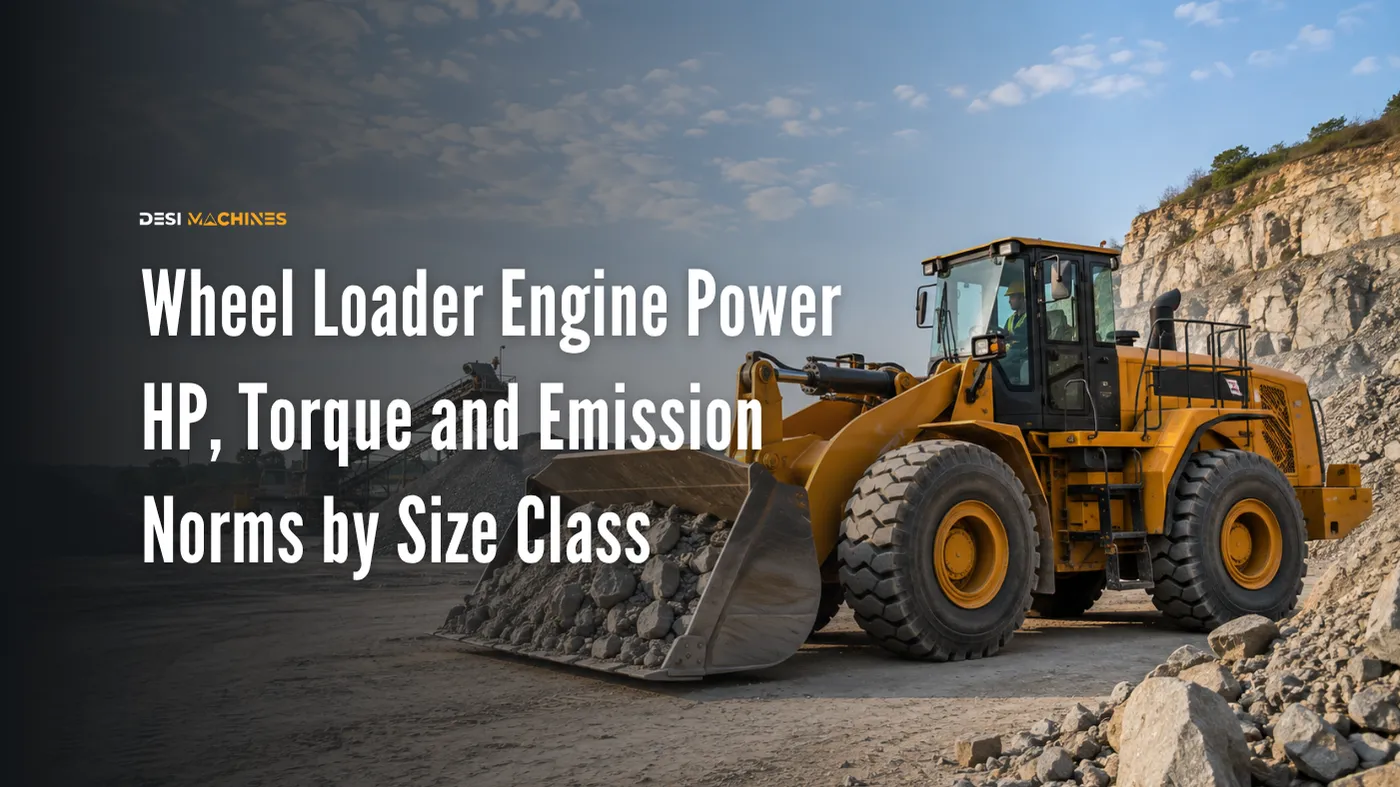
Wheel loader engine power in India runs from about 75 HP (56 kW) on the smallest compact machines to 225 HP (168 kW) on the medium machines that do most commercial work, with the largest mining loaders reaching far beyond that. Engine torque climbs alongside it, from roughly 295 Nm to over 1,200 Nm. Almost every machine built for the Indian market today carries a CEV Stage IV or Stage V engine.
Horsepower is the number every dealer leads with, and it is also the number buyers most often read wrong. This page sets out what each size class actually carries, using the published engine specifications for all 54 wheel loaders sold here, and explains why the torque figure beside the HP matters more for loading work.
How much horsepower does a wheel loader have?
It depends entirely on size class, and the jumps between classes are large. A compact wheel loader of 1 to 8 Tonne operating weight carries about 75 HP (56 kW). An 8 to 15 Tonne machine — the size most Indian contractors buy — carries 121 to 160 HP (90 to 118 kW). A 15 to 30 Tonne machine starts around 180 HP (134 kW) and the common commercial models sit at 225 to 230 HP (168 to 170 kW).
Above that you are into quarry and mining territory, where published ratings run into several hundred horsepower and, on the biggest imported machines, past 1,000 HP. Those are not machines a general contractor buys, and their numbers distort any “wheel loader HP” figure quoted as a single range.
One term worth defining before the table: HP (horsepower) and kW (kilowatts) measure the same thing, engine output. India’s spec sheets print both because the OEM’s home market may use one or the other. Divide HP by about 1.34 to get kW.
Wheel loader engine power by size class
Every machine below is currently sold in India. Power and torque are as published on each model’s specification sheet.
| Size class | Machines listed | Engine power | Typical torque | Emission standard |
|---|---|---|---|---|
| Compact (1–8 Tonne) | 2 | 74.5–75 HP (55–56 kW) | 295–300 Nm | BS III (CEV), CEV Stage IV |
| Small (8–15 Tonne) | 12 | 121–160 HP (90–118 kW) | 475–650 Nm | CEV Stage IV / CEV V / Stage 5 |
| Medium (15–30 Tonne) | 24 | 180–412 HP (134–303 kW) | 800–2,040 Nm | CEV Stage IV / CEV V, or US EPA Tier 3–4 on imports |
| Large (over 30 Tonne) | 16 | 273–1,847 HP (204–1,377 kW) | 1,125–11,591 Nm | Mostly US EPA Tier 3–4 / EU Stage |
Specifications are as per the current August 2026 listings. The compact class has only two machines on it, so read that row as two data points rather than a settled class range.
Where the classes overlap is worth noticing. The 412 HP Cat 980L sits in the medium bracket while the 273 HP Komatsu WA470-6A sits in the large one — because class here is set by operating weight, not by engine. Never assume a heavier machine has a bigger engine, or the reverse.
Which wheel loader engines do Indian buyers actually get?
The commercial middle of the market is tightly grouped, and that makes shortlisting easier than the full range suggests.
In the 8 to 15 Tonne class, twelve machines sit between 121 and 160 HP. The Tata Hitachi TL340H Prime is the least powerful at 121 HP (90.2 kW) with 500 Nm; the L&T 9020, Hindustan 2021E, Hyundai HL630I-V and XCMG ZL33FV all cluster at 133 HP; and the Liugong 836N and 838H MAX top the class at 160 HP (118 kW) with 650 Nm. Prices in this class run from about ₹47 – 49 Lakhs to ₹54 – 56 Lakhs (indicative, as of Aug 2026).
In the 15 to 30 Tonne class, the 225 HP mark is where the volume sits: the JCB 455-5N, Liugong 856H MAX, CAT 950GC and Tata Hitachi ZW225 CEV 5 are all rated 225 HP (168 kW). What separates them is torque and price, not power. The Hyundai HL950I at 227 HP is listed around ₹85 – 87 Lakhs, while the Tata Hitachi ZW225 is listed at ₹1.16 – 1.18 Crore (indicative, as of Aug 2026) — same headline horsepower, very different machines.
At the entry end, the ACE ALN 100 at 75 HP is listed at ₹19 – 22 Lakhs and the Liugong 818N at 74.5 HP at ₹35 – 37 Lakhs (indicative, as of Aug 2026). Identical power, and a gap of roughly ₹15 Lakh between them — proof on its own that HP is a poor way to compare price.
A wheel loader is a registrable wheeled machine, so on-road cost adds transportation, RTO registration, TCS, warranty, insurance and FOC charges where applicable. Where a machine shows no figure, it is quoted on request. Compare live wheel loader models and prices and talk to a dealer.
Why torque matters more than horsepower for loading
Torque is turning force — how hard the engine can push when it is working slowly and under strain. Horsepower is how fast it can keep doing that work. For a wheel loader, most of the hard part of the job happens at low speed: driving the bucket into a stockpile, breaking the material free, then lifting.
That is why the torque figure and the engine speed printed beside it deserve as much attention as the HP. A Volvo L150H produces its 1,999 Nm at just 1,000 rpm. The 225 HP Liugong 856H MAX makes 1,200 Nm at 1,300 rpm. Both are pulling hard right where a loader lives. An engine that only reaches peak torque at 1,600 or 1,700 rpm has to be revved harder to do the same digging, which burns more diesel for the same bucket.
The practical test at a demo is simple: watch the machine push into a heap without the engine bogging down or the operator having to rev it. That tells you more than any number on the brochure.
How that torque reaches the wheels is a separate decision, and it changes the machine’s character completely — the wheel loader transmission guide compares powershift against hydrostatic drive.
What emission standard do wheel loaders in India have?
Machines built and sold for the Indian market carry CEV Stage IV or CEV Stage V engines. CEV stands for Construction Equipment Vehicle, India’s own emission standard for off-road machinery, which is separate from the BS norms that apply to trucks and cars.
The Hyundai HL630I-V and HL650I-V are listed as CEV V; the L&T 9020, XCMG ZL33FV and ZL48GV, Liugong 836N and 848H, and Hindustan 2021E are CEV Stage IV; the JCB 433-5, 440-5 and 455-5N are listed as Stage 5. The older ACE ALN 100 is listed as BS III (CEV).
Many of the large imported machines — the Cat, Komatsu, Volvo and Liebherr models in the heavier classes — are listed against US EPA Tier 3 or Tier 4 and EU Stage standards instead, because that is what their home markets certify to. If emission compliance matters for your project or tender, check the certification on the specific machine and variant before you commit, rather than assuming from the brand. The guide to BS-CEV emission norms for construction equipment explains what each stage requires.
Six cylinders is the norm above 160 HP; the smaller machines up to about 150 HP mostly run four. More cylinders generally means a smoother engine and better low-speed pulling, and it also means a bigger service bill.
How much power do you actually need?
Start from the material and the truck you are loading, not from a horsepower target.
For sand, loose soil and light aggregate feeding tippers on a building site, an 8 to 15 Tonne machine at 121 to 140 HP has ample power. Buying 160 HP for that work means paying for diesel you never use.
For blasted rock, wet clay or continuous quarry feed, the 15 to 30 Tonne class at 225 HP earns its cost, because the machine is fighting the material on every pass and a smaller engine will simply take longer and work harder.
For farm, yard and municipal work on tight sites, the compact class at 75 HP is often the right answer — and the deciding factor there is usually width and turning circle rather than power at all.
Two things constrain the choice more than horsepower does: the bucket you can fill and the tyres under it. The wheel loader bucket types and sizing guide covers matching bucket volume to material density, and wheel loader tyre sizes and types covers what survives Indian site conditions.
Where to read next
If you are new to these machines, how a wheel loader works explains the parts and systems, and wheel loader types by size class sets out what each class is built for. The complete wheel loader guide pulls the buying side together.
On running costs, wheel loader fuel tank and oil capacities gives the service volumes for these engines. For the equivalent numbers on tracked machines, see excavator engine power by size class and backhoe loader engine power and torque. Everything we have written on this machine family sits in the wheel loader guide.
Ready to compare? Browse live wheel loader models, specifications and prices and connect with a dealer near you.
Before you buy
Prices, specifications and features are indicative, vary by variant, location and date, and should always be confirmed with the official OEM or authorised dealer before any purchase decision. DesiMachines is not liable for decisions taken on the basis of information that may have changed after publication. Figures on this page are taken from our listings at the time of writing.
