Excavator
316 models
 Backhoe Loader
54 models
 Crane
68 models
 Concrete Mixer
79 models
 Wheel Loader
65 models
 Compactor / Roller
45 models
 Motor Grader
42 models

 Concrete Pump
66 models
 Skid Steer Loader
11 models


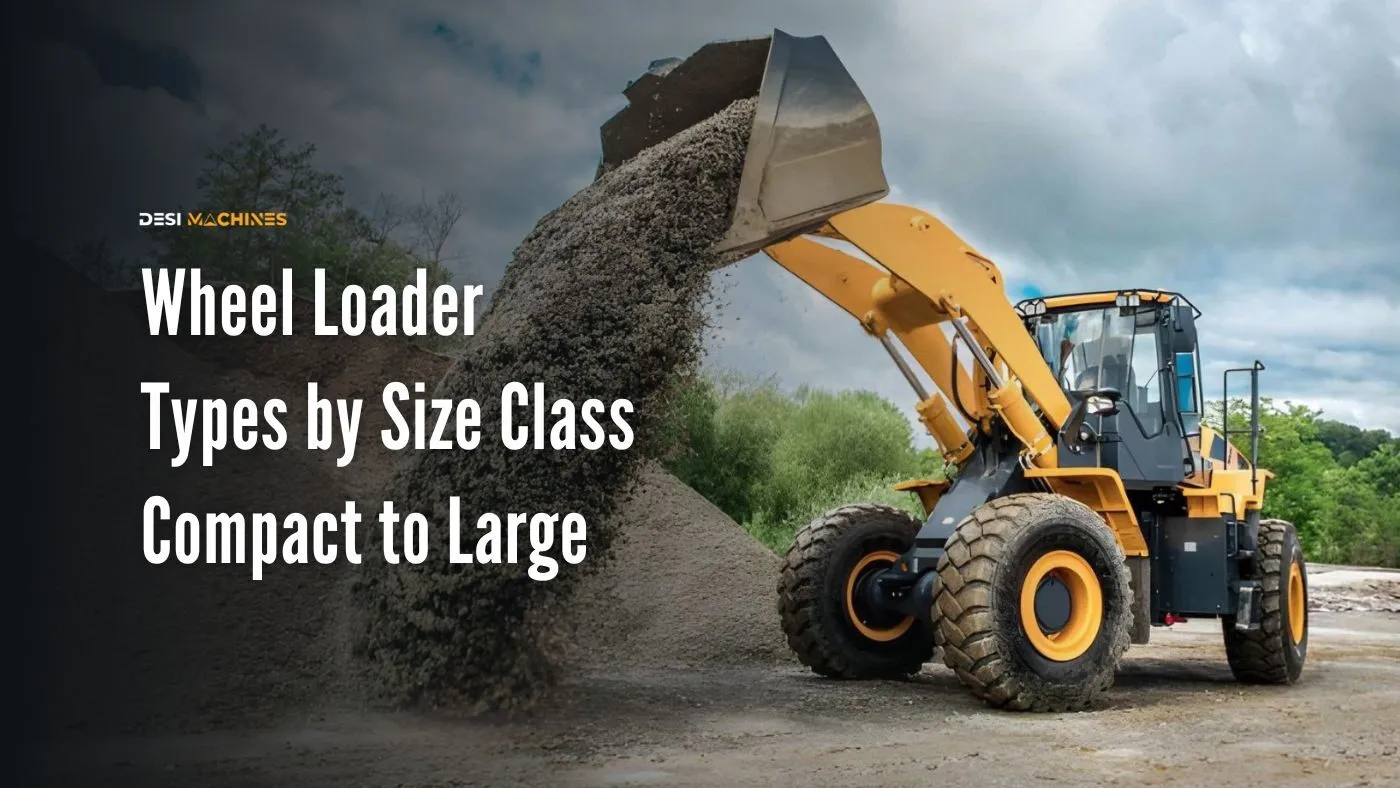
Wheel loaders come in four size classes, set by operating weight: Compact (1 to 8 Tonne), Small (8 to 15 Tonne), Medium (15 to 30 Tonne) and Large (above 30 Tonne). On most Indian sites the machine is simply called a payloader, and the same name covers a 4 Tonne yard loader and a 240 Tonne mining loader. They are completely different machines for completely different jobs. Pick the wrong class and you either pay for capacity you will never use or watch the machine struggle on every shift.
What are wheel loader size classes?
Three numbers describe a wheel loader: operating weight, engine power and bucket capacity. Together they decide what a loader can lift, how fast it can cycle and what ground it can handle. The class itself is set by operating weight alone, which is why the 54 wheel loaders listed on DesiMachines are grouped as Compact (1–8 Ton), Small (8–15 Ton), Medium (15–30 Ton) and Large (above 30 Ton). The figures below are read from those product pages.
Compact wheel loaders (1-8 Ton)
Compact wheel loaders sit in the 1 to 8 Tonne (1,000 to 8,000 kg) class. The two listed here weigh 4,000 kg and 5,610 kg, run 74.5 to 75 HP engines and carry 1.0 to 1.2 m³ buckets. These are the machines you see on tight urban sites, landscaping jobs and farms, where a full-size loader simply won’t fit.
Specifications at a glance:
- Operating weight: 4,000–5,610 kg (4–5.6 Tonne) across the two listed
- Engine power: 74.5–75 HP
- Bucket capacity: 1.0–1.2 m³
Where they work best: Landscaping in Bangalore’s tech parks. Small construction sites in congested areas of Mumbai or Delhi. Agricultural operations across Punjab and Haryana. Municipal work in Tier 2 cities where roads are narrow and turning radius matters. Urban infrastructure projects under Smart City missions where space is at a premium.
The real advantage? Maneuverability. A compact loader can work in spaces a 20 Ton machine can’t even enter, and with about half the engine power of the smallest 8 to 15 Tonne machine it burns less diesel every hour it runs. The two listed are the ACE ALN 100 and the Liugong 818N. The trade-off is lifting capacity. These machines struggle with dense material like wet clay or large aggregate.
Small wheel loaders (8-15 Ton)
Step up to small wheel loaders and you’re looking at the 8 to 15 Tonne (8,000 to 15,000 kg) class. The twelve listed here weigh 9,970 to 12,480 kg, run 121 to 160 HP engines and carry 1.5 to 2.5 m³ buckets as standard, up to 3.5 m³ with a light-material bucket. This is where the balance shifts from pure maneuverability toward real production.
Specifications at a glance:
- Operating weight: 9,970–12,480 kg (10–12.5 Tonne) across the twelve listed
- Engine power: 121–160 HP
- Bucket capacity: 1.5–2.5 m³ standard, up to 3.5 m³ for light material
Where they work best: General construction sites. City infrastructure work. Material handling at warehouses and stockyards. Loading small trucks and tippers. Road construction projects where you need more muscle than a compact but don’t need a 25 Ton machine.
Compared to compact loaders, small loaders deliver much higher breakout force, the push that lets the bucket dig into a stockpile and fill completely. Common machines here include the Tata Hitachi TL340H Prime, the L&T 9020 and the JCB 440-5. That matters when you’re loading crushed stone at a batching plant near Pune or moving sand at a construction site in Hyderabad. The extra weight also provides better stability when lifting loads to full height. These machines handle light to medium duty applications across most Indian construction scenarios.
Medium wheel loaders (15-30 Ton)
Medium wheel loaders are the all-rounders of the 15 to 30 Tonne (15,000 to 30,000 kg) class. The twenty-four listed here weigh 14,500 to 30,090 kg, run 180 to 412 HP engines and carry 2.2 to 5.2 m³ buckets as standard, with light-material buckets up to 16 m³. This class handles the widest variety of Indian construction and quarry work.
Specifications at a glance:
- Operating weight: 14,500–30,090 kg (14.5–30 Tonne) across the twenty-four listed
- Engine power: 180–412 HP, with most machines near 225 HP
- Bucket capacity: 2.2–5.2 m³ standard, up to 16 m³ for light material
Where they work best: Mining operations in Jharkhand and Odisha. Quarrying across Karnataka and Tamil Nadu. Large construction sites on NHAI highway packages. Earthmoving on infrastructure projects. Loading operations at ports and logistics hubs.
Models like the CAT 950GC and JCB 455-5N sit in this category, alongside the XCMG ZL55GV. The versatility is the selling point: one machine handles stockpile work, truck loading and general material handling without being oversized for the job. For contractors running medium-scale projects, this class often gives the best balance between production and running cost, which is how the machine pays for itself.
Compare wheel loader models side by side on DesiMachines, with the specs and listed prices for each.
Large wheel loaders (above 30 Ton)
Large wheel loaders start above 30 Tonne (30,000 kg) and go all the way up to mining machines of more than 240 Tonne. The largest listed here run 31,200 to 242,605 kg, with 357 to 1,847 HP engines and 4.3 to 19.1 m³ buckets as standard, up to 24.5 m³ for light material. These are industrial machines built for continuous, heavy production.
Specifications at a glance:
- Operating weight: 31,200–242,605 kg (31–243 Tonne)
- Engine power: 357–1,847 HP
- Bucket capacity: 4.3–19.1 m³ standard, up to 24.5 m³ for light material
Where they work best: Large-scale mining: coal mines in Chhattisgarh, iron ore in Odisha, limestone quarries in Rajasthan. How the loader fits the rest of a pit’s fleet is covered in the guide to mining equipment. Heavy infrastructure projects. Port operations handling bulk cargo. Industrial stockyard management where daily volumes run into thousands of tonnes.
Machines listed in this class include the Volvo L220H, the Komatsu WA500-6R, the Liugong 8128H, the Tata Hitachi ZW550 and the Cat 988K, with Cat’s K-series running up to the 1,847 HP 994K. They are designed for continuous operation in dust, heat and abrasive material, and cycle times are set for high-volume loading. But running costs match the scale. Fuel, maintenance and operator skill requirements all rise sharply.
How to choose the right wheel loader size class?
Choosing wrong costs real money. Not theoretical money, but lakhs lost every month. Here are the five factors that matter:
1. Project scale and material volume: How many cubic metres are you moving daily? A compact loader moving 50 cubic metres is fine. That same machine trying to move 500 cubic metres will burn out, and so will your timeline. Match the loader to your daily output requirement.
1b. The truck you load: class does not decide loading height on its own, and some medium machines dump lower than small ones; check the figures in the guide to wheel loader dump height and reach before you fix on a class.
2. Workspace and site conditions: Confined urban site in old Delhi? Compact is your only option. Open quarry in Madhya Pradesh? Medium or large makes sense. The turning radius and overall dimensions of the machine must fit your actual working space.
3. Material type and weight: Sand and loose soil load easily. Wet clay and dense aggregate require higher breakout force. Light material such as coal takes a bigger light-material bucket, while stone chips and crusher dust are heavy enough that the bucket must stay within the loader’s payload. Know your material before you size your machine.
4. Operating costs and budget: A larger loader isn’t just more expensive to buy. It is more expensive to run every single day. Fuel, tyres, maintenance, operator wages. If your project doesn’t need the capacity, you’re paying for power you’ll never use. Buying a class smaller and second-hand is often the better trade, and the used wheel loader buying guide sets out what to check before you do. A cheaper machine only saves money if it is sized correctly.
5. Transport and mobility needs: Will the loader move between sites? Compact and small loaders transport easily on standard trailers. Large loaders need special permits, low-bed trailers, and route planning. If you’re working multiple sites across a city, mobility matters.
Travel speed does not rise with class the way most buyers expect; the figures by weight band are in our guide to wheel loader top speed.
How do the wheel loader size classes compare?
Compact vs small: when to choose each
Choose compact when space is the constraint. Urban sites, indoor work, landscaping, agricultural operations. Choose small when you need more production capacity but still work in moderately confined spaces. The jump from compact to small takes the standard bucket from about 1 m³ to 1.5–2.5 m³ and the engine from 75 HP to 121–160 HP, but it also widens your turning circle and raises the running cost.
Medium vs large: application differences
Medium loaders handle most Indian construction and quarrying applications efficiently. Large loaders are specifically for mining and bulk material operations where daily volumes justify the higher operating cost. A medium loader at a mining site will struggle to keep up with production targets. A large loader at a construction site is overkill, and expensive overkill.
Operating cost differences
Fuel use scales roughly with engine power, and the listed large loaders carry five to twenty-five times the power of a compact one (357–1,847 HP against 75 HP). To put a rupee figure on the gap for your own job, multiply the litres per hour the dealer quotes for each machine by your shift hours and the diesel price you pay. Add maintenance, tyres and operator costs, and the gap widens further. Every time.
Still deciding on a size? It helps to first understand how a wheel loader works: the parts, hydraulics and load cycle that make one machine right for your job.
Ready to find the right machine for your project? Explore all models and request a quote on Desi Machines.
For the engine power, torque and emission figures published against each machine currently sold in India, see the wheel loader engine power and torque guide.
Size class also decides whether the machine can reach the site: width, height and turning circle by class are set out in wheel loader dimensions.
Once the size is settled, the tools decide how much of the year the machine earns. Our guide to wheel loader attachments covers buckets, forks, grapples and blades, and what each one does to payload.
Prices, specifications and features are indicative, vary by variant, location and date, and should always be confirmed with the official OEM or authorised dealer before any purchase decision. DesiMachines is not liable for decisions taken on the basis of information that may have changed after publication.
Machines, tenders and news for this industry: Steel, Cement and Process Plants · Ports and Dredging · Power and Renewable Energy