
 Excavator
294 models
Excavator
294 models  Backhoe Loader
51 models
Backhoe Loader
51 models  Crane
68 models
Crane
68 models  Concrete Mixer
79 models
Concrete Mixer
79 models  Wheel Loader
54 models
Wheel Loader
54 models  Compactor / Roller
45 models
Compactor / Roller
45 models  Motor Grader
42 models
Motor Grader
42 models 
 Concrete Pump
66 models
Concrete Pump
66 models  Skid Steer Loader
11 models
Skid Steer Loader
11 models 


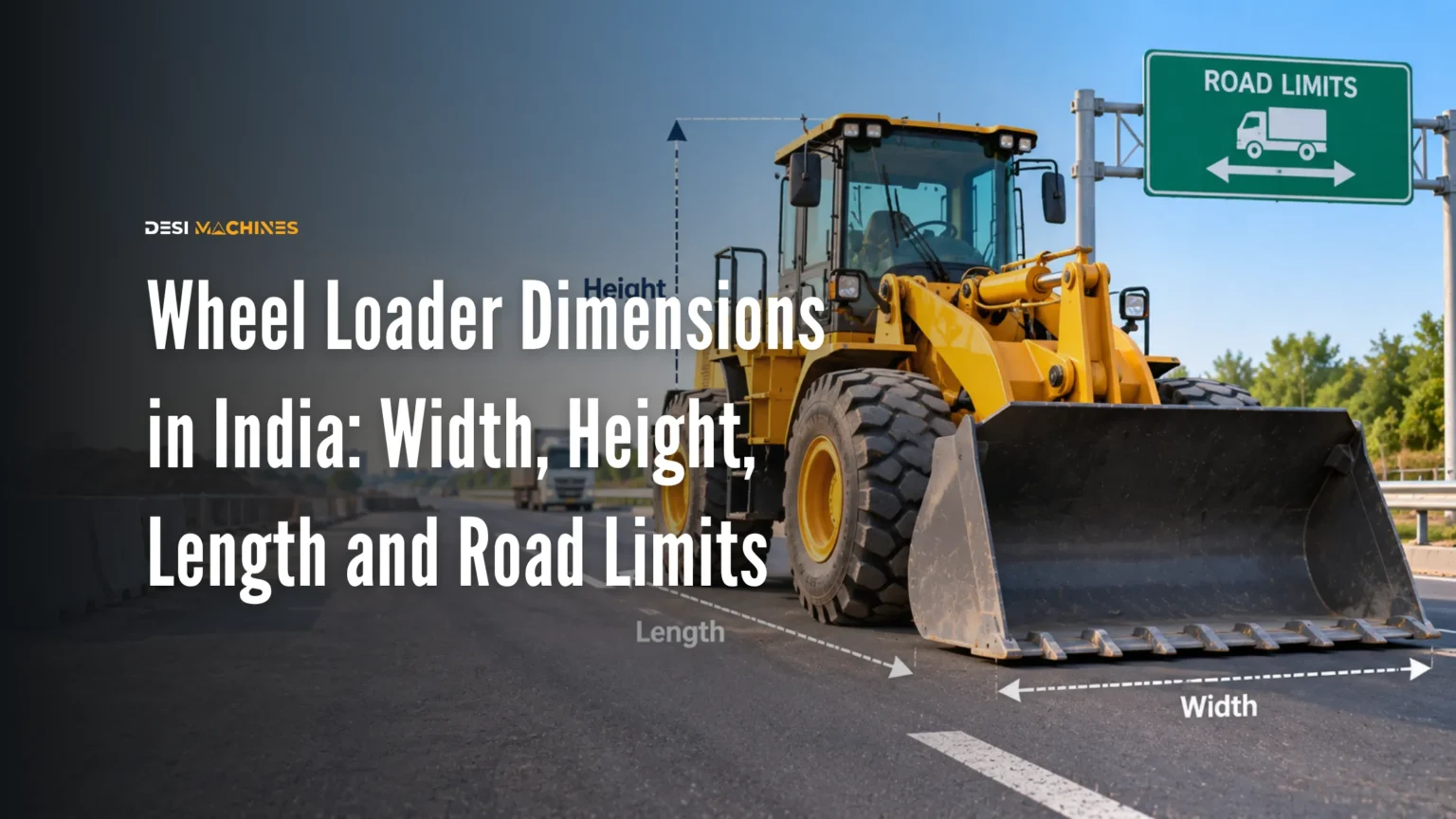
Wheel loader dimensions are the machine’s overall width, height, length, wheelbase and ground clearance — the five numbers that decide whether the machine fits through your gate, under your shed roof, down your approach road and onto a trailer. Across the 54 wheel loaders on these listings, width runs from 1,948 mm (1.95 m) on the smallest compact machine to 5,758 mm (5.76 m) on the largest mining loader, and height over the cab from 2,873 mm (2.87 m) to 7,118 mm (7.12 m).
Most first-time buyers ask about lifting capacity first. Dimensions are what actually stop the work. A machine that cannot turn inside your yard, or that has to wait three days for a transport permit, is costing you money whatever its bucket holds.
There is one number in this guide that matters more than the rest, and it is width. The legal width for a vehicle on an Indian road is 2.6 metres. Of the 45 wheel loaders here that publish a width figure, 32 are wider than that. This is where a wheel loader behaves differently from a backhoe loader or a telehandler, and it is worth understanding before you buy rather than on the morning the machine is due to arrive.
How wide is a wheel loader?
A wheel loader on these listings is between 1,948 mm (1.95 m) and 5,758 mm (5.76 m) wide across the tyres, and the working machines most Indian contractors buy sit between 2,300 mm (2.3 m) and 3,012 mm (3.01 m). Width over tyres is published for 46 of the 54 machines.
Width climbs with size class, but not evenly:
- Compact, under 8 tonne: 1,948 mm (1.95 m) on the Liugong 818N, the only compact machine here publishing a width.
- Small, 8 to 15 tonne: 2,300 mm to 2,500 mm (2.3 m to 2.5 m) across 11 machines.
- Medium, 15 to 30 tonne: 2,300 mm to 3,012 mm (2.3 m to 3.01 m) across 22 machines — the widest is the Cat 966H.
- Large, over 30 tonne: 3,150 mm to 5,758 mm (3.15 m to 5.76 m). These are quarry and mining machines.
Two different width figures appear on a spec sheet and they are easy to confuse. Wheel tread is measured from the centre of one tyre to the centre of the tyre on the other side. Width over tyres is measured from the outside edge of one tyre to the outside edge of the other. The second is the one that has to fit through your gate.
The gap between them is the part of the tyres that sticks out past the axle. Across the 43 machines publishing both figures, that gap runs from 385 mm to 1,458 mm, with a middle value of 650 mm. It is a useful check: if a spec sheet gives you only the tread, the machine is roughly half a metre wider than that number. It also means changing to a wider tyre changes the width of the machine, which is worth remembering before you fit something bigger than standard. Wheel loader tyre sizes covers what the markings on the sidewall mean.
Will a wheel loader fit on an Indian road?
Only if it is under 2.6 metres wide, or under 3 metres and marked correctly. Rule 93 of the Central Motor Vehicles Rules, 1989 caps the overall width of a motor vehicle at 2.6 metres, and allows a construction equipment vehicle up to 3 metres in travel mode — but the width beyond 2.6 metres has to carry yellow and black zebra stripes front and rear, with red lamps for night movement. Overall height is capped at 3.8 metres. The over dimensional cargo permit guide sets out the full table and who arranges the permit.
Measured against those limits, the machines here fall into three groups:
| Width over tyres | Machines | What it means for a move |
|---|---|---|
| 2,600 mm (2.6 m) or under | 13 of 45 | Within the ordinary vehicle limit on width |
| 2,601 mm to 3,000 mm (2.6 m to 3 m) | 17 of 45 | Allowed in travel mode with zebra marking and lamps |
| Over 3,000 mm (3 m) | 15 of 45 | Over the width limit — a permitted, escorted move |
Two things owners get wrong here. The first is that these are the machine’s own dimensions — once it is loaded on a trailer, it is the whole combination that gets measured, and the trailer bed adds height underneath. The second is assuming every machine class behaves the same way. It does not: on telehandler weight and dimensions the widest machine is 2,540 mm, so no telehandler here crosses the 2.6 metre line, and most backhoe loaders sit well inside it, so an owner moving up from a backhoe to a wheel loader meets the width question for the first time.
How tall is a wheel loader?
Height over the cab runs from 2,873 mm (2.87 m) to 7,118 mm (7.12 m) across the 47 machines with a usable figure, and the working classes are remarkably consistent. A small 8 to 15 tonne machine stands 3,072 mm to 3,340 mm (3.07 m to 3.34 m) tall. A medium 15 to 30 tonne machine stands 3,360 mm to 3,590 mm (3.36 m to 3.59 m) — a spread of just 230 mm across 19 machines.
That consistency is worth knowing. Doubling the operating weight from 15 tonnes to 30 tonnes buys you far more bucket and far more push, but it adds almost nothing to how tall the machine is, because the cab is sized around a person either way. Height is rarely the reason to choose one machine over another in this class; it is a shed-and-gate check, not a buying criterion.
Height over the exhaust is published for 22 machines. On almost all of them the exhaust sits below the cab roof, so cab height is the tallest point. On the biggest mining machines the pattern reverses and the stack stands above the cab — the Cat 988K publishes 4,187 mm over the cab and 4,498 mm over the exhaust. If you are moving a machine that size, measure to the stack.
For transport, remember the 3.8 metre height cap applies to the loaded vehicle, not the machine standing in your yard. A 3.5 metre machine on a trailer bed is already close to the line before anything else is added. Do not confuse cab height with hinge pin height, which is how high the loader arms lift the bucket pivot and is a working figure, not a transport one — dump height and reach covers that side.
How long is a wheel loader, and what does the wheelbase tell you?
Overall length with the bucket on the ground runs from 5,800 mm (5.8 m) on a compact machine to 19,508 mm (19.51 m) on the largest mining loader, and it is published for 52 of the 54 machines. A small machine is 7,034 mm to 7,700 mm (7.03 m to 7.7 m) long. A medium machine is 7,150 mm to 9,545 mm (7.15 m to 9.55 m), the longest being the Liebherr L580.
Length with bucket is measured with the bucket flat on the ground in front of the machine. Roughly a third of that length is bucket and loader arms hanging out in front of the front axle, which is why a wheel loader needs more room to manoeuvre than its wheelbase suggests.
The wheelbase is the distance from the centre of the front axle to the centre of the rear axle: 2,658 mm to 3,050 mm on small machines, 2,660 mm to 3,970 mm on medium ones. A longer wheelbase rides steadier over rough ground and is more stable with a full bucket at height. A shorter one turns tighter. Because a wheel loader steers by bending in the middle rather than by turning its front wheels, the wheelbase and the turning circle are linked directly — how a wheel loader works explains the articulated joint.
What is the turning radius of a wheel loader?
Turning radius over the bucket runs from 5,598 mm (5.6 m) to 8,075 mm (8.08 m) on machines under 30 tonnes, and it is the figure that decides whether the machine can work inside your yard. It is published for 37 machines; a second figure, turning radius over the tyres, is published for 39.
| Size class | Machines with a figure | Turning radius over bucket |
|---|---|---|
| Small (8 to 15 tonne) | 13 | 5,598 mm to 6,470 mm (5.6 m to 6.47 m) |
| Medium (15 to 30 tonne) | 17 | 6,026 mm to 8,075 mm (6.03 m to 8.08 m) |
| Large (over 30 tonne) | 6 | 7,935 mm to 11,308 mm (7.94 m to 11.31 m) |
Take the over-bucket figure, not the over-tyres one. The bucket corner sweeps the widest circle, and the bucket corner is what hits your compound wall. The radius is half the circle, so a machine with a 6,000 mm turning radius needs roughly 12 metres of clear width to swing right around. The tightest turner here is the Hindustan 2021E at 5,598 mm.
How much ground clearance does a wheel loader have?
Between 270 mm and 535 mm on machines under 30 tonnes, published for 52 of the 54 machines. Ground clearance is the gap between the lowest fixed point under the machine and the ground, and on a wheel loader that low point is usually the axle housing or the articulation joint.
It matters in two places. On an unmade approach road with a high centre ridge, a low machine drags. On a site where you cross kerbs, rubble or a raised plinth, clearance decides whether you cross it or go round. The compact ACE ALN 100 publishes 270 mm; medium machines run 368 mm to 535 mm, and the mining machines go up to 898 mm because they work broken ground all day.
Clearance is not something to chase for its own sake. A machine with more clearance sits higher, so its centre of gravity is higher and it is less steady with a full bucket at full lift. That trade-off is the same one behind tipping load.
Wheel loader dimensions by size class
The four size classes below are the ones used across the industry and set out in wheel loader types by size class. Every figure is taken from the machines’ own published specifications, and the machine count for each figure is shown because not every machine publishes every dimension.
| Dimension | Compact (under 8 t) | Small (8–15 t) | Medium (15–30 t) | Large (over 30 t) |
|---|---|---|---|---|
| Machines in class | 2 | 13 | 23 | 16 |
| Width over tyres | 1,948 mm (1 machine) | 2,300–2,500 mm | 2,300–3,012 mm | 3,150–5,758 mm |
| Height over cab | 2,873 mm (1 machine) | 3,072–3,340 mm | 3,360–3,590 mm | 3,710–7,118 mm |
| Length with bucket | 5,800–5,893 mm | 7,034–7,700 mm | 7,150–9,545 mm | 9,410–19,508 mm |
| Wheelbase | 2,100–2,200 mm | 2,658–3,050 mm | 2,660–3,970 mm | 3,600–6,800 mm |
| Ground clearance | 270–490 mm | 318–479 mm | 368–535 mm | 440–898 mm |
| Turning radius over bucket | 6,000 mm (1 machine) | 5,598–6,470 mm | 6,026–8,075 mm | 7,935–11,308 mm |
Fourteen machines publish operating weight as a range rather than a single figure, because a fully-equipped machine weighs more than a base one. Each of those is placed in its class on the lower figure. The compact class has only two machines on these listings, so treat its figures as two examples rather than a class span.
Compare wheel loader models and prices and check the dimensions on the machine you are actually considering before you commit to it.
How to check your site before the machine arrives
Measure four things and you will avoid almost every dimension problem contractors run into.
- Gate and compound entry. Measure the narrowest point, not the gate posts. Allow at least 300 mm clear either side of the machine’s width over tyres — an operator on an unfamiliar machine will not thread a 2.5 metre loader through a 2.6 metre gap.
- Shed and overhead clearance. Compare cab height against the shed door, and look for cables, pipe runs and low branches along the route inside the yard.
- Turning room. Take the turning radius over the bucket and double it. If the yard cannot give you that width anywhere, the machine has to reverse out every time.
- The approach road and the trailer. Check the machine’s width against the 2.6 metre and 3 metre lines above, and remember the loaded height on a trailer is machine height plus bed height. Settle who is arranging the permit before the machine is loaded, not after.
If the machine is coming on hire rather than being bought, the same checks apply and the transporter usually handles the permit — hire terms usually say who arranges it. For a second-hand machine, check the dimensions against the tyres actually fitted rather than the brochure, since non-standard tyres change the width: the used wheel loader checks go through the rest.
A note on the figures in this guide
Every number here comes from the machines’ own published specifications. Coverage is not complete, and it is more honest to say where: of the 54 machines, 52 publish overall length, wheelbase and ground clearance, 49 publish height over cab, 46 publish width over tyres, and all 54 publish a tyre size. The two ACE machines, the ALN 300 and the ALN 500, publish no dimension figures at all.
Three published figures contradict the machine’s own other specifications and have been left out of the ranges above rather than used. The Hyundai HL950I publishes a height over cab of 400 mm on a 17,700 kg machine, which is the same as its own ground clearance figure. The JCB 455-5N publishes a height over cab of 2,400 mm that sits below its own height over exhaust of 3,220 mm on an 18,000 kg machine. The JCB 433-5 publishes a width over tyres of 2,230 mm identical to its own wheel tread, which cannot be right because the tyres always stand outside the tread. Separately, the XCMG ZL33FV and the XCMG ZL55GV both publish 2,300 mm width despite one weighing 10,600 kg and the other 17,300 kg; both are included above, but ask the dealer to confirm the width in writing before you plan a move around either.
Prices, specifications and features are indicative, vary by variant, location and date, and should always be confirmed with the official OEM or authorised dealer before any purchase decision. DesiMachines is not liable for decisions taken on the basis of information that may have changed after publication.
Wheel loader dimensions: the short version
- Width is the number that decides transport. Of 45 machines publishing one, 13 are within 2.6 metres, 17 sit between 2.6 and 3 metres, and 15 are over 3 metres.
- Width over tyres is roughly 650 mm more than wheel tread. Bigger tyres make the machine wider.
- Cab height barely changes inside a class — every medium machine here stands between 3,360 mm and 3,590 mm.
- Turning radius over the bucket, doubled, is the yard width you need.
- Ground clearance runs 270 mm to 535 mm below 30 tonnes; more clearance means a higher, less steady machine.
- Measure your gate, your shed, your turning room and your approach road before you sign anything.
Read next: the main parts of a wheel loader. For the same figures on other machines, see backhoe loader dimensions and road roller dimensions.
Frequently Asked Questions (FAQ)
Between 1,948 mm (1.95 m) and 5,758 mm (5.76 m) across the tyres, on the 46 machines that publish a width figure. Small 8 to 15 tonne machines run 2,300 mm to 2,500 mm, medium 15 to 30 tonne machines 2,300 mm to 3,012 mm, and machines over 30 tonnes 3,150 mm upwards. Use width over tyres, not wheel tread — the tyres stand about 650 mm wider than the tread figure.
Rule 93 of the Central Motor Vehicles Rules, 1989 caps the overall width of a motor vehicle at 2.6 metres, and allows a construction equipment vehicle up to 3 metres in travel mode if the width beyond 2.6 metres carries yellow and black zebra stripes front and rear plus red lamps for night movement. Overall height is capped at 3.8 metres. Of the 45 wheel loaders publishing a width, 13 are within 2.6 metres, 17 sit between 2.6 and 3 metres, and 15 are over 3 metres and need a permitted move.
Height over the cab runs from 2,873 mm (2.87 m) to 7,118 mm (7.12 m). A small machine stands 3,072 mm to 3,340 mm and a medium machine 3,360 mm to 3,590 mm — only 230 mm of difference across 19 medium machines, because the cab is sized around a person whatever the machine weighs. On a trailer it is the loaded height that counts against the 3.8 metre cap, so add the trailer bed height.
5,598 mm to 8,075 mm over the bucket on machines under 30 tonnes. Small machines turn in 5,598 mm to 6,470 mm, medium machines in 6,026 mm to 8,075 mm. Take the over-bucket figure rather than the over-tyres one, because the bucket corner sweeps the widest circle, and double it to get the yard width the machine needs to turn right around.
Wheel tread is measured from the centre of one tyre to the centre of the tyre on the other side. Width over tyres is measured from the outside edge of one tyre to the outside edge of the other, and that is the figure that has to fit through your gate. Across the 43 machines publishing both, the gap between them runs from 385 mm to 1,458 mm with a middle value of 650 mm. Fitting wider tyres makes the machine wider.
