
 Excavator
294 models
Excavator
294 models  Backhoe Loader
51 models
Backhoe Loader
51 models  Crane
68 models
Crane
68 models  Concrete Mixer
79 models
Concrete Mixer
79 models  Wheel Loader
54 models
Wheel Loader
54 models  Compactor / Roller
45 models
Compactor / Roller
45 models  Motor Grader
42 models
Motor Grader
42 models 
 Concrete Pump
66 models
Concrete Pump
66 models  Skid Steer Loader
11 models
Skid Steer Loader
11 models 


A wheeled excavator carries its boom, arm and bucket on a rubber-tyred, road-going undercarriage, while a crawler excavator carries the same upper structure on steel or rubber tracks. Everything below the slewing ring is the difference, and that difference decides where the machine can work, how it travels between sites, and what it costs you to keep running. That is the whole of the wheeled vs crawler excavator decision.
Get it wrong and the loss does not show up in the purchase price. It shows up afterwards — in a machine that sinks, a machine that waits for a trailer, or a surface-repair penalty on a road you have just finished. Contractors in Pune have bought wheeled machines for canal work in black cotton soil and got stuck within a week. Highway contractors in Rajasthan have hauled crawlers on trailers between sites 8 km apart, when a wheeled machine would have driven itself. This guide breaks down every factor that matters so you don’t make either mistake.
What is a Crawler Excavator?
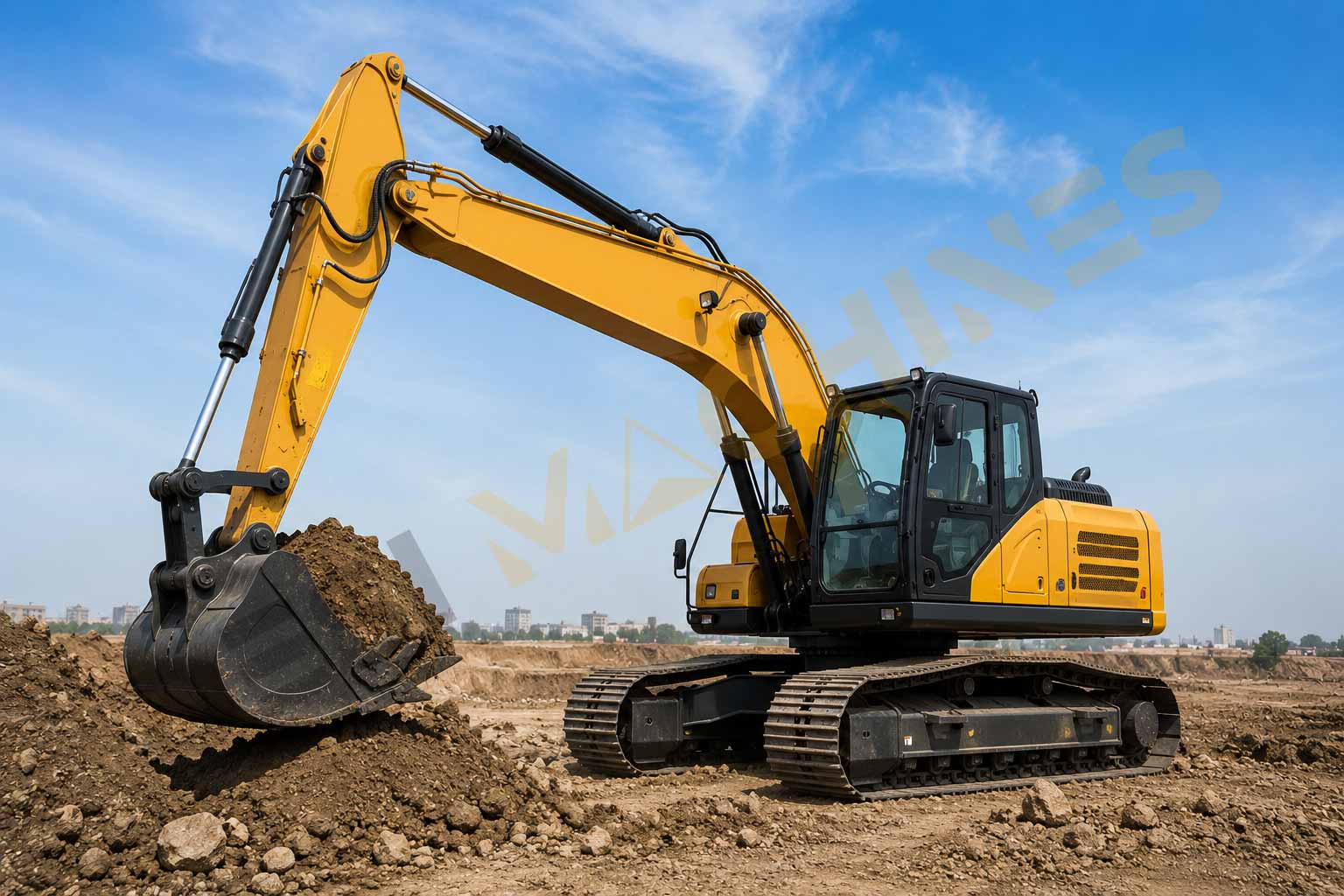
A crawler excavator — also called a tracked excavator — moves on continuous steel or rubber tracks instead of wheels. Those tracks wrap around a system of rollers, idlers, and sprockets that form the undercarriage. The upper structure sits on a slewing ring, allowing 360-degree rotation. Our crawler excavator guide covers the size classes, specs and price ranges in more detail. Same components you’d find on any excavator: boom, dipper arm (also called stick), bucket, and operator cab.
The tracked base is what defines this machine. Tracks spread the excavator’s weight along the full length of both track frames instead of four tyre contact patches, which is why a crawler does not sink into soft soil the way a wheeled machine does. Ground bearing pressure is published for 225 of the 294 excavators listed on Desi Machines, in kilopascals (kPa), and the figures by size class are set out in the guide to excavator ground pressure. In India, crawlers dominate: of the 294 excavators listed on Desi Machines, exactly one is a wheeled machine. The SANY SY210C-9, Tata Hitachi EX 210LC Prime, JCB NXT 205LC, and Hyundai R215 SMART X Plus — all crawlers. All built for the terrain most Indian sites throw at them.
The tracks and rollers a crawler runs on are its costliest wear parts, so it pays to understand the excavator undercarriage and how to maintain it.
What is a Wheeled Excavator?
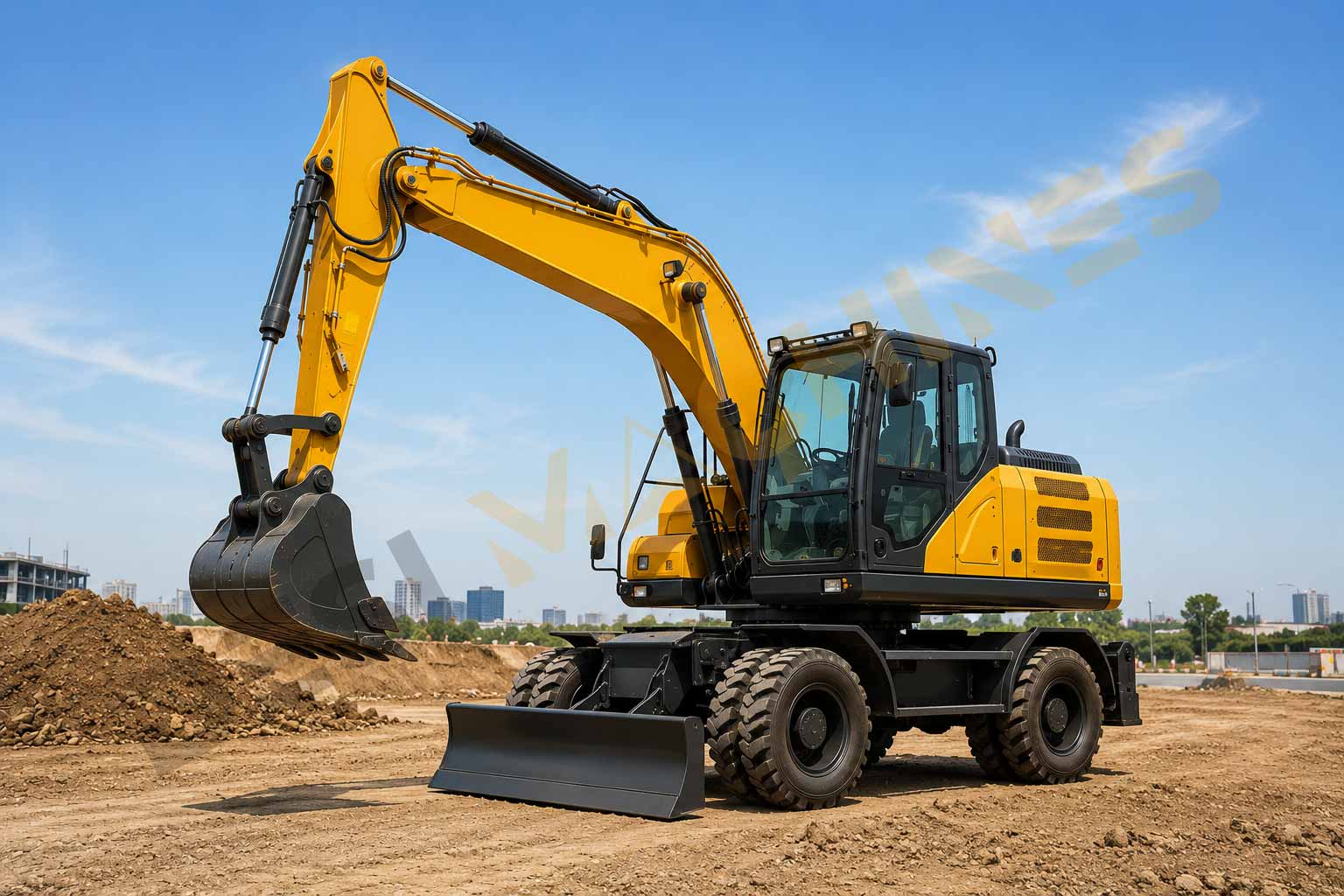
A wheeled excavator mounts the same upper structure—boom, arm, bucket, and cab—on a rubber-tired undercarriage. Typically four wheels, sometimes more. Pneumatic tires provide mobility, and the machine can travel on roads at up to 37 km/h — that is the top travel speed published for the SANY SY155W, the one wheeled excavator we list. That is roughly six times the top speed of the fastest crawler on our books.
The upper works identically to a crawler. Same hydraulic systems. Same digging motion. Same attachments. The difference is entirely below the slewing ring. Wheeled excavators are a common sight on European sites and stay rare here. The SANY SY155W at ₹90–95 Lakh (indicative, as of September 2026) is currently the only wheeled excavator listed on Desi Machines. But that’s changing. Urban infrastructure projects, smart city missions, metro rail corridors—these need machines that can move fast on paved surfaces without tearing them up.
Key Differences Between Wheeled and Crawler Excavators
The undercarriage changes everything. Mobility, terrain handling, stability, maintenance costs, transport logistics — all different. Understanding these differences isn’t academic. It’s the difference between a machine that earns money and one that sits idle waiting for a trailer or sinking into mud. Here’s each factor, one at a time.
1. Mobility and Travel Speed
Crawler excavators move at 2.0–6.1 km/h. That is the real span across the 264 crawler excavators on Desi Machines that publish a top travel speed, and more than half of them sit between 5 and 6 km/h. Designed for stability, not speed. Moving a crawler between sites 10 km apart? You’re loading it onto a flatbed trailer, driving to the new site, unloading. That’s 2–3 hours minimum. Plus trailer rental. Plus a driver with the right licence.
Wheeled excavators travel far faster on roads. The SANY SY155W publishes a top travel speed of 37 km/h and can drive itself between sites. No trailer. No loading time. No CDL headaches. For contractors running multiple small jobs across a city — utility work, road repairs, building foundations — this changes how the day runs. A wheeled machine can hit three sites in a day. A crawler? Maybe one, if the trailer shows up on time.
But here’s the catch. That speed advantage only matters if your sites are connected by paved roads. A wheeled excavator driving across a muddy field at 5 km/h isn’t faster than a crawler. It’s stuck.
2. Terrain Adaptability and Ground Conditions
Crawlers win on rough terrain. Soft soil, mud, rocky ground, slopes, uneven surfaces — tracks handle all of it. The weight distribution prevents sinking. In black cotton soil near Nagpur, waterlogged clay in Bengal during monsoon, sandy riverbeds in UP — a crawler keeps working. A wheeled machine would need stabilizers deployed constantly, and even then, mobility between dig points becomes a problem.
Wheeled excavators need firm ground. Asphalt, concrete, compacted gravel, dry hard-packed soil. They perform brilliantly in urban environments where the ground is already prepared. But take a wheeled machine onto a soft construction site after rain? You’re calling for a tow.
The site decides the machine. A highway project through Madhya Pradesh with rocky outcrops and unprepared ground? Crawler. Municipal utility work in Ahmedabad on paved streets? Wheeled makes more sense.
3. Stability and Ground Pressure
Crawler excavators have lower ground pressure, because the tracks create a large contact area rather than four small ones. That figure is published for 225 of the 294 excavators listed here, so check it against the worst ground on your own site rather than working off a rule of thumb. What they do publish is gradeability — the slope the machine can climb — and on the 224 excavators that carry it, the house standard is 70% (35°). You can dig on uneven ground without worrying about tipping.
Wheeled excavators concentrate weight on four tire contact points. Higher ground pressure. Less inherent stability. But modern wheeled machines compensate with outriggers (stabilizer legs) and a front dozer blade. Deploy the outriggers, lower the blade, and the machine becomes stable enough for serious digging. The SANY SY155W has hydraulic outriggers that extend automatically.
The difference shows up in dynamic work. A crawler can swing a loaded bucket over the side while moving. A wheeled machine needs to be stationary with stabilizers down for the same operation. Not a problem for trench work. Big problem for loading trucks while repositioning.
4. Lifting Capacity and Digging Performance
Crawlers generally offer higher lifting capacity — especially over the side and rear. The tracked base provides a stable platform for heavy lifts. Breakout force (the force the bucket applies to break into hard material) tends to be higher on crawlers of equivalent size. For deep excavation, quarry work, heavy material handling — crawlers are the default.
Wheeled excavators match crawler digging performance when stabilizers are deployed. The SANY SY155W publishes a bucket digging force of 102.3 kN; the 20 crawler excavators we list in the same 13,000–15,500 kg weight band run 77.7 to 110.7 kN, with a median of 93.6 kN. On digging force the wheeled machine sits at the strong end of its class, not behind it. Lifting over the side is the weaker point, because the load goes through tyres and outriggers rather than a tracked frame. Our listings do not publish an over-side lift chart, so ask the dealer for one before you commit. For light to medium-duty work — trenching, utility installation, foundation digging — wheeled machines handle the job. For moving 3 Ton concrete blocks? Stick with a crawler.
5. Maneuverability in Tight Spaces
Wait — let me back up. Both machine types can rotate 360 degrees on the spot. The upper structure swings independently of the undercarriage. So “maneuverability” here means something specific: how easily can the whole machine reposition within a confined site?
Wheeled excavators have a tighter turning radius. They can drive forward, reverse, and steer like a truck. In narrow urban streets, between buildings, in congested city blocks — a wheeled machine repositions faster. Quick three-point turns. No track marks left behind.
Crawlers can counter-rotate tracks to spin in place, but moving the whole machine forward through a tight space is slower. Better for stationary work where the upper structure does all the repositioning.
For metro rail station excavation in Chennai or basement digs in Mumbai’s tight plots, wheeled machines offer real advantages in getting into position.
6. Surface Impact and Ground Damage
This is where wheeled excavators earn their keep in urban India.
Crawler tracks damage finished surfaces. Steel tracks chew up asphalt. Rubber tracks are gentler but still leave marks on pavement, tear up lawns, and create ruts in soft ground. If you’re working on a completed road, in a residential colony, or anywhere with surface damage penalties — a crawler is a liability.
Wheeled excavators roll on rubber tires. Minimal surface impact. They can drive across finished pavement without leaving a trace. For Smart City projects, municipal work, landscaping, and any job where the client will charge you for surface repairs — wheeled is the only sensible choice.
Surface-repair penalties are written into the contract before you start, not negotiated after the damage. If the tender says no track damage, a crawler is the wrong machine for that job and no amount of care on site changes it.
7. Fuel Efficiency and Operating Costs
Wheeled excavators are more fuel-efficient on hard surfaces. Lower rolling resistance. The tires don’t fight the ground the way tracks do. For a machine that spends much of its time travelling between dig points on paved roads, that saving adds up. No manufacturer publishes a litres-per-hour figure for either type, so measure your own: log the diesel you actually burn over a paved-site month and a soft-site month, and compare the two.
Crawlers consume more fuel — especially when travelling on hard surfaces where track friction is highest. But on soft ground, the efficiency gap narrows. A crawler working in mud isn’t fighting rolling resistance; it’s using that track grip productively.
The real operating cost difference comes from how you use the machine. A wheeled excavator doing urban utility work saves fuel. The same wheeled machine struggling through a muddy site burns more than a crawler would.
8. Transportation Requirements
Crawlers need trailers. Every site move requires a flatbed or lowboy. Loading takes 20–30 minutes. Unloading the same. You need a driver with appropriate licensing. Trailer hire is charged per move and climbs with distance. We do not publish a trailer rate card, so price it with your own transporter for the distances you actually run, then multiply by your moves per month. That figure is the transport cost a wheeled machine removes — before fuel.
Wheeled excavators drive themselves. The SANY SY155W is road-legal. It can tow a trailer carrying attachments and tools. No separate transport vehicle. No loading/unloading time. For multi-site urban contractors, this eliminates an entire cost category.
That said — if your sites are 100 km apart on highways, a wheeled excavator driving at 37 km/h isn’t practical either. The self-transport advantage works for urban and peri-urban operations where sites are 5–30 km apart.
9. Maintenance Costs and Requirements
Crawler undercarriages are expensive to maintain. Tracks, rollers, idlers, sprockets — these are wear items. On hard surfaces, tracks wear faster. A full track replacement on a 20 Ton excavator is the single biggest running-cost item the machine will hand you. We do not list spare parts, so get it quoted by your dealer for your exact model rather than working off a general figure. Undercarriage components need regular inspection. Tension adjustment. Lubrication. The complexity adds up.
Wheeled excavators have simpler undercarriages. Tires wear out, but a full set costs a fraction of a track set. Get both quoted by your dealer and compare them over the hours you actually run. Steering and suspension systems need maintenance, but access is easier. Overall maintenance costs run 20–30% lower for wheeled machines in appropriate applications.
Here’s the catch: “appropriate applications” is doing heavy lifting in that sentence. A wheeled excavator working on rough terrain destroys tires and suspension components. A crawler on soft ground is in its element. Match the machine to the terrain, and maintenance costs stay predictable.
10. Purchase Price and Initial Investment
Crawlers are cheaper upfront. The 20 Ton class is the mature end of the market and the prices show it. All three below are indicative, as of September 2026: the SANY SY210C-9 is listed at ₹51–57 Lakh (as of September 2026), the JCB NXT 205LC at ₹53–58 Lakh (as of September 2026) and the Tata Hitachi EX 210LC Prime at ₹60–65 Lakh (as of September 2026). Competition is fierce and prices reflect that.
Wheeled excavators cost more. The SANY SY155W at ₹90–95 Lakh (indicative, as of September 2026) is a 13.5 Ton (13,500 kg) machine priced above every 20 Ton crawler listed above. Less competition in India. Lower production volumes. Import costs for some components. The sticker price shock is real.
But sticker price isn’t total cost. A wheeled excavator that removes most of your trailer bill and burns less diesel on paved roads claws that premium back over the life of the machine — how fast depends entirely on your own transport and fuel numbers, so run them before you decide. Compare first, then buy: Desi Machines exists precisely because that one-number comparison misses the full picture.
Compare excavator models side-by-side on Desi Machines — check specs, get transparent pricing.
Crawler vs Wheeled Excavator: Comparison Table
| Factor | Crawler Excavator | Wheeled Excavator |
|---|---|---|
| Travel Speed | 2.0–6.1 km/h (264 machines listed) | 37 km/h (SANY SY155W) |
| Best Terrain | Soft, muddy, rocky, uneven, slopes | Paved, compacted, firm surfaces |
| Ground Pressure | Lower (weight spread along both tracks; published in kPa on most crawler machines) | Higher (concentrated on four tyres) |
| Stability | Excellent on all terrain | Good with outriggers deployed |
| Lifting Capacity | Higher, especially over side | Lower over side (lift chart not published — ask the dealer) |
| Surface Damage | High on finished surfaces | Minimal |
| Fuel Efficiency | Lower on hard surfaces | Higher on paved roads |
| Transport | Requires trailer | Self-transporting on roads |
| Maintenance Cost | Higher (track system) | Lower (tire system) |
| Purchase Price | ₹51–65 Lakh, 20 Ton class (indicative, as of September 2026) | ₹90–95 Lakh, SANY SY155W 13.5 Ton (indicative, as of September 2026) |
| Best Applications | Mining, quarries, rural infrastructure, heavy excavation | Urban construction, utilities, road maintenance, multi-site work |
Factors to Consider When Choosing Between Wheeled and Crawler Excavators
The comparison table gives you the facts. Now you need a decision framework. Every contractor’s situation is different. Here’s how to think through the choice systematically.
Job Site Terrain and Ground Conditions
Start here. Everything else is secondary.
If your primary work surface is soft, muddy, or unprepared — black cotton soil, waterlogged clay, sandy riverbeds, rocky hillsides — a crawler is the only practical choice. A wheeled excavator will struggle, get stuck, or destroy its tires. No amount of fuel savings compensates for a machine that can’t work.
If your work is primarily on paved or compacted surfaces — urban roads, industrial yards, established construction sites with prepared ground — a wheeled excavator makes sense. You’ll move faster, damage less, and spend less on transport.
Am I overcomplicating this? No. The terrain question really is that decisive. Get it wrong, and nothing else matters.
Project Duration and Location
Long-term single-site projects favour crawlers. If you’re on one site for 6–18 months — a highway package, a large housing project, a mining operation — the crawler’s stability and heavy-duty capability matter more than mobility. You’re not moving between sites. Transport costs are a one-time expense.
Short-term multi-site projects favour wheeled machines. Municipal contracts with 20 small jobs across a city. Utility installation work. Road repair tenders. If you’re moving every few days, the wheeled excavator’s self-transport capability saves time and money every single move.
Mobility and Transportation Needs
Calculate this honestly. How often does your machine relocate? What’s the distance?
If you move once a month and sites are 50+ km apart — trailer transport for a crawler is manageable. If you move twice a week and sites are 5–15 km apart — trailer logistics become a full-time headache. A wheeled machine eliminates that headache entirely.
Also consider: do you own a suitable trailer? Do you have access to a CDL driver? If not, every move means coordinating with a transport contractor. That’s time, money, and dependency on someone else’s schedule.
Scope of Work and Task Requirements
Heavy-duty work favours crawlers. Deep excavation. Quarry loading. Heavy material handling. Demolition with large breakers. If you’re moving 500+ cubic metres per day or lifting loads over 2 Ton regularly, the crawler’s stability and power matter.
Light to medium work suits wheeled machines. Trenching for utilities. Foundation digging for residential buildings. Road shoulder work. Landscaping. If your typical lift is under 1.5 Ton and your digging depth is under 4 metres, a wheeled excavator handles it fine.
Budget: Purchase Price vs Operating Costs
The crawler costs less to buy. The wheeled excavator often costs less to operate — if you’re in the right application.
Run the numbers for your specific situation:
- Transport costs: How many moves per year × cost per move
- Fuel difference: Estimate 10–15% savings for wheeled on urban work
- Maintenance: Track replacement every 3,000–4,000 hours vs tire replacement every 2,000–3,000 hours
- Surface damage penalties: If applicable to your contracts
On our current listings the wheeled machine’s premium is the gap between the crawler bands and the SY155W’s ₹90–95 Lakh (indicative, as of September 2026). Work out what it saves you in a year on transport, diesel and surface penalties, divide the premium by that, and you have your payback in years. After that, it’s pure margin. The machine pays for itself — but only if you’re using it where it belongs.
Surface Damage Regulations and Environmental Impact
Some contracts specify no track damage. Smart City projects, municipal tenders, work in residential areas — surface protection requirements are increasingly common. If your tender documents include surface damage clauses, a wheeled excavator isn’t optional. It’s mandatory.
Check the specs before bidding. A contractor who wins a job assuming crawler use, then discovers surface restrictions, faces an expensive problem.
Which excavator type has better resale value?
Crawlers have a broader resale market in India. More buyers. More applications. A well-maintained 20 Ton crawler holds 50–60% of its value after 5,000 hours. The used machine market is established.
Wheeled excavators are newer to India. Smaller buyer pool. Resale depends heavily on finding the right buyer — someone with urban work who understands the value proposition. That said, as urban infrastructure spending grows, demand for used wheeled machines will follow.
The real resale factor isn’t machine type — it’s condition. A crawler beaten to death in a quarry is worth less than a wheeled machine maintained properly on urban sites. The right machine on the right work — and proper maintenance — that’s what holds value.
What is the typical lifespan of crawler vs wheeled excavators?
Both types can run 10,000–15,000 hours with proper maintenance. That’s 8–12 years of typical Indian contractor use.
Crawlers are built for punishment. Heavy-duty undercarriages. Designed for rough terrain. They tend to survive abuse better — which matters because Indian sites aren’t gentle.
Wheeled excavators last just as long when used appropriately. The key word is “appropriately.” A wheeled machine forced onto rough terrain repeatedly will have suspension and steering problems. Tires will fail prematurely. The machine ages faster than it should.
Match the machine to the application, maintain it properly, and lifespan is comparable. Mismatch the application, and you’ll be shopping for a replacement years early.
Ready to find the right excavator machine for your project? Explore all models and request a quote on Desi Machines.
The biggest mechanical difference between these two sits under your feet: the undercarriage. To see how the tracks, wheels and the rest of the machine work together, read our excavator components guide.
Prices, specifications and features are indicative, vary by variant, location and date, and should always be confirmed with the official OEM or authorised dealer before any purchase decision. DesiMachines is not liable for decisions taken on the basis of information that may have changed after publication.

