
 Excavator
294 models
Excavator
294 models  Backhoe Loader
51 models
Backhoe Loader
51 models  Crane
68 models
Crane
68 models  Concrete Mixer
79 models
Concrete Mixer
79 models  Wheel Loader
54 models
Wheel Loader
54 models  Compactor / Roller
45 models
Compactor / Roller
45 models  Motor Grader
42 models
Motor Grader
42 models 
 Concrete Pump
66 models
Concrete Pump
66 models  Skid Steer Loader
11 models
Skid Steer Loader
11 models 


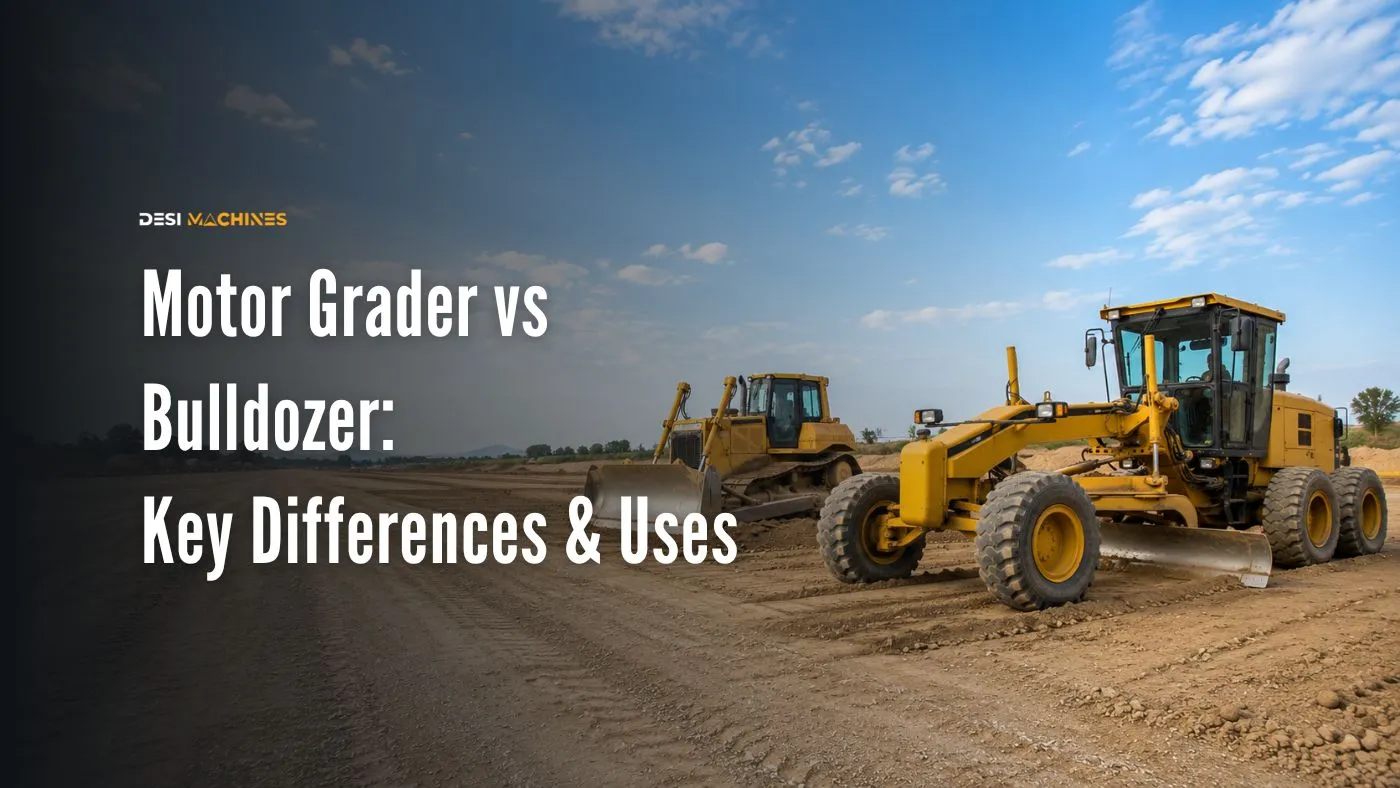
A motor grader is a road-levelling machine with a long steel blade hung between its front wheels and back wheels. Its job is to shape and fine-level a surface to an exact slope. A bulldozer (in the field everyone just says dozer or “bull”) is a tracked machine with a wide blade on the front, built to push and shove large amounts of soil, clear land and cut a rough level.
So the plain difference is this: a grader finishes a surface to a fine, accurate level, while a dozer moves bulk earth and does the rough, heavy work. They are not rivals. On most Indian road and site jobs you use the dozer first to push and rough-cut, and the grader later to trim the surface smooth. This guide explains what each machine really does, where they differ, what they cost, and how to pick the right one for your work.
What is a motor grader?
A motor grader is a long machine that runs on six wheels, with a curved blade (called the moldboard) fitted in the middle, under the body. The operator can tilt this blade, turn it, raise it or drop it by a few millimetres. That fine control is the whole point of a grader: it is a finishing and levelling machine.
In India you see graders on almost every highway, PMGSY village road and airport runway job. They spread and level the sub-base and base layers, cut the correct camber (the gentle slope that drains rain water off a road), and shape roadside drains. A well-graded surface is what makes a road last through the monsoon, because water runs off instead of soaking in and breaking the layers. That is why road contracts insist on a grader for the finishing stage even when a dozer has already done the rough work. Most graders sold here sit in the 100 to 210 HP range. You can see the full spread of models, engines and prices on our motor grader types and specifications page, and read how the machine is built in how a motor grader works.
What is a bulldozer?
A bulldozer is a heavy tracked machine (it runs on crawler tracks, not wheels) with a big flat or curved blade bolted to the front. Where a grader is about fine control, a dozer is about brute pushing power. It shoves soil, rock and rubble forward, rips hard ground with a rear claw (the ripper), clears jungle and boulders, and cuts rough levels on tough ground.
Because it sits on tracks, a dozer grips well on soft, wet or steep ground where a wheeled machine would slip. That is why you see dozers on mining benches, dam sites, land-clearing jobs and the early “cut and fill” stage of a road, long before the surface is ready for a grader. If bulldozers are new to you, our bulldozer types and uses guide walks through the full range.
Motor grader vs bulldozer: the main differences
The two machines look different and do different jobs. Here is a side-by-side comparison to keep it simple.
| What you compare | Motor Grader | Bulldozer (Dozer) |
|---|---|---|
| Main job | Fine levelling and finishing a surface to an exact slope | Pushing bulk earth, rough cutting, clearing land |
| Runs on | Wheels (usually six) | Crawler tracks |
| Blade position | In the middle, under the body, tilts and angles | At the front, mostly pushes straight ahead |
| Best on | Prepared, fairly firm ground | Soft, wet, steep or rocky ground |
| Accuracy | Very high, works to millimetres | Rough, works to the nearest few centimetres |
| Typical stage of a road job | Later: shaping, camber, final level | Earlier: cut and fill, land clearing |
| Moves material | Short distances, sideways along the blade | Pushes forward, larger volumes |
One line to remember: a dozer does the heavy moving, a grader does the accurate finishing. A dozer cannot cut a smooth camber, and a grader cannot push a hill of soil out of the way. That is why big projects keep both in the yard.
Can a bulldozer do a motor grader’s job?
Not really, and this is the question most first-time buyers ask. A dozer can rough-level ground and even give a fairly flat cut, so for a small farm road or a plot levelling job it may look like enough. But it cannot hold a fine, even slope, cannot cut an accurate road camber, and cannot trim the surface to the tolerance a highway or runway needs. The tracks also chew up a finished surface instead of smoothing it.
The reverse is also true: a grader cannot replace a dozer. Try to push a big volume of soil with a grader and you will strain the machine, because it is built to shave and spread, not to shove. So for serious road work the honest answer is that you need the dozer for the rough stage and the grader for the finish. On very small jobs, a backhoe loader or a compactor often covers the light levelling instead of buying either big machine.
When do you need a motor grader, and when a bulldozer?
Match the machine to the stage of work and the ground you are on.
Choose a motor grader when:
- You build or maintain roads, and need an accurate surface, camber and drainage slope.
- You spread and level gravel or base material over a prepared area.
- You maintain haul roads in a mine or long approach roads on a site.
- Fine finish and level accuracy matter more than raw pushing power.
Choose a bulldozer when:
- You clear land, jungle, boulders or old structures.
- You do bulk “cut and fill”, pushing large volumes of earth over short distances.
- You work on soft, wet, steep or rocky ground where wheels would slip.
- You rip hard or rocky soil before it can be dug or graded.
If your work is mostly roads and finishing, the grader earns its keep. If your work is mostly clearing and heavy earthmoving, the dozer does. A contractor who takes on full road contracts usually ends up owning or hiring both, because they cover different halves of the same job. Our motor grader buying guide goes deeper into picking the right size once you have decided a grader is what you need.
For the full picture of what a grader does once you have chosen one, see our guide to motor grader applications.
Motor grader vs bulldozer price in India
Prices move with variant, engine size, features and dealer, so treat these as indicative bands, not fixed quotes. The motor grader figures below are taken from live listings on DesiMachines and are current as of August 2026.
| Class | Rough power | Indicative price | Example models |
|---|---|---|---|
| Compact / entry | 74 to 125 HP | ₹29.5 to 55 Lakh | Mahindra Roadmaster G80 (74 HP), Mahindra G75 Smart (74 HP), BEML BG405A (125 HP) |
| Mid range | 148 to 180 HP | ₹55 to 95 Lakh | Sany STG140C-10 (150 HP), ACE AG 176 (180 HP), Komatsu GD535-6 (148 HP), BEML BG605A (170 HP) |
| Large | 171 to 280 HP | ₹1.1 to 1.9 Crore | Cat 120 GC (171 HP), Komatsu GD705-5 (260 HP), BEML BG825 (280 HP) |
Motor grader price bands in India (indicative, as of August 2026)
One thing to note before you read power as a price guide: it is not one. The 180 HP ACE AG 176 is listed at ₹74–76 Lakh, while the 171 HP Cat 120 GC — slightly less powerful — sits at ₹1.1–1.4 Crore. Build quality, blade size, cabin, transmission and brand support move the price far more than the horsepower figure does, so compare machines on the whole package, not the HP number.
Bulldozers are not listed on DesiMachines, so we will not quote a price we cannot stand behind. As a rough market guide, small crawler dozers overlap the mid-grader band and large mining dozers run well past a crore, but the real figure swings a lot by size and brand. Always confirm the current bulldozer price with our team.
Whichever machine you pick, the on-road cost is only part of the story: fuel, blades, ground engaging parts and operator wages add up over the years. If you plan to fund the purchase, an equipment finance and EMI option can spread the cost, and it is worth comparing a few lenders before you sign.
Do you need both a grader and a dozer on a road project?
On a full road contract, yes, most of the time. Think of the sequence of a typical highway or PMGSY stretch. First the dozer clears the land and does the rough cut and fill, pushing soil to build up the rough road bed. Then the earth is watered and rolled. After that the motor grader steps in to spread the base layers, cut the exact camber and trim the surface to level, ready for the compactor and the bitumen or concrete.
A small contractor doing only village lanes or plot work may manage with a hired dozer for a day and a small grader, or even skip one of them. But once the job needs an accurate, long-lasting road surface, both machines earn their place. Many owners buy the grader (the finishing machine that decides road quality) and hire the dozer when a clearing job comes up, since clearing work is less frequent. You can compare live motor grader models, prices and dealer contacts to plan that purchase.
To go further, see how motor graders are used across construction jobs and the best motor grader brands in India.
What separates the two machines most is the moldboard’s freedom to swing, pitch and tilt, which is set out in the guide to motor grader blade angles.
If the bulldozer is the machine you are leaning towards, our guide to bulldozer parts and components names what you will be maintaining on it.
Prices, specifications and features are indicative, vary by variant, location and date, and should always be confirmed with the official OEM or authorised dealer before any purchase decision. DesiMachines is not liable for decisions taken on the basis of information that may have changed after publication. Prices shown are taken from our listings at the time of writing.
Machines, tenders and news for this industry: Power and Renewable Energy