

 Excavator
  Backhoe Loader
  Motor Grader
  Wheel Loader
  Crane
Crane  Concrete Mixer
  Compactor
  Skid Steer Loader
  Concrete Pump
  Telehandler


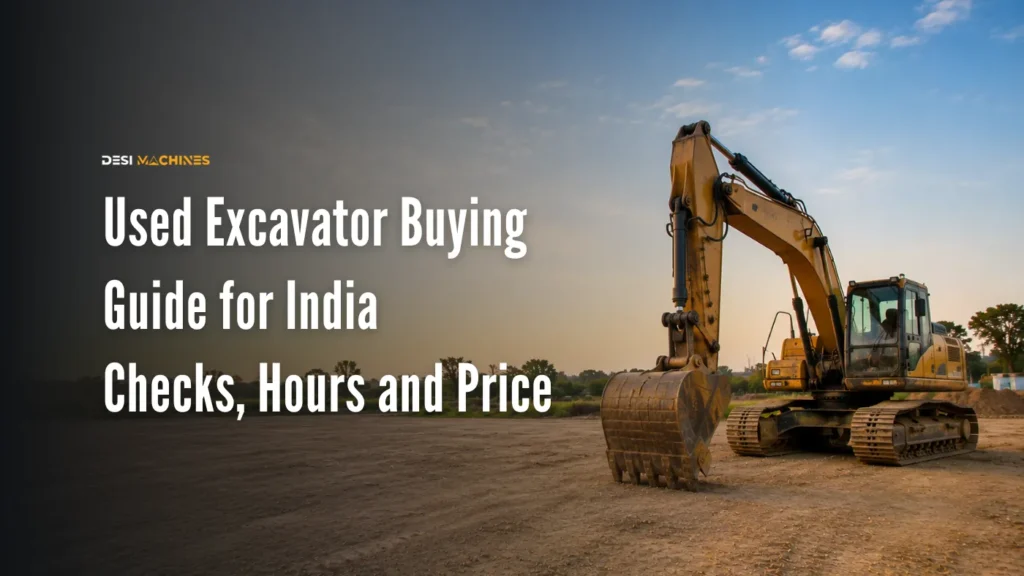
A used excavator is a digging machine that has already worked hours on a site and is being sold on by its owner, a dealer or a financier. In India these machines move constantly between contractors, and a well-chosen one can earn from the first week. A badly chosen one can swallow more money in repairs than the discount you thought you had won.
Buying used is mostly a job of measurement rather than negotiation. Two machines of the same year and model can be worth lakhs apart, and the difference sits in the undercarriage, the hydraulics, the hours and the paperwork. This guide covers what to inspect on a second-hand excavator, how to read the hour meter honestly, what the equivalent new machine costs today, and which papers must come with it. For the wider rules that apply to any second-hand machine, start with our guide to buying used construction equipment in India.
Last updated: July 2026.
What should you check when buying a used excavator?
Check the undercarriage first, the hydraulics second and the engine third, because that is the order of what they cost to put right. Reach the machine before it is started, since a warm engine hides smoke, hard starting and weak batteries.
Undercarriage is the running gear a crawler excavator sits on: tracks, rollers, idlers and sprockets. On a worn set the pins and bushings are loose, the sprocket teeth are hooked and pointed instead of squared, and the track sags. A full undercarriage replacement is one of the largest single bills in the machine’s life, so a cheap machine with a finished undercarriage is not cheap at all. Our guide to the excavator undercarriage and how it wears shows what to look for part by part.
Hydraulics do the digging, so test them properly:
- Raise the boom to full height, hold it, and watch. If the boom or bucket sinks on its own, the cylinder seals or control valves are worn. This slow sinking is called drift.
- Look along every cylinder rod for scoring, pitting or a bent rod, and for oil weeping at the seals.
- Work the swing and travel together while digging. Slow or jerky movement under load points to a tired pump.
- Check hoses for cracking and for fresh clamps or tape, which often mark a leak someone hid.
Engine should start without repeated cranking. Blue or heavy black smoke after warm-up, a knocking sound, or oil in the coolant are all reasons to stop the inspection.
Then check the work end. Bucket teeth, the bucket lip and the pins tell you how hard the machine has lived, and a mismatched bucket often means the original was destroyed. Sizing a replacement is covered in our guide to excavator bucket types. Finally, match the chassis and engine numbers against the papers; if they do not match exactly, walk away.
Watch the exhaust while the machine is working. Steady black smoke on a test dig points to an air or fuel fault worth pricing before you agree anything, and our guide to black smoke from an excavator exhaust sets out what causes it.
How many hours is too many on a used excavator?
There is no fixed hour limit that makes an excavator a bad buy, so read the hours against the machine’s age, the work it did and its service file. Divide the meter reading by the age in years to get hours per year. A machine used gently on soil for eight years is often healthier than a four-year-old machine that broke rock every day.
Three checks make the number meaningful:
- Match hours to visible wear. Low hours with a badly worn undercarriage, torn seat and polished controls means the meter is not telling the truth.
- Ask what the machine dug. Quarry, rock breaking and demolition work are far harder than canal, road or municipal earthwork. A rock breaker attachment in the seller’s yard is a clue.
- Ask the dealer what is due next. The authorised dealer for that model can tell you the next major service point and how far this machine is from it. That cost is yours, so it belongs in your offer.
Where the hours cannot be trusted, price the machine purely on condition, and budget for the wear parts you can already see.
How much does a used excavator cost in India?
A used excavator is always priced downward from the current new price of the same class, so find that new price first and negotiate against it. Second-hand asking prices are not published anywhere and vary with hours, condition and location, but the new-machine band gives you the ceiling. Current bands by size class:
| Size class | Example new model | New price band (indicative, July 2026) | Where these machines work |
|---|---|---|---|
| Mini, about 2 Ton (2,000 kg) | XCMG XE20U | ₹19.0–21.0 Lakh | Narrow lanes, plumbing and cable trenches, farm work |
| Mini, about 3.5 Ton (3,500 kg) | SANY SY35U Pro | ₹24.7–27.3 Lakh | Urban sites, small foundations, landscaping |
| Medium, 20–21 Ton (20,000–21,000 kg) | XCMG XE215i | ₹48.5–53.6 Lakh | Highways, canals, bulk earthwork, the workhorse class |
| Medium, 21 Ton heavy-duty build | Tata Hitachi EX 210 Infra | ₹57.0–63.0 Lakh | Continuous infrastructure work |
| Large, 36 Ton (36,000 kg) and above | SANY SY365C-9LA | ₹1.05–1.16 Crore | Mining, quarry, large infrastructure packages |
Two costs decide whether a used machine is really cheaper. The first is the wear parts due in year one, mainly undercarriage, bucket and hoses. The second is the earning you lose while the machine sits in a workshop. Running costs across a machine’s life are broken down in our note on excavator maintenance cost in India.
Before you make an offer, price the new machine too. Compare live excavator models and prices and get a current dealer quote, so you know exactly what you are saving.
Which size of used excavator should you buy?
Buy the smallest machine that can finish your regular work, because every extra ton adds diesel, tyre or track wear and transport cost. Size in the excavator world is quoted as operating weight, so a 20 Ton (20,000 kg) machine weighs that much, and its digging depth and bucket size follow from it.
- Mini excavators suit water lines, cable trenches, farm ponds and work inside villages and colonies where a big machine cannot turn. They also travel on a small trailer, which keeps shifting cheap. The full range is covered in our mini excavator guide, and current models sit under mini excavators.
- The 20-ton class is what most Indian contractors run, because it moves enough soil per day to justify itself on road, canal and site work while still being transportable. Machines in this class are listed under medium excavators.
- Large machines earn only on continuous bulk work such as mining and big infrastructure packages. On stop-start contracts they idle expensively. See large excavators for what this class costs new.
Wheels or tracks matters too. Almost every used excavator in the Indian market is a crawler on tracks, and the reasons are explained in our comparison of crawler excavator types, specs and applications.
What papers should come with a used excavator?
A used excavator must come with proof of ownership, proof that any loan on it is closed, and its service history. Excavators are usually not road-registered the way a backhoe or crane is, so the invoice trail carries more weight here.
- Original purchase invoice and any later sale documents, showing an unbroken chain of owners.
- Hypothecation NOC from the bank or NBFC if the machine was ever financed. An unclosed loan follows the machine, not the previous owner.
- Insurance policy, which also shows past claims and any accident history.
- Service records with dated entries and parts replaced, ideally from an authorised workshop.
- A written sale agreement naming the machine, its serial numbers, the price and the condition agreed.
Pay through the bank, never take delivery against a promise that a paper will follow, and get the machine insured in your own name from day one. The full documentation list for every machine type is in the used construction equipment guide.
Should you buy a used excavator or a new one?
Choose used when your work is irregular and cash is short, and new when the machine will run most days on committed contracts. A new machine carries warranty, dealer service and predictable running costs, which matter more than the EMI difference once a machine is booked solid. A used machine frees up capital, which matters more when work is seasonal.
Whichever you choose, brand and parts availability decide how much the machine actually earns. A model your district mechanic knows, with parts on the shelf nearby, keeps working. The two sides of this decision are compared in our note on new versus used excavators in India, and resale patterns by brand are in which excavator brands hold resale value.
If you plan to finance the purchase, arrange it before you commit. Lenders fund used machines at a lower share of value, on shorter tenure and at higher rates, as set out in our note on the used construction equipment loan, and the wider options sit on our equipment finance page.
Buying a used excavator in short
Inspect the undercarriage before anything else, test the hydraulics for drift under load, read the hours against the machine’s age and service file, and confirm the papers are clean before money moves. Judge every asking price against what the same class costs new today, and buy a model your local market can repair.
To go deeper into the machine itself, read the complete excavator guide and the breakdown of excavator components. When you are ready to price a machine, compare live excavator models and get the best current offer.
Not sure whether to buy at all yet? The excavator rental guide sets out when hiring costs less than owning.
One check deserves its own walk-through before you pay: the slewing ring is among the costliest repairs on a used excavator, and the tilt test that exposes a worn one takes only a few minutes.
The excavator-specific checks above sit inside a wider buying process, and the sequence of shortlisting, paperwork and staged payment is set out in our guide to how to buy used construction equipment step by step.
Disclaimer: Prices, specifications and features are indicative, vary by variant, location and date, and should always be confirmed with the official OEM or authorised dealer before any purchase decision. Prices shown are taken from our listings at the time of writing. DesiMachines is not liable for decisions taken on the basis of information that may have changed after publication.