
 Excavator
294 models
Excavator
294 models  Backhoe Loader
51 models
Backhoe Loader
51 models  Crane
68 models
Crane
68 models  Concrete Mixer
79 models
Concrete Mixer
79 models  Wheel Loader
54 models
Wheel Loader
54 models  Compactor / Roller
45 models
Compactor / Roller
45 models  Motor Grader
42 models
Motor Grader
42 models  Dozer
41 models
Dozer
41 models  Concrete Pump
66 models
Concrete Pump
66 models  Skid Steer Loader
11 models
Skid Steer Loader
11 models  Telehandler
13 models
Telehandler
13 models 


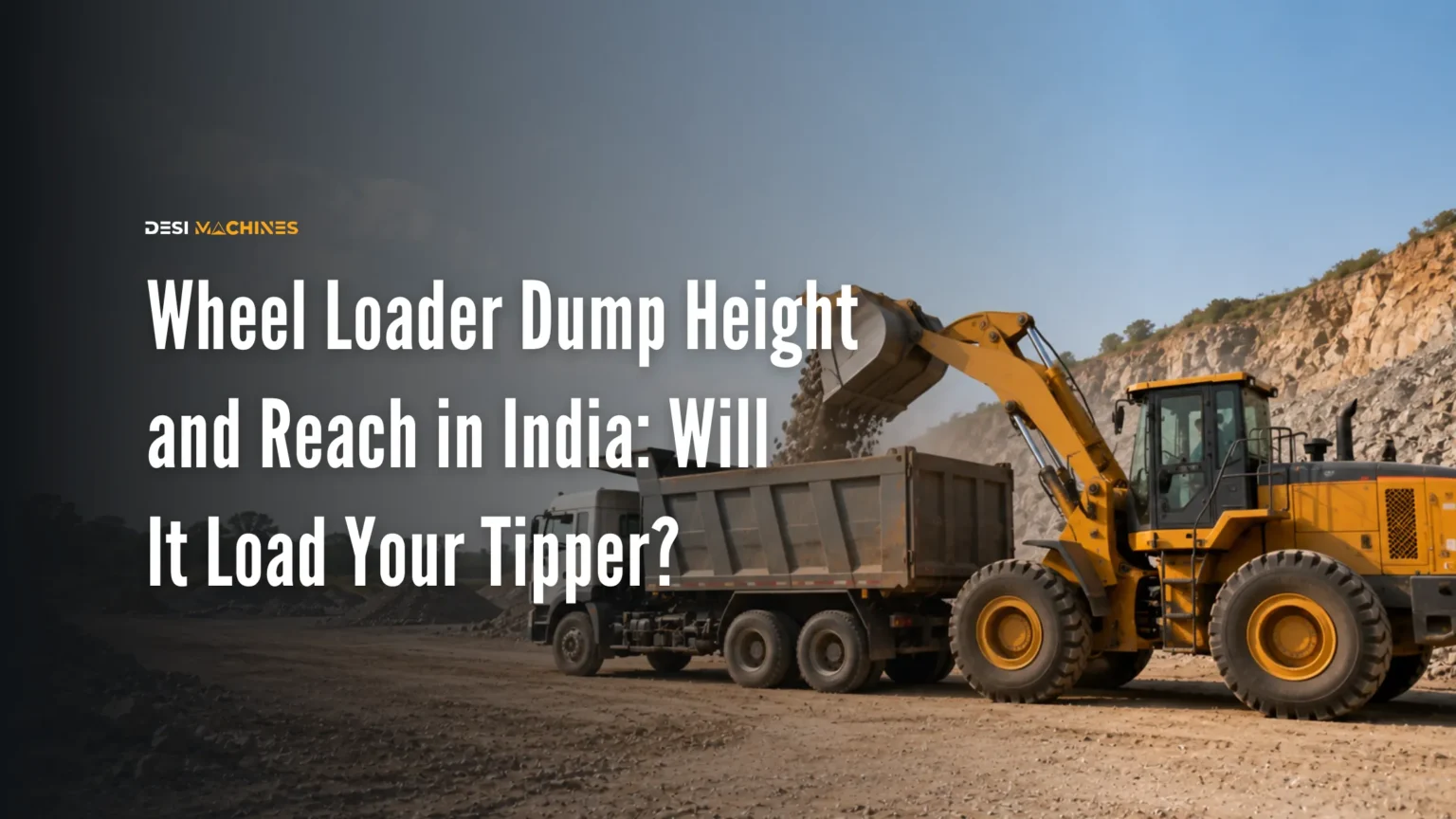
Dump height is how high a wheel loader can lift its bucket and still tip it out, measured from the ground to the bucket’s cutting edge with the lift arms fully raised. Dump reach is how far forward the bucket edge sits at that height. Together they decide the one thing that matters on a loading job: whether the machine can empty into your tipper without the bucket fouling the body.
For the class below this one, skid steer dump height and reach tables the same three figures across all eleven skid steer loaders listed in India, where the tallest machine dumps at 2,675 mm and so sits just below where the wheel loader range begins.
Across the wheel loaders listed on DesiMachines, published dump height runs from about 2,710 mm (2.71 m) on a 12 tonne machine to 3,300 mm (3.3 m) on a 27 tonne machine, with mining-size loaders going far higher. This guide gives both numbers by size class, and explains why the heavier machine does not always dump higher.
What is dump height on a wheel loader?
Dump height is measured with the lift arms at full height and the bucket rolled forward to the dumping angle. It is the clearance you actually have under the bucket edge, so it is the figure to compare against the top rail of whatever you are loading.
Three numbers describe the same movement and are easy to mix up:
- Dump height (fully raised) – ground to the bucket’s cutting edge with the bucket tipped. This is the working number.
- Dump reach (fully raised) – how far the bucket edge reaches forward from the machine at that height. This decides how close you must drive to the truck.
- Hinge pin height – ground to the pin where the bucket attaches. It is always higher than dump height, because the bucket hangs below the pin, and it is the number brochures quote when they want a bigger figure.
Compare like with like. A brochure showing 4,150 mm is almost certainly quoting hinge pin height, while the machine’s real dump height may be around 2,810 mm.
Wheel loader dump height and reach by size class
The table groups the listed machines by the size classes used in the wheel loader size class guide. Not every machine publishes every figure, so the count behind each range is given.
| Size class | Dump height, fully raised | Dump reach, fully raised | Hinge pin height |
|---|---|---|---|
| Small (8 – 15 tonne) | 2,710 – 2,950 mm (11 machines) | 1,010 – 1,320 mm (11) | 3,725 – 3,998 mm (9) |
| Medium (15 – 30 tonne) | 2,756 – 3,300 mm (23 machines) | 1,025 – 1,481 mm (23) | 3,995 – 4,590 mm (21) |
| Large (above 30 tonne) | 3,070 – 6,167 mm (15 machines) | 1,480 – 2,821 mm (15) | 4,620 – 8,790 mm (15) |
Figures as per the current August 2026 spec sheets on DesiMachines. The compact class below 8 tonnes is too thinly listed to give a range from – only one machine publishes a dump height, the 5.6 tonne Liugong 818N at 2,909 mm.
The useful part of this table is how tight the small class is. Eleven machines from four brands sit inside 240 mm of each other. If your work is loading tippers with an 8 to 15 tonne loader, dump height will almost never be the number that separates two machines – bucket size, tyres and dealer support will.
The large class is wide only because it holds true mining loaders alongside quarry machines. The 6,167 mm top figure belongs to a 242 tonne machine that no contractor buys for site work.
Does a bigger wheel loader always dump higher?
No, and this catches people out. The Tata Hitachi ZW225 CEV 5 weighs 17.7 to 18.2 tonnes and publishes a dump height of 2,756 mm. The Liugong 836N weighs 11.7 tonnes – six tonnes lighter, a whole class down – and publishes 2,950 mm, nearly 200 mm higher.
Weight buys you a bigger bucket, more breakout force and a stronger machine. It does not automatically buy lift geometry. Loader arms are designed around what the machine is expected to load: a machine built for feeding a crusher or a low hopper does not need the extra height, and the shorter arm gives better stability and faster cycles.
Here is what common machines in the classes Indian contractors buy actually publish:
| Machine | Operating weight | Dump height | Dump reach |
|---|---|---|---|
| JCB 440-5 | 12,480 kg | 2,710 mm | 1,320 mm |
| L&T 9020 | 11,500 kg | 2,715 mm | 1,248 mm |
| XCMG ZL33FV | 10,600 kg | 2,850 mm | 1,010 mm |
| Liugong 836N | 11,660 kg | 2,950 mm | 1,060 mm |
| CAT 950GC | 18,849 kg | 3,050 mm | 1,262 mm |
| Volvo L120H | 19,000 – 21,600 kg | 2,840 mm | 1,250 mm |
| Liebherr L580 | 26,950 kg | 3,300 mm | 1,330 mm |
Notice the JCB 440-5: the lowest dump height in the small class and the longest reach in it. That is the trade-off in one machine. A longer reach lets you stand further back from the truck, which matters when the ground beside the tipper is soft or the driver will not come close to the face.
Will the loader clear my tipper?
Measure, do not guess. Take a tape to the loaded truck you use most and measure from the ground to the top edge of the side wall, on the side the loader will work from. That is the height the bucket edge must clear.
Then check three things:
- Height with a margin. The bucket edge has to pass over the rail with room to spare, not just equal it. Tyre pressure, a rutted approach and a body that sits higher when the truck is empty all eat that margin.
- Reach against how close you can park. If the truck cannot come closer than a metre, a machine with 1,010 mm of reach will be dropping material down the outside of the body.
- The bucket you will actually fit. A rock bucket, a high-tip bucket or a different cutting edge changes both numbers, because both are measured to the bucket edge.
If the loader is short by a little, the site fix people use is a ramp or a raised pad so the machine stands higher than the truck. It works, but it costs you a level working area and adds risk on wet ground, so treat it as a workaround and not as the reason to buy the smaller machine.
Bucket choice is the other half of the same decision and is covered in the wheel loader bucket guide, along with how struck and heaped capacity are measured.
What else changes how well the machine loads?
Dump height gets you over the rail. What decides your day’s output is the loading cycle: drive into the pile, fill, reverse, turn, approach the truck, dump, return. A machine that clears the truck by 400 mm but takes twenty seconds longer per cycle will move less material.
The parts of the machine that decide that cycle are the transmission, the tyres and the engine. Powershift and hydrostatic drives behave differently in this exact loading pattern, which is set out in the guide to wheel loader transmission types. Tyre choice decides grip in the pile and is covered in the guide to wheel loader tyres, and the power available is in the guide to wheel loader engine power and torque.
How the lift arms and hydraulics produce the movement in the first place is explained in the guide to how a wheel loader works.
How do you check dump height before you buy?
Ask the dealer for the dump height of the exact bucket being supplied, in writing, and confirm whether the figure quoted is dump height or hinge pin height. Those two are commonly swapped in sales material and the difference is around a metre.
On a used machine, check the figure differently: worn bucket edges, tired lift cylinders and soft tyres all reduce what you get in practice. Take the machine to a truck and try it before you agree a price – the same check that matters most when buying a used wheel loader.
If the job is short, hiring avoids the whole question, since you can specify the loading height you need for the work; hire rates and what they include are in the guide to wheel loader rental.
Compare live wheel loader models and prices across brands and check the published dump height on each machine before you shortlist.
Dump height and reach, in short
Dump height is ground to bucket edge with the arms fully raised, and it is the number that must clear your tipper’s side rail. Small loaders of 8 to 15 tonnes publish 2,710 to 2,950 mm, medium machines of 15 to 30 tonnes 2,756 to 3,300 mm, and the class does not decide it – the ZW225 dumps lower than a machine six tonnes lighter. Measure your truck, allow a margin, and check whether the figure you were quoted is dump height or hinge pin height. If you are weighing a loader against a tracked machine for the same job, excavator dumping height starts at 4,534 mm for anything above 6 tonnes, so an excavator clears a truck body far more easily than a loader does.
Clearing the rail is one half of loading a tipper; the other is how many passes it takes and whether enough trucks are on the haul. Wheel loader productivity, output and truck matching works through both.
Weight buys digging force as well as bucket size, and our guide to wheel loader breakout force and tipping load gives the published figures by size class.
Prices, specifications and features are indicative, vary by variant, location and date, and should always be confirmed with the official OEM or authorised dealer before any purchase decision. DesiMachines is not liable for decisions taken on the basis of information that may have changed after publication.
Frequently Asked Questions (FAQ)
Dump height is the distance from the ground to the bucket’s cutting edge when the lift arms are fully raised and the bucket is rolled forward to dump. It is the clearance available under the bucket edge, so it is the figure to compare against the top rail of the truck or hopper you are loading.
Listed 8 to 15 tonne wheel loaders publish 2,710 to 2,950 mm across 11 machines, and 15 to 30 tonne machines publish 2,756 to 3,300 mm across 23 machines, as per the current August 2026 spec sheets. Loaders above 30 tonnes range from 3,070 mm to 6,167 mm, but that band includes mining machines.
Hinge pin height is measured to the pin where the bucket attaches, and dump height is measured to the bucket’s cutting edge, which hangs below that pin. Hinge pin height is around a metre higher, so it is the figure brochures often quote. Always confirm which one you have been given before comparing machines.
No. The Tata Hitachi ZW225 CEV 5 weighs 17.7 to 18.2 tonnes and publishes 2,756 mm, while the 11.7 tonne Liugong 836N publishes 2,950 mm. Weight buys bucket size and breakout force, not lift geometry, and machines built to feed low hoppers or crushers use shorter arms on purpose.
Measure from the ground to the top edge of the truck’s side wall on the side the loader will work from, and compare that with the machine’s published dump height plus a margin. Then check dump reach against how close the truck can actually park, and confirm the figures apply to the bucket being supplied with your machine.

