
 Excavator
294 models
Excavator
294 models  Backhoe Loader
51 models
Backhoe Loader
51 models  Crane
68 models
Crane
68 models  Concrete Mixer
79 models
Concrete Mixer
79 models  Wheel Loader
54 models
Wheel Loader
54 models  Compactor / Roller
45 models
Compactor / Roller
45 models  Motor Grader
42 models
Motor Grader
42 models  Dozer
41 models
Dozer
41 models  Concrete Pump
66 models
Concrete Pump
66 models  Skid Steer Loader
11 models
Skid Steer Loader
11 models  Telehandler
13 models
Telehandler
13 models 


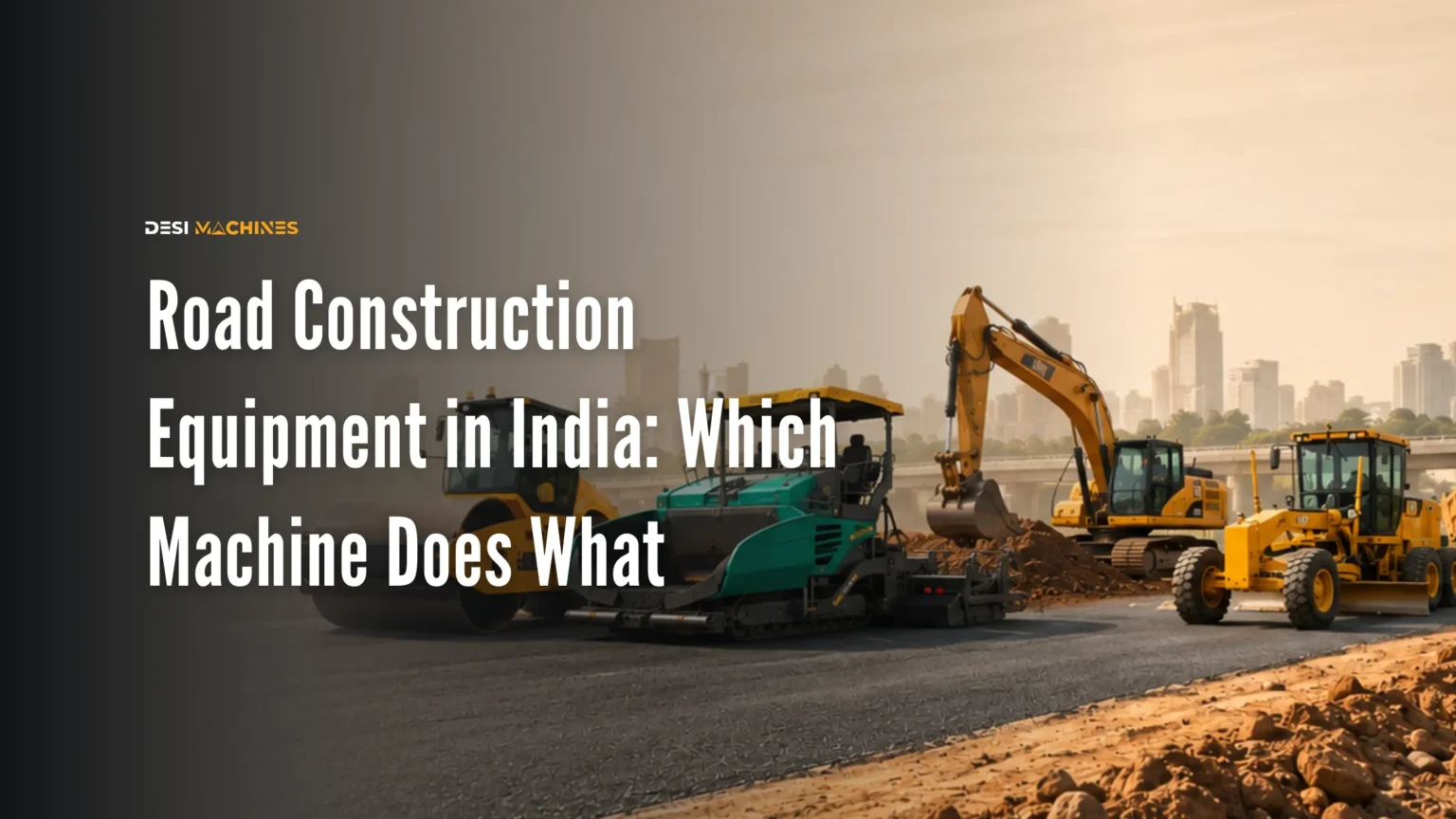
Road construction equipment is the set of machines that turn a marked alignment into a finished road: machines that cut and move earth, machines that shape it to level, machines that press it down hard enough to carry traffic, and machines that lay the surface on top. In India most of that work runs on six machine types, and they arrive on site in a fixed order.
This guide follows a road job from the first cut to the last pass, and names which machine does what at each stage. It is written for a contractor bidding his first road package or a machine owner deciding what to buy to get on one.
What machines are used in road construction?
Six machine types do the bulk of the work on an Indian road job, and each one owns a stage. The table lists them in the order they are used, with the number of machines listed on DesiMachines in each category as of August 2026.
| Stage of the job | Machine | What it does | Listed here |
|---|---|---|---|
| Clearing and earthwork | Excavator | Cuts, digs and loads soil and rock; digs side drains | 294 |
| Bulk earth moving | Dozer | Pushes earth over short distances, strips topsoil, spreads fill | 41 |
| Loading and haul feed | Wheel loader | Loads tippers with soil, sand, aggregate; feeds plants | 54 |
| Shaping and levelling | Motor grader | Trims the formation to line, level and camber | 42 |
| Compaction | Compactor (road roller) | Presses each layer to the required density | 45 |
| Utilities, drains, small works | Backhoe loader | Digs trenches and pits, loads, handles odd jobs | 51 |
A concrete road adds a second set: transit mixers to carry concrete from the batching plant and concrete pumps to place it. A road with structures on it, meaning bridges, culverts or flyovers, adds a crane for lifting girders and precast sections.
One machine on a real road job is not in that list because we do not deal in it: the paver, which lays the bituminous surface. It is worth knowing where it fits, because the rollers that follow it are the ones you will be buying or hiring. What it lays is graded bitumen, and which of the four Indian grades belongs on a given road is decided by the site’s design air temperature, which the guide to bitumen road construction sets out.
What is the order of work on a road job?
A road is built in layers, from the bottom up, and each layer is shaped and then compacted before the next one goes on. Skipping or short-cutting a stage is what causes a road to fail in its first monsoon.
The sequence runs like this. The alignment is cleared and the topsoil stripped, usually by a dozer with an excavator on the drains and any rock. The formation, meaning the prepared ground the road sits on, is cut or filled to the design level. A grader trims that formation to the correct line, level and camber, the slight slope that sheds rainwater to the sides. A roller compacts it.
Then the sub-base and base layers of granular material go on, each one spread, graded and rolled in turn. On a bituminous road the paver lays the surface course and rollers finish it while it is still hot. On a concrete road the concrete is placed instead, by pump or chute, and cured. The thickness, concrete grade and joint spacing that job has to hit are set out in CC road construction.
The pattern to notice is that the grader and the roller come back at every single layer. An excavator works at the start and then goes to the drains. That is why on a long road package the grader and rollers are the machines that are booked for the whole contract, and it is a large part of why they hold their hire value.
Which roller do you need for road work?
Three roller types do three different jobs on the same road, and buying the wrong one is a common first mistake.
| Roller | Where it works | Listed here |
|---|---|---|
| Soil compactor (single drum) | Earthwork, sub-base and base layers; the heavy compaction end of the job | 21 |
| Tandem roller (double drum) | Bituminous surface, behind the paver; finishing passes | 20 |
| Pneumatic tyre roller | Sealing and kneading the bituminous layer after the tandem | 4 |
A soil compactor uses one heavy steel drum with vibration to drive density deep into loose soil and stone. A tandem roller uses two smooth drums and works on hot bitumen, where the aim is a tight, even surface rather than depth. The same machine also compacts the lean concrete sub-base on a concrete road, where the specification calls for 80 to 100 kN of static weight, and the DLC layer under a concrete slab works out what that means in tonnes. A pneumatic tyre roller runs on rubber tyres that knead the surface and close it up.
If your work is village and district roads under PMGSY, the rural roads programme, a soil compactor and a tandem roller cover almost everything. Our guide to the types of roads in India explains how village, district and state roads differ in width and design speed. Our compactor buying guide works through sizing, and static versus vibratory rollers explains when vibration helps and when it does damage.
What size machines suit Indian road projects?
Size follows the contract, not ambition. Three broad tiers cover most of what is tendered here.
On rural and village roads, typically PMGSY packages, the work is narrow, the layers are thin and access is tight. A backhoe loader, a small soil compactor and a 4 to 12 tonne grader handle the job, and a mini excavator is often more useful than a large one because it can work between houses and existing drains.
On state highways and district road upgrades, the volumes rise and the machines step up: a 20 tonne excavator class, a 12 to 20 tonne grader, full-size soil compactors and tandem rollers, and wheel loaders feeding tippers all shift.
On national highway and expressway packages, the ones NHAI tenders, machines run in fleets rather than singly and the large grader and dozer classes appear. Most machine owners at this level are hiring to an EPC contractor rather than holding the contract, which changes what is worth buying: utilisation matters more than size.
Our guides to excavator size classes and choosing a motor grader go into the sizing for the two machines where the choice is hardest.
How do you get work on a road project?
Two routes, and they suit different owners.
You can bid for the work directly, which means watching tenders. Road packages are tendered by NHAI for national highways, by state PWDs and road development corporations for state roads, and by district and panchayat bodies under PMGSY for rural roads. Live construction tenders and opportunities across sectors are listed and updated as they open.
Or you can hire your machines to the contractor who won the package, which is how most single-machine and small-fleet owners in India actually earn from road work. It removes the bidding and the payment risk of a main contract, and it puts the burden on utilisation instead: an idle machine on hire earns nothing. Knowing who is building what is the whole game there, and our roundup of the EPC companies building India’s highway projects is a good place to start a list of who to approach. To see what those contractors already own, down to one builder’s 402 excavators and 1,273 tippers and tankers, read the biggest contractor fleets in India.
If you are going the hire route, price the work before you commit the machine. How to rent construction equipment in India covers the documents, deposits and billing terms that decide whether a hire contract is worth taking.
What does it cost to run road equipment?
The purchase price is the smaller half of the question. A road machine earns or loses money on three running lines: diesel, tyres or undercarriage, and operator.
That is the machine line only. Where the whole job is being priced, our guide to road construction cost per km sets out what a village road, a two-lane highway upgrade and a new four-lane actually cost, and where machinery sits against material and haulage.
Diesel is the largest and it scales with how hard the machine works, not with how long it is switched on. Wear is the second: a grader and a roller are wheeled machines and their cost centre is tyres, while an excavator on a road job is running its undercarriage over abrasive base material, which is expensive. Our guide to excavator undercarriage wear covers what that actually costs to neglect.
The third is availability. A machine booked for a whole road package cannot be down for two days waiting for a filter, so service discipline is a commercial matter on a road job in a way it is not on a small site. The hour-by-hour service schedule sets out what falls due when.
Prices for every machine named here change by variant, state and dealer. Compare live listings and current prices in the road roller, motor grader and excavator ranges, and speak to a dealer before you budget.
Which machine should you buy first for road work?
If you are starting out and can buy one machine, buy the one that is hired for the longest stretch of the job.
On rural road work that is usually a backhoe loader. It digs the drains, loads, handles culvert work and travels between sites on its own wheels, so it is never idle for a whole stage. It is also the easiest machine to find an operator for anywhere in India.
If the work is squarely road-building rather than general contracting, a soil compactor is the better single buy. Compaction is required at every layer, the machine is booked for the full duration, and there are fewer of them chasing the same work than there are backhoes.
Buy a motor grader only when you have a road contract in hand or a standing hire arrangement. It is the most specialised machine on this list, it does nothing useful off a road job, and it is the one most likely to sit idle. That specialisation is exactly why it earns well when it is working.
To check what machine your road job needs at each stage, choose road work in the finder and pick the stage and the road.
A note on the figures in this guide
The machine counts in the tables are the number of models listed on DesiMachines in each category in August 2026, and they describe what is available to buy here, not the size of the Indian market.
This guide names no prices on purpose. Every machine type mentioned has its own current listings, and prices for construction equipment move with variant, state taxes, dealer and date often enough that a figure written into a guide is out of date before it is useful. The category links above go to live listings.
Paver finishers, tippers and drilling rigs appear in the sequence because a road job uses them, but we do not list those machines, so nothing here should be read as a recommendation on them.
Road construction equipment, in short
An Indian road job runs on six machine types in a fixed order: excavator and dozer for earthwork, wheel loader for loading, motor grader for shaping, roller for compaction, backhoe loader for drains and everything else. Concrete roads add transit mixers and pumps; roads with structures add a crane.
The two machines that stay for the whole contract are the grader and the roller, because every layer has to be shaped and compacted before the next one goes on. For a first machine, a backhoe loader is the safest buy on rural work and a soil compactor the better one on dedicated road-building. Keep the grader for when you have the contract to feed it. The same grader-and-roller pairing keeps haul roads alive on a mine, which the guide to mining equipment in India covers alongside the excavators and dozers that work the face.
Which layer each of those machines is actually building, and how thick it goes, is set out in the guide to road construction layers.
The road construction application page keeps the machine classes, the models buyers ask about most, open tenders, the main companies and the latest news for this work in one place, rebuilt twice a day.
Prices, specifications and features are indicative, vary by variant, location and date, and should always be confirmed with the official OEM or authorised dealer before any purchase decision. DesiMachines is not liable for decisions taken on the basis of information that may have changed after publication.