
 Excavator
294 models
Excavator
294 models  Backhoe Loader
51 models
Backhoe Loader
51 models  Crane
68 models
Crane
68 models  Concrete Mixer
79 models
Concrete Mixer
79 models  Wheel Loader
54 models
Wheel Loader
54 models  Compactor / Roller
45 models
Compactor / Roller
45 models  Motor Grader
42 models
Motor Grader
42 models  Dozer
41 models
Dozer
41 models  Concrete Pump
66 models
Concrete Pump
66 models  Skid Steer Loader
11 models
Skid Steer Loader
11 models  Telehandler
13 models
Telehandler
13 models 


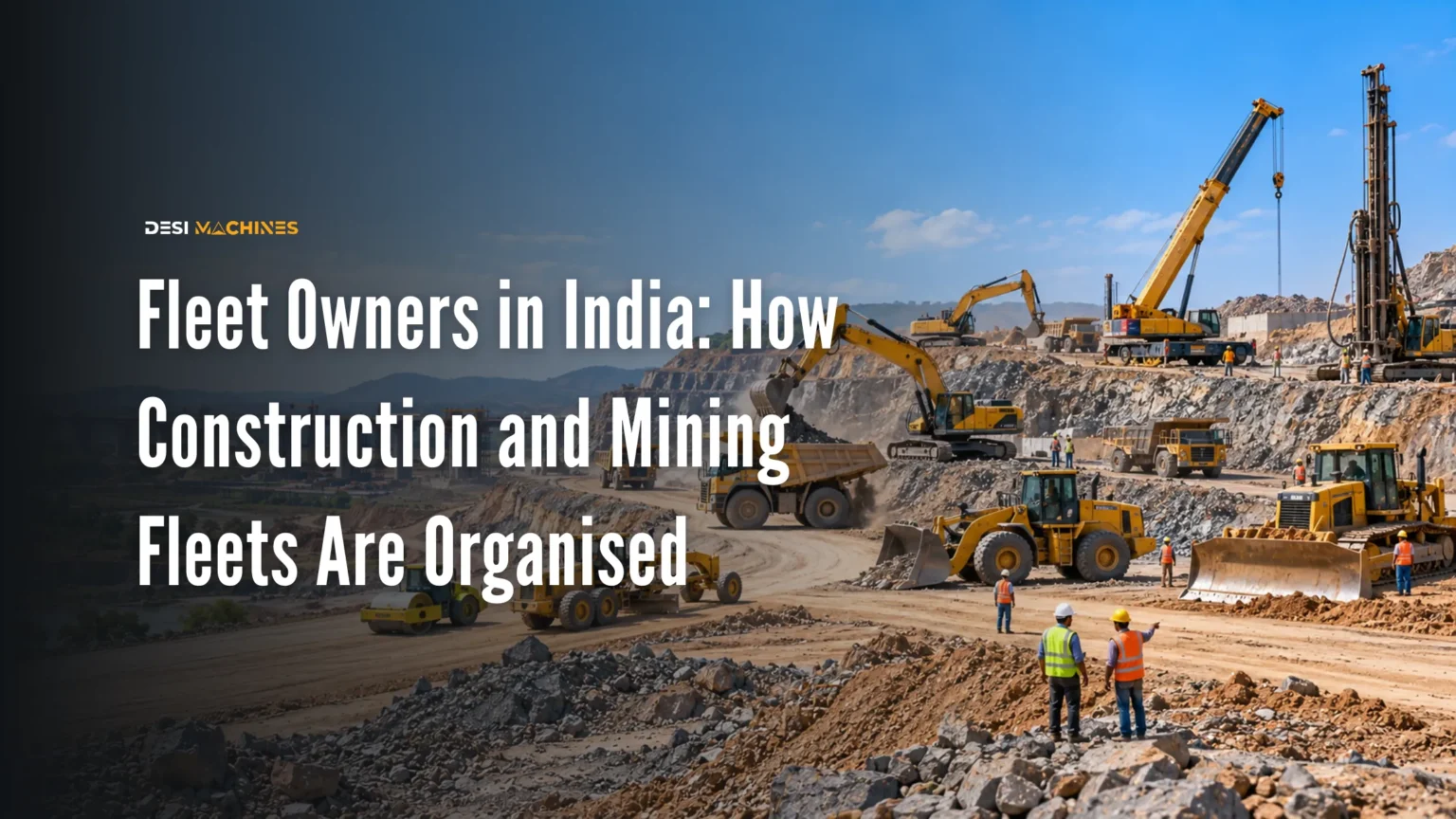
A fleet owner in India is a company or a person who owns more than one construction or mining machine and earns a living by putting those machines to work. Five kinds of owner hold almost every big machine working in the country: road and infrastructure contractors, mine owners and contract miners, rental and crane-hire companies, government departments and public-sector undertakings, and factories, plants and ports that keep machines for their own use. Beside them sit thousands of small owners with one to ten machines, who hire them out to the first five.
This page explains how those fleets are put together. Who owns what, how an owner chooses between buying, leasing and hiring a machine, who inside a company signs off the purchase, how the fleet measures whether a machine is earning, how it keeps the machine running, and how it pays for it. Company names and machine counts change every year. The way the fleets are organised does not.
Who counts as a fleet owner in India?
Five groups own most of the heavy machines working in India, and each one buys for a different reason.
| Type of owner | Why they keep machines | How the machines usually come in |
|---|---|---|
| Road and infrastructure contractors | A highway, metro, canal or bridge package keeps the same machines on one site for two or three years | Mostly bought, on a loan or a lease, timed to the contract they have just won |
| Mine owners and contract miners | An opencast mine digs every day for decades, so the machines never leave | Bought for the long life of the mine; peaks and specialist work are hired in |
| Rental and crane-hire companies | The machine itself is the product; they earn from the monthly or hourly rate | Bought to hire out, and sold on once the machine is too old to earn its rate |
| Government departments and public-sector undertakings | State road, irrigation, water and municipal works, and mineral and coal production | Bought through open tender; shortfalls hired through tender as well |
| Factories, plants and ports (captive fleets) | Machines that work inside one boundary wall and never go out to a project | Bought with the plant, then replaced one at a time |
| Small owners with one to ten machines | The machine is the family business; the owner often drives or supervises it | Bought second-hand or on a long loan, then hired out to the groups above |
The road and infrastructure contractor is usually called an EPC company, short for engineering, procurement and construction. The words mean exactly what they say: the company designs the work, buys the material and machines, and builds it. Because a road package needs the same excavators, rollers, graders and tippers standing on the same stretch for years, buying works out cheaper than paying a monthly hire rate for the whole period. That is why contractors, not rental firms, own the largest construction fleets in the country.
In mining you will hear one word constantly: HEMM. It stands for heavy earth moving machinery, and it covers the big machines of an opencast mine. The shovel or excavator that digs, the dumper that carries coal and waste rock out, the dozer that cleans the benches and pushes material into reach, the drill that makes blast holes and the dragline that strips the soil and rock lying over the coal. A mine owner holds the lease on the mine and sells the coal or mineral. A contract miner owns no mine; it brings its own machines and crew and digs for whoever holds the lease, paid per tonne or per cubic metre moved.
A captive fleet is the quietest of the five and the easiest to forget. A cement plant, a steel works, a thermal power station or a port runs its own loaders, dozers and tippers to move limestone, coal, ash, slag or cargo inside its own premises. The machines are old, they work short distances every single day, and they are replaced one at a time rather than in a batch.
Goods-truck fleets are a different business. A company that owns a thousand trucks is a transport and logistics firm, not an equipment fleet. Tippers and dumpers are the exception, because those work on the site and in the mine and are counted as part of the machine fleet.
Which companies hold the biggest fleets, and how many machines each one reports, changes every few months. For the current picture, see who runs India’s big construction and mining machine fleets.
What does a fleet owner’s machine list contain?
A fleet is not a shopping list of favourite machines. It is built around the job on site, step by step, and the machines are chosen so that no step holds up the next one.
The five jobs every earthmoving fleet has to cover
Behind these five sit the support plant a site cannot run without: batching plant, crusher, hot mix plant, paver, generator, compressor, water tanker and service vehicle.
Read the list the way a site engineer does. The digging machine sets the cost of the job, and the carrying machines set its speed. Put too few tippers with an excavator and the excavator sits waiting with its engine running; put too many and the tippers queue. So a fleet is planned outward from the loading machine, and in almost every road or earthwork fleet the tippers outnumber the excavators several times over. Further down the line, the grader and the roller work as a pair: the grader spreads and levels each layer of soil or aggregate to the thickness the drawing asks for, and the roller packs it down before the next layer goes on.
On road and earthwork packages the usual loading machine is a 20-tonne class excavator such as the Tata Hitachi EX 210 Infra or the Hyundai R210 Smart Plus, working with compactors and road rollers, motor graders and wheel loaders. The road construction equipment guide walks through that machine set layer by layer.
A mine fleet is the same five jobs in much bigger sizes. The digging machine is a mining excavator or shovel of the kind of the Komatsu PC2000-8 or the Tata Hitachi EX 1200V, the carrying machine is a rigid dumper that never leaves the haul road, and the bench is kept clean by mining dozers such as the BEML BD475-2. Live models, tenders and mining news sit together on the mining equipment page.
Should a fleet own, lease or hire a machine?
One question settles it: how many months of the year will this machine actually work? A machine that works most months of most years is cheaper to own. A machine needed for a few weeks, for one lift or for a seasonal peak is cheaper to hire, because a hire rate is only paid on the days the machine is there.
| Route | What it means | Suits | What to watch |
|---|---|---|---|
| Buy outright or on a loan | The machine is yours and sits on your books; the lender holds it as security until the loan closes | Work that runs for years, and machine types you use on every job | Margin money upfront, and the instalment keeps coming in a month with no work |
| Finance lease or hire purchase | You pay a monthly amount and own the machine at the end of the term | Owners who want the machine but cannot put down a large margin | The total paid over the term is higher than a plain purchase |
| Operating lease | You pay for the use of the machine for a fixed period and hand it back | A machine needed for one long project, not for the business after it | Hour limits and condition clauses at hand-back |
| Dry hire | The machine comes alone; you supply the operator, the diesel and usually the daily upkeep | Fleets that already have trained operators and a workshop | You carry the breakdown risk on somebody else’s machine |
| Wet hire | The machine comes with its operator, and often with fuel and maintenance included | Short jobs, peaks, and machine types the fleet has never run before | Agree minimum guaranteed hours and who stands the idle days |
Two words are worth learning because every hire conversation turns on them. Dry hire means the machine and nothing else. Wet hire means the machine with an operator, and usually with diesel and routine servicing in the rate. A rate quoted without saying which one it is tells you nothing, and the gap between the two is wide enough to decide whether a job makes money.
Most real fleets do all of this at once. A contractor owns its excavators and rollers because every package needs them, leases the tippers it will not want after the job, and hires a large crane for the two days a girder has to be lifted. Even the largest mining fleets hire machines in, because an open pit has months when it has to move far more material than its own machines can carry. Machines offered on hire are listed under equipment on rent, and the construction equipment rental market guide explains how the hire business is put together.
Who decides what a fleet buys and hires?
In any fleet larger than about twenty machines the decision is shared, and knowing which desk to talk to saves a seller or a hire vendor months.
The need starts at the site. A project in-charge works out that the earthwork will not finish on the machines standing there and raises a requirement. That goes to the plant and machinery department, usually written P&M, which is the department that owns, deploys, repairs and disposes of every machine in the company. The P&M head decides whether to move a machine from a site that is winding down, hire one for the peak, or buy. The workshop or maintenance head is asked how a given make holds up and whether its parts arrive quickly. Procurement negotiates the rate and the terms. Finance decides how it is paid for, and on a large purchase the board or the managing director signs.
In a fleet of one to ten machines, the owner is all of those desks at once, which is why the decision is faster and why the machine is usually chosen on two things: what the local dealer can service, and what the owner has run before.
Public-sector fleets work differently again. A state road or irrigation department, a municipal body or a coal or mineral public-sector undertaking buys and hires through open tender, with a published specification and a price-bid opening date, because public money cannot be spent on a handshake. If you own machines and want that work, the tender is the only door in, and live notices are collected on the tenders and opportunities page.
How does a fleet measure whether a machine is earning?
Two numbers run every fleet, and they are easy to confuse. Availability is the share of the working time a machine was fit to work: not broken down, not waiting for a part, not out for service. Utilisation is the share of that time it was actually put to work. A machine can be fully available and still earn nothing, because the limit was the work, the haul road, the operator or the diesel, not the machine.
That gap is the most useful thing to understand about big fleets. In mines and large contracting fleets, availability is routinely higher than utilisation, sometimes far higher. In plain words, the machines were fit to work more often than they were given work to do. It tells you where a fleet’s money leaks, and it tells a hire vendor why a contractor with four hundred machines still calls for a fifth hundred in a busy month: the shortfall is rarely across the whole fleet, it is one machine type in one district in one quarter.
The counting itself is simple. Every machine has an hour meter, and the fleet records engine hours, working hours and idle hours against it, along with diesel drawn and any breakdown. Divide the month’s running cost by the hours worked and you get the cost per hour, which is the number a rate is argued from. An owner with one machine can keep the same record in a notebook and will learn more from it than from any opinion about which make is best.
How do big fleets keep their machines running?
Upkeep in a large fleet is a department, not a task. It has four standing parts, and a small owner can copy all four at his own scale.
The first is scheduled servicing by the hour meter rather than by the calendar. Engine oil, filters, hydraulic oil and greasing fall due at fixed hour intervals set by the maker, and a fleet plans them around the work so the machine is down when the site can spare it. The second is a workshop. Big fleets keep a repair shed and a service vehicle at every large site, and a central workshop that does the heavy jobs: engine and hydraulic overhauls, undercarriage replacement, and rebuilding a machine that is worth more repaired than sold. The third is a parts store, stocked with the items that stop a machine the day they fail, like filters, hoses, bucket teeth, pins and bushes, belts and batteries. Those sit under spare parts for construction machines. The fourth is the operator, and it is the part most often underrated: the same machine on the same job will burn noticeably different diesel and wear its undercarriage at a different rate depending on who is in the seat. The operator training guide covers the courses and certificates.
A machine working inside a notified mine carries a further layer. Mine machinery and the people who run it come under the Mines Act 1952 and are inspected by the Directorate General of Mines Safety, so a mine fleet keeps statutory records, fitness checks and operator competencies that a highway fleet does not. If you plan to hire a machine into a coal or mineral mine, ask about that paperwork before you quote a rate, not after.
How does a fleet pay for its machines?
Very few fleets of any size pay cash for machines. The common route is an equipment loan, where the lender pays the dealer and keeps the machine hypothecated, meaning it stays security against the loan until the last instalment is cleared and the lender’s name sits on the registration papers of a wheeled machine. The owner puts in margin money, which is the share of the price the loan will not cover, and repays over a term matched roughly to how long the machine will earn.
The habit that separates fleets that grow from fleets that stall is matching the repayment to the contract, not to the machine. A contractor buys when an order is won and the machine has somewhere to work for the next three years. A rental company buys against hire commitments already signed. The owner who buys a second machine because the first one did well, with no work lined up for it, is the one who finds out that an instalment falls due in a month when the machine never left the yard. Equipment loan options are compared under construction equipment loans, and fleet expansion finance works through the money for an owner adding a machine.
How does a small machine owner get work from a big fleet?
Big fleets hire in, always. A contractor with hundreds of machines still runs short when several packages peak in the same month, and large mines run hired machines alongside their own. That gap is where an owner with one to ten machines earns, and the work comes through two doors.
Public-sector mines and project owners hire through open tender, published on their own e-procurement portal, with the machine specification, the period and the rate structure written into the notice. Private contractors hire through the P&M department at each project site: you register as a vendor, submit the machine’s papers, insurance and operator details, and settle a monthly or hourly rate.
Three things decide whether you get the call. The machine type has to be what the fleet is short of, which is why tippers, excavators and rollers move fastest on road work. The machine has to be young enough and documented, with registration and fitness in order where it is a registrable wheeled machine, and insurance in force. And the operator has to be trained, because a large contractor or a mine will check. Get the rate conversation right as well: agree whether diesel and the operator are in or out, what the minimum guaranteed hours are, who pays during a breakdown and how shifting the machine to site is charged.
The crane class a small owner can realistically enter is not the crawler crane standing on a metro job but the pick-and-carry hydra crane, such as the Escorts Hydra 14, which one person can buy and hire out locally. Crane rental business profit works through the numbers for that owner.
Prices, specifications and features are indicative, vary by variant, location and date, and should always be confirmed with the official OEM or authorised dealer before any purchase decision. DesiMachines is not liable for decisions taken on the basis of information that may have changed after publication.