
 Excavator
294 models
Excavator
294 models  Backhoe Loader
51 models
Backhoe Loader
51 models  Crane
68 models
Crane
68 models  Concrete Mixer
79 models
Concrete Mixer
79 models  Wheel Loader
54 models
Wheel Loader
54 models  Compactor / Roller
45 models
Compactor / Roller
45 models  Motor Grader
42 models
Motor Grader
42 models  Concrete Pump
66 models
Concrete Pump
66 models  Skid Steer Loader
11 models
Skid Steer Loader
11 models  Telehandler
13 models
Telehandler
13 models 


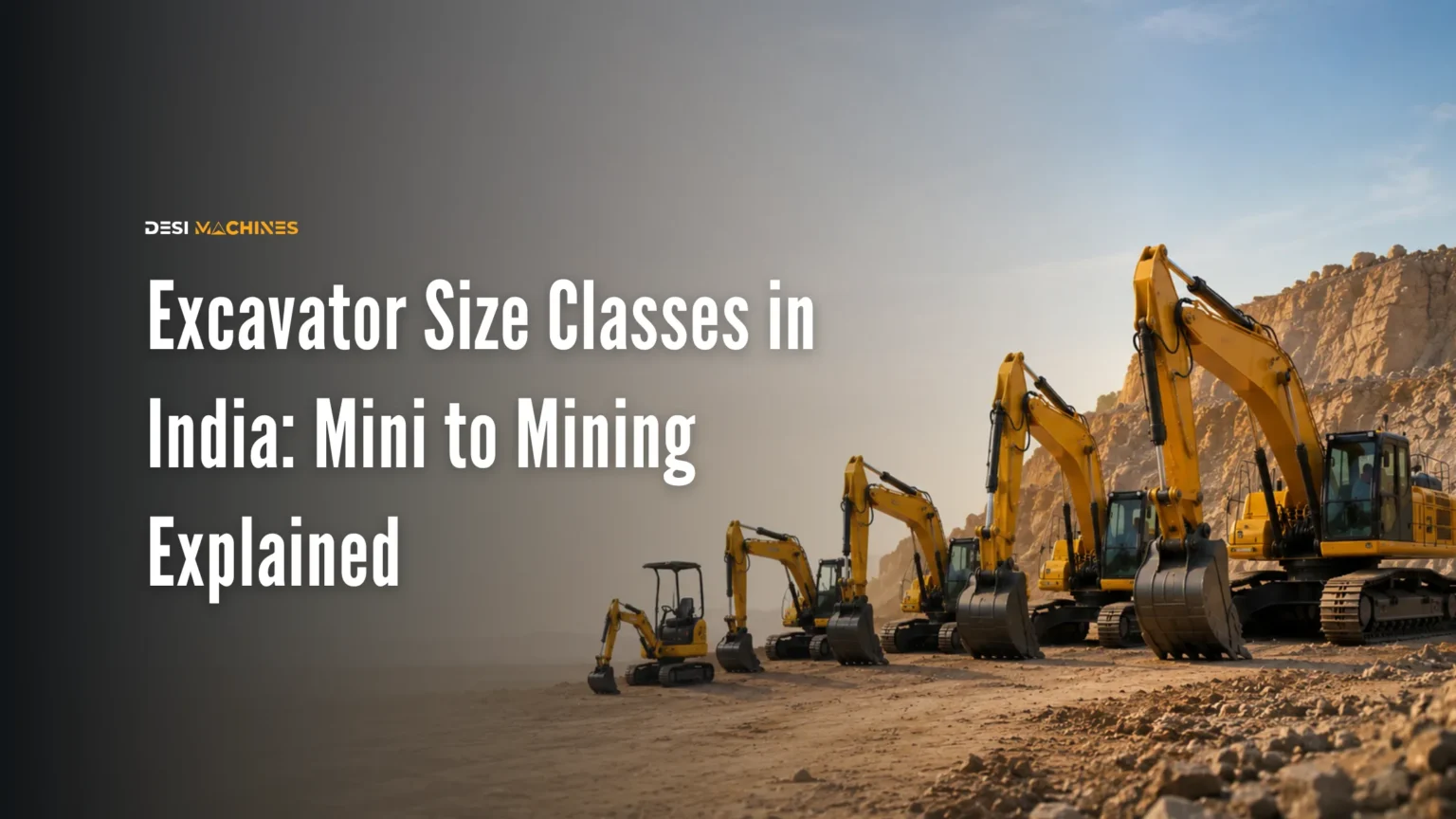
Excavator size classes are the weight groups that the industry uses to sort excavators, measured by the machine’s operating weight in tonnes. In India the working split is mini (0–6 tonne), small (6–15 tonne), medium (15–25 tonne), large (25–50 tonne) and extra-large or mining (above 50 tonne), with long reach, electric and wheeled machines sitting alongside as special types. Operating weight, not engine horsepower and not bucket size, is what decides the class, because weight is what gives a machine its digging force, its stability and its transport cost.
What are excavator size classes?
An excavator size class is a band of operating weight that groups machines of similar capability together. Operating weight means the weight of the complete machine ready to work — body, tracks, fuel, a standard bucket and the operator. A 20 tonne excavator weighs about 20,000 kg on the ground, and every maker in India builds a model to sit in that band.
Buyers and dealers use the class as shorthand. When a contractor says he needs “a 20 tonner”, everyone on the site knows roughly what is coming: a machine that can load a tipper in four to five passes, dig about six metres deep, and need a proper trailer to move. That is the value of the class. It travels faster in conversation than a spec sheet does.
The class is not the same thing as the machine type. Type is about how the machine is built and how it moves — crawler, wheeled, long reach. Class is only about weight. A crawler and a wheeled excavator can both be 15 tonne machines. If you are still deciding on type, start with our guide to the types of excavators, then come back here to fix the size.
What are the main excavator size classes in India?
India works with five main weight classes, from mini machines under 6 tonne to mining machines above 50 tonne. The table below sets out each class, what it is normally used for, and the price band each class spans as of August 2026.
| Size class | Operating weight | Typical work in India | Indicative price band (Aug 2026) |
|---|---|---|---|
| Mini | 0–6 tonne (up to 6,000 kg) | Narrow lanes, plot work, pipe and cable trenches, farm work, indoor demolition | ₹20–36 Lakh |
| Small | 6–15 tonne (6,000–15,000 kg) | House foundations, drainage, small roads, canal work, municipal jobs | ₹28–54 Lakh |
| Medium | 15–25 tonne (15,000–25,000 kg) | Highways, bulk earthwork, tipper loading, general contracting — the most common class here | ₹50–94 Lakh |
| Large | 25–50 tonne (25,000–50,000 kg) | Heavy earthmoving, quarrying, dams, large infrastructure packages | ₹62 Lakh – ₹2.60 Crore |
| Extra-large (mining) | Above 50 tonne (50,000 kg and up) | Coal and iron ore mines, big quarries, mass excavation | ₹1.25–5.0 Crore |
Each band runs from the cheapest machine in that class to the dearest. Mini starts at the XCMG XE20U at ₹20–22 Lakh and tops out at the Bobcat E50z at ₹33–36 Lakh. The large class covers the most ground of any row, from the Liugong 926E XD at ₹62–68 Lakh to the CAT 350 at ₹2.20–2.60 Crore. Every band here is indicative, as of August 2026, and moves with variant, attachment, state taxes and dealer. The classes themselves are the ones used to sort the machines here, so you can walk straight from a class into the models inside it: mini excavators, small excavators, medium excavators, large excavators and mining-class excavators. If your work is at a mine rather than a construction site, the guide to mining equipment in India sets out which machines a surface mine actually runs.
What is a mid-size excavator?
A mid-size or medium excavator is a machine weighing roughly 15 to 25 tonnes, and it is the size most Indian contractors buy first for serious work. The 20–21 tonne machine inside this band is the workhorse of Indian construction. It is big enough for highway earthwork and tipper loading, small enough to move on a normal low-bed trailer, and it has the widest choice of models, attachments and second-hand buyers when the time comes to sell.
The SANY SY215C-9LCS is a typical machine of this class, at ₹53–59 Lakh (indicative, as of August 2026). Others in the same band sit higher or lower depending on brand and features. If you want the class compared model by model, our roundup of the best 20 ton excavators in India does exactly that.
People often ask for a “mid size” machine and mean something smaller — an 8 or 10 tonner. If your work is house foundations, village drains and municipal contracts rather than highways, the small class is what you actually want, and it will cost you less to buy, to feed and to move.
Which excavator size is right for my work?
To turn “how much earth in a day” into a machine size, work out the output you need first: the excavator productivity calculation converts bucket size and cycle time into cubic metres an hour, which is what the size class should be chosen against.
Pick the size class from three things: how much earth you must move in a day, how tight the site is, and how far you must transport the machine. Bigger is not automatically better. A machine that cannot reach the corner of the plot, or that needs a low-bed trailer and a separately paid trip each way between two small jobs, earns nothing while it waits.
- Working in lanes, compounds and farm plots? Take a mini. Machines like the SANY SY35U Pro, at ₹26–29 Lakh (indicative, as of August 2026), get through gates a bigger machine cannot, and many can be moved on a tractor trolley.
- Doing house foundations, drains and small roads? The small class, 6 to 15 tonne, is the balance point. A machine such as the Tata Hitachi NX 80 sits at ₹31–35 Lakh (indicative, as of August 2026).
- Loading tippers all day on highway or bulk earthwork? Go medium, 15 to 25 tonne. Anything smaller will keep your tippers waiting, and waiting tippers are where the money is lost.
- Quarry, dam or a large infrastructure package? Large class, 25 to 50 tonne. A Liugong 935E HD comes in at ₹82–88 Lakh (indicative, as of August 2026).
- Mine or mass excavation on a long, fixed contract? Only then does the extra-large class pay. A SANY SY580C-10HD is ₹1.50–1.70 Crore (indicative, as of August 2026), and it needs the work to justify it.
One more test that people skip: match the excavator to the tipper. A 20 tonne machine fills a standard tipper in four to five bucket passes, which is about right. If it takes eight or nine passes, the machine is too small for the job and your fuel and your hours are being wasted. Browse the full range of excavators and talk to our team before you commit.
How does size affect running cost and transport?
Cost rises faster than size does. Step from a 6 tonne machine to a 20 tonne machine and the purchase price roughly doubles, but the diesel burn, the undercarriage bill and the transport charge climb with it, and those never stop.
Three costs move with the class:
- Diesel. Fuel is the largest running cost on any excavator, and it scales with engine size. A mini sips, a 20 tonner drinks, and a mining machine is a different order altogether. Our breakdown of excavator cost per hour puts real numbers to this.
- Undercarriage. Tracks, rollers and sprockets are wear parts — parts made to be replaced over the machine’s life — and both the parts and the labour get dearer with weight. See our guide to the excavator undercarriage and its maintenance.
- Transport. Below about 6 tonne a machine can often travel on a tractor trolley or a small truck. Above that you need a proper low-bed trailer, and above 50 tonne the machine may have to be dismantled and moved in parts. If your jobs are scattered across villages and districts, this cost alone can decide the class.
Where a machine is wanted for only a few months, hiring often beats buying, and the same size logic applies to a rental. For the buying side, our equipment finance and EMI options show how the monthly outgo changes as you step up a class. The machine’s own measurements matter just as much as its class: the excavator dimensions guide gives width, height, length and tail swing radius for every size bracket.
What about long reach, electric and wheeled excavators?
Long reach, electric and wheeled excavators are variations built on the same weight classes, not classes of their own. A long reach machine is usually a 20 to 25 tonne excavator fitted with a much longer boom and arm, so it can dig canals, dredge ponds and cut slopes while standing at a safe distance on the bank. The Tata Hitachi EX 215LC-SLR is one such machine, at ₹79–84 Lakh (indicative, as of August 2026); the rest sit together under long reach excavators.
Electric excavators run on battery or cable power instead of diesel, which suits enclosed sites, tunnels and any job where fumes and noise are a problem. They span the classes too, from small machines like the Liugong 908FE EV at ₹33–38 Lakh (indicative, as of August 2026) up to crore-plus machines; the full set is listed under electric excavators.
Wheeled excavators run on tyres instead of tracks and can drive themselves between nearby jobs, which is why municipal and utility crews like them. They are still rated by the same operating weight. The trade-offs are covered in our comparison of wheeled versus crawler excavators, and tracked machines in general in the crawler excavator guide.
Does bucket size change with the class?
Yes, and it is fixed by the class rather than chosen freely. Every excavator has a bucket range its hydraulics and counterweight can carry safely, and fitting a bucket bigger than that range makes the machine slow, unstable and expensive to repair.
The ladder is plain on the spec sheets: the 1,800 kg XCMG XE20U carries a 0.04 m³ (40 litre) bucket, the 5,019 kg Bobcat E50z 0.14 m³, the 20,500 kg XCMG XE210i 0.9 to 1.2 m³, and the 47,600 kg CAT 350 2.70 m³. The exact figure is on each model’s spec sheet, and it changes with the material: a wide bucket for loose soil, a narrow heavy one for rock. Our guides to excavator attachments and choosing the right bucket type go into that choice properly.
The same rule applies to breakers, rippers and other attachments — each is sized for a weight class. A breaker meant for a 20 tonner will damage a 10 tonne machine. Check the attachment against the class before you buy it.
Buying by class: a short checklist
Before you sign for a machine, run through five questions in this order. They take ten minutes and they settle most bad purchases before they happen.
- Daily output. How many cubic metres, or how many tippers a day, does the contract need? Size the machine to that, not to the biggest job you might win someday.
- Site access. Measure the narrowest gate and the tightest turn on the sites you work regularly. A machine that fits the work but not the site is useless.
- Transport. Count what it costs to move the machine between your usual jobs, and how often you will do it in a year.
- Dealer and parts. Check that the brand has a service point and parts stock within reach of where you work. With a machine down in the field, distance is money.
- Resale. The 20–21 tonne class has the deepest second-hand market in India, and minis are close behind. Very large machines take longer to sell. If you are also weighing a used machine, read our used excavator buying guide first.
Once the class is settled, compare the actual models inside it and their current prices. Start with the full excavator range, or go straight into a class, and get a written quote from an authorised dealer before you decide. If a backhoe loader would in fact suit your work better, the backhoe loader range is worth a look too.
Size classes are defined by operating weight, so if you want the actual kilogram and tonne figures for each class, see the excavator and backhoe weight guide. For how far down each class actually reaches, see mini excavator digging depth by size.
The mining band at the top of this table is also where the old rope-driven machines lived, and the power shovel versus hydraulic excavator comparison explains why the hydraulic design took that work over.
Engine power follows the same class ladder: the rated output for each size is set out in excavator engine power by size class.
Operating weight is only one line on the sheet. What every other figure on it means, and which ones actually decide a purchase, is set out in how to read excavator specifications.
The class a machine belongs to is usually written on its side. On most brands the digits in the model number are the operating weight in tonnes multiplied by ten, a rule decoded in the guide to excavator model numbers.
Prices, specifications and features are indicative, vary by variant, location and date, and should always be confirmed with the official OEM or authorised dealer before any purchase decision. DesiMachines is not liable for decisions taken on the basis of information that may have changed after publication. Price figures are taken from our listings at the time of writing.