
 Excavator
294 models
Excavator
294 models  Backhoe Loader
51 models
Backhoe Loader
51 models  Crane
68 models
Crane
68 models  Concrete Mixer
79 models
Concrete Mixer
79 models  Wheel Loader
54 models
Wheel Loader
54 models  Compactor / Roller
45 models
Compactor / Roller
45 models  Motor Grader
42 models
Motor Grader
42 models  Dozer
41 models
Dozer
41 models  Concrete Pump
66 models
Concrete Pump
66 models  Skid Steer Loader
11 models
Skid Steer Loader
11 models  Telehandler
13 models
Telehandler
13 models 


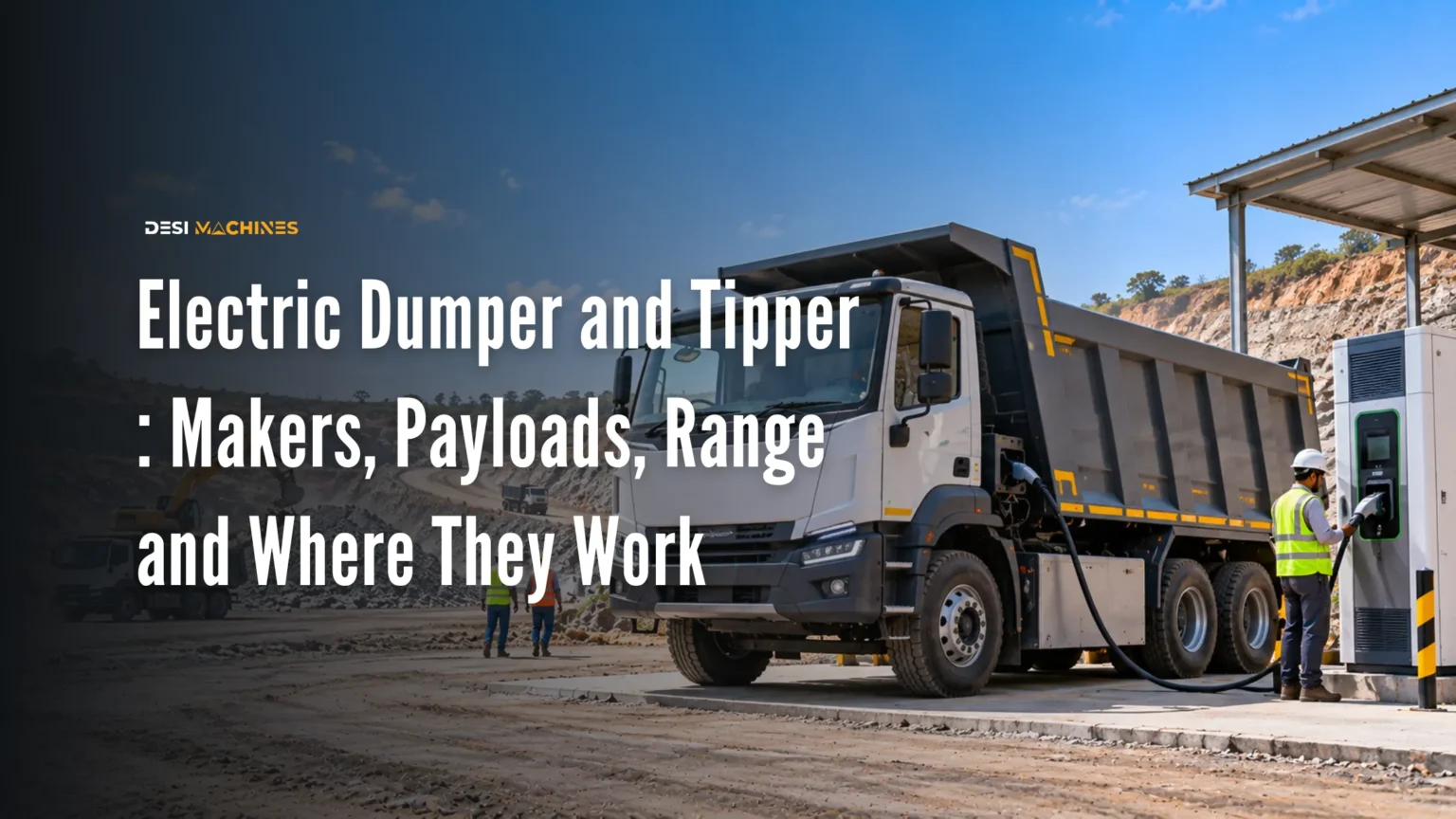
An electric dumper in India today means one of three quite different machines, and they sit a long way apart: a road-going electric tipper rated at 28,000 kg (28 tonne) gross weight, an off-highway electric dump truck built to carry 54,500 kg (54.5 tonne) in a mine, and an electric tractor-trailer running a fixed plant-to-plant haul. Only the first is a tipper you can order against a maker’s published sheet. None of the three carries a published list price.
Two words first, because Indian site language mixes them freely. A dumper or tipper is a truck whose body tips to empty the load. A dump truck in mining usually means a much larger rigid off-highway machine that never goes on a public road. Both are called dumpers on site, and that is exactly why buyers searching for an electric one land on three unrelated answers.
What does an electric dumper mean in India today?
It means one of three machine families, and choosing between them is not really a choice at all — the job decides it.
The road tipper. A registrable 6×4 truck with a tipping body, rated by gross vehicle weight, driven on public roads and registered with the RTO like any other truck. Gross vehicle weight, or GVW, is the loaded weight of the vehicle including its own body and the material on it.
The off-highway dump truck. A rigid mine truck rated by payload, not GVW, because it never leaves the lease and never needs a registration. These are the machines mine operators call dumpers, and they are far bigger than anything road rules would allow.
The closed-loop tractor-trailer. Not a tipper at all, but it does the same haulage work on fixed routes between a plant and a grinding unit or a port. Cement and steel groups are the buyers here.
A fourth family is worth naming so you can rule it out: the cable-electric mining excavator and shovel, which runs on a trailing power cable rather than a battery. We list those. The BEML BE1800E and the Liebherr R 992 E are both mains-fed machines, but they dig, they do not haul.
Which electric tippers and dump trucks can you actually see in India?
Four makers have shown something real, and only one of them publishes a specification sheet a buyer can read. The figures below are company-stated, taken from each maker’s own page or its own launch, with the date it was stated.
Closed loop: the shape electric suits
Load at face
Haul road
Tip at crusher
EV
Charger
Scattered work: it does not
Three sites in a week, no fixed
parking spot, no power connection
| Machine | Family | Company-stated rating | Battery / motor | Status as of October 2026 |
|---|---|---|---|---|
| Olectra Meghaetron Electric Tipper | Road tipper, 6×4 | 28,000 kg (28 tonne) GVW | 270 kW (about 362 HP) permanent magnet motor | Marketed, full specification published |
| BEML BH60-EV | Off-highway dump truck | 54,500 kg (54.5 tonne) payload, 36.4 m³ body | 1,000 kWh pack, permanent magnet motor with gearbox | Shown 30 September 2026, no price, no delivery window |
| BEML 35-tonne electric dump truck | Off-highway dump truck | 35 tonne (35,000 kg) class | Not published | Launched 10 April 2026, a separate machine from the BH60-EV |
| SANY SKT115E and 7540E | Mining truck and mining tipper | Not published | Not published | Displayed at bauma CONEXPO INDIA, September 2026 |
| SANY 3555E | Tipper | Not published | 462 kWh pack | Displayed at bauma CONEXPO INDIA, September 2026 |
| JSW Ampstar tipper | Road tipper | Not published | Not published | On the roadmap, no date or tonnage announced |
Read that table for what is missing as much as for what is in it. One machine, the Olectra tipper, publishes enough to compare against a diesel truck. Everything else is a launch photograph with a payload beside it. BEML’s BH60-EV launch at Mysuru is the most detailed of the lot and it still came without a price. JSW’s Ampstar brand started with a 55 tonne (55,000 kg) electric tractor-trailer and put tippers on a roadmap with no tonnage against them. SANY showed battery machines in eight classes and disclosed one pack size between the two haulage models.
How far will an electric tipper go on one charge?
The only published range figure for an Indian electric tipper is Olectra’s: up to 150 km, from the company’s own Meghaetron Electric Tipper page, with a top speed of 80 kmph. Treat “up to” as the laboratory end of it. A loaded 28 tonne tipper climbing a quarry ramp in May heat will not see the same number as an unladen run on level ground, in the same way a diesel tipper’s mileage falls on the same work.
For the mining machines there is no range figure at all, and that is honest rather than evasive. A mine truck is measured in tonnes moved per shift, not kilometres. What BEML has published is the pack: 1,000 kWh on the BH60-EV. SANY has published 462 kWh on its 5565E tractor and 3555E tipper. Those two numbers are more useful than a range claim, because they tell you the size of the electrical connection you will have to build.
The one real-world Indian data point at this weight is a road fleet, not a tipper. UltraTech runs 45 electric heavy-duty trucks at 55 tonne (55,000 kg) each on a route of about 250 km from Kotputli in Rajasthan to grinding units at Dadri and Sikandarabad, a deployment reported by Construction World on 18 June 2026. A fixed lane of a known length, run again and again, with charging at both ends. That is the duty cycle electric haulage works on today.
Which jobs suit an electric dumper, and which do not?
An electric dumper suits work where the machine comes home. A captive mine with a crusher at a fixed point, a port yard, a batching plant feeding one site, a cement or steel loop between two of your own gates. What matters is that the round trip has a known length and the vehicle parks in the same place every night.
It does not suit scattered work. Take a tipper that carries earth from three different district-road sites in one week, parks wherever the job finishes and loads sand from a riverbed with no power supply within kilometres. There is nowhere to plug it in, and no charger you can afford to move with it. The machine would spend its day waiting rather than carrying.
Two site realities decide it before any spreadsheet does. First, is there a power connection where the vehicle stops, with enough capacity for the pack size in the table above? Second, does the vehicle return to that point every shift? If either answer is no, a diesel tipper is still the right machine, and there is no shame in saying so.
What do you gain, and what do you give up?
| What you gain | What you give up |
|---|---|
| No diesel bill on the haul. UltraTech states about 2.9 million litres of diesel displaced a year across 45 trucks, roughly 64,000 litres per truck. | A charging connection you have to build. A 462 kWh or 1,000 kWh pack needs a transformer, a feeder and a slab, which is a civil job, not an accessory. |
| Lower running cost claims from the maker. BEML states 40 to 60 per cent lower operating cost on the BH60-EV than a comparable diesel machine. | No published price, so you cannot compare the purchase against a diesel tipper before you enquire. |
| Far fewer wearing parts in the driveline — no engine oil changes, no fuel filters, no exhaust after-treatment to clog. | Thin service reach. A diesel tipper can be fixed in any town; a high-voltage driveline needs the maker’s own trained hands. |
| Quiet, fumeless operation, which matters in a tunnel, an indoor yard or on night work in a built-up area. | No resale history. Electric heavy vehicles in India have no five-year price prints, so you carry the residual-value risk alone. |
| Regenerative braking recovers energy on a loaded downhill run, which is common on a pit ramp. Olectra lists ABS with regenerative braking on the Meghaetron. | Range and payload are traded against each other. A bigger pack is also more weight you are hauling instead of material. |
| Emissions you can report. BEML states about 130 tonnes of CO2 avoided per vehicle per year. | Charging time eats shift hours unless it fits your break pattern. |
One line is worth repeating from that table, because it is the one buyers underestimate. The charging connection is a construction project with a budget of its own, and it has to be approved before the vehicle is ordered, not after it arrives.
What makes an electric dumper hard to run in India?
Site power is the first wall. A pack measured in hundreds of kilowatt-hours cannot be filled from an ordinary site board, so you are looking at a dedicated transformer and a sanctioned load from the distribution company. On a mine lease that is routine. On a road project that moves every few months it is close to impossible.
Runtime per shift is the second. A diesel tipper refuels in ten minutes and goes back to work. An electric one is tied to however long its charger needs, so the shift has to be planned around the charge rather than the other way round. No Indian maker publishes a charging time for a tipper or dump truck yet; Olectra lists fast charging through what its page calls a CC2 connector, without a figure beside it.
Then there is service. Battery packs and high-voltage drivelines are not roadside repairs, and the dealer network for electric heavy vehicles is a fraction of the diesel one. Ask where the nearest trained technician actually sits, in kilometres, before you sign.
Last, the money question nobody can answer yet. With no published prices and no resale prints, the full cost of ownership is a forecast rather than a calculation. Our own working through of electric versus diesel running cost on an excavator shows the method, and the same arithmetic applies here once a price exists to put into it.
What should you check before you order one?
Work through these in order. Each one has stopped an electric haulage purchase somewhere in India this year.
- The loop. Measure your actual round trip in kilometres and count the trips in a shift. Compare the total against the published range, not against the “up to” figure.
- The connection. Get a written sanctioned-load figure from your distribution company for the point where the vehicle will park, and a quotation for the transformer and feeder.
- The rating that matters. On a road tipper, ask for GVW and the payload that is left after the body and the pack. On a mine truck, ask for payload and body volume. They are not the same question.
- Registration. A road tipper needs RTO registration and a permit like any truck. An off-highway dump truck does not go on a public road at all, so confirm how it will be moved to site.
- The sheet, in writing. Insist on pack size in kWh, motor rating in kW, charging time at your chosen charger, and gradeability with a full load. If a figure is not on paper, treat it as not promised.
- Service distance. Nearest trained technician, nearest spare pack, and the warranty terms on the battery specifically — packs and vehicles are often warranted differently.
- The finance. Lenders price an asset they can resell. Ask early how an electric tipper is valued, and look at equipment finance options before committing.
If you are weighing the purchase against hiring instead, a rented diesel tipper on the same route for a season is a cheap way to measure the loop properly before you electrify it.
What can you actually buy electric today?
No electric tipper or dump truck is listed on DesiMachines yet, because the category does not exist on the Indian market in a form a buyer can price. What is listed and in use is electric digging and concrete equipment, and that is where an owner curious about electric can start with real numbers in front of them.
We list 13 machines under electric excavators, covering both routes into an electric machine. The battery route includes the LiuGong 926FE EV, the SANY SY215EP and the Volvo EC500 Electric. The cable route, where the machine draws mains power through a trailing cable and never needs charging at all, includes the BEML BE1800E, worth understanding because on a fixed working face a cable sidesteps every charging problem in this guide.
For the price side of the electric question, what an electric truck costs in India sets out the PM E-DRIVE subsidy table by gross vehicle weight and what it implies, and is the right page for any rupee question about electric haulage. If your interest is materials handling rather than earthmoving, electric forklifts are the one electric category in India with a settled market. For the mine itself, our guide to mining equipment in India covers the machines that load these trucks, and batteries on construction machines explains how the packs are looked after. The full pillar sits at electric construction machines and vehicles in India.
When an electric tipper or dump truck does become something an Indian contractor can buy and price, it will be listed and this guide will link it. For now, the honest answer to “which electric dumper should I buy” is that the machine exists, the price does not, and the site power decides everything.
Specification and claim figures above are company-stated, from Olectra’s published Meghaetron page and from the BEML, SANY, JSW and UltraTech launches dated in the text, read in October 2026. Prices, specifications and features are indicative, vary by variant, location and date, and should always be confirmed with the official OEM or authorised dealer before any purchase decision. DesiMachines is not liable for decisions taken on the basis of information that may have changed after publication.