
 Excavator
294 models
Excavator
294 models  Backhoe Loader
51 models
Backhoe Loader
51 models  Crane
68 models
Crane
68 models  Concrete Mixer
79 models
Concrete Mixer
79 models  Wheel Loader
54 models
Wheel Loader
54 models  Compactor / Roller
45 models
Compactor / Roller
45 models  Motor Grader
42 models
Motor Grader
42 models  Dozer
41 models
Dozer
41 models  Concrete Pump
66 models
Concrete Pump
66 models  Skid Steer Loader
11 models
Skid Steer Loader
11 models  Telehandler
13 models
Telehandler
13 models 


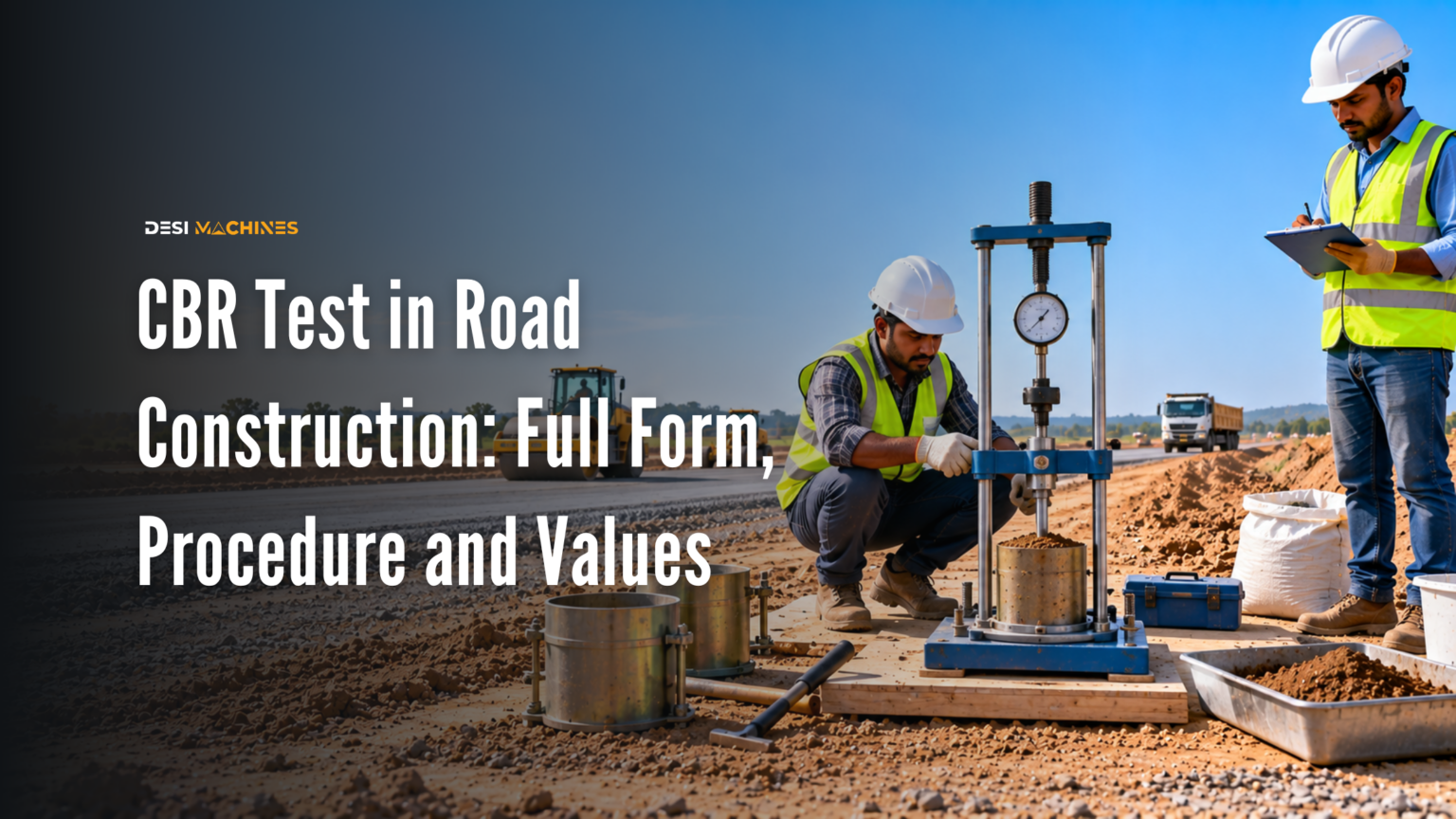
A soil that scores 2% on the CBR test needs a much thicker road on top of it than a soil that scores 10%, and that difference is decided before a single truck of stone arrives. CBR, short for California Bearing Ratio, is a laboratory test that pushes a steel plunger into a soaked sample of the soil and compares the force it takes against the force needed for crushed stone.
The answer comes out as a percentage. Indian pavement design reads it as the strength of the ground the road will stand on, and every layer above is sized from it. The test method is IS 2720 (Part 16), and the design rules on this page come from the Indian Roads Congress guidelines IRC:37-2018 for flexible pavements and IRC:SP:72-2015 for low volume rural roads. Where a contract or a pavement design sets its own figures, the contract wins.
What does CBR mean in road construction?
CBR in road construction is the strength score of the subgrade, the compacted natural soil at the bottom of the road. A score of 100% means the soil resists the plunger as well as a standard crushed stone does. Subgrade soils score far less: the Indian rural roads guideline grades them from about 2% to 15%.
The name comes from where the test began. The foreword to IS 2720 (Part 16) records that the California State Highway Department in the USA used the method until 1950 to judge subgrade strength for flexible pavements, which are roads with a bitumen surface on layers of stone. India still uses it because the equipment is simple and the design curves built on it come from decades of watching real roads perform.
The same standard is honest about what the number is. It calls CBR an index related to strength, and says the value depends heavily on the condition of the soil at the time of testing. That is why the moisture and density of the sample matter as much as the test itself.
How is the CBR test done?
The CBR test is done in a soil lab on a sample packed into a steel mould, soaked for four days and then pressed with a plunger at a fixed slow speed. IS 2720 (Part 16) sets every step:
- Sieve the soil. The material for a remoulded sample must pass a 19 mm sieve. Stones bigger than that are replaced by an equal weight of 4.75 mm to 19 mm material, so the sample keeps the same amount of coarse stone.
- Pack it into the mould. The mould is 150 mm across, and the soil is compacted to a set density at the moisture the design asks for, usually the optimum moisture content, the water level at which the soil packs tightest.
- Put weights on top. Annular weights, flat steel rings, are stacked on the sample to copy the weight of the pavement layers that will sit on the soil. They go on in steps of 2.5 kg.
- Soak it for 96 hours. The mould sits under water with free access top and bottom, and a dial gauge on a tripod records how much the soil swells each day.
- Drain and press. After 15 minutes of draining, the mould goes into a loading frame of at least 5,000 kg capacity. A plunger 50 mm across is seated with a 4 kg load and then driven into the soil at 1.25 mm per minute.
- Read the load. Loads are recorded at penetrations of 0.5, 1.0, 1.5, 2.0, 2.5, 4.0, 5.0, 7.5, 10.0 and 12.5 mm, and plotted as a load against penetration curve.
The standard also lets a lab test undisturbed soil, cut straight out of the ground with a sharp-edged mould, or skip the soaking where it is not needed. For new roads, IRC:37-2018 asks for remoulded samples, packed by static compaction (pressing rather than ramming) to the target density.
Figure 1: The CBR test set-up, from top to bottom
Two dial gauges reading to 0.01 mm track the plunger’s travel and, during soaking, the swell of the soil. Arrangement as described in IS 2720 (Part 16), clauses 3 and 5.
How is the CBR value calculated?
The CBR value is the test load divided by a standard load for the same penetration, multiplied by 100. The standard loads are what crushed stone carries at that depth, and IS 2720 (Part 16) fixes them:
| Plunger penetration | Standard unit load | Standard total load |
|---|---|---|
| 2.5 mm | 70 kg/cm² | 1,370 kg |
| 5.0 mm | 105 kg/cm² | 2,055 kg |
Before reading the curve, the lab corrects it. The first part of the curve often bends the wrong way because the soil surface is not perfectly flat, so a straight line is drawn along the steepest part and the zero point is moved to where that line meets the axis.
Here is how it works with example figures, not from a real test. Say the corrected load is 82 kg at 2.5 mm and 110 kg at 5.0 mm:
- At 2.5 mm: 82 ÷ 1,370 × 100 = 6.0%
- At 5.0 mm: 110 ÷ 2,055 × 100 = 5.4%
The 2.5 mm figure is usually the higher one, and when it is, it becomes the CBR of the soil. In this example the soil’s CBR is 6%. If the 5 mm figure comes out higher, the standard asks for the test to be repeated, and only if the repeat gives the same result is the 5 mm value used.
The lab also reports the expansion ratio, the swell during soaking as a percentage of the sample’s height. It is a warning sign more than a design number: a soil that swells a lot in the mould will heave under a road in the monsoon.
Why is the sample soaked for four days?
The sample is soaked because soil is at its weakest when it is wet, and a road has to survive its worst monsoon, not an average dry day. IRC:37-2018 says the subgrade CBR should be found at the most critical moisture condition likely at the site, and that pavement thickness should be based on the 4-day soaked CBR of soil remoulded at placement density, at least 97% of the maximum dry density, and at its optimum moisture content.
The same guideline allows one exception. In areas with less than 1,000 mm of rainfall a year, four days of soaking may be too harsh for a subgrade well protected by a thick bituminous layer, and it can make the soil look weaker than it will ever be. Where data on the seasonal moisture is available, the moulding moisture for the test can be chosen from that field data instead.
For rural roads, IRC:SP:72-2015 sorts sites by groundwater. Where the water table rises close to the road, or seasonal floods are likely, it falls back on the 4-day soaked CBR. Its own trigger depths are 1 m for non-plastic soils, 3 m for clays of low plasticity and 7 m for heavy clays.
What is a good CBR value for a road?
For a road carrying regular trucks, a subgrade CBR above 5% is the working minimum, and 10% or more is good ground. IRC:37-2018 says the effective subgrade CBR should be more than 5% for roads expected to carry more than 450 commercial vehicles a day, counting both directions, in the year the road is built. IRC:SP:72-2015 applies the same 5% floor to village roads even when traffic is light, and asks for weaker soil to be stabilised up to it.
The rural roads guideline also gives typical soaked values by soil type, useful as a first guess before the lab report arrives, and splits subgrades into five classes:
| Soil (IS classification) | Typical soaked CBR |
|---|---|
| Highly plastic clays and silts (CH, MH) | 2% to 3% |
| Silty clays and sandy clays (ML, MI, CL, CI) | 4% to 5% |
| Clayey sands and silty sands (SC, SM) | 6% to 10% |
| Expansive clays such as black cotton soil | May be below 2% |
| Subgrade class (IRC:SP:72) | Quality | CBR range |
|---|---|---|
| S1 | Very poor | 2% |
| S2 | Poor | 3% to 4% |
| S3 | Fair | 5% to 6% |
| S4 | Good | 7% to 9% |
| S5 | Very good | 10% to 15% |
The layers above the subgrade have their own, much higher, bars. MoRTH’s specification for road works, Table 400-2, asks granular sub-base material for a CBR of at least 30% at 98% dry density unless the contract says otherwise. A concrete road has a lower soil bar of its own, set out in the guide to CC road construction, and the test limits for every road material are listed in road construction materials in India.
How does CBR decide the thickness of a road?
CBR sets road thickness because it is turned into a stiffness figure that the pavement design runs on. IRC:37-2018 designs a flexible pavement from the resilient modulus of each layer, which is how much a material springs back under a passing wheel. Measuring that directly needs an expensive repeated-load machine, so the guideline lets designers estimate it from CBR:
- For CBR up to 5%: resilient modulus (MPa) = 10 × CBR
- For CBR above 5%: resilient modulus (MPa) = 17.6 × CBR0.64
The estimated modulus is capped at 100 MPa for design. Worked through the two formulas, the numbers climb like this:
| Subgrade CBR | Estimated resilient modulus |
|---|---|
| 2% | 20 MPa |
| 3% | 30 MPa |
| 5% | 50 MPa |
| 7% | 61 MPa |
| 10% | 77 MPa |
| 15% | 100 MPa (99.6, at the cap) |
Ground at 2% gives the road above it a fifth of the support that 15% ground does. The design makes up the difference with thicker layers of stone and bitumen, which is why a low CBR is expensive. How those layers stack up is explained in road construction layers in India.
One test is never enough. IRC:37-2018 asks for the CBR of each soil type to be the average of at least three specimens. The design then takes the 90th percentile value for expressways, national highways, state highways and urban roads, meaning a value that 90% of the test results reach or beat. Other roads can use the 80th percentile if design traffic is below 20 msa, million standard axles, a count of heavy wheel loads over the road’s life. IRC:SP:72-2015 asks for at least three soil samples per kilometre on a rural road, and at least one CBR test for each soil group found.
Can CBR be checked on site without a lab?
Yes, roughly, with a dynamic cone penetrometer, or DCP. IRC:SP:72-2015 describes it in its Appendix C: a 20 mm steel cone with a 60 degree point, driven into the ground by an 8 kg hammer dropped 575 mm down a 16 mm rod. The reading is how many millimetres the cone sinks per blow, and the guideline gives a chart that converts it to CBR. The softer the soil, the further the cone goes with each blow.
It reaches about 1.2 m deep with an extension rod, and a cone lasts 30 to 40 tests in subgrade soil before it needs replacing. For an existing rural road, the guideline suggests a DCP test every 250 m, staggered on both sides, 0.6 m to 1.0 m from the edge of the carriageway.
The DCP does not replace the lab. If the soil holds stones bigger than 20 mm, or repeated tests on one kilometre vary by more than a third of their average, IRC:SP:72-2015 asks for a soaked CBR test on remoulded samples instead.
During construction, MoRTH’s specification asks for one CBR test, the average of three specimens, on the material going into the subgrade, and for the finished subgrade to be tested on samples compacted to the field density at the field moisture. A field lab equipped to its list carries a 5-tonne motorised load frame, six CBR moulds 150 mm across and 175 mm high, 2.5 kg surcharge weights and a soaking tank.
What can you do when the soil’s CBR is too low?
When the CBR is too low you improve the soil, replace it, or design a thicker road on top, and the cheapest choice depends on how far short it falls. The usual routes:
- Stabilise it. Lime suits clayey soil and cement suits sandy soil. MoRTH asks that the laboratory CBR of a lime-treated soil be at least 1.5 times the minimum field value the contract asks for, because a lab mix always comes out stronger than one mixed on the road. Cement-treated layers have their own strength rules, covered in CTSB and CTB in road construction.
- Replace it. Where the CBR is 2% or less, IRC:SP:72-2015 says replacing 300 mm of subgrade with better soil should be explored, and the road then designed on the improved soil. It adds that replacement should be picked only when it is cheaper than stabilisation.
- Separate it. A geotextile laid on a weak subgrade stops the stone above from sinking into it. The service-life gain IS 16391 quotes for 2% and about 4% CBR soils is in the guide to geotextile and geogrid in road construction.
- Drain it. A wet subgrade is a weak subgrade. Side drains and a shoulder that sheds water protect the CBR the design assumed.
Which machines decide whether the field soil matches the lab CBR?
The roller decides it. The lab tests soil packed to a set density, at least 97% of the maximum dry density under IRC:37-2018, so the design CBR only holds on site if the roller actually reaches that density. Soil left at a lower density is weaker than the lab sample, so a road designed on one CBR ends up standing on a lower one.
On the subgrade, a motor grader spreads and shapes each layer, a water tanker brings it to the right moisture, and a soil compactor, the single drum vibratory roller, packs it. Smooth drums suit sandy and gravelly soil; clay needs the padded drum of a sheepsfoot roller that kneads it from below. How rollers reach density, and why moisture matters, is explained in the guide to soil compaction. MoRTH asks for at least one set of ten density measurements for every 3,000 m² of compacted area, so the roller’s work is checked as hard as the lab’s.
Single drum machines such as the JCB VM117, Escorts EC 5250 and L&T 1190 are the usual subgrade rollers on Indian road jobs, and the soil compactor guide explains how to size one. When you are ready to plan the fleet, compare soil compactors and motor graders and connect with a dealer.
The test procedure on this page follows IS 2720 (Part 16): 1987, Laboratory Determination of CBR, and the design rules follow IRC:37-2018, Guidelines for the Design of Flexible Pavements, Section 6, together with IRC:SP:72-2015 and the MoRTH Specifications for Road and Bridge Works (5th revision). Every other road topic sits under the road construction guide.
Prices, specifications and features are indicative, vary by variant, location and date, and should always be confirmed with the official OEM or authorised dealer before any purchase decision. DesiMachines is not liable for decisions taken on the basis of information that may have changed after publication. Test and design requirements quoted here follow the standards named above and are not a substitute for the contract specification or a pavement design by a qualified engineer.
Machines, tenders and news for this industry: Road Construction