
 Excavator
294 models
Excavator
294 models  Backhoe Loader
51 models
Backhoe Loader
51 models  Crane
68 models
Crane
68 models  Concrete Mixer
79 models
Concrete Mixer
79 models  Wheel Loader
54 models
Wheel Loader
54 models  Compactor / Roller
45 models
Compactor / Roller
45 models  Motor Grader
42 models
Motor Grader
42 models  Dozer
41 models
Dozer
41 models  Concrete Pump
66 models
Concrete Pump
66 models  Skid Steer Loader
11 models
Skid Steer Loader
11 models  Telehandler
13 models
Telehandler
13 models 


A hybrid excavator still runs on diesel. What makes it a hybrid is a second store of energy, an electric capacitor or a gas-charged hydraulic accumulator, that catches the power a normal excavator wastes as heat when the upper body brakes after a swing or the boom comes down, and gives it back on the next cycle.
That one idea explains everything else on this page. The saving depends on how much your machine swings and lowers its boom, which is why makers quote anything from 15% to 25% less fuel, and sometimes more, each against a different comparison machine. It also explains why a hybrid needs no charger and no power line at the site, which is the biggest difference between a hybrid and the electric excavators now sold in India.
How does a hybrid excavator work?
Start with where a normal excavator wastes energy. A 20-tonne machine loading tippers swings its upper body, called the house, back and forth all shift. Each swing has to be started, which takes engine power, and then stopped, which on a conventional machine means the swing motor works against its own oil and turns that moving mass into heat. The same thing happens when a loaded boom comes down: its weight pushes oil out of the cylinder, and that pressure is mostly thrown away across a valve.
The trick is to catch some of that energy, hold it for a few seconds and spend it on the next movement. Komatsu, which says it launched the first hydraulic excavator with a working hybrid system in 2008, describes it on its own Komatsu Hybrid Technology page: the electric swing motor becomes a generator “as the upper structure slows down”, the electricity goes into an ultra-capacitor, and a generator-motor fitted between the engine and the pumps uses it “to assist the engine when it needs to accelerate”.
One swing cycle on an electric hybrid excavator
| Step | What the machine is doing | Where the energy goes |
|---|---|---|
| 1 | Bucket full, house starts to swing towards the tipper | The engine, helped by energy from the capacitor, drives the swing |
| 2 | House slows to stop over the tipper | Swing motor works as a generator and charges the capacitor |
| 3 | Bucket dumps, house swings back to the cut | Capacitor gives its energy back to help the engine |
| 4 | House stops at the cut | Capacitor is charged again, ready for the next load |
Based on Komatsu’s description of its hybrid system. On a hydraulic hybrid the same loop runs through a gas-charged accumulator instead of a capacitor.
The energy store is small and works in seconds, so it never runs the machine on its own. It only helps the engine at the moments it works hardest, such as getting a loaded house moving. That is the whole difference from an electric machine, which carries all its energy in a battery or takes it from a cable.
What kinds of hybrid system are there?
Makers have taken two routes. The difference is the energy store, and it changes what can go wrong and who can repair it.
An electric hybrid stores energy in an ultra-capacitor, also called a supercapacitor. A capacitor holds electric charge on its plates rather than in a chemical reaction, so it fills and empties far faster than a battery and lasts through many more cycles, but holds much less energy for its size. That suits an excavator well, because the job is to soak up a burst of energy and release it a few seconds later, hundreds of times an hour. Komatsu’s own page puts it simply: capacitors “transfer power much faster than batteries, which use chemical reactions”.
A hydraulic hybrid skips the electrics. It stores energy in a hydraulic accumulator, a steel bottle with oil on one side and nitrogen gas on the other. Oil pushed in squeezes the gas, and the squeezed gas pushes the oil back out when it is needed, much like a spring. It is an ordinary hydraulic part, not a new invention, which is why this route adds so little to the machine.
| System | Energy is caught from | Stored in | Maker example (as the maker describes it) |
|---|---|---|---|
| Electric hybrid | Swing braking | Ultra-capacitor | Komatsu HB215LC-3 and HB365LC-3: electric swing motor-generator plus a generator-motor on the engine |
| Hydraulic hybrid, swing | Swing braking | Hydraulic accumulators | Caterpillar 336E H: swing brake energy captured in accumulators and reused “during swing acceleration” |
| Hydraulic hybrid, boom | Boom coming down | Hydraulic accumulator | Volvo EC300E Hybrid: boom-down energy drives hydraulic assist motors that help power the pump |
| Energy recovery on a diesel machine | Not described in detail | Not specified | SANY GENe 20-tonners: “potential energy hybrid power recovery” in their feature lists |
The electric route adds more parts: a generator-motor, an inverter that turns the generator’s AC into DC for the capacitor, and a capacitor bank that needs its own cooling. On the HB365LC-3 Komatsu lists three extra fluid fills that a conventional machine does not have, for the motor-generator, the swing motor-generator and the ultra-capacitor cooling system. The hydraulic route adds very little, which is the point Volvo makes about its EC300E Hybrid: “just a few add-on components that are simple to maintain”.
Is boom or arm regeneration the same thing as a hybrid?
No, and this is the mix-up that matters most when you read an Indian spec sheet. Many ordinary diesel excavators list a “regeneration” feature, and it sounds like energy recovery. It is something smaller.
When the boom or the arm comes down under its own weight, the oil pushed out of one end of the cylinder is under pressure. A regeneration valve sends some of that oil straight round to the other end of the same cylinder instead of dumping it back to the tank. The cylinder needs less fresh oil from the pump, so the arm moves faster and the engine does a little less work. Nothing is stored. The saving happens inside that one stroke and is gone by the next. The valve that does this sits in the main control valve, the block of spools every joystick movement passes through.
You can see the feature named on machines that are plainly not hybrids:
- The Hyundai R210 Smart Plus lists “arm regeneration”, which its feature list says recirculates hydraulic energy “from return line to pump supply line” for a smoother, faster arm.
- The CAT 320D3 lists boom and stick regeneration circuits and puts their fuel saving at “up to 2%”.
- The BEML BE200 lists boom and arm regeneration as part of its load-sensing hydraulic system.
All three are conventional diesel-hydraulic excavators. Regeneration is worth having, but it is not a hybrid, and a seller who calls a regeneration valve “hybrid technology” is stretching the word. The CAT figure is a useful yardstick: if a valve trick is worth about 2%, a real hybrid has to show a lot more than that to justify its extra parts.
How much fuel does a hybrid excavator really save?
Most makers publish a figure, and each one is measured against a different machine. Read the second column before the first.
| Machine | Fuel saving the maker claims | Compared with | Where the maker said it |
|---|---|---|---|
| Komatsu HB215LC-3 | More than 20% | A non-hybrid excavator; the same page also gives 20% against Komatsu’s PC210LC-11 | Komatsu Europe launch news |
| Komatsu HB365LC-3 | Up to 20% | The non-hybrid excavator design | Komatsu Australia product page |
| Caterpillar 336E H | Up to 25% | A standard 336E (up to 33% against the older 330D and 336D) | Caterpillar 336E H questions and answers, 2012 |
| Kobelco SK200H | 16% | A standard SK200-8 | Kobe Steel annual report, 2013 |
| Volvo EC300E Hybrid | Up to 15% | A conventional EC300E | Volvo CE news release, January 2020 |
| SANY GENe 20-tonners | No figure for the recovery system | Not specified | SANY India product pages |
Three things to take from that table.
The word “up to” carries a lot of weight. Caterpillar ties its bigger figure to a footnoted test of 90-degree truck loading. Volvo says its payback of about two years applies to high-production “dig and dump” work, “especially those within a 90° swing”, and its brochure adds that savings “may vary based on operator, application and conditions”. Those are the best cases, not the average.
The comparison machine matters as much as the number. A saving against an older model mixes the hybrid’s gain with every other improvement made since. Kobelco’s and Volvo’s figures, each measured against the same maker’s standard version of that model, are the cleaner comparison.
And one maker can quote several numbers. Komatsu’s own pages range from about 20% on the model pages to “up to 40%” on its general hybrid page, and a rental line on its Australian site says “as much as 40 percent” against a same-sized conventional Komatsu. Ask the dealer which figure applies to the exact model, and against what.
SANY’s page for the SY225C-10HD GENe does carry an 11% fuel figure, but they credit it to the engine’s Direct Power Control and give no comparison machine, so it cannot be read as the saving from the recovery system.
Which jobs suit a hybrid excavator?
Swing-heavy work is where a hybrid earns its money: short cycles repeated all day. Picture a 20-tonne machine loading tippers in a quarry or a borrow pit. It digs, swings 90 degrees, dumps, swings back, and does that again and again for the whole shift. Every swing ends in a stop, and every stop is energy a hybrid catches.
The work that suits it best:
- Truck and tipper loading at quarries, crusher plants, sand reaches and road earthwork, where the swing never stops.
- Mass excavation for basements and canals, where the machine stands in one place and slews from the cut to the spoil heap.
- High-hour fleets. Fuel saving is a percentage, so a machine doing 3,000 hours a year gains three times what a machine doing 1,000 hours gains.
Where a hybrid gains little:
- Long straight trenching for pipelines and cables, where the machine digs and creeps forward with little swing.
- Rock breaker work, where the boom holds steady and the hammer does the work.
- Travel and waiting. A machine that spends half its day idling for tippers saves fuel through auto-idle, which ordinary machines also have, not through its hybrid system.
So before you look at any fuel claim, look at your own site. If your operator swings most of the day, a hybrid has something to work with. If he mostly digs in a line or waits, it does not.
If you are sizing a machine for that kind of loading work, compare the 15 to 25 tonne excavators first. That is the class the hybrids named above belong to, and the class the GENe machines sit in.
Is a hybrid excavator the same as an electric excavator?
No. A hybrid fills up with diesel at the same bowser as every other machine and charges its small store by itself while it works. An electric excavator has no diesel engine at all and has to get all its energy from outside, either from a big traction battery charged between shifts or from the grid through a cable. The guide to charging an electric excavator explains what that means for site power.
In practice a hybrid changes nothing about how your site runs: same fuel, same remote locations, no power sanction. An electric machine removes diesel and exhaust completely, but only where power is available and the work stays close to it.
The electric excavators listed in India fall into three groups:
- Battery machines: the LiuGong 9027FE EV, LiuGong 908FE EV, LiuGong 922FE Battery and SANY SY215EP. The LiuGong 926FE EV and LiuGong 939FE EV are listed as electric without saying battery or cable, so ask the dealer.
- Cable machines that plug into the grid: the LiuGong 922FE Cable and Volvo EC500 Electric, plus the SANY SY375EP, which lists a 300 kVA transformer.
- Mains-powered mining machines: the BEML BE1000E-1, BEML BE1800E, Liebherr R 992 E and Liebherr R 998 SME-E.
The running-cost sums for the electric side are in electric vs diesel excavator running cost. The same energy-recovery idea shows up on electric loaders and tippers too, where the motor recovers energy on a loaded downhill run, covered in the guide to electric wheel loaders. Where electric and hybrid machines are heading as a market is a separate subject, followed in the blog on heavy construction equipment market trends.
What are the pros and cons of a hybrid excavator?
| In favour | Against |
|---|---|
| Uses less diesel on swing-heavy work, by the makers’ own claims of about 15% to more than 20% against their non-hybrid twins. | The saving shrinks on trenching, breaker work and idling, which is a large part of many Indian machines’ day. |
| Needs no charger, cable or power sanction. It works on any site a diesel machine can reach. | Still burns diesel and still has exhaust, so it does not meet a zero-emission site rule. |
| Drives like a normal excavator. Volvo says its EC300E Hybrid keeps “the same levels of controllability and performance” as the standard machine. | Extra parts to look after: on electric hybrids a generator-motor, an inverter and a capacitor bank with its own cooling; on hydraulic hybrids an accumulator that must hold its nitrogen charge. |
| Hydraulic hybrids add only a few ordinary hydraulic parts. | Electric hybrids add electrical power parts that only technicians trained by the maker should open, and those technicians may be far from your site. |
| Some makers back the hybrid parts with a longer warranty; Komatsu Europe quotes 5 years or 10,000 hours on hybrid components of the HB215LC-3. | That warranty is regional, so it means nothing until the Indian dealer puts the same terms in writing. |
| Payback can be quick on high-hour loading work; Volvo puts it at about two years in “dig and dump” use. | It costs more to buy than its diesel twin, which is why Caterpillar talks of recovering the “added investment”. Resale is also harder to judge, since a used buyer will ask the same questions about the hybrid parts. |
What should you check before buying a hybrid or energy-recovery excavator?
Ask these questions in writing, and keep the answers with the quotation.
- Which system is it? Electric hybrid with a capacitor, hydraulic hybrid with an accumulator, or a regeneration valve on a normal machine? If the dealer cannot say, treat it as the last.
- Against what is the fuel figure measured? Get the comparison model and the test work. A saving against a ten-year-old model is not a saving against today’s diesel twin.
- What does your own work look like? Estimate how many hours a day the machine will spend loading with swings, trenching, breaking and idling. Only the first earns much from a hybrid.
- Who services the hybrid parts in your area? Ask where the nearest technician trained on the hybrid system sits, and how long a breakdown call takes to reach your site.
- What is the warranty on the hybrid parts in India? Get the years, the hours and the parts covered, especially the capacitor bank or accumulator, from the Indian dealer, not from a foreign brochure.
- What does the extra servicing involve? Ask for the service schedule for the hybrid parts: coolant for the capacitor system, nitrogen pressure checks on accumulators, and what each costs.
- Can the hybrid be added later? Do not count on it. Volvo said in 2020 that its hybrid system was not available to fit to an existing machine, so the choice is made at purchase.
For the hydraulics underneath, the guide to excavator hydraulic motors explains how the swing motor works and why it wears.
Where does this leave an Indian buyer?
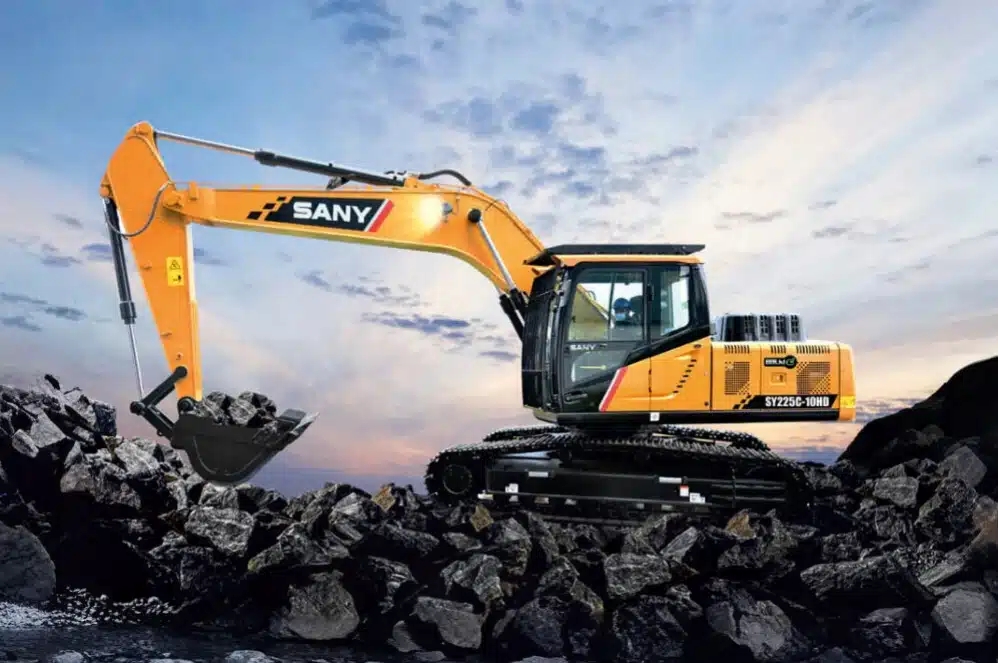
For most Indian sites, the useful question is not “hybrid or not” but how much of the day the machine spends swinging. If the answer is most of it, ask the dealer of any 20-tonne class machine what energy recovery it has and what saving it can prove on work like yours. The SANY SY225C-10HD GENe, SY230C-10HD GENe and SY260C-10HD GENe are the 20-tonne class models whose feature lists name energy recovery, so they are a natural place to start that conversation. If your work is fixed and close to power, look at the electric excavator range instead.
Whatever you choose, compare the full range of excavator models and prices, and see the machinery finance options if the extra cost of a fuel-saving machine has to be spread over its working life. More on battery and cable machines is in the guide to electric construction machines.
Maker descriptions and fuel-saving claims are quoted from each maker’s own published material as dated in the text, and the excavator features from each machine’s specification as of October 2026. Prices, specifications and features are indicative, vary by variant, location and date, and should always be confirmed with the official OEM or authorised dealer before any purchase decision. DesiMachines is not liable for decisions taken on the basis of information that may have changed after publication.