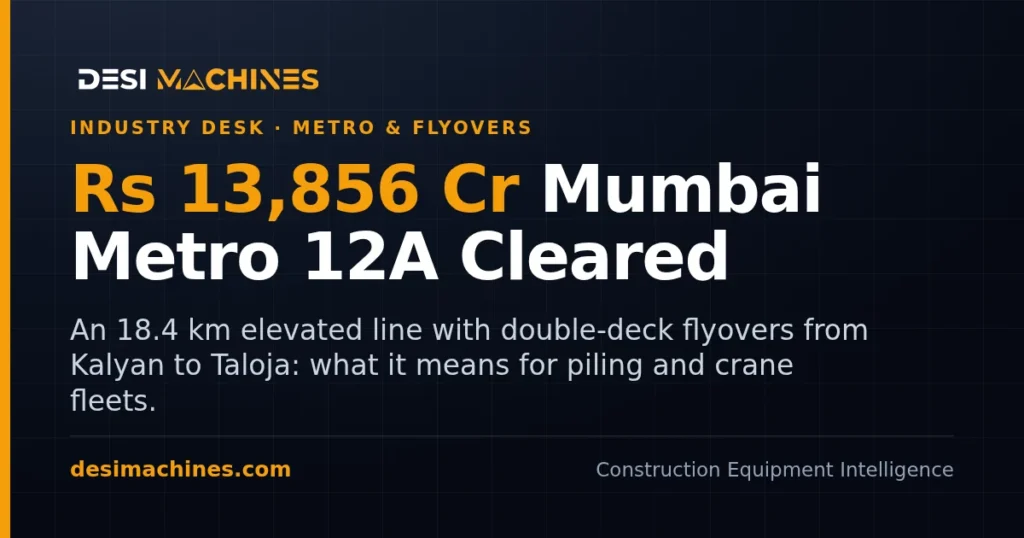
Maharashtra’s Cabinet Infrastructure Committee on Tuesday cleared Mumbai Metro Line 12A at Rs 13,856.37 crore. The figure is far bigger than the metro alone would cost, because the approval folds two long stretches of elevated road into the same alignment. For piling, crane and batching-plant owners working the MMR, that makes 12A one of the more structure-heavy elevated jobs the region has sanctioned this year.
The quick facts
- Rs 13,856.37 crore, approved by the Maharashtra Cabinet Infrastructure Committee at Mantralaya on 27 October 2026.
- 18.40 km, fully elevated, from Manpada-Katai Naka to Taloja via Kalyan Phata, with 12 stations.
- Two integrated elevated road stretches on the same corridor: 6.93 km and 8.69 km, the longer one six-lane.
- MMRDA will build it; Chief Minister Devendra Fadnavis has set a three-and-a-half-year completion target.
What the committee approved
The Free Press Journal and News18 both carry the Tuesday decision with the same cost, length and station count. News18 attributes the projected 40 to 50 percent cut in travel time and 4.74 lakh daily riders to MMRDA Metropolitan Commissioner Sanjay Mukherjee. Interchanges are planned with Metro 12 and the bullet-train link at Katai Naka, with Metro 14 between Katai Naka and Kalyan Phata, and with Navi Mumbai Metro Line 1 at Amandoot.
This is a new stage. In February, MMRDA announced the same 18.4 km extension at Rs 8,414.53 crore as a metro project. The state-level approval now on record is for the combined metro-and-flyover scheme.
What does Metro 12A mean for equipment buyers?
Start with the rate. Rs 13,856.37 crore over 18.40 km is about Rs 753 crore a km. Our own anchors from August put Mumbai Metro 13 near Rs 708 crore a km, with 3.25 km of underground work, and Metro 10 near Rs 808 crore a km on a short 9.676 km line. Metro 12A has no tunnel at all, so the road decks are what keep its rate in that band. The February metro-only figure worked out near Rs 457 crore a km. Neither report splits today’s total between metro and road, so we are not putting a number on the flyover share.
The fleet follows the structure. With 15.62 km of road deck along an 18.4 km route, most of the alignment carries piers built for two decks: taller columns, wider pier caps and deeper, larger-diameter piles. That pulls heavier hydraulic piling rigs, higher-capacity crawler cranes for pier caps and segment handling, launching gantries, and casting yards running batching plants and transit mixers. Excavators and tippers handle pile caps, station foundations and spoil, mostly beside the busy Kalyan-Shilphata road, which means night shifts and short haul cycles.
Our take: three and a half years is tight for a double-deck corridor through built-up Kalyan, and Mumbai’s monsoon slows foundation work every year. Winning contractors are likely to hire the heaviest crane and piling capacity for the job and keep their own concrete chain running from the casting yard. Our railway and metro equipment page lists the machine classes these packages usually call for.
One detail is not settled. A Navi Mumbai paper, Newsband, describes one of the elevated roads as two-lane, where FPJ and News18 report four lanes on the 6.93 km stretch. Treat the shorter stretch’s lane count as open until MMRDA’s tender documents fix it.
What to watch
- How MMRDA splits the civil work into viaduct, station and integrated-flyover packages, and at what values.
- Land acquisition along the Kalyan-Shilphata road, which sets when piling can start in the dense stretches.
- Award letters naming the contractors, which tell local fleet owners who will be hiring cranes and rigs.
Bidding for metro or flyover work in the MMR? Line up cranes, piling support and transit mixers before the packages are tendered, and check equipment finance options before you commit to a fleet for one corridor.
FAQ
What has been approved for Mumbai Metro Line 12A?
Maharashtra’s Cabinet Infrastructure Committee approved Metro Line 12A on 27 October 2026 at Rs 13,856.37 crore. The 18.40 km elevated line runs from Manpada-Katai Naka to Taloja via Kalyan Phata with 12 stations, and includes integrated elevated road stretches of 6.93 km and 8.69 km.
How is the approved Metro 12A different from February’s plan?
In February MMRDA announced the 18.4 km extension at Rs 8,414.53 crore as a metro project. The October approval covers a combined metro and flyover scheme at Rs 13,856.37 crore. No published breakdown separates the metro and road costs.
When will Metro 12A be completed?
The Chief Minister has set a three-and-a-half-year completion target. None of the reports we read gives a construction start date, and civil packages have not yet been awarded.
Related on DesiMachines: Mumbai Metro 10 approval: Rs 8,535 crore cleared with Ghodbunder Road widening
Source: News18
Machines, tenders and news for this industry: Bridges and Tunnels

 Excavator
294 models
 Backhoe Loader
51 models
 Crane
68 models
 Concrete Mixer
79 models
 Wheel Loader
54 models
 Compactor / Roller
45 models
 Motor Grader
42 models

 Concrete Pump
66 models
 Skid Steer Loader
11 models