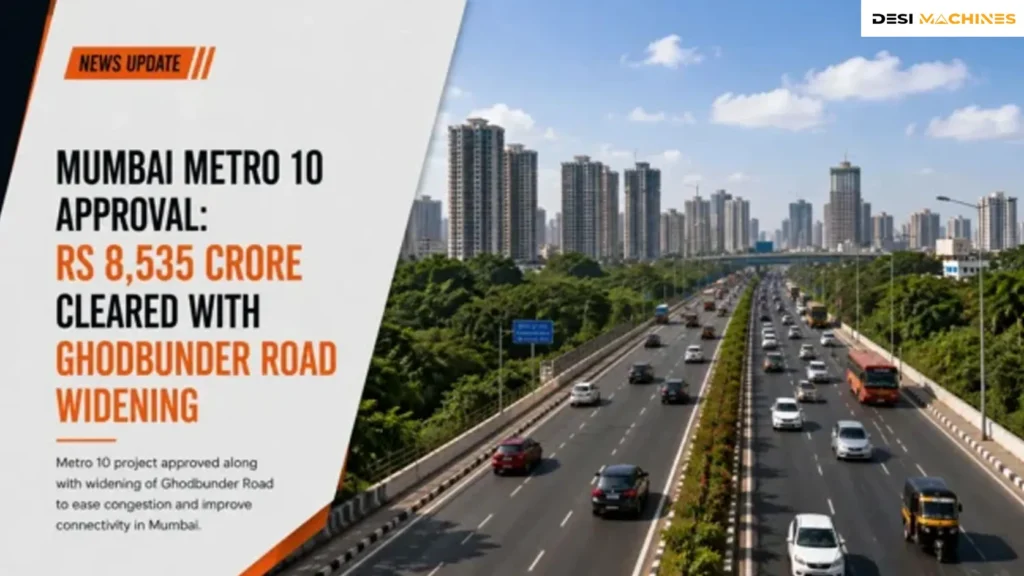
Maharashtra has re-approved Mumbai Metro Line 10 at Rs 8,535.49 crore and bolted a Ghodbunder Road widening job onto the same sanction. For anyone running plant in the Thane and Mira-Bhayandar belt, the headline number is not the interesting bit. What matters is that 0.68 km of planned tunnel has become viaduct, and a five-kilometre road widening now sits inside a metro approval.
The quick facts
- Revised approval issued by Maharashtra’s Urban Development Department through a government resolution dated 20 August 2026. MMRDA is the implementing agency.
- Metro Line 10 runs 9.676 km from Gaimukh to Chhatrapati Shivaji Maharaj Chowk at Mira Road, with five elevated stations. The metro component is Rs 7,813.35 crore.
- Rs 715.96 crore covers widening 5.4 km of Ghodbunder Road to 60 metres, up to Fountain Hotel.
- A 0.68 km underground stretch in the earlier plan is now fully elevated. Land take is 3.73 hectares permanent and 4.40 hectares temporary.
What Maharashtra approved
The Free Press Journal, which reported the resolution in full, put the sanction at Rs 8,535.49 crore and named the Urban Development Department as the issuing authority. Two Marathi desks, Loksatta and My Mahanagar, carried the same decision that day with a different emphasis: they framed it as a Rs 716 crore rise in the Metro 10 bill, which is the road-widening scope being folded in. The state said the underground section was dropped to cut tree felling and shorten the build.
Two things need separating. This is not the Rs 22,611 crore Ghodbunder package cleared earlier in the year, which covers a Gaimukh tunnel and a Bhayandar elevated bridge. And the two published cost heads add up to Rs 8,529.31 crore against a stated total of Rs 8,535.49 crore, so about Rs 6 crore sits outside the split the state released. We quote the heads as published rather than reconciling them.
What does this mean for equipment buyers?
Run the per-kilometre test and Metro 10 looks dear. Rs 7,813.35 crore over 9.676 km is roughly Rs 808 crore a km. Mumbai Metro 13, cleared the same month, works out at about Rs 708 crore a km, and that line carries 3.25 km of underground work. Short lines do not get cheaper per km: depot, systems, rolling stock and dense urban land are close to fixed, and here they spread across under ten kilometres.
The road half reads differently. Rs 715.96 crore over 5.4 km is about Rs 133 crore a km. Set that beside the Rs 7.3 crore a km an EPC contractor is taking for greenfield hill road on NH-913, and the gap tells you what this money is. Widening a live arterial to 60 metres in Thane is land, utility diversion and structures. Only a thin slice converts into excavator, grader and paver hours.
The tunnel-to-viaduct switch is what actually moves a machine list. Boring or cut-and-cover work would have brought specialist plant and a long shaft programme. An all-elevated alignment instead means piling rigs off the road median, launching gantries, batching plants and crane support running the full contract term rather than front-loading. The land figure backs that up: 3.73 hectares permanent across 9.676 km is a corridor built on an existing right of way. Expect night possessions, tight footprints and smaller rigs than the budget suggests.
Our take: for Maharashtra fleet owners this is a hire story before it is a purchase story. Constrained corridors reward machines that mobilise into a lane closure and leave, which favours backhoe loaders, tandem compactors and short-shuttle tippers over big earthmoving fleets. The stated window runs April 2025 to March 2030, so part of it is already behind us. Packaging is likely closer than a fresh sanction implies, and the 2030 date has less room in it than it looks.
What to watch
- MMRDA’s civil packaging for the 9.676 km viaduct, and whether the Ghodbunder widening is tendered separately from the metro.
- Whether the dropped 0.68 km underground scope stays dropped once detailed design lands.
- Utility shifting on Ghodbunder Road, which usually starts before structural work and is where the first machine hours appear.
Sizing a fleet for urban metro and road work? Compare machines by class and price band on DesiMachines, and check what financing looks like before you bid. Start with the equipment finance hub.
FAQ
How long is Mumbai Metro Line 10 and where does it run?
It runs 9.676 km from Gaimukh to Chhatrapati Shivaji Maharaj Chowk at Mira Road, with five elevated stations. MMRDA is the implementing agency.
Is the Ghodbunder Road widening part of the metro project?
Yes. The 20 August 2026 resolution puts Rs 715.96 crore for widening 5.4 km of Ghodbunder Road to 60 metres inside the same sanction as the metro line.
Why does a shorter metro line cost more per kilometre?
Depot, systems, rolling stock and urban land costs barely shrink with route length. At about Rs 808 crore a km, Metro 10 is dearer than the longer Metro 13 at roughly Rs 708 crore a km.
Related on DesiMachines: Mumbai Metro 13 approval: Rs 17,725 crore cleared for Mira-Bhayandar to Virar
Source: Free Press Journal
Machines, tenders and news for this industry: Railway and Metro

 Excavator
294 models
Excavator
294 models  Backhoe Loader
51 models
Backhoe Loader
51 models  Crane
68 models
Crane
68 models  Concrete Mixer
79 models
Concrete Mixer
79 models  Wheel Loader
54 models
Wheel Loader
54 models  Compactor / Roller
45 models
Compactor / Roller
45 models  Motor Grader
42 models
Motor Grader
42 models  Dozer
41 models
Dozer
41 models  Concrete Pump
66 models
Concrete Pump
66 models  Skid Steer Loader
11 models
Skid Steer Loader
11 models  Telehandler
13 models
Telehandler
13 models