
 Excavator
294 models
 Backhoe Loader
51 models
 Crane
68 models
 Concrete Mixer
79 models
 Wheel Loader
54 models
 Compactor / Roller
45 models
 Motor Grader
42 models

 Concrete Pump
66 models
 Skid Steer Loader
11 models


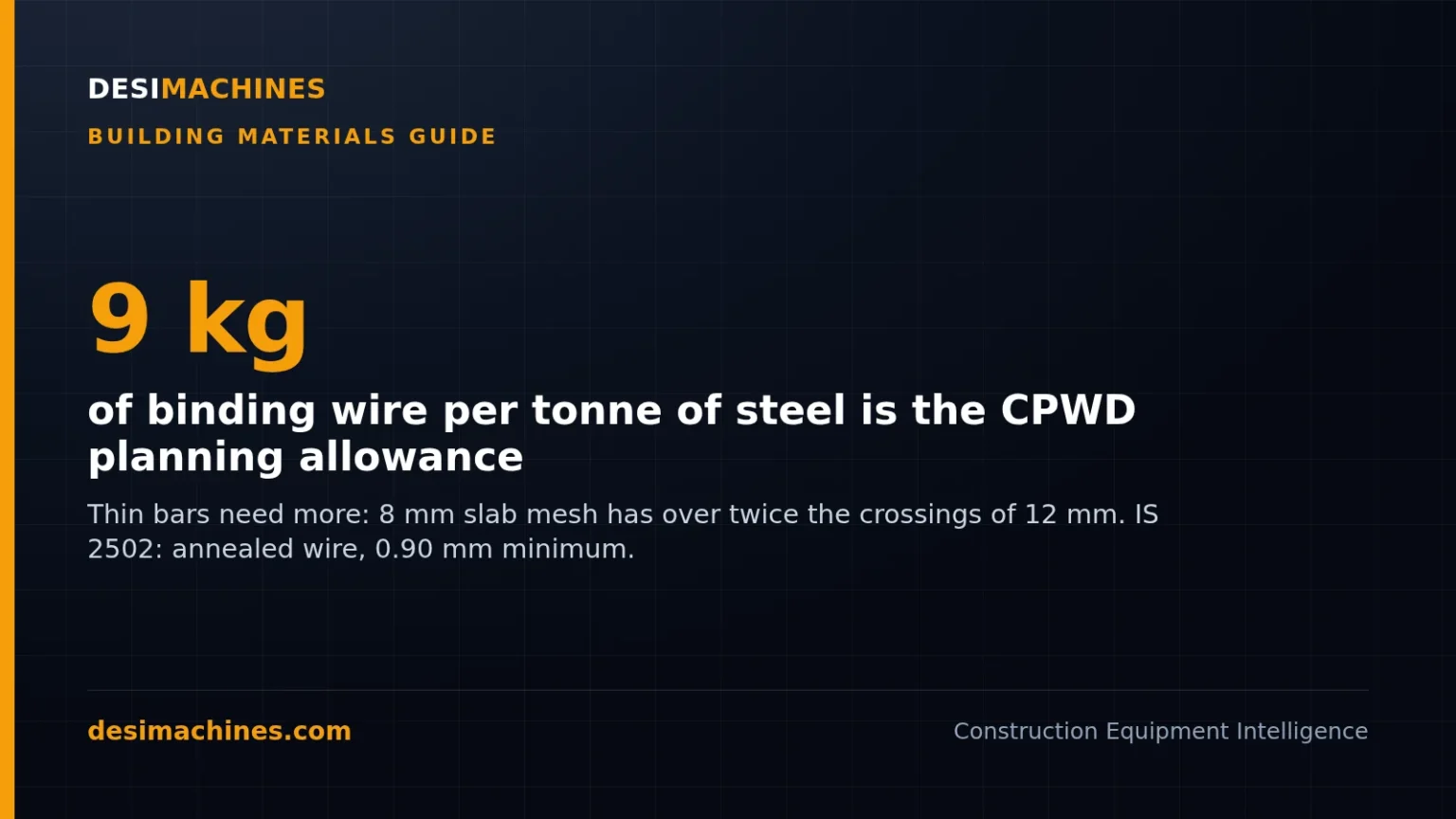
CPWD’s Delhi Analysis of Rates allows no more than about 0.9 kg of binding wire per 100 kg of reinforcement bars, which works out to roughly 9 kg of binding wire for every tonne of steel. Treat that as a starting figure, not a fixed one: binding wire consumption depends on how many bar crossings a tonne of steel has to be tied at, and a slab mesh of 8 mm bars has more than twice as many crossings per tonne as the same mesh in 12 mm bars.
This guide explains what binding wire is, which gauge Indian codes allow, why the kg per tonne changes with bar size, how to work out the wire for your own job, and how the bars are actually tied on site.
Key points
- IS 2502 asks for annealed binding wire of at least 0.90 mm, made to IS 280.
- 20 gauge wire is 0.914 mm thick and gives about 194 metres per kg; 18 gauge is 1.219 mm and gives about 109 metres.
- At 9 kg per tonne, an 8 mm slab mesh at 150 mm spacing leaves only about 21 cm of 20 gauge wire for each crossing.
- On CPWD work the wire is never measured or paid as a separate item. Its cost sits inside the rate for reinforcement.
What is binding wire?
Binding wire is soft, thin mild steel wire used to tie reinforcement bars together where they cross or overlap, so the steel cage holds its shape while concrete is poured and vibrated around it. On site it is also called tying wire or rebar tie wire. It does not add strength to the structure. Its only job is to keep every bar where the drawing puts it until the concrete has set.
The wire is annealed, which means it has been heated and cooled slowly after drawing so that it turns soft. Soft wire can be twisted tight by hand with a hook without snapping. Hard drawn wire of the same thickness would spring back or break at the twist.
The Indian Standard for this wire is IS 280:2006, Mild Steel Wire for General Engineering Purposes. It covers wire from 0.125 mm to 12.5 mm thick and lists “annealed” as one of eight finishes a buyer can order. Its tensile table shows how different annealed wire is from hard wire:
Table 1: Tensile strength of mild steel wire by condition (IS 280:2006, Table 2, finishes other than galvanized)
| Condition | Tensile strength | What it means for tying |
|---|---|---|
| Annealed | 500 MPa maximum | Soft. Twists tight and stays twisted. This is binding wire. |
| Soft drawn | 550 MPa maximum | A little stiffer; harder to twist cleanly |
| Quarter hard | 450 to 650 MPa | Springs back at the twist |
| Half hard | 600 to 800 MPa | Not used for tying |
| Hard | 700 to 950 MPa | Not used for tying |
One MPa is one newton per square millimetre. The point to take from the table is the top row: annealed wire has a ceiling on its strength, not a floor, because it is meant to be soft.
Which gauge of binding wire is used for reinforcement?
IS 2502:1963, the code of practice for bending and fixing bars for concrete reinforcement, sets the floor in clause 7.2: bars crossing each other shall be secured by annealed binding wire of size not less than 0.90 mm, conforming to IS 280. The CPWD Specifications 2009 (Volume 1, clause 5.3.3.1) set the band for government work: two strands of annealed steel wire 0.9 to 1.6 mm thick, twisted tight, at every intersection.
In the market, binding wire is sold by its SWG number (Standard Wire Gauge, the old British system where a higher number means a thinner wire), mostly as 18 gauge or 20 gauge. Here is how those gauges sit against the code limits. The weight per metre is our own arithmetic for a round steel wire at 7,850 kg per cubic metre.
Table 2: Binding wire gauge in mm, weight per metre and metres per kg
| Gauge (SWG) | Diameter | Weight per metre | Metres in 1 kg | Against IS 2502 (0.90 mm minimum) |
|---|---|---|---|---|
| 16 | 1.626 mm | 16.3 g | about 61 m | Above the minimum; just over the CPWD 1.6 mm upper limit |
| 18 | 1.219 mm | 9.2 g | about 109 m | Above the minimum |
| 20 | 0.914 mm | 5.2 g | about 194 m | Only 0.014 mm above the minimum |
| 22 | 0.711 mm | 3.1 g | about 321 m | Below the minimum. Not allowed for tying bars. |
Two things follow from the table. First, a kg of 20 gauge wire goes almost twice as far as a kg of 18 gauge, because it is lighter per metre. That is why the gauge matters as much as the kg figure when you estimate. Second, 20 gauge passes the IS 2502 minimum by a very thin margin. IS 280 allows a diameter tolerance of plus or minus 0.02 mm on wire between 0.50 and 1.00 mm, which is more than that margin. If a contract calls for IS 2502, check the wire with a screw gauge before it goes on the cage.
IS 280 does not list SWG sizes at all. Its standard metric sizes nearest to these gauges are 0.90 mm, 1.00 mm, 1.25 mm and 1.60 mm, so the gauge number on a coil and the size it was made to may not match. Go by the millimetre figure.
How much binding wire is required for 1 tonne of steel?
About 9 kg is the planning figure, and it comes from how CPWD prices reinforcement. In the Delhi Analysis of Rates 2014, item 5.22 (steel reinforcement for RCC work up to plinth level, including straightening, cutting, bending, placing in position and binding) costs one quintal of bars and adds one lump sum for “sundries and binding wire” together. At the binding wire rate listed in the same analysis, that lump sum buys at most about 0.9 kg of wire per quintal, or about 9 kg per tonne. Because the same allowance also covers sundries, the wire share is a little below that.
Two more details from CPWD are worth knowing:
- For hard drawn steel wire fabric (item 5.22.5, the ready-welded mesh), the same analysis halves the allowance. The crossings in fabric are already welded, so far less tying is needed.
- CPWD Specifications 2009, clause 5.3.4, say that annealed wire used for binding (or tack welding used instead of it) shall not be measured, its cost being included in the rate of reinforcement. On a government bill of quantities you will never see a separate line for binding wire.
No Indian Standard fixes a binding wire consumption figure. IS 2502 and IS 280 set the size and quality of the wire; the kg per tonne is an estimating allowance. For the dated market rate of the wire itself, see the binding wire price per kg page.
Why does binding wire consumption change with bar size?
Wire is used per crossing, but steel is bought per tonne. A tonne of thin bars is a long length of bar with many crossings. A tonne of thick bars is a short length with few. So the same 9 kg of wire has to stretch over very different numbers of ties.
The table below takes a plain two-way slab mesh with bars at 150 mm spacing both ways and counts the crossings in one tonne of steel, using the bar weights in CPWD Table 5.4 (8 mm = 0.395 kg per metre, 10 mm = 0.617, 12 mm = 0.888). It then shows how much wire 9 kg would leave for each crossing. All of it is our own arithmetic, rounded.
Table 3: Crossings per tonne of steel in a slab mesh at 150 mm spacing, and wire per crossing at 9 kg per tonne
| Bar size | Steel per sq m of mesh | Mesh area in 1 tonne | Crossings in 1 tonne | Wire per crossing, 20 gauge | Wire per crossing, 18 gauge |
|---|---|---|---|---|---|
| 8 mm | 5.27 kg | about 190 sq m | about 8,440 | about 21 cm | about 12 cm |
| 10 mm | 8.23 kg | about 122 sq m | about 5,400 | about 32 cm | about 18 cm |
| 12 mm | 11.84 kg | about 85 sq m | about 3,750 | about 47 cm | about 26 cm |
Figure 1: Crossings to tie in one tonne of slab mesh (150 mm spacing both ways)
Bar length per tonne falls with the square of the bar diameter, so the crossings fall fast as bars get thicker. Our arithmetic from CPWD Table 5.4 bar weights.
Read the 8 mm row slowly. If every crossing is tied, as the CPWD specification asks, 9 kg of 18 gauge wire gives each tie about 12 cm, which is hardly enough to wrap two bars and twist. That is the arithmetic behind using the thinner 20 gauge on thin-bar slab mesh, and the reason a job made mostly of 8 mm and 10 mm bars can run over 9 kg per tonne. Beams and columns are the other way round: 16 mm to 25 mm main bars carry most of the weight, the ties are only where stirrups cross them, and the figure per tonne drops.
How do you calculate binding wire for a slab or beam?
Count the ties, measure one tie, and convert to kg. The formula is:
Binding wire (kg) = number of crossings to tie × length of wire per tie (m) ÷ metres per kg for your gauge
The length per tie is the one number you have to get from your own site, because it depends on bar size and on how your bar bender ties. Cut one piece the way he cuts it and measure it.
A worked example: a roof slab panel of 4 m by 3 m with 8 mm bars at 150 mm spacing both ways.
- Bars running the 4 m way: 3 ÷ 0.15 + 1 = 21 bars, 84 m in all. Bars running the 3 m way: about 28 bars, 84 m in all.
- Steel: 168 m × 0.395 kg = about 66 kg.
- Crossings: 21 × 28 = 588.
- If each tie takes a 25 cm piece of 20 gauge wire (folded into two strands): 588 × 0.25 = 147 m. At about 194 m per kg that is about 0.76 kg of wire.
- As a rate: 0.76 kg for 66 kg of steel is about 11.4 kg per tonne, above the 9 kg allowance, exactly as Table 3 predicts for thin bars.
For a whole building, take the steel quantities by bar size from the bar bending schedule and do the same count for each part: slab mesh, beam stirrups, column ties. Add an allowance for coil ends and offcuts; the material wastage guide covers how allowances are set. If you only need a quick total for the steel weight, the unit weight of building materials page lists steel density and bar weights.
Planning the pour that follows the tying? Compare concrete mixer models and talk to a dealer about the size your slab needs.
How are reinforcement bars tied with binding wire?
IS 2502 clause 7.2 asks only that crossing bars, where required, are secured so they will not slip over each other while being fixed and while concrete is placed. It adds two rules: every compression bar is tied in at least two perpendicular directions (7.2.1), and of the three tying methods drawn in its Figure 6, the first is preferred over the second and the second over the third (7.2.3). The CPWD specification is stricter on government work: ties at every intersection, two strands, twisted tight, so the cage does not move when concrete is dropped and vibrated into it. It also allows tack welding at crossings instead of wire, if the Engineer-in-Charge approves. Where lapped bars cannot be kept apart with concrete between them, clause 5.3.1.1 has them bound together at intervals of not more than twice the bar diameter, with the same two-strand wire.
On Indian sites the common ties have trade names more than code names:
- A single or snap tie: one loop around the crossing, twisted on top. The fastest tie, common on flat slab mesh.
- A saddle tie: the wire passes under the lower bar and around the upper one before the twist. Holds better against a bar rolling sideways.
- A cross or figure-eight tie: the wire runs diagonally both ways round the crossing. Used where a bar must not twist out of square, such as column corners.
The tool is a simple tying hook or pliers that grip the loop and spin the twist. Battery rebar tying tools that wrap and twist wire from a small spool are also sold; they usually take the maker’s own wire spools, not loose coil.
Three habits matter more than the type of tie. Twist until the bars cannot move by hand, and no further, because over-twisting snaps soft wire. Bend the twisted ends inwards, towards the centre of the member, so they do not stick out into the concrete cover. And tie the cover blocks to the cage too: IS 2502 clause 7.3.1 describes mortar cover blocks with binding wire cast into them for exactly this purpose.
A cage that moves during the pour is one of the causes of voids and exposed steel, explained in the guide to honeycombing in concrete.
Black annealed or GI binding wire: which one?
Black annealed wire is the plain soft wire with its dark oxide surface, and it is the normal choice for ties that will be buried inside concrete, where the concrete cover protects both the bar and the wire. GI (galvanized iron) binding wire has a zinc coat. IS 280 treats galvanizing as a separate finish and gives galvanized annealed wire a tensile range of 300 to 550 MPa, so it is still soft enough to twist.
GI wire makes sense where the wire stays exposed to weather, such as fencing, gabions or temporary tying outdoors. Inside an RCC member it adds cost without adding life, because the tie is already in concrete. Neither kind of wire changes the strength of the member.
How do you check binding wire before you use it?
A few quick checks catch most bad coils:
- Read the coil tag. IS 280 clause 15.1 asks for each coil to be marked with its finish, wire size, lot number and the maker’s name or trade-mark. A coil with no size on it is a coil you have to measure.
- Measure the thickness with a screw gauge at two or three points. For 20 gauge, anything under 0.90 mm fails IS 2502.
- Twist a piece by hand. IS 280’s wrapping test (clause 9.2) winds wire under 5 mm eight times round its own diameter and straightens it again without breaking or splitting. On site, wire that cracks when you twist it round a bar is not properly annealed.
- Look at the surface. IS 280 clause 13 asks for wire free from splits, surface flaws and rough edges. Light surface rust is common on black wire; flaking rust or pitting means the coil has been stored wet.
For the bars themselves, the TMT bar grades guide explains what to check, and the plinth beam cost guide lists the question to put to a labour contractor: is binding wire included in the tying rate?
What happens after the cage is tied?
Once the steel is tied and checked against the drawing, the rest is concrete work. On a house or a small building, a self-loading mixer such as the AJAX ARGO 4500 batches and delivers at the site. On bigger pours, ready-mixed concrete arrives in a transit mixer such as the Schwing Stetter AM 7 (C2). Either way, the vibrator will test every tie, which is why the tying is worth doing properly.
Browse the full range of concrete mixers to match a machine to the size of your pours. More material topics are in the building materials guides.
Wire size, finish, tolerance, tensile and wrapping-test figures on this page are from IS 280:2006, Mild Steel Wire for General Engineering Purposes. Tying rules are from IS 2502:1963, Code of Practice for Bending and Fixing of Bars for Concrete Reinforcement, clauses 7.2 and 7.3, and from CPWD Specifications 2009 Volume 1, clauses 5.3.1.1, 5.3.3.1 and 5.3.4. The binding wire allowance is from the CPWD Delhi Analysis of Rates 2014, items 5.22 and 5.22.5, and bar weights from CPWD Table 5.4. SWG diameters are the standard British gauge values. Crossing counts, weights per metre and wire per tie are our own arithmetic. All sources were read in October 2026.
Prices, specifications and features are indicative, vary by variant, location and date, and should always be confirmed with the official OEM or authorised dealer before any purchase decision. DesiMachines is not liable for decisions taken on the basis of information that may have changed after publication. Binding wire consumption on your job depends on bar sizes, spacing and tying practice; follow your structural engineer’s drawings and the specification in your contract.
Machines, tenders and news for this industry: Building Construction