Excavator
294 models
 Backhoe Loader
51 models
 Crane
68 models
 Concrete Mixer
79 models
 Wheel Loader
54 models
 Compactor / Roller
45 models
 Motor Grader
42 models

 Concrete Pump
66 models
 Skid Steer Loader
11 models


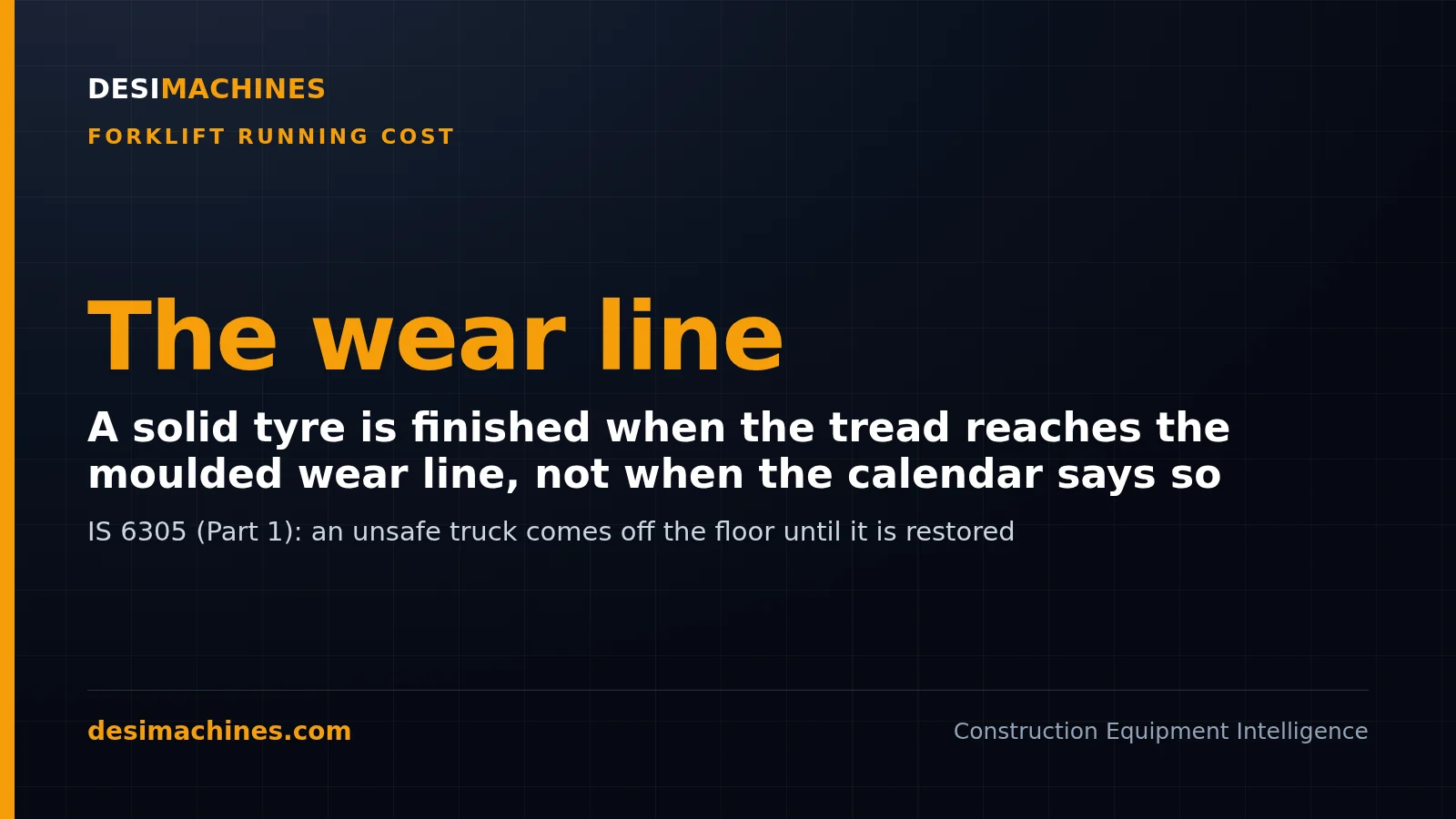
A forklift solid tyre replacement is decided by the moulded wear line on the sidewall, not by a service calendar or by how the tread looks. Once the rubber has worn down to that line the tyre has almost no cushioning left, and every joint in the floor goes straight into the mast, the bearings and the operator. Life is measured in hours, and the floor sets it: the same tyre gives one figure on smooth warehouse concrete and a much smaller one on a broken yard apron. Log the hour-meter reading at fitting and at the line, and after two sets you know your own number.
What actually wears on a solid tyre
A solid tyre has no air in it, so it cannot go soft and it cannot be punctured. What it does instead is lose rubber. Every turn on a rough floor scuffs a little off the tread, and heat from a long shift softens the rubber and speeds that up. A tyre that spends its day crossing an expansion joint, a dock plate or a broken patch of apron wears several times faster than one that runs on clean concrete.
Three other things end a solid tyre before the tread does. Chunking, where pieces tear out of the tread, usually means the truck has been running over debris or sharp edges. Separation, where the rubber parts company with the steel band it is bonded to, is a change-it-now fault. And a tyre that has gone out of round sets up a vibration that the operator feels all day and that works its way into the mast.
The reason any of this matters to an owner is that a forklift has no springs. The tyre is the suspension. When the rubber is gone the shock has nowhere else to go, so it travels into the mast rollers, the wheel bearings and the drive axle, and the repair bill lands somewhere far more expensive than the tyre.
Read the wear line, not the tread
Most solid tyres carry a wear-indicator line moulded into the sidewall, and the tyre maker’s own literature names it and shows where it sits. That line, not your judgement of the tread, is the limit. Above it the tyre still has usable rubber. At it, the tyre is done, even if the tread still looks serviceable from across the yard.
Check it with the forks down and the truck off, and look at all four tyres rather than the one that caught your eye. Uneven wear between the two drive tyres usually points at something other than the tyre: a dragging brake, a misaligned steer axle, or a driver who turns the same way all day in a one-way aisle. Fixing that is cheaper than fitting a tyre into the same fault twice.
The other check is bonding. IS 6305 (Part 1): 1980, the Bureau of Indian Standards safety code for powered industrial trucks, says plainly that the bonding of solid tyres to the metal bands or the rims shall be checked, and foreign matter removed from the treads. For air pneumatic tyres the same code calls for the bearing surface, side walls and rims to be checked and the truck maker’s inflation pressure to be maintained, and it warns that the internal pressure must be completely relieved before a pneumatic tyre on a split rim is demounted. A split rim that comes apart under pressure is the one tyre job on a forklift that injures people.
When a worn tyre should take the truck off the floor
IS 6305 (Part 1) gives the owner a clear rule in clause 3.4.6.1: if a powered industrial truck is found to be in any way unsafe or to contribute to an unsafe condition, it shall be removed from service until it is restored to a safe operating condition. A tyre worn past its line, a separated tread or a tyre that has lost a chunk all sit inside that sentence.
That is worth knowing before the argument starts, because the pressure in a busy warehouse always runs the other way. The truck still lifts, the shift still has four hours in it, and the tyre gets another week. The standard, your insurer and your own repair bill all point at the same answer.
Work out your own tyre hours
Nobody can hand you a correct hours figure for your forklift, because your floor is the variable. What you can do is measure it once and then stop guessing. Write the hour-meter reading on the job card when a set goes on. Write it again when the tyres reach the wear line. The gap is your site’s tyre life.
Take an example. A diesel forklift in a yard has new solid tyres fitted at 3,250 hours on the meter. They reach the wear line at 5,050 hours. That yard gets about 1,800 hours from a set. If the truck runs roughly 1,500 hours a year, the owner now knows a tyre change falls due a little over every fourteen months and can put it in the plan instead of losing a day to it.
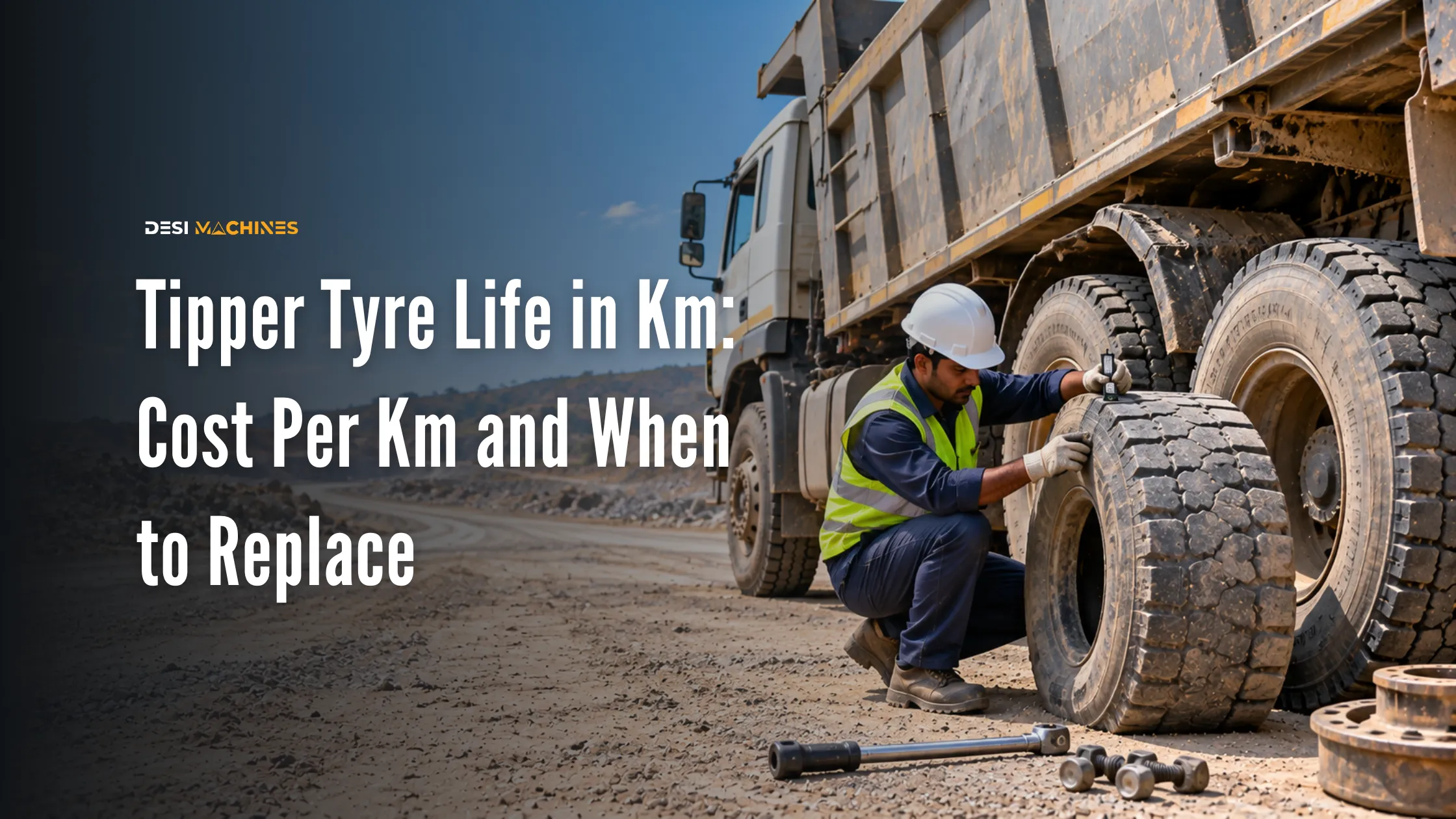
Two sets give you a better figure than one, and the number is worth keeping per machine rather than per fleet, because the forklift that lives on the loading dock and the one that crosses the yard are not doing the same work. The same habit is what makes tipper tyre costs predictable, as the method in our piece on tipper tyre life in kilometres sets out.
Solid, solid pneumatic-shaped or air pneumatic
Three tyre types fit forklifts in India, and the floor decides which belongs under yours.
| Tyre type | Where it fits | Shock absorbed | Puncture risk | How it is changed |
|---|---|---|---|---|
| Press-on solid (cushion) | Smooth indoor concrete, warehouses, cold stores | Low | None | Pressed on and off a steel band with a hydraulic press |
| Solid pneumatic-shaped (resilient) | Yards, docks, loading aprons, scrap and timber sites | Medium | None | Fitted to a standard rim, usually in a workshop |
| Air pneumatic | Rough, broken or unmade ground outdoors | High | Real | Changed like a vehicle tyre; split rims need care |
The trade is straightforward. Solid tyres take punctures out of your week and put shock into the machine. Air pneumatic tyres do the opposite. A warehouse that has never had a puncture is paying for puncture-proofing it does not need, and a scrap yard that changes a tube every fortnight is paying for cushioning in downtime. Our guide to forklifts in India covers how capacity, mast and floor are specified in the first place, and the tyres and spare parts pages list what each maker supplies by machine. If the truck is outdoors on bad ground most of the day, the honest question is whether a telehandler is the right machine for that work rather than a forklift wearing tyres out.
Why forklift solid tyre replacement is a workshop job
A press-on solid tyre is held on a steel band by interference fit alone, and it takes a hydraulic press to get it off and the new one on. That press is not something a site keeps. Solid pneumatic-shaped tyres fit a conventional rim and are closer to an ordinary tyre change, but still want a workshop and the right tools.
IS 6305 (Part 1) also restricts the work: only qualified and authorised personnel are permitted to maintain, repair, adjust and inspect a powered industrial truck. Before a set is anywhere near its line, find out from your authorised dealer where the nearest press is, how long the turnaround takes and whether they can do the change on your shift pattern. A tyre that arrives in two days on a truck that earns every day is not the saving it looked like. The same thinking applies to a punctured machine tyre and to deciding whether retreading is worth it on larger machines.
Change the tyre or change the machine?
If a forklift is eating tyres, the tyre is rarely the problem. Repair the floor and the wear slows down. Fix the brake that drags and the pair wears evenly. Move the machine that spends its day on broken ground to a tyre built for it, or to a telehandler that was designed for it, and talk to your authorised dealer about what the fleet is actually doing before the next set goes on.
Specifications, standards and supply terms change — confirm current wear limits, tyre options and service terms with the OEM or authorised dealer before deciding.