
 Excavator
294 models
 Backhoe Loader
51 models
 Crane
68 models
 Concrete Mixer
79 models
 Wheel Loader
54 models
 Compactor / Roller
45 models
 Motor Grader
42 models

 Concrete Pump
66 models
 Skid Steer Loader
11 models


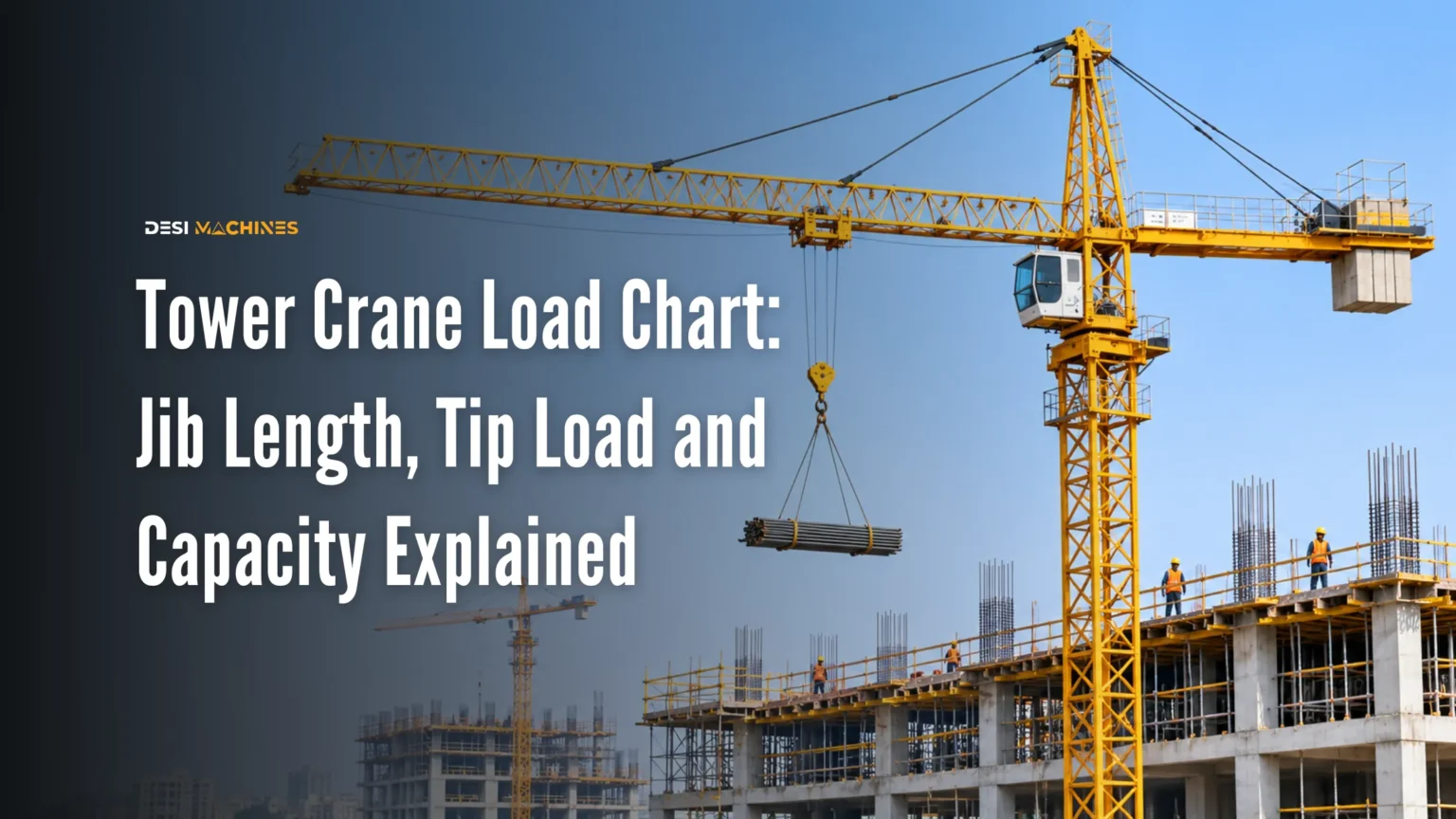
A tower crane load chart lists the heaviest load the crane may lift at each radius, and that figure drops fast as the hook moves out along the jib. On the Potain Evy 30-23 4 t, a small self-erecting tower crane, the chart allows 4,000 kg (4 tonnes) up to 9.5 m from the mast, but only 1,000 kg at the 30 m jib tip: a quarter of the headline figure.
That gap is why the capacity in a crane’s name or brochure is the wrong number to plan a lift with. This guide shows how to read a tower crane load chart line by line, what tip load and jib length mean, how to decode model numbers such as TC 5540, what eats into the chart on a real site, and what India’s building code says about it. The figures come from ACE, the Indian maker, and from a full chart in Potain’s published data sheet, all read on 3 November 2026. No prices are quoted here.
What is a tower crane load chart?
A tower crane load chart is the maker’s table of safe working load against radius. Radius is the flat distance from the centre of the mast (the vertical tower) to the hook. Safe working load is the most the crane is allowed to lift at that radius, with everything hanging from the hook counted in.
The reason a tower crane needs a chart and not a single number is the trolley. The jib, the long horizontal arm, carries a trolley that runs in and out with the hook under it. The trolley can stop anywhere from close to the mast to the very end of the jib, and every position has its own limit. So the chart is a row of numbers: one for each radius, and a separate row for each jib length the crane can be rigged with.
India’s National Building Code asks for exactly this. NBC 2016 Part 7, clause 9.7.2.10, says that where a hoisting machine has a variable safe working load, each safe working load and the conditions under which it applies must be clearly shown. The same clause says hoisting appliances should be fitted with an automatic safe load indicator. On a tower crane, that indicator and the limit switches described in the guide to safe load indicators and limit switches are what stop a lift that breaks the chart.
The idea is the same one behind every crane load chart. What changes on the common flat-top or hammerhead tower crane is that the radius is set by the trolley running along a level jib, so the chart is a single falling line for each jib length. Luffing-jib tower cranes, which raise and lower the jib instead, carry charts of their own.
How do you read a tower crane load chart?
Read it in five steps, in this order:
- Find the line for the jib length actually fitted to your crane on this site. A model can often be rigged with several jib lengths, and each has its own line.
- Measure the radius from the centre of the mast to where the load will be picked up and to where it will be set down. Use the larger of the two.
- Read the safe load at that radius. If your radius falls between two columns, use the column for the next larger radius, never the smaller one.
- Add up everything below the hook: slings, shackles, a spreader beam, a concrete bucket or a skip. That gear is part of the load. Check the chart’s notes to see whether the hook block is already allowed for.
- Read the conditions printed with that line, such as the rope reeving or a working mode. A figure only holds under its own conditions.
Here is the chart for the Potain Evy 30-23 4 t with its full 30 m jib, taken from the maker’s data sheet. The last column is simple arithmetic, load multiplied by radius, to show how the crane’s lifting effort changes along the jib.
Table 1: Potain Evy 30-23 4 t load chart, 30 m jib (standard line)
| Radius from mast | Safe load | Load × radius (worked out) |
|---|---|---|
| Up to 9.5 m | 4,000 kg (4 tonnes) | 38.0 tonne-metres at 9.5 m |
| 11 m | 3,360 kg | 37.0 tonne-metres |
| 12 m | 3,030 kg | 36.4 tonne-metres |
| 15 m | 2,330 kg | 35.0 tonne-metres |
| 20 m | 1,650 kg | 33.0 tonne-metres |
| 22 m | 1,470 kg | 32.3 tonne-metres |
| 25 m | 1,260 kg | 31.5 tonne-metres |
| 30 m (jib tip) | 1,000 kg (1 tonne) | 30.0 tonne-metres |
Source: Potain Evy 30-23 4 t data sheet, load curves page. The sheet also prints a second, slightly higher line marked Potain Plus; this table uses the standard line.
Bar chart of the Potain Evy 30-23 4 t standard load chart with a 30 m jib: 4,000 kg up to 9.5 m, 2,330 kg at 15 m, 1,650 kg at 20 m, 1,260 kg at 25 m and 1,000 kg at 30 m.
4,000 kg
2,330 kg
1,650 kg
1,260 kg
1,000 kg
up to 9.5 m
15 m
20 m
25 m
30 m (tip)
Radius from the mast
Two things stand out. First, the drop is steep: by 20 m the crane is down to 1,650 kg, well under half its maximum. Second, the last column is not constant. Load times radius falls from 38 tonne-metres to 30 along the jib, so you cannot work out a figure by dividing one number by the radius. Read the actual line every time.
A worked example. Say a gang needs to lift a 1,500 kg bundle of rebar, slung with 60 kg of slings and shackles, to a slab edge 22 m from the mast. The chart allows 1,470 kg at 22 m. The lift weighs 1,560 kg, so it fails. At 20 m the chart allows 1,650 kg, so the same bundle can go to a point 20 m out, or it is split into two lighter bundles for the far edge. That decision takes two minutes with the chart and cannot be made at all from the words “4 t” on the crane.
What is tip load on a tower crane?
Tip load is the safe load at the very end of the jib, at the crane’s longest radius. It is the smallest number on the chart, and for many building jobs it is the one that matters most, because the heaviest loads often have to go to the far corner of the slab, not to the foot of the mast.
ACE, the Indian crane maker, publishes both figures side by side for its range of fixed tower cranes. The pattern holds across the range: the maximum load applies only close in, and the tip load is a fraction of it.
Table 2: Maximum load and tip load on ACE tower cranes
| Model | Jib length | Free-standing height | Maximum load | Tip load | Tip load as share of maximum |
|---|---|---|---|---|---|
| TC 5034 | 50 m | 34 m | 5 t | 1.3 t | 26% |
| TC 5540 | 55 m | 40 m | 5 t | 1 t | 20% |
| TC 6040 | 60 m | 40 m | 5 t | 1 t | 20% |
| TC 6552 | 65 m | 52 m | 10 t | 2 t | 20% |
| TC 7052 | 70 m | 52 m | 12 t | 3 t | 25% |
| TC 7054 | 70 m | 54 m | 16 t | 3.5 t | 22% |
| TC 7059 | 70 m | 59 m | 20 t | 5.2 t | 26% |
| TC 7074 | 70 m | 74 m | 25 t | 2.5 t | 10% |
Source: ACE tower cranes range table, read 3 November 2026. The last column is worked out from the two before it.
Look at the last two rows. The TC 7074 has the bigger maximum, 25 tonnes against 20, but on the same 70 m jib its tip load is 2.5 tonnes, less than half the 5.2 tonnes of the TC 7059. A buyer or hirer comparing the two by maximum load alone would pick the wrong crane for heavy work at the far end of the jib. Compare tip loads, and the load at your own critical radius, before you compare anything else.
If the heaviest pieces on your job are short, close-in lifts that last only a few days, a tower crane may not be the right machine at all. The pick-and-carry models in the range of cranes in India each lift to a chart of their own.
How does jib length change a tower crane’s capacity?
A longer jib reaches further, but it lowers the load at every radius. The jib is steel hanging out from the mast, and more of it leaves less of the crane’s strength for the hook. That is why the same crane carries a different chart for each jib length.
The Potain Evy 30-23 4 t shows it clearly, because its data sheet prints a chart for each of its three jib set-ups:
Table 3: Tip load by jib length, Potain Evy 30-23 4 t (standard line)
| Jib rigged | Maximum load | Load at the jib tip | Load at 24 m radius |
|---|---|---|---|
| 30 m | 4,000 kg up to 9.5 m | 1,000 kg at 30 m | 1,320 kg |
| 24 m | 4,000 kg up to 10.2 m | 1,450 kg at 24 m | 1,450 kg |
| 14.9 m (jib folded) | 4,000 kg up to 10.7 m | 2,700 kg at 14.9 m | Out of reach |
At 24 m from the mast, the crane rigged with the 24 m jib lifts 1,450 kg; rigged with the 30 m jib, it lifts 1,320 kg at the same spot. The shorter-jib line is higher at every radius from 12 m to 24 m. The practical rule follows: rig the shortest jib that reaches your farthest pick and drop point, and no longer. Extra jib you do not need costs capacity on every lift.
Jib length also decides how close a crane can stand to its neighbours, the site boundary and power lines, because the jib swings through a full circle. The guide to equipment used in high-rise building construction covers how the tower crane fits with the hoists and concrete pumps that share the job.
What does a tower crane model number like TC 5540 mean?
On ACE’s fixed tower cranes, the model number is two measurements. The first two digits are the jib length in metres and the last two are the free-standing height in metres. A TC 5540 has a 55 m jib and stands 40 m tall on its own; a TC 7074 has a 70 m jib and a 74 m free-standing height. The pattern holds on all 13 TC models in ACE’s published table. ACE’s luffing-jib LC models are numbered differently.
Free-standing height is the tallest the mast can stand on its base without being tied to the building. Above it, the mast has to be tied back to the structure as it climbs. ACE’s table also gives a maximum height for each model, from 103.5 m on the TC 5034 to 275 m on the TC 7074, far above the free-standing figures.
Potain’s Evy 30-23 follows a similar idea: 30 m of jib and about 23 m of height under the hook, with the 4 t maximum load added at the end of the name.
The lesson is the same for both makers. The model number tells you the reach and the height. It does not tell you what the crane lifts at your radius. Only the chart does that, and other makers use their own naming codes, so never read capacity from a model number.
What reduces a tower crane’s capacity on site?
The chart is the most the crane may lift under the conditions printed with it. Several things on a real site take a share of that figure or change which line applies.
Lifting gear comes off first. Slings, shackles, spreader beams, concrete buckets and brick cages all count as load. A heavy steel bucket can take a large bite out of the tip load before any concrete goes in. The guides to lifting slings and their capacity and to the crane hook and its safety latch explain how each piece is rated.
Rope reeving decides which line you read. The hoist rope can run down to the hook block in two falls or four. More falls share the load across more lengths of wire rope, so the crane can lift more, but the hook travels more slowly. The Evy 30-23 4 t works with a permanent four-fall set-up. On cranes that can switch, the chart gives a separate line for each reeving, and the line you read must match the way the rope is rigged that day.
Some small self-erecting cranes can work with the jib tilted up to gain hook height. Raising the jib costs load. On the Evy 30-23 4 t data sheet, the 30 m jib carries at most 2,000 kg when raised to 10 degrees, 1,000 kg at 20 degrees and 700 kg at 30 degrees, against 4,000 kg when level.
Then there is wind. The maker’s manual sets the wind speed above which the crane must stop work. Large flat loads such as formwork panels and roof sheets catch the wind and swing, which adds to the effective load and can make placing them unsafe even below the crane’s own wind limit.
None of these can be fixed by the operator reading the chart more optimistically. If a lift is close to the line after allowing for all of them, split the load, move the pick point closer to the mast, or use a bigger crane.
Who checks the load chart on an Indian building site?
Three people share it. The crane supplier provides the chart and the machine set up to it. The lift supervisor or rigger plans each heavy lift against the chart, including the weight of the gear. The operator watches the safe load indicator in the cabin and refuses a lift the chart does not allow.
NBC 2016 Part 7 notes, in clause 7.3, that tower cranes are usually supplied on hire, with the client responsible for designing and building the base the crane stands on, using loading details from the crane supplier. Clause 9.7.2.10 adds that every hoisting machine and every piece of lifting gear must be marked with its safe working load, and that a register of tools and tackle, with each item’s safe working load and date of examination by a competent person, must be kept. The guide to crane safety rules, checks and operator training covers the inspections and certificates in more detail.
Height brings one more check. A tower crane near an airport may need clearance before it goes up, and the steps are set out in the blog on the AAI NOC for height clearance.
When is a tower crane the wrong machine for the lift?
A tower crane earns its keep on jobs where the work goes high and stays in one place for months, and where the crane can sit at the centre of the building. For short jobs, lifts at ground level or work that moves around a yard, the foundation, erection and dismantling make little sense.
That ground is covered by pick-and-carry Hydra and Farana cranes, which also lift to a load chart, read in the same way: find the configuration, find the radius, read the figure and take off the gear. Two of the most asked-about models are the Escorts HYDRA 14 and the Escorts HYDRA 15. Telehandlers carry a chart of their own too, explained in the telehandler load chart guide.
The rest of the lifting family, from crawler cranes to overhead cranes, is covered in the crane guides. To compare machines you can own and move between sites, browse crane models and specifications and connect with a verified dealer.
Sources
Jib lengths, free-standing heights, maximum heights, maximum loads and tip loads for ACE’s tower cranes were read on 3 November 2026 from ACE’s tower cranes range page. The load curves, jib set-ups, raised-jib loads and four-fall reeving for the Evy 30-23 4 t were read the same day from the data sheet and flyer linked on Potain’s Evy 30-23 4 t page. The rules on safe working load, safe load indicators, the tackle register and tower crane bases are from the National Building Code of India 2016, Part 7, clauses 7.3 and 9.7.2.10. The load × radius and tip-share columns are our own arithmetic on those published figures.
Prices, specifications and features are indicative, vary by variant, location and date, and should always be confirmed with the official OEM or authorised dealer before any purchase decision. DesiMachines is not liable for decisions taken on the basis of information that may have changed after publication.