
 Excavator
294 models
 Backhoe Loader
51 models
 Crane
68 models
 Concrete Mixer
79 models
 Wheel Loader
54 models
 Compactor / Roller
45 models
 Motor Grader
42 models

 Concrete Pump
66 models
 Skid Steer Loader
11 models


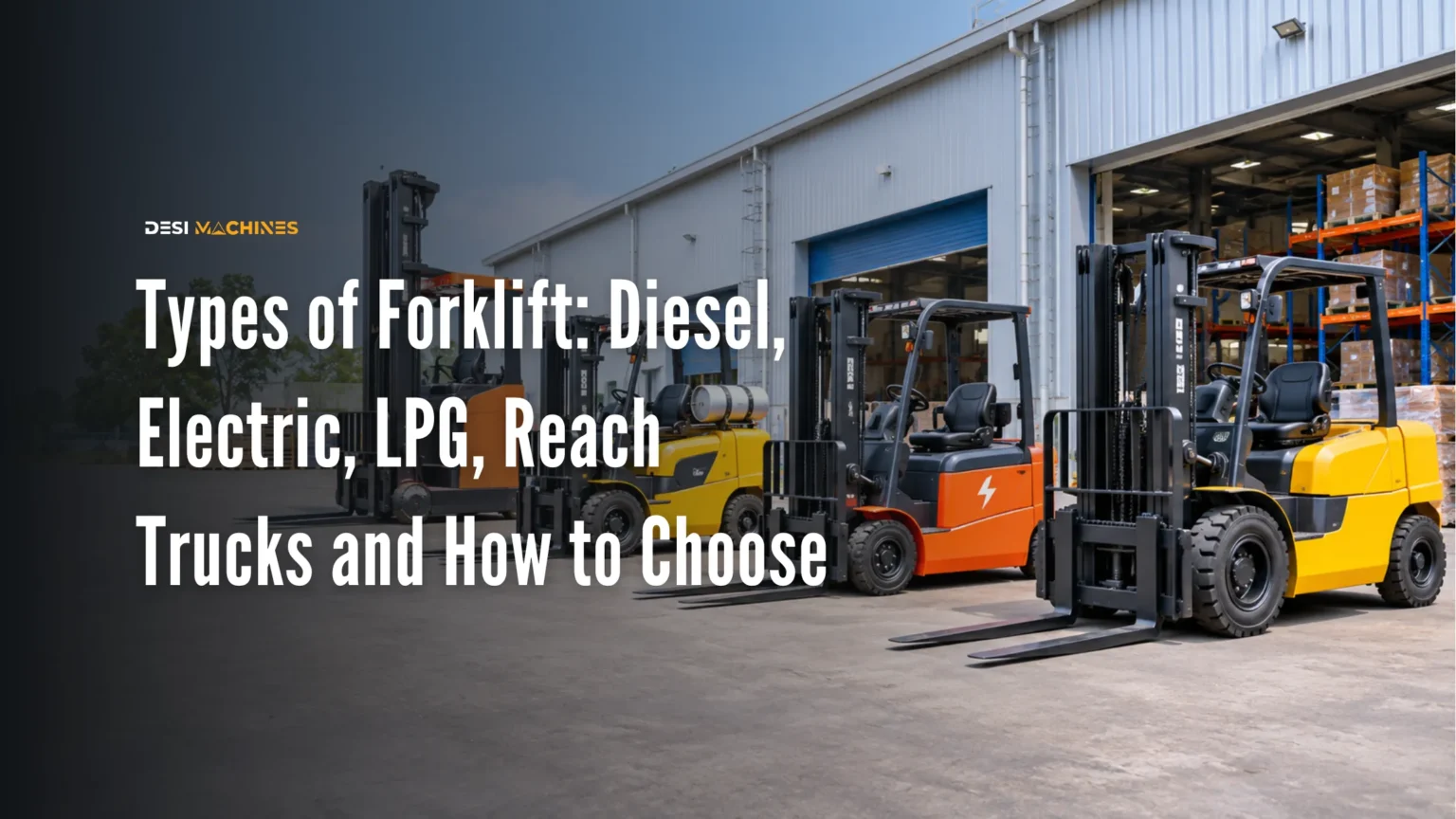
Forklifts sold in India run from small 1.2-tonne reach trucks to 16-tonne diesel machines, and container reach stackers go up to 45 or 50 tonnes. The types split two ways: by what powers the machine (diesel, LPG or a battery) and by how it is built to lift (counterbalance, reach truck, articulated, side loader, rough-terrain or reach stacker). Pick the body for your floor and your racks first, then the power for your shift.
This guide is for a godown owner, a plant manager, a transporter or a contractor who is buying or hiring a forklift for the first time and wants to understand the machines before a dealer starts talking. It explains how a forklift lifts without tipping, the main types with the capacities that Indian ranges actually offer, diesel against LPG against electric, what changes when the ground is rough, and a plain checklist for choosing one. No prices are quoted here.
What is a forklift, and how does it lift without tipping over?
A forklift is a small, powerful truck with two steel arms in front, called forks, that slide under a pallet or a crate, lift it and carry it. The forks ride up and down a vertical frame called the mast. The Indian standard for these machines, IS 7217, calls the whole family “powered industrial trucks” and the common forklift a “counterbalanced lift truck”.
Counterbalanced is the important word. The load sits in front of the front wheels, so it is always trying to tip the truck forward over the front axle. A heavy cast-iron weight built into the back of the machine, the counterweight, pulls the other way. In an electric forklift the big battery does part of that job. As long as the load’s pull stays smaller than the counterweight’s pull, the truck stays on all four wheels.
That is why a forklift’s capacity is always quoted with a distance. The load centre is the distance from the back of the forks to the middle of the load. IS 6765 (Part 1) fixes the standard distances that makers must rate their counterbalance trucks at, so two machines can be compared fairly:
Table 1: Standard load centre distances for counterbalance forklifts (IS 6765 Part 1)
| Rated capacity of the truck | Standard load centre |
|---|---|
| Under 1,000 kg | 400 mm |
| 1,000 kg up to under 5,000 kg | 500 mm |
| 5,000 kg up to 10,000 kg | 600 mm |
The same standard rates capacity at a standard lift height of 3.3 m for most trucks. Carry a long or deep load further out than the rated load centre, or lift it much higher, and the safe load falls below the figure on the brochure. The capacity plate fixed on the truck shows the real limits. Read it before every new kind of load.
Figure 1: The main parts of a counterbalance forklift
A forklift seen from the side. The mast and forks are at the front, the operator seat and overhead guard in the middle, and the counterweight at the back. Numbered callouts mark the forks, carriage, mast, overhead guard, counterweight, front drive axle and rear steer axle.
1
2
3
4
5
6
7
load
counterweight balances the load
- Forks: the two arms that go under the pallet.
- Carriage: the plate the forks hang on; it slides up the mast and can tilt.
- Mast: the upright frame. A simplex mast has one stage; duplex, triplex and quad masts have two, three or four stages that telescope for more height.
- Overhead guard: the steel roof that protects the operator from a falling load.
- Counterweight: the heavy block at the back that stops the truck tipping forward.
- Front axle: on most counterbalance trucks it drives the machine and carries most of the load.
- Rear axle: steers the truck, which is why a forklift swings its tail out on a turn.
What are the different types of forklift?
IS 7217 sorts lift trucks by body, by power, by tyre, by how the operator controls them and by how high they lift. For a buyer, the body type matters most, because it decides where the machine can work at all. The capacity and height ranges below are from Godrej’s Indian forklift range, as listed on its site in November 2026. Godrej, based in Mumbai, calls itself India’s largest maker of material handling products, so its range gives a fair picture of what is on sale here.
Table 2: Forklift types, with capacities from an Indian range
| Type | How it works | Capacity and height (Godrej range, Nov 2026) | Where it fits |
|---|---|---|---|
| Diesel counterbalance | Engine-driven, counterweight at the back, usually on pneumatic or solid tyres | 1.5 to 16 tonne, lift up to 7.2 m | Open yards, factory gates, timber, steel, stone, loading trucks outdoors |
| Electric counterbalance (3 or 4 wheel) | Same body, battery and electric motors; the three-wheel version turns tighter | 1.5 to 5 tonne, lift up to 7.2 m | Inside sheds and warehouses, food, pharma, export packing |
| LPG counterbalance | Engine runs on LPG from a cylinder at the back | Not listed on the pages read | Mixed indoor and outdoor work in well-ventilated sheds |
| Reach truck | Usually battery-powered; the mast moves forward to place a pallet deep into a rack, then pulls back | 1.2 to 2 tonne, lift up to 11 m | High racking on a smooth floor, narrow aisles |
| Articulated (VNA) forklift | The truck bends in the middle, so it can face a rack without turning its whole body | 1.4 to 2 tonne, lift up to 12.5 m | Very narrow aisles where every metre of floor counts |
| Electric stacker | Small walk-behind or stand-on truck that stacks pallets | 1.2 and 1.5 tonne, lift up to 6.3 m | Small godowns, light racking, low budgets |
| Battery operated pallet truck | Lifts a pallet just off the floor and moves it | 1.5 to 2 tonne | Moving pallets at ground level, dock to store |
| Side loader | Picks the load from the side and carries it along the truck’s length | Listed, no figures read | Long loads: pipes, steel sections, timber |
| Rough-terrain forklift | Big pneumatic tyres, high ground clearance, often four-wheel drive | Not in this range | Unpaved yards, brick kilns, building sites |
The same standard also lists order-picking trucks, where the operator rides up with the forks to pick single cartons from a rack. For a closer look at the battery machines, including the walk-behind ones, see the guides to electric forklifts and to electric pallet trucks and stackers.
A word on names. People search for a “telescopic forklift” when they mean a telehandler, which lifts on a boom that slides out, not on an upright mast. And a “hydra forklift” is usually a hydra crane, which hangs the load from a hook. Neither is a forklift, and both are covered further down.
Diesel, LPG or electric: which forklift power is right for you?
IS 7217 lists three power families: internal combustion (diesel, petrol, LPG, or LPG and petrol together), electric (on a storage battery or an outside supply), and hybrids of the two. In India the real choice is between the first three on this list.
Table 3: Forklift power types compared
| Power | Good at | Watch out for | Best place |
|---|---|---|---|
| Diesel | Heavy loads, long hours, rough and wet yards; refuels in minutes | Exhaust smoke and noise; engine servicing; cannot work in a closed shed | Outdoor yards, steel, timber, stone, ports |
| LPG | Quieter and cleaner-burning than diesel; empty cylinder swaps in a few minutes | Still an engine with exhaust, including carbon monoxide; cylinder storage and gas safety rules | Sheds with good ventilation, mixed in-and-out work |
| Electric (battery) | No exhaust, very quiet, cheap to run per hour, little engine-style servicing | Charging time and a charging point; battery care; usually needs a smooth, dry floor | Warehouses, cold stores, food, pharma, night shifts near homes |
The rule is simple. If the forklift will spend its day indoors, the fumes decide it, and electric wins. If it will spend its day outdoors on broken ground, lifting heavy steel or stone for two shifts, diesel still does that job best. LPG sits between them for operations that run in and out of a ventilated shed all day.
The battery is the part first-time electric buyers underestimate. A lead-acid battery needs watering and a long charge, while a lithium battery charges faster and needs less care. The forklift battery guide explains charging, watering and battery changeover in detail.
What capacity of forklift do you need?
Start with your heaviest regular load, not your average one. Add the weight of the pallet and of any attachment on the forks, such as a side shift or a clamp, because the attachment uses up part of the truck’s capacity. Then check how far out the load sits and how high it has to go. If the answer is “further than the standard load centre” or “to the top of the racks”, go up a class.
In the Godrej range the common counterbalance classes are 1.5, 2, 2.5 and 3 tonne, then 5 tonne, then heavy diesel trucks at 8, 10, 12 and 16 tonne. Most Indian godowns, factories and transport yards work in the 2 to 3 tonne band. The 5 tonne class shows up in steel, cement and heavy crates. Above that, the buyers are steel plants, ports and big precast or fabrication yards.
Two height figures on the spec sheet matter as much as the weight:
- Lift height: how high the forks go at their rated load. Measure your top rack beam and add a margin.
- Mast height, lowered: the height of the folded mast. It must pass under your shed door, your mezzanine and the roof of any container you load. A tall triplex mast that will not enter the container is a common and costly mistake.
IS 7217 also names free lift, which is how high the forks rise before the mast itself starts to grow taller. If you stack inside containers or under a low ceiling, ask for a mast with full free lift.
Can a forklift work on a construction site or a rough yard?
An ordinary warehouse forklift cannot. Its small wheels and low ground clearance are made for concrete floors, and on mud, gravel or a slope it loses grip and becomes unstable. IS 7217 sorts trucks by tyre for this reason: pneumatic tyres (air-filled), pneumatic-shaped solid tyres, solid tyres and metal rims. Solid tyres suit hard, clean floors. Air-filled or pneumatic-shaped tyres suit yards. The solid tyre replacement guide explains wear limits for solid tyres.
For genuinely rough ground there is the rough-terrain forklift, with its own Indian safety code, IS 13971. Part 1 of that code covers its application, operation and maintenance, says the machine must have an overhead guard, and leaves out machines built mainly for earthmoving or road hauling.
On a building site, though, most contractors in India use a telehandler instead. It has the rough-ground wheels and four-wheel drive, and its boom reaches forward and up, over a trench or onto a slab, which a mast cannot do. The JCB 530-70, for example, is listed with a 3,000 kg rated capacity and a 7,000 mm maximum lifting height, and the Manitou MXT 840 K IND with 4,000 kg and 7,600 mm. The telehandler or forklift answer sets out when each one makes sense.
Need forklift-type lifting on rough ground? Compare telehandler models and specifications and connect with a verified dealer.
Where the job is lifting a load from above, for example setting a pump into a pit or loading a generator onto a trailer, a hydra crane is the usual machine, not a forklift. And where people need to work at height, use an aerial work platform, never a pallet on the forks.
What is a reach stacker, and is it a forklift?
A reach stacker is a heavy machine for lifting shipping containers at ports, rail yards and inland container depots. It is not a forklift in the usual sense. Instead of forks on a mast, it carries a telescopic boom with a spreader on the end that locks onto the corners of a container.
The boom is what makes it useful. Wikipedia’s article on reach stackers notes that a reach stacker can reach over the first row of containers to the second, so container blocks can be kept four deep. SANY’s global range, read in November 2026, splits its reach stackers into two classes: below 40 tonne (10 to 35 tonne capacity, lift height 13,910 to 16,200 mm) and over 40 tonne (45 to 50 tonne, 9,300 to 15,100 mm).
Depots also run empty container handlers, built only for empty boxes. Indian standards add extra stability tests for trucks that handle containers 6 m long and above: IS 15515 for variable-reach trucks and IS 15611 (Part 2) for single-side loaders. For a reader running a yard rather than a warehouse, the material handling equipment page brings together the machines and tenders in this line.
How do you choose the right forklift?
Answer these nine questions before you ask for a quotation. Write the answers down and give the same sheet to every maker or hire company, so the quotes compare like with like.
- What is the heaviest load, and how big is it? Weight, length, width, and where its centre sits on the forks.
- How high must it go? The top rack beam, the truck bed or the stack height, plus a margin.
- What must the folded mast pass under? Shed doors, mezzanines, container roofs.
- What is the floor or ground? Smooth concrete, cracked yard, gravel, mud, a ramp. This decides tyres and body type.
- Indoors, outdoors or both? Indoors with no fumes points to electric; outdoors and heavy points to diesel.
- How many hours a day, and how many shifts? Long shifts on battery mean a spare battery or a fast charger.
- How wide are the aisles? Narrow aisles call for a three-wheel truck, a reach truck or an articulated truck.
- What attachments do you need? Side shift, fork positioner, clamps for bales or drums, a rotator. Each one lowers the usable capacity.
- Who will service it in your town? Ask where the nearest service engineer and parts store are, and how fast they reach you.
Two last points. Ask for the truck’s capacity plate and load diagram for the exact mast and attachment you are buying, not the brochure figure. And plan the operator before the machine. India’s safety code for powered industrial trucks, IS 6305 (Part 1), covers application, operation and maintenance, and a trained, steady operator does more for safety and for the life of the truck than any feature on the spec sheet. For Hindi-speaking operators, the Hindi guide to forklift operation covers the controls and safe lifting step by step.
If you are paying for the machine over time, check equipment finance options alongside the quotes. If the work is short or seasonal, equipment on rent can be the cheaper first step.
What should you ask the maker or dealer?
A good dealer will answer all of these in writing:
- The rated capacity at the standard load centre, and the actual capacity with your mast and attachment.
- Lowered mast height, free lift and maximum lift height.
- Turning radius and the minimum aisle width for right-angle stacking.
- Tyre type, and whether a different tyre is offered for your ground.
- For electric trucks: battery type, capacity, charging time, charger supply needed, and the battery warranty.
- For diesel and LPG trucks: engine make, the service interval and the emission norm the engine meets.
- The service network in your district, parts stock, and the cost of an annual maintenance contract.
Planning the lifting on your site or yard? Compare telehandlers for rough-ground lifting, browse the material handling machines and tenders, and connect with a verified dealer.
Sources
The classification of trucks by body, power, tyre, control and lift height, the component names and the free lift term are from IS 7217:1990, Classification and nomenclature of powered industrial trucks. The standard load centres and the 3.3 m standard lift height are from IS 6765 (Part 1):2003. The rough-terrain forklift rules are from IS 13971 (Part 1):1994. The container stability tests are IS 15515:2004 and IS 15611 (Part 2):2005, and the operating code is IS 6305 (Part 1):1980. All were read from the Bureau of Indian Standards texts on archive.org on 3 November 2026. Capacities and lift heights for each truck type were read the same day from Godrej’s forklifts and warehouse trucks range. The reach stacker classes are from SANY’s global reach stacker range page. The LPG cylinder and second-row container points are from Wikipedia’s forklift and reach stacker articles. Telehandler figures are from each machine’s listed specifications.
Prices, specifications and features are indicative, vary by variant, location and date, and should always be confirmed with the official OEM or authorised dealer before any purchase decision. DesiMachines is not liable for decisions taken on the basis of information that may have changed after publication.