Excavator
294 models
 Backhoe Loader
51 models
 Crane
68 models
 Concrete Mixer
79 models
 Wheel Loader
54 models
 Compactor / Roller
45 models
 Motor Grader
42 models

 Concrete Pump
66 models
 Skid Steer Loader
11 models


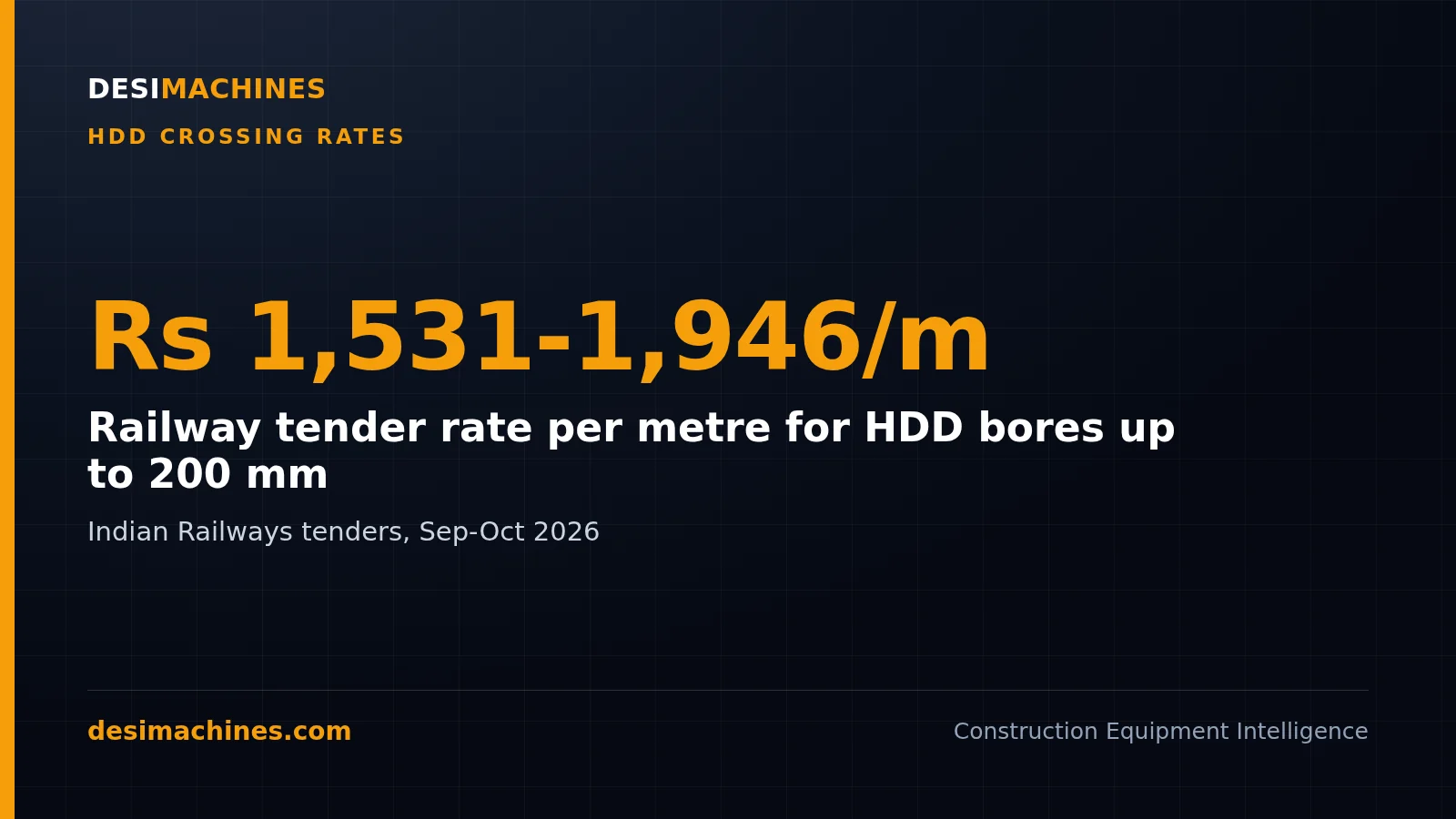
HDD (horizontal directional drilling) under a small road or track crossing is scheduled at Rs 1,531 to Rs 1,946 a metre for the bore alone in two Indian Railways tenders from September and October 2026, with the pipe supplied separately. That is the dated HDD rate per meter for bores up to 175-200 mm, the size railways use for cable crossings. HDD drills a curved bore under a road, rail line or canal and pulls a duct, gas pipe, water pipe or power cable back through it. For bigger pipeline bores, GAIL hires the rig by the day: Rs 40,000 for a rig of 60-90 MT capacity, up to Rs 1,15,000 for 250-300 MT (October 2026). Mobilisation, pits, drilling fluid, permissions and restoration sit on top of the bore rate unless the quote says otherwise.
What should a telecom subcontractor quote per metre to take two 40 mm ducts under a state highway? Government buyers scheduled Rs 1,531 to Rs 1,946 a metre for small bores this autumn, and that figure only holds once you know what it includes.
Most HDD work in India is priced in one of three ways: per metre of bore for small crossings, per crossing for a named pipeline crossing, or per rig day when the client wants to control the job. The figures below are the dated ones we could trace to an official document. Private contractor quotes are not published, so we do not print a market rate.
What is the HDD rate per meter in 2026 government tenders?
Railway signalling and telecom work uses HDD to take cables under tracks and roads, and its tenders print a rate against each item. These are the figures we found:
| Document and date | Item as written | Pipe in the rate? | Rate |
|---|---|---|---|
| Eastern Railway, Sealdah Division, tender DCPM-GS-SNT-HWH-03-26-27 (uploaded 7 Oct 2026), SOR item 1905 | HDD machine with accessories, boring up to 175 mm at a track or pucca road crossing, at least 1 m below | No, railway supplies it | Rs 1,946 per metre |
| Same tender, SOR item 1216 | Supply of HDPE pipe, PE 100, 160 mm diameter | Pipe only | Rs 792 per metre |
| Ranjitapura (RNJP) track machine siding schedule on IREPS (signed 25 Sep 2026), item 7 | HDD or auger boring under road or track, bore up to 200 mm, at least 1,200 mm deep, minimum 4 m long | No | Rs 1,531 per metre |
| South East Central Railway signalling SOR 2021, Schedule A item 1(iii)(a) | Track or road crossing by pushing method (HDD method), at least 1 m deep, 4-inch HDPE or DWC pipe | Yes | Rs 1,080 per metre |
| Same SOR, item 1(iii)(b) | Same, with 76 mm medium-grade GI pipe, for pushes over 5 m | Yes | Rs 2,246 per metre |
| Same SOR, item 1(i)(a) | Open trench 1.2 m deep, 0.3 m wide, all soils including soft rock | Not applicable | Rs 92,115 per km |
Read these as schedule rates. Bidders quote a percentage above, below or at par, so the awarded figure can differ. The Eastern Railway tender says GST was considered in its assessment. The 2021 SECR figures are older and include the pipe, which is why they look low next to the 2026 numbers.
Look at the gap between the last row and the rest. An open trench costs about Rs 92 a metre to dig in that schedule, so a metre of HDD costs roughly 12 to 21 times as much. You pay for HDD when the road, track or canal above cannot be cut. Where it can, trenching and the excavation rate per cubic meter are the cheaper basis.
How gas pipeline HDD is priced: per crossing and per rig day
City gas and cross-country pipeline jobs use bigger rigs and bigger pipe, and the buyer prices them differently. GAIL’s tender GAIL/NOIDA/C&P/PROJ/26-60, dated 8 October 2026, sets day rates for equipment it hires or recovers on its pipeline, LMC and CGD hook-up projects:
| Equipment (GAIL Annexure-8) | Rate per day |
|---|---|
| HDD rig with all equipment and accessories, 60-90 MT capacity | Rs 40,000 |
| HDD rig with all equipment and accessories, 100-135 MT capacity | Rs 80,000 |
| HDD rig with all equipment and accessories, 250-300 MT capacity | Rs 1,15,000 |
| Excavator, Ex 200/260 series or equivalent | Rs 7,000 |
| Hydra crane, 8-10 MT | Rs 3,500 |
The notes say these rates include operators, fuel, overheads and profit, and exclude GST. When GAIL recovers the cost from a contractor, it adds 20%. HDD rigs are normally rated by the pull-back force they can apply, in tonnes; the tender itself only says capacity. A bigger pipe or a longer crossing needs a bigger rig, and the day rate nearly triples from the smallest band to the largest.
For the bore itself, GAIL’s October 2026 pipeline laying tender (GAIL/NOIDA/CNP/PROJ/JLPL/26-58) lists every crossing as its own line, split by pipe size and by strata. A 16-inch river crossing in normal strata and a nala crossing in hard rock are separate items. Its two payment notes are worth copying into your own contract: the HDD length is measured as the actual curvilinear length between the tie-ins at entry and exit, and payment moves pro rata if that length changes.
The same item bundles in mobilisation and demobilisation, trial pits to find buried services, entry and exit pits with their restoration, disposal of the bentonite, and the NOCs from road and rail owners. That is the full scope of a crossing. If a contractor quotes you a per-metre figure, ask which of those items are inside it.
What drives an HDD quote up or down
Five things move the number most.
- Bore and pipe size. A pair of 40 mm OFC ducts can go in with a small rig. A 315 mm water main or a steel gas pipe usually needs a larger rig, a wider reamed hole and more drilling fluid.
- Strata. Soft soil drills fast. Hard strata and rock slow the pilot bore and wear the tooling, which is why GAIL prices hard rock as a separate line.
- Bore length and depth. Railway items set a minimum depth of 1 m to 1.2 m below the track or road, and the Ranjitapura item sets a 4 m minimum bore. Short bores still carry the full set-up cost.
- Drilling fluid and its disposal. Bentonite has to be bought, mixed, recycled and carted away.
- Pits and support machines. Entry and exit pits are dug by a backhoe loader such as the JCB 3DX or an excavator. GAIL’s schedule hires an Ex 200 class excavator at Rs 7,000 a day.
Power cables add one more limit. BSES’s cable-laying specification, attached to its NIT 59/2025-26, says cable laid by HDD should not exceed 12% of the total route length, to avoid de-rating the cable. That caps how much of a power job you can bill at the HDD rate.
Worked example: turning a rig day rate into a rate per metre
Take GAIL’s Rs 40,000 a day for a rig of 60-90 MT capacity and a 60 m road crossing. The days are our assumption for the sake of the sum, not a production norm.
| Line | Soft soil, 1 day | Hard strata, 3 days |
|---|---|---|
| Rig at Rs 40,000 a day | Rs 40,000 | Rs 1,20,000 |
| Excavator for pits, 2 days at Rs 7,000 | Rs 14,000 | Rs 14,000 |
| Total for 60 m | Rs 54,000 | Rs 1,34,000 |
| Per metre, before pipe, fluid, permissions and restoration | Rs 900 | about Rs 2,233 |
The rig rate stays the same in both columns, and the rate per metre still more than doubles. Metres completed per day decide your rate, which is why a quote without a soil report is a guess. The piling rate per meter works on the same day-rate-to-metre logic.
Permission and restoration charges on telecom crossings
For OFC work, the Department of Telecommunications has fixed the public-property charges. Under the Telecommunications (Right of Way) Rules, 2024, in force from 1 January 2025, the one-time application fee for an underground line is Rs 1,000 per kilometre. Restoration is charged at the CPWD rate for the area, or the state PWD rate where CPWD has none. For a line laid by horizontal directional drilling, restoration is limited to the area of the pit. If you restore the road yourself, the bank guarantee is 20% of the restoration cost.
That rule is the strongest argument for HDD on a long urban fibre route. An open trench pays restoration on the full length of cut road. An HDD bore pays it on two pits. Gas, water and power lines follow the road owner’s own permission rules, so check the NOC and its fee before you price.
Where the crossing sits inside a larger job, look at how it is packaged. Live tender opportunities for OFC, CGD and railway signalling work often list HDD as one line among trenching, duct laying and cable blowing. The cable and OFC laying and pipeline and water supply work pages cover the rest of the machine spread, and the types of drilling rigs guide places the HDD rig among the others.
The question to ask before you sign
Before you sign, ask the HDD contractor, or your own client: “Is this rate per metre of measured curvilinear bore between entry and exit, and does it include the pipe, the pits, the drilling fluid and its disposal, mobilisation, and the restoration, or will each come as an extra?” The answer tells you whether two quotes can be compared at all.
If your crossings run often enough that rig hire costs more than owning, look at equipment finance for an HDD rig or the backhoe that digs its pits.
Rates, permissions and tender terms change — confirm current rates with the tendering authority, the road or rail owner and your HDD contractor before you quote.