
 Excavator
294 models
 Backhoe Loader
51 models
 Crane
68 models
 Concrete Mixer
79 models
 Wheel Loader
54 models
 Compactor / Roller
45 models
 Motor Grader
42 models

 Concrete Pump
66 models
 Skid Steer Loader
11 models


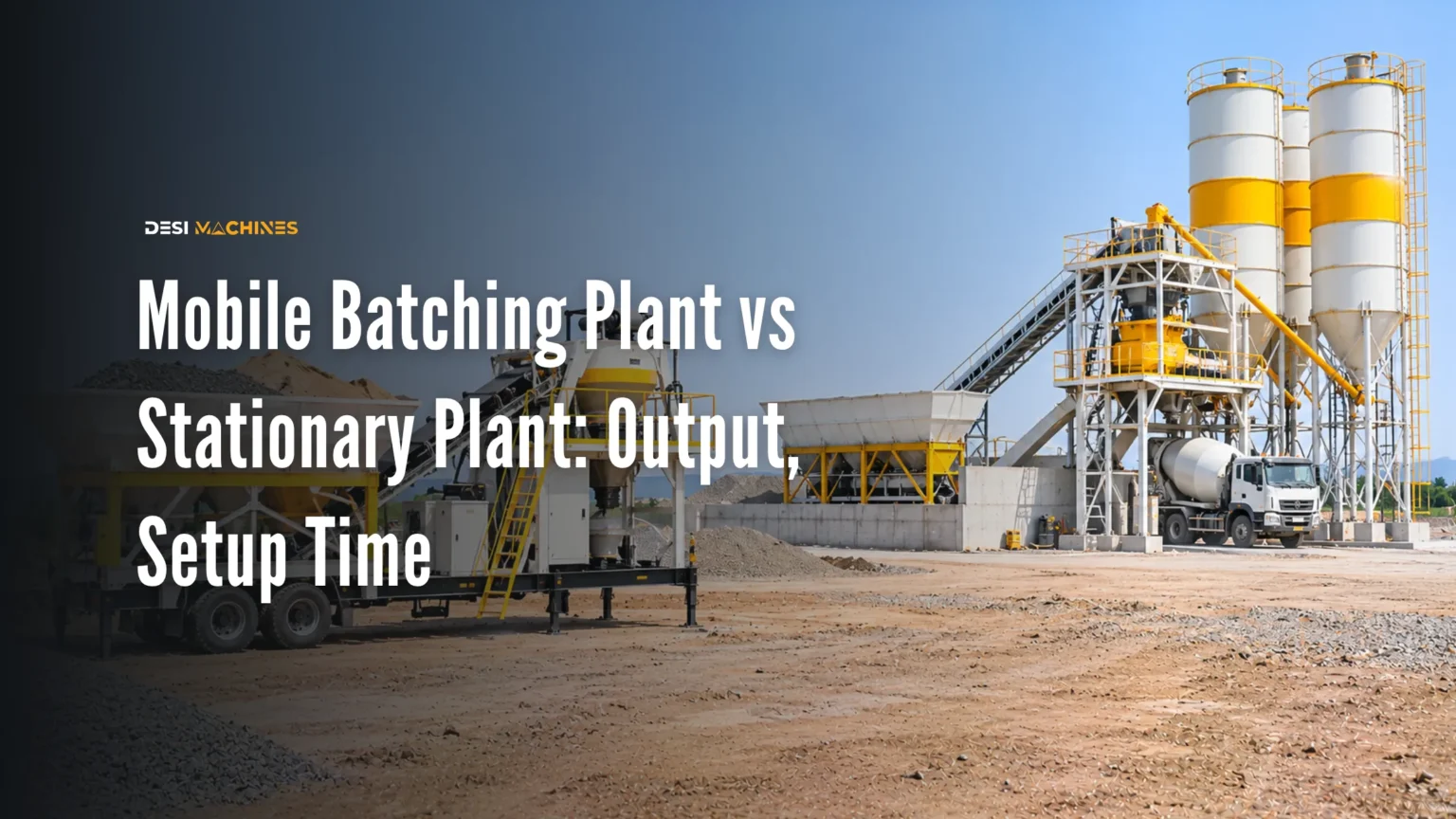
If you are choosing between a mobile batching plant and a stationary one, the output figure will not settle it. Indian makers sell both kinds at the same output, so the real choice is about what sits under the plant and how many times you will move it in its working life.
Where the plant will stand at one address for years, such as a city ready-mix yard, a dam or a precast yard, it belongs on concrete foundations with large bins and silos. Where it must follow the work along a highway, a canal or from one project to the next, it should fold, travel and stand on firm level ground with no raised foundation. This guide sets out the three kinds of plant you will meet, what each needs underneath, how long a move takes, which jobs suit which, and five questions to settle before you ask a maker for a quote. How a batching plant works, its parts and its mixer types are covered in the main guide to types of batching plant.
What is the difference between a mobile and a stationary batching plant?
A stationary batching plant is built on concrete foundations at one site and stays there, while a mobile batching plant is built to be taken down, carried to the next site and set to work again on prepared ground. Both weigh cement, sand, stone, water and admixture and mix them the same way. The difference is in the frame, the base and the storage.
In practice “mobile” covers two quite different machines. A wheeled plant carries everything on its own chassis and is towed from site to site. A semi-mobile plant, which makers also call folding, compact or transport-optimised, travels in a few truck loads or containers, folds open on site and sits on a steel frame. Macons, an Ahmedabad maker, lists all three kinds side by side, which makes a fair comparison.
| Point | Wheeled mobile | Semi-mobile (folding or compact) | Stationary |
|---|---|---|---|
| How it moves | Towed on its own wheels as one unit | Folded into a few truck loads or shipping containers | Taken apart module by module, if it moves at all |
| What it stands on | Its own chassis on firm, level ground | A steel frame on compacted soil or a plain concrete (PCC) slab | Concrete foundations built to the maker’s foundation plan |
| Output in makers’ Indian ranges | About 12 to 25 m³ an hour (Macons MA series) | About 20 to 150 m³ an hour (Macons, Ajax, Ammann) | About 30 to 240 m³ an hour (Macons horizontal range) |
| Aggregate storage on the plant | 3 or 4 small hoppers, 2.5 to 3.5 m³ each | From a few small hoppers up to about 100 m³ in standard bins | Large bins, up to 40 m³ per compartment |
| Makers’ set-up claims | Towed in; needs power, water and an aggregate feed | One day to about nine days, plus your site work | About 15 days for Liebherr’s Betomix on a base plate or strip footings, plus the foundation work |
| Suits | Small, scattered pours and short stays | Projects that move every year or two, and long linear jobs | Ready-mix yards and one-site projects that last years |
Ranges are drawn from the maker pages and brochures named in this guide, read on 5 November 2026. Other makers draw the lines in other places, so treat the bands as a guide to the shape of the market, not a rule.
Is a mobile batching plant smaller than a stationary plant?
Only at the wheeled end. A towed plant has to fit on one chassis, so it stays small. Macons lists its wheeled MA plants from 12 to 25 m³ an hour, each with a pan mixer, its own water and admixture tanks and a weight of about 5.5 to 12 tonnes.
| Model | Output | Concrete per batch | Aggregate hoppers | Wheels | Weight (approx.) | Connected power |
|---|---|---|---|---|---|---|
| MA-12 | 12 m³/hour | 400 litres | 3 × 2.5 m³ | 4 | 5.5 tonnes | 45.75 HP |
| MA-15 | 15 m³/hour | 600 litres | 3 × 2.5 m³ | 4 | 8 tonnes | 50.75 HP |
| MA-18 | 18 m³/hour | 800 litres | 4 × 3 m³ | 6 | 8 tonnes | 61.75 HP |
| MA-20 | 20 m³/hour | 1,000 litres | 4 × 3 m³ | 6 | 10 tonnes | 71.75 HP |
| MA-25 | 25 m³/hour | 1,250 litres | 4 × 3.5 m³ | 6 | 12 tonnes | 83 HP |
Semi-mobile plants are a different story. They reach the same outputs as many stationary plants. Ammann’s CC Elba plants, built at Mehsana in Gujarat, run from 30 to about 150 m³ an hour across the range, and Ammann’s India brochure says each of its plants comes in stationary and semi-mobile versions. Liebherr shows the same thing in its own range: the mobile Mobilmix is listed at 105 to 150 m³ an hour of theoretical output for truck-mixer filling, and the stationary Betomix at 105 to 165 m³ an hour, with the same aggregate storage options. Only the very top of the Betomix range, with a 4.5 m³ mixer, goes past what Mobilmix offers.
| Plant | Max output* | Mixer volume | Standard aggregate stock | Power with a genset | Power on mains | Ships in |
|---|---|---|---|---|---|---|
| CC 30 Elba | 30 m³/hour | 500 litres | 22 m³ | 82 kVA | 33 kW | One 40-foot open-top container |
| CC 45 Elba | 45 m³/hour | 750 litres | 22 m³ | 113 kVA | 45 kW | One 40-foot open-top container |
| CC 60 Elba | 60 m³/hour | 1,000 litres | 30 m³ (up to 50) | 138 kVA | 55 kW | Two 40-foot open-top containers |
| CC 105 Elba | 91 m³/hour | 2,000 litres | 75 to 100 m³ | 315 kVA | 125 kW | Two or three 40-foot containers plus a flat rack |
| CC 130 Elba | 120 m³/hour | 3,000 litres | 75 to 100 m³ | 360 kVA | 145 kW | Two or three 40-foot containers plus a flat rack |
*Ammann notes that its output figures assume discharge into dump trucks and that real output has to be worked out for each job. The power figures are as Ammann lists them: the genset figure assumes every motor runs at once (a simultaneous factor of 1, against 0.8 on mains), which is why it is so much higher. Size a set for your own load list with the guide to a diesel generator for a construction site.
Where a stationary plant still pulls ahead is storage and the very top of the output scale. Macons lists its horizontal plants from 30 to 240 m³ an hour, with four aggregate compartments that grow from 5 m³ each on the smallest to 40 m³ each on the largest. Big bins mean the wheel loader can fall behind for a while without stopping the plant, which matters when a ready-mix yard is loading trucks all day.
What foundation does a batching plant need?
A semi-mobile plant needs firm, level ground that can carry its weight, and a stationary plant needs proper concrete foundations designed by the maker. That difference shapes everything a move involves.
Ammann asks for compacted soil or a PCC slab that carries 250 to 300 kN/m² under its CC Elba plants, and no raised foundation. Liebherr asks for compacted soil of 300 kN/m² under Mobilmix. In plain terms, 250 kN/m² is about 25 tonnes resting on every square metre (our arithmetic), so the ground has to be rolled and tested as well as levelled. Macons says its compact MAC plant does not need large foundations or other civil works.
A stationary plant is a different job. IS 4925:2004, the Indian Standard for batching and mixing plants, makes the maker supply the foundation plan and erection drawings (clause 11.4), and makes the buyer provide the bin partition walls, the bin supporting structures and the foundation bolts, to sizes the maker gives in advance (clause 11.3.2). When the buyer does the civil works, the maker has to guide them (clause 11.7). Those foundations are poured once and stay behind if the plant ever moves.
Figure 1. What sits under each kind of batching plant
123
Chassis and wheelson firm level ground
Steel frame on compactedsoil or a PCC pad
Concrete foundations and bolts
1 = wheeled mobile plant, towed in on its own chassis. 2 = semi-mobile plant on a steel frame resting on a compacted or PCC pad of 250 to 300 kN/m², as Ammann and Liebherr specify. 3 = stationary plant bolted to raised concrete foundations built to the maker’s foundation plan under IS 4925. Not to scale.
How long does it take to move and set up a batching plant?
Makers quote anything from a single day to about two weeks for the plant itself, and the site work around it decides the rest. Ajax says its CRB plants, from 20 to 120 m³ an hour, have a foldable mixer unit and a swivelling operator’s cabin for single-day erection and dismantling, and that one truck carries the entire plant. Macons says it can have its compact MAC plant producing concrete at a new site in one week. Liebherr gives about nine days for Mobilmix and about 15 for the stationary Betomix, in each case under the right conditions.
Those figures count the steel going up. A move also takes in work the brochures leave out:
- Dismantling at the old site, and a crane for the mixer, silos and conveyor.
- Trailers or containers for the modules, and an over-size permit if a silo or conveyor needs one.
- A new base: rolling and testing the pad for a semi-mobile plant, or fresh foundations for a stationary one.
- Power and water: a grid connection or a generator, a water source and storage, and site air if the maker does not supply a compressor.
- Re-commissioning and trial batches, and a check of every scale with test weights before the first pour.
- The state pollution control board’s consents for the new location, explained in consent to establish and consent to operate.
Count those steps once for every move you expect. A stationary plant leaves its foundations behind and needs new ones at every new site, while a semi-mobile plant needs only a fresh pad.
Which job needs a mobile plant and which needs a stationary one?
Let the length of the stay and the spread of the work decide. One rule in IS 4926:2003, the Indian code for ready-mixed concrete, often settles it on long jobs: concrete has to be discharged from the truck mixer within 2 hours of loading, unless retarding admixtures are used, the weather is cool and humid, or chilled concrete is made (clause 5.2.2.1). The clock starts when the water meets the cement.
Take a 60 km road package with the plant at one end. Say loaded transit mixers average 30 km/h over the mix of highway and diversion roads (an assumption; time your own route). The far end is then 2 hours away, and the whole window is spent driving before any wait at the paver or pump. Put the plant at the middle and the longest run drops to 30 km, about an hour. On long highway and canal jobs a plant that can move along the alignment keeps every pour inside the limit. Some road layers set a tighter window still, as the guide to dry lean concrete explains.
| Job | How long the plant stays | Usual fit | Why |
|---|---|---|---|
| Ready-mix yard serving a city | Many years at one address | Stationary | Largest bins and silos, top output, foundations paid for once |
| Dam, barrage, metro depot or precast yard | The whole project at one spot | Stationary, or semi-mobile if it goes to the next project after | One location, steady demand |
| Highway, expressway, canal or rail package | The work front moves tens of kilometres | Semi-mobile, moved along the line | Keeps the haul inside the two-hour window |
| Factory, bridge or building of a year or two | Months, then the next site | Semi-mobile or compact | Short stay, low base cost, quick move |
| Village roads, culverts, small scattered pours | Days or weeks at each spot | Wheeled mobile plant, or no plant at all | Small output, frequent moves |
Canal work shows the pattern well: the lining goes down kilometre after kilometre, so the plant has to keep up with it. The machines used for that job are listed in the guide to canal lining.
Whichever plant you choose, it is only as busy as the trucks under it. Compare transit mixer models with their specifications and prices and send an enquiry to a verified dealer.
How do you choose between a mobile and a stationary batching plant?
Answer five questions before you speak to a maker, and the choice usually makes itself.
- How many times will the plant move in its life? Once or never points to a stationary plant. Every year or two points to a semi-mobile one.
- How far apart are the pours? If the farthest pour is near the two-hour limit from any single spot, plan a plant that moves along the work, or two plants.
- What is the peak output? Take your largest continuous pour in m³ an hour and divide by 0.75, the planning efficiency in IS 4925’s enquiry format. A wheeled plant tops out around 25 m³ an hour in the ranges above; beyond that you are choosing between semi-mobile and stationary.
- How many materials? Count the sizes of sand and stone and the powders (OPC, PPC, fly ash, slag). Ammann lists its CC 30 Elba for up to four aggregate sizes and two cement types, and its CC 105 and CC 130 for up to eight sizes and six cement types. Many materials and long runs favour bigger bins and more silos.
- What ground and power do you have? Firm open ground and a short stay suit a pad-mounted plant. Check whether the site has a grid supply or will run on a genset, and ask the maker for the connected load in both cases.
Around the plant you also need a loader to feed it and trucks or pumps to carry the concrete away. Feeding the bins is wheel loader work; browse wheel loaders for bucket sizes that suit bin heights.
When do you need neither?
When the pours are small and scattered, any plant spends more time being moved than mixing. A self-loading mixer loads, weighs, mixes and pours on its own, and the guide to self-loading vs transit mixer explains where it beats a plant with trucks. In a town with ready-mix suppliers close by, buying the concrete is often simpler still. The machines, models and tenders around ready-mix work are gathered on the RMC plant equipment page.
What machines work with a batching plant?
A plant of either kind sends its concrete out in transit mixers. Drum sizes on the listed models include 6 m³ on the AJAX AF 6XE, 8 m³ on the Schwing Stetter AM 8 C2 and 10 m³ on the AJAX AF 10XP, as listed in their specifications. For the larger end, see AJAX AF 10XP vs Schwing Stetter AM 12 C. At the pour, a concrete pump lifts it to the slab or deck.
Ready to plan the fleet around your plant? Compare transit mixers and self-loading mixers with their specifications and listed prices, and talk to a verified dealer before you fix the plant size. Batching plants are not listed on DesiMachines, so this guide quotes no plant prices; more plant guides are on the batching plant guide home.
Sources, read on 5 November 2026: Ammann India’s CC Elba concrete-mixing plant page, its CC 30 to 130 Elba data sheet, its CC 30 to CC 150 Elba brochure and its India product range brochure; Macons’ pages for its mobile, semi-mobile, compact and horizontal batching plants; Ajax Engineering’s CRB 20, CRB 30 and CRB 120 pages; Liebherr’s Mobilmix and Betomix page. Foundation and supply duties are from IS 4925:2004, Concrete Batching and Mixing Plant: Specification, clauses 11.3.2, 11.4 and 11.7. The two-hour delivery limit is from IS 4926:2003, Ready-Mixed Concrete: Code of Practice, clause 5.2.2. Transit mixer drum sizes are from each machine’s listed specifications.
Prices, specifications and features are indicative, vary by variant, location and date, and should always be confirmed with the official OEM or authorised dealer before any purchase decision. DesiMachines is not liable for decisions taken on the basis of information that may have changed after publication.