Excavator
294 models
 Backhoe Loader
51 models
 Crane
68 models
 Concrete Mixer
79 models
 Wheel Loader
54 models
 Compactor / Roller
45 models
 Motor Grader
42 models

 Concrete Pump
66 models
 Skid Steer Loader
11 models


The largest electric mining equipment in India at work today is a 20 cubic metre rope shovel at Northern Coalfields’ Nigahi mine in Singrauli, handed over by BEML in April 2025 and fed from the mine’s own power supply rather than a battery. Under it sit a battery-electric fleet underground at Hindustan Zinc’s Sindesar Khurd mine, electrified harbour cranes at two Adani ports, ten electric ready-mix drums with UltraTech, and 45 battery trucks hauling clinker across 250 km of Rajasthan, Haryana and Uttar Pradesh. This page lists every case we could confirm from a public source, with the date and the source named for each one.
Electric mining equipment in India starts with one shovel at Nigahi
At the Nigahi project of Northern Coalfields, a subsidiary of Coal India in the Singrauli coalfield of Madhya Pradesh, a BEML-built rope shovel digs overburden without burning a drop of diesel. International Mining reported the handover on 29 April 2025: the BRS21, with a 21 cubic metre bottom-dump bucket, a Siemens IGBT-based AC drive system and an operating weight of 720 tonnes, passed from BEML’s chairman to the chairman of Northern Coalfields. Equipment India reported it commissioned at Nigahi on 4 May 2025 and put the bucket at 20 cubic metres, with an annual production capacity of 4.45 million cubic metres. The two figures sit a cubic metre apart, so treat the class as 20 cubic metres and confirm the exact bucket with the maker.
What matters more for a buyer than the bucket is the cord. A rope shovel of that size has no battery and no fuel tank. It draws from the mine’s high-voltage supply through a trailing cable, which is also how the four heaviest electric machines listed here work. The BEML BE1000E-1 is a 95,000 kg machine rated at 536 HP (400 kW), and the BEML BE1800E runs twin motors of 300 kW each at an operating weight of 175,000 kg. The Liebherr R 992 E and the Liebherr R 998 SME-E are both 90,550 kg at 544 HP (400 kW). None of them is a machine you move between sites on a Tuesday, and none of them needs to be. For the full list of models in this class and how they compare, see our round-up of the most advanced electric excavators.
Battery machines went underground at Sindesar Khurd first
Hindustan Zinc’s Sindesar Khurd mine at Rajpura Dariba in Rajasthan is where battery machines started working in Indian mining. Sandvik announced on 2 May 2022 that it would supply an underground battery-electric fleet to the mine: one LH518B loader, three TH550B trucks and a DD422iE drill rig carrying the maker’s charging-while-drilling technology, with the loader and trucks using AutoSwap, which Sandvik describes as changing a battery in a few minutes. Sandvik called it the first underground battery-electric vehicle fleet deployed in India, with deliveries scheduled to begin in the first quarter of 2023.
A second machine reached the same mine around then. Autocar Professional reported on 31 January 2023 that Hindustan Zinc had introduced a Normet Agitator SmartDrive EV, powered by a 90 kWh lithium-ion battery with energy recuperation, into its underground operations. The company’s wider target, as reported in that article, is to convert around 900 diesel mining vehicles to battery over five years against an investment of more than one billion US dollars. That figure is the company’s own stated plan, not a delivered fleet.
Above ground, the same company moved to electric haulage. The Machine Maker reported on 9 September 2026 that Hindustan Zinc had contracted MFL India Limited to deploy 30 electric trucks on concentrate haulage between the Rampura Agucha mine and its Rajasthan smelters, on a six-year contract extendable by two years, and that its green logistics fleet stood at 232 vehicles in FY2026, made up of 52 electric vehicles and 180 LNG vehicles. Why the underground machines came first, and what a mine checks before buying one, is covered in our guide to electric underground mining equipment.
The ports electrified their cranes before their earthmovers
Ports are the one Indian setting where electric machines are now ordinary rather than notable, and the first thing they electrified was lifting.
At Netaji Subhas Dock in Kolkata, Construction World reported on 4 July 2025 that Syama Prasad Mookerjee Port had commissioned its first two electric-powered mobile harbour cranes, taking the dock’s fleet to six, with the equipment deployed by Adani Ports and Special Economic Zone under a five-year operations and maintenance contract. The port operator’s own Integrated Annual Report 2025-26 records the Kolkata terminal operating six mobile harbour cranes and four rubber-tyre gantry cranes under that contract.
The same report records Gopalpur Port in Odisha having electrified its harbour mobile cranes, and sets out a phased plan to shift major equipment there, naming excavators and loaders, to electric power from the following financial year. That one is a stated plan rather than a running fleet, and it is the clearest signal in any Indian port document that earthmoving machines are next in line. At Kattupalli in Tamil Nadu, the report describes new electric rubber-tyred gantry cranes going in with the Berth 3 upgrade, targeted for completion by March 2026, and Ennore Phase 2 adding further electric gantries along with a reach stacker and 18 internal transfer vehicles.
Across the harbour from Mumbai, ITLN reported on 3 January 2024 that PSA Mumbai at Nhava Sheva had committed to an all-electric rubber-tyred gantry crane fleet for its Phase 2 development, with electrification of all existing Phase 1 gantry cranes under way and due by 2027, and a solar installation sized to supply over 75% of the terminal’s electricity.
City work: ready-mix drums and clinker trucks
The urban cases are concrete and cement, and both are the same machine type a contractor already hires.
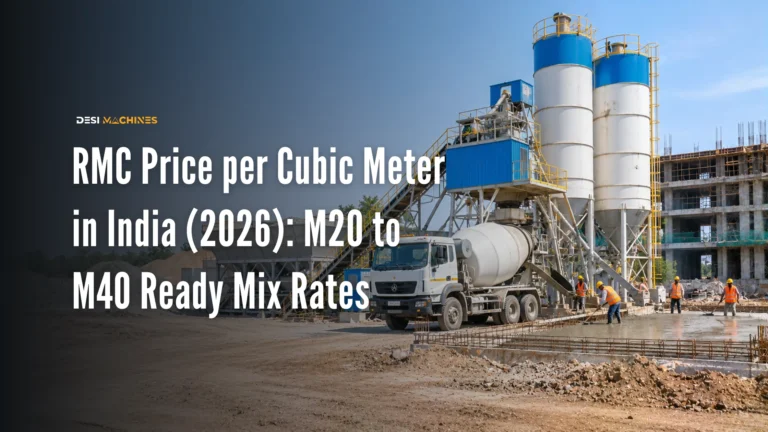
UltraTech said on 16 September 2026 that it had partnered Putzmeister to induct 10 iONTRON electric transit mixers into its ready-mix concrete operations, with the first of the ten handed over at bauma CONEXPO India at Greater Noida. Putzmeister’s own launch figures, as reported by Indian Infrastructure on 14 August 2026, put the iONTRON at a 282 kWh LFP battery, up to 200 km of range, 205 kW rated and 405 kW peak power, 240 kW DC fast charging and ARAI certification. Those are the maker’s claims for the vehicle, not measured site figures.
On long-haul cement movement, UltraTech’s press release of 16 June 2026 records 45 electric heavy-duty trucks of 55 tonnes capacity each, deployed with Energy In Motion on the 250 km run from Kotputli Cement Works in Rajasthan to the grinding units at Dadri and Sikandarabad in Delhi-NCR, through Rajasthan, Haryana and Uttar Pradesh. The company projects over 8,900 tonnes of carbon dioxide saved a year and about 2.9 million litres of diesel displaced, and states a standing fleet of 638 CNG, 32 LNG and 89 electric trucks. We covered that deployment when it started in our news on 45 electric heavy-duty trucks on the clinker route.
A larger commitment is signed but not yet running. Autocar Professional reported on 24 October 2026 a ten-year tripartite agreement between Paradeep Parivahan, JSW Cement and JSW Eco-Mobility to deploy 100 electric heavy trucks carrying clinker and slag from Nandyal in Andhra Pradesh to Vijayanagar in Karnataka, at roughly 125,000 tonnes a month. Our news item on the Paradeep Parivahan JSW contract has the detail. Treat it as contracted, with the fleet arriving over the contract term.
Every case we could confirm, with its source
Status is as at November 2026. Anything we could not confirm from a public source is left off this table.
| Place | What is running | Status | Source and date |
|---|---|---|---|
| Nigahi mine, Northern Coalfields, Singrauli (MP) | BEML BRS21 electric rope shovel, 20 cu m class, mains-fed | Working | International Mining, 29 Apr 2025 (handover); Equipment India, 4 May 2025 (commissioned) |
| Sindesar Khurd mine, Rajpura Dariba (Rajasthan) | Sandvik LH518B loader, 3 x TH550B trucks, DD422iE drill, battery with AutoSwap | Working | Sandvik news release, 2 May 2022 (deliveries from Q1 2023) |
| Sindesar Khurd mine (Rajasthan) | Normet Agitator SmartDrive EV, 90 kWh lithium-ion | Working | Autocar Professional, 31 Jan 2023 |
| Rampura Agucha mine to Rajasthan smelters | 30 electric trucks on concentrate haulage, operated by MFL India | Contracted | The Machine Maker, 9 Sep 2026 (six-year contract) |
| Netaji Subhas Dock, Kolkata | First two electric mobile harbour cranes, dock fleet of six | Working | Construction World, 4 Jul 2025; APSEZ Integrated Annual Report 2025-26 |
| Gopalpur Port (Odisha) | Harbour mobile cranes electrified; excavators and loaders to follow | Cranes working, earthmovers planned | APSEZ Integrated Annual Report 2025-26 |
| Kattupalli and Ennore (Tamil Nadu) | New electric rubber-tyred gantry cranes, reach stacker, 18 transfer vehicles | Under way | APSEZ Integrated Annual Report 2025-26 |
| PSA Mumbai, Nhava Sheva | All-electric gantry fleet for Phase 2; Phase 1 gantries being converted by 2027 | Part working, part under way | ITLN, 3 Jan 2024 |
| UltraTech ready-mix operations | 10 Putzmeister iONTRON electric transit mixers, first handed over at Greater Noida | Working | UltraTech, 16 Sep 2026; Indian Infrastructure, 14 Aug 2026 (vehicle figures) |
| Kotputli (Rajasthan) to Dadri and Sikandarabad (Delhi-NCR) | 45 electric trucks, 55 t each, 250 km lane, with Energy In Motion | Working | UltraTech press release, 16 Jun 2026 |
| Nandyal (AP) to Vijayanagar (Karnataka) | 100 electric trucks for clinker and slag, about 125,000 t a month | Contracted | Autocar Professional, 24 Oct 2026 |
What these cases show about duty cycle and charging
What follows is our reading of the eleven cases above, not a claim any maker or operator has made.
Every machine on that list shares one property: it works to a fixed pattern. The Nigahi shovel sits in one cut for months, so a trailing cable costs nothing in productive hours. A harbour crane works inside a yard with a substation behind it. A clinker truck runs the same 250 km lane every day, so a charger at each end solves the whole problem once. None of these duty cycles asks the machine to turn up somewhere new with no power.
The machines that have not gone electric in India are the mirror image. A hired 20-tonne excavator that moves site every few weeks, or one working where the only power on site is a diesel generator, has nowhere to plug in and no predictable charging window. That, more than price, is what the confirmed cases suggest holds the segment back.
Charging in these fleets is solved three different ways, and the difference is duty, not technology. Underground at Sindesar Khurd, where a machine cannot stand idle in a heading, the answer is swapping the battery in minutes. On the road, the answer is a fixed lane with chargers at the ends. On a mine bench, nothing charges at all, because the machine is simply plugged in. Our guide to charging an electric machine on site works through the supply and connection side, and if you want the cost arithmetic rather than the deployment picture, our piece on electric versus diesel excavator running cost sets out the per-hour method with the tariff stated.
The electric excavators we list, and how each one is fed
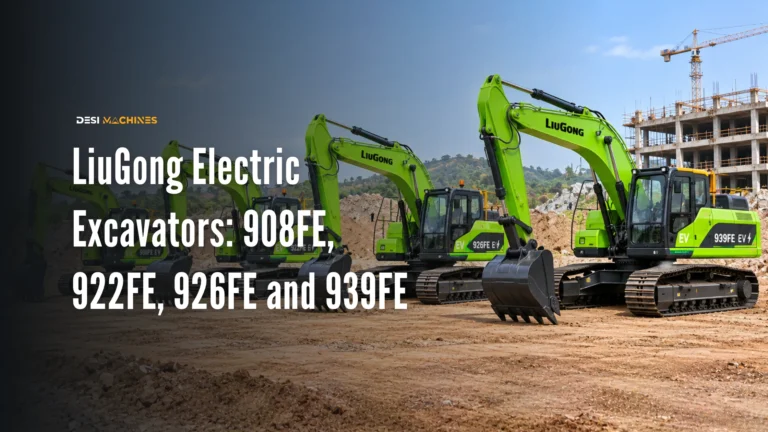
Thirteen electric excavators are listed here as of November 2026. Our own figures show the same split the deployment cases show: the five heaviest are all mining-class machines, while the only two under 8,000 kg are the smallest LiuGong models. Weights and rated power below are from each machine’s own specification.
| Machine | Operating weight | Rated power | Feed as listed |
|---|---|---|---|
| BEML BE1800E | 175,000 kg | 2 x 402 HP (2 x 300 kW) | Electric |
| BEML BE1000E-1 | 95,000 kg | 536 HP (400 kW) | Electric |
| Liebherr R 992 E | 90,550 kg | 544 HP (400 kW) | Electric |
| Liebherr R 998 SME-E | 90,550 kg | 544 HP (400 kW) | Electric |
| Volvo EC500 Electric | 47,846 kg | Not specified | Electric |
| LiuGong 939FE EV | 39,000 kg | 325 HP (250 kW) | Electric |
| SANY SY375EP | 37,800 kg | 269 HP (200 kW) | Electric |
| LiuGong 926FE EV | 26,000 kg | 201 HP (150 kW) | Electric |
| LiuGong 922FE Battery | 24,100 kg | 140 HP (105 kW) | Battery |
| LiuGong 922FE Cable | 22,000 kg | 140 HP (105 kW) | Cable |
| SANY SY215EP | 21,900 kg | 201 HP (150 kW) | Electric |
| LiuGong 908FE EV | 7,600 kg | 63 HP (47 kW) | Electric |
| LiuGong 9027FE EV | 2,750 kg | 21.1 HP (16.5 kW) | Electric |
One honest gap in that table is worth naming, because it changes what you ask a dealer. Only two of the thirteen listings state the power feed outright, the 922FE pair, where one is cable and one is battery. The other eleven say only “Electric”, which covers a mains cable, a battery pack or both. Ask which it is before you plan any site power, because the answer decides whether you are buying a connection or a charger. Dated price ranges for these machines are set out in our piece on electric excavator prices in India, and the wider question of which electric machine classes are genuinely on sale here is covered in electric construction equipment in India. The knowledge side of the pillar sits in our electric machines guide, including the electric tippers and dump trucks page that covers the truck classes in these cases.
If your own work has the fixed pattern these cases share, a site that stays put or a route that repeats, compare the electric excavators listed here against the diesel machine you would otherwise hire, and talk to a dealer about the supply before the machine. Finance options for either are set out on our equipment finance pages.
Rates, schemes, specifications and prices change — confirm current terms with the OEM, dealer, bank or insurer before deciding. Prices, specifications and features are indicative, vary by variant, location and date, and should always be confirmed with the official OEM or authorised dealer before any purchase decision. DesiMachines is not liable for decisions taken on the basis of information that may have changed after publication.