Excavator
294 models
 Backhoe Loader
51 models
 Crane
68 models
 Concrete Mixer
79 models
 Wheel Loader
54 models
 Compactor / Roller
45 models
 Motor Grader
42 models

 Concrete Pump
66 models
 Skid Steer Loader
11 models


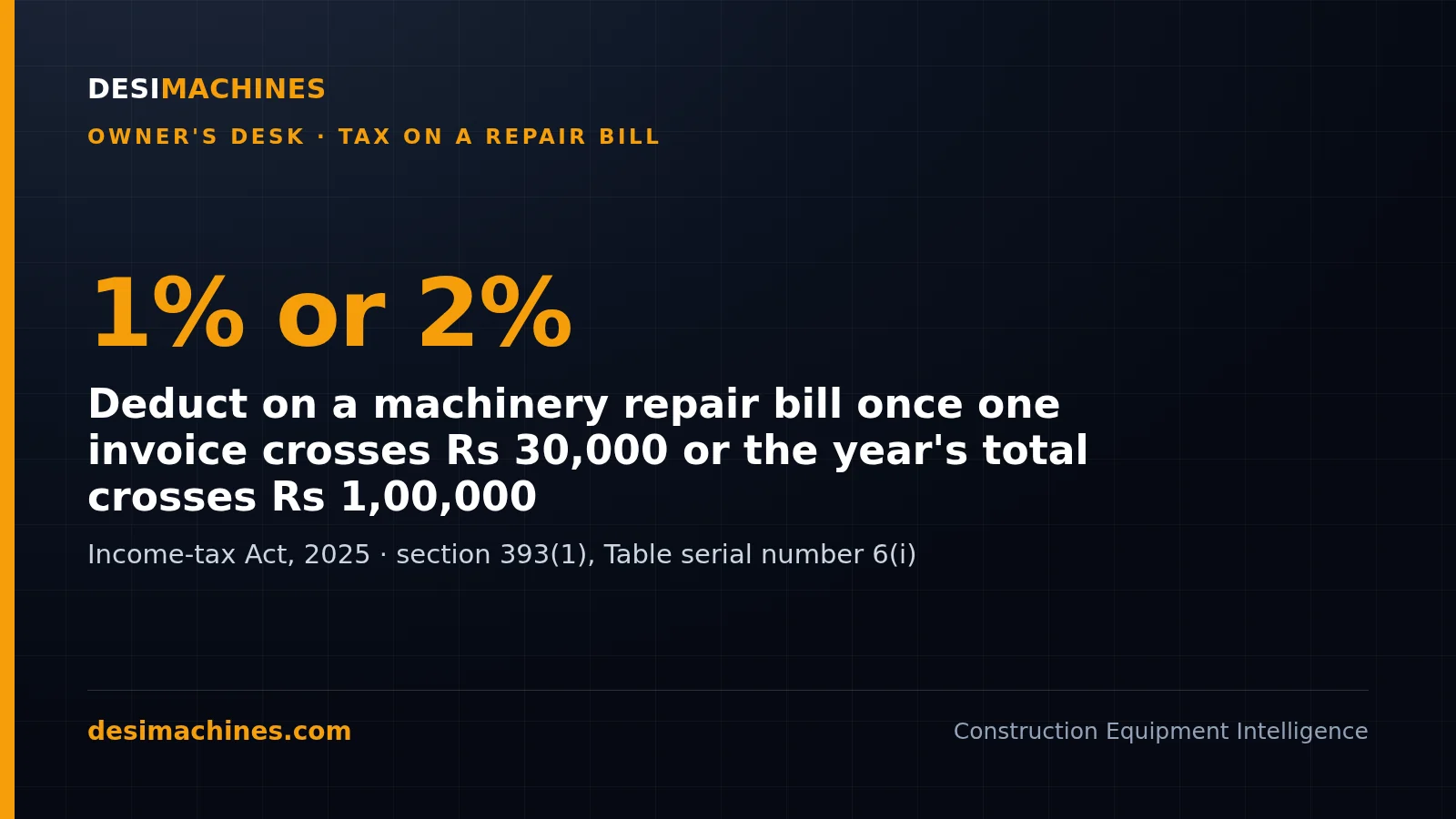
Two owners can get the same workshop bill and only one of them has to cut tax from it. TDS on machinery repair and maintenance is governed by section 393(1) of the Income-tax Act, 2025, Table serial number 6(i): the payer deducts 1% where the repairer is an individual or a Hindu undivided family and 2% where the repairer is a firm or a company, once a single bill crosses ₹30,000 or the year’s payments to that workshop cross ₹1,00,000. The duty only arises if you are a designated person, and a proprietor whose sales, gross receipts or turnover were ₹1 crore or less in the previous year is not one.
The rate is the question most owners ask first. It is the second question. The first is whether the law puts the deduction duty on you at all, and for a large number of single-machine and two-machine owners it does not.
Who has to deduct TDS on machinery repair and maintenance
Serial number 6(i) of the section 393(1) Table applies to a sum paid for carrying out any work under a contract between a contractor and a designated person. If you are not a designated person, that row does not reach you and the workshop gets the full invoice amount.
Section 402(11) defines the term, and the list is wide. It covers the Central Government and any State Government, a local authority, a corporation set up under a Central, State or Provincial Act, a company, a co-operative society, a development or housing authority, a society registered under the Societies Registration Act, 1860, a trust, a university, a foreign government or enterprise, and any firm. Then it adds an individual, HUF, association of persons or body of individuals who does not fall in any of those classes but whose total sales, gross receipts or turnover from business exceeded ₹1 crore, or ₹50 lakh in the case of a profession, during the tax year immediately before the year of payment.
Two things follow from that wording. A partnership firm or an LLP running three tippers is a designated person from its first rupee of turnover, because “any firm” is in the list with no threshold attached. A proprietor running the same three tippers is outside the row until his previous year’s turnover crosses ₹1 crore.
| If you pay the repair bill as | Deduct under 6(i)? |
|---|---|
| Private limited or public company | Yes, from the first bill |
| Partnership firm or LLP | Yes, from the first bill |
| Proprietor, previous year turnover above ₹1 crore | Yes |
| Proprietor, previous year turnover ₹1 crore or less | No |
| Co-operative society, trust or registered society | Yes, from the first bill |
| Government department or local body paying for its own plant | Yes, from the first bill |
The turnover test looks backwards, at the year that has closed, so it is settled before the repair happens. An owner who crossed ₹1 crore last year carries the duty through the whole of this year even if the current year turns out slower.
What decides the rate, 1% or 2%
The rate follows the status of the repairer. Serial number 6(i) sets 1% where the contractor is an individual or a Hindu undivided family and 2% where the contractor is any other person. A roadside mechanic working in his own name takes 1%. A partnership workshop, an LLP or the authorised dealer’s service division takes 2%. The machine, the fault and the invoice value change nothing here.
Two limits sit alongside the rate: ₹30,000 for any single such sum, and ₹1,00,000 for the aggregate of such sums in the tax year. Either one brings the deduction in, and section 393(1)(a) requires it on the entire amount or aggregate rather than on the excess. The second limit is the one that catches owners who use the same workshop all year for small jobs.
Take four invoices from one mechanic across a year at ₹28,000, ₹26,000, ₹24,000 and ₹27,000. No single bill touches ₹30,000, so the first two are paid in full with nothing deducted. The running total reaches ₹1,05,000 on the fourth bill, which crosses the aggregate limit. Tax is then due on the whole ₹1,05,000 and not on the ₹5,000 of excess, so the catching-up comes out of the last payment. Section 393(1)(c) fixes the moment as the credit of the sum to the mechanic’s account or its payment, whichever is earlier, which means a bill booked in March and paid in May is caught in March.
For the other side of the same ledger, where a machine of yours goes out on hire and the client deducts from your bill, the rate logic is different and sits in a different row of the same Table. That is covered in TDS on machinery hire charges.
When the bill is only for parts
Buying a filter set, a set of pins and bushes or a hose assembly over the counter is a purchase of goods. No work is carried out for you, so serial number 6(i) has nothing to bite on and the parts invoice is paid in full.
One other row can still reach a parts purchase. Serial number 8(ii) puts 0.1% on any sum exceeding ₹50 lakh paid for the purchase of goods, and section 402(6) limits “buyer” for that row to a person whose total sales, gross receipts or turnover from business exceeded ₹10 crore in the previous tax year. Both conditions have to hold, and the note to that row deducts only on the sum above ₹50 lakh, and only where no other provision of the Act already applies to the transaction. A fleet buying its full year of spares from one authorised dealer is the realistic case; a single-machine owner is nowhere near it.
If you are sizing that ₹50 lakh line against your own spares spend, the dealer-side catalogue on our spare parts pages is the place to start, and the collection side of a machine purchase is set out in TCS on purchase of machinery.
Parts and labour on the same invoice
Most workshop bills are mixed: a pump, the seals, and two days of labour to fit them. The Act carries a split rule, and it is narrower than it is usually quoted. The note to serial number 6(i) says that where a sum is paid for work specified in section 402(47)(e), tax is deducted on the invoice value excluding the value of material if that value is shown separately on the invoice, and on the whole invoice value if it is not.
Section 402(47)(e) describes manufacturing or supplying a product to a customer’s requirement or specification using material purchased from that customer. Its own carve-out (A) takes out the case where the material is bought from anyone else. A workshop that fits parts from its own stock is therefore outside clause (e), and the note’s split does not apply to that invoice by its own terms. Where you send your own casting or your own hose to a fabricator to be worked on, clause (e) fits and the split is written into the law.
Our reading of what to do with the ordinary mixed bill: ask for parts and labour as separate lines on the invoice and keep the deduction on the service line, because that is the only version of the bill you can later show to anyone. An invoice that gives a single consolidated figure leaves the entire amount exposed, and the Act gives you nothing to argue back with. Whether the parts line should also be booked as spend or capitalised is a separate decision, worked through in repair of machinery: capital or revenue expenditure.
Diagnosis and advice sit in a different row
Serial number 6(iii) covers fees for technical services at 2% and professional fees at 10%, on a threshold of ₹50,000, where the payer is a specified person. Section 402(37) defines that almost identically to a designated person: any person other than an individual or HUF, plus an individual or HUF above the same ₹1 crore and ₹50 lakh turnover lines.
The boundary matters because the two rows carry different rates and different limits. Section 9(7)(b) reads fees for technical services as consideration for rendering any managerial, technical or consultancy service, including the provision of technical personnel, but excludes consideration for any construction, assembly, mining or like project undertaken by the recipient. A specialist called in to diagnose a recurring hydraulic fault and give an opinion is rendering a consultancy service. The same specialist contracted to strip the pump and rebuild it is carrying out work, and the bill goes back to 6(i).
An annual maintenance contract follows the work route. Its yearly value normally clears ₹1,00,000 by itself, so the deduction runs from the first instalment instead of starting part-way through the year.
| What you are paying for | Table row | Rate | Threshold |
|---|---|---|---|
| Repair job, overhaul or AMC under a contract | 6(i) | 1% individual or HUF, 2% others | ₹30,000 single, ₹1,00,000 aggregate |
| Job work on material you supplied | 6(i) with the 402(47)(e) note | 1% or 2% on value less material | ₹30,000 single, ₹1,00,000 aggregate |
| Technical diagnosis or engineering opinion | 6(iii) | 2% | ₹50,000 |
| Parts bought over the counter | None | Nil | Not applicable |
| Spares from one seller above ₹50 lakh a year | 8(ii) | 0.1% | ₹50 lakh, buyer turnover above ₹10 crore |
What a missed deduction costs
Section 35(b)(i) disallows 30% of any sum payable to a resident on which tax was deductible and was either not deducted or not paid by the due date. Carry the four-invoice example above to its conclusion: miss the deduction on that ₹1,05,000 and ₹31,500 is added back to your business income for the year, against a deduction that would have been ₹1,050 at 1%. The disallowed 30% comes back in the year the tax is actually paid, so what you lose is timing and working capital rather than the expense itself.
Two more lines run alongside it. Section 398(3) charges simple interest at 1% a month from the date the tax was deductible to the date it is deducted, and 1.5% a month from deduction to actual payment. Section 397(2) requires the payee to give a valid PAN, and without one the deduction goes to the higher of the prescribed rate, the rates in force, or 20%, which turns a 1% cut on a mechanic with no PAN into a 20% one.
Section 398(2) provides the one real escape. A payer who failed to deduct is not treated as an assessee in default if the payee has filed his return, taken the amount into account in computing income and paid the tax on it, and the payer holds a certificate to that effect from an accountant in the prescribed form. Section 397(1) also requires anyone who deducts to hold a tax deduction and collection account number, so an owner crossing the ₹1 crore line for the first time needs the TAN in place before the first deduction, not after it. The certificate you then owe the workshop, and the statement that proves the credit reached it, are covered in Form 16A for contractors. Deposits and returns are filed through the income tax e-filing portal.
Owners on the presumptive route should note that this duty is unaffected by how business income is computed. The scheme fixes your taxable profit; it does not switch off a deduction obligation that section 402(11) has already fastened on you, as set out in presumptive taxation for contractors. The separate 1% deduction under GST on a government works bill is a different levy altogether and is explained in GST TDS on works contract.
When to hold back tax before you release a workshop payment
Settle three things while the invoice is still on your desk. Check last year’s turnover against the ₹1 crore line, because that answers whether any of this applies to you. Check the repairer’s constitution, which fixes 1% or 2%. Then check your running total with that workshop for the year against ₹1,00,000, since that is the limit that arrives without warning on a series of small jobs. Owners planning a year of parts and service spend around a machine can price it against the catalogue on our spare parts pages and the funding options on our equipment finance pages.
Rates, schemes, specifications and prices change — confirm current terms with the OEM, dealer, bank or insurer before deciding. The rupee amounts used above are illustrative invoice totals chosen to show how the statutory limits work, and are not a price for any part or any repair.