
 Excavator
316 models
 Backhoe Loader
51 models
 Crane
68 models
 Concrete Mixer
79 models
 Wheel Loader
54 models
 Compactor / Roller
45 models
 Motor Grader
42 models

 Concrete Pump
66 models
 Skid Steer Loader
11 models


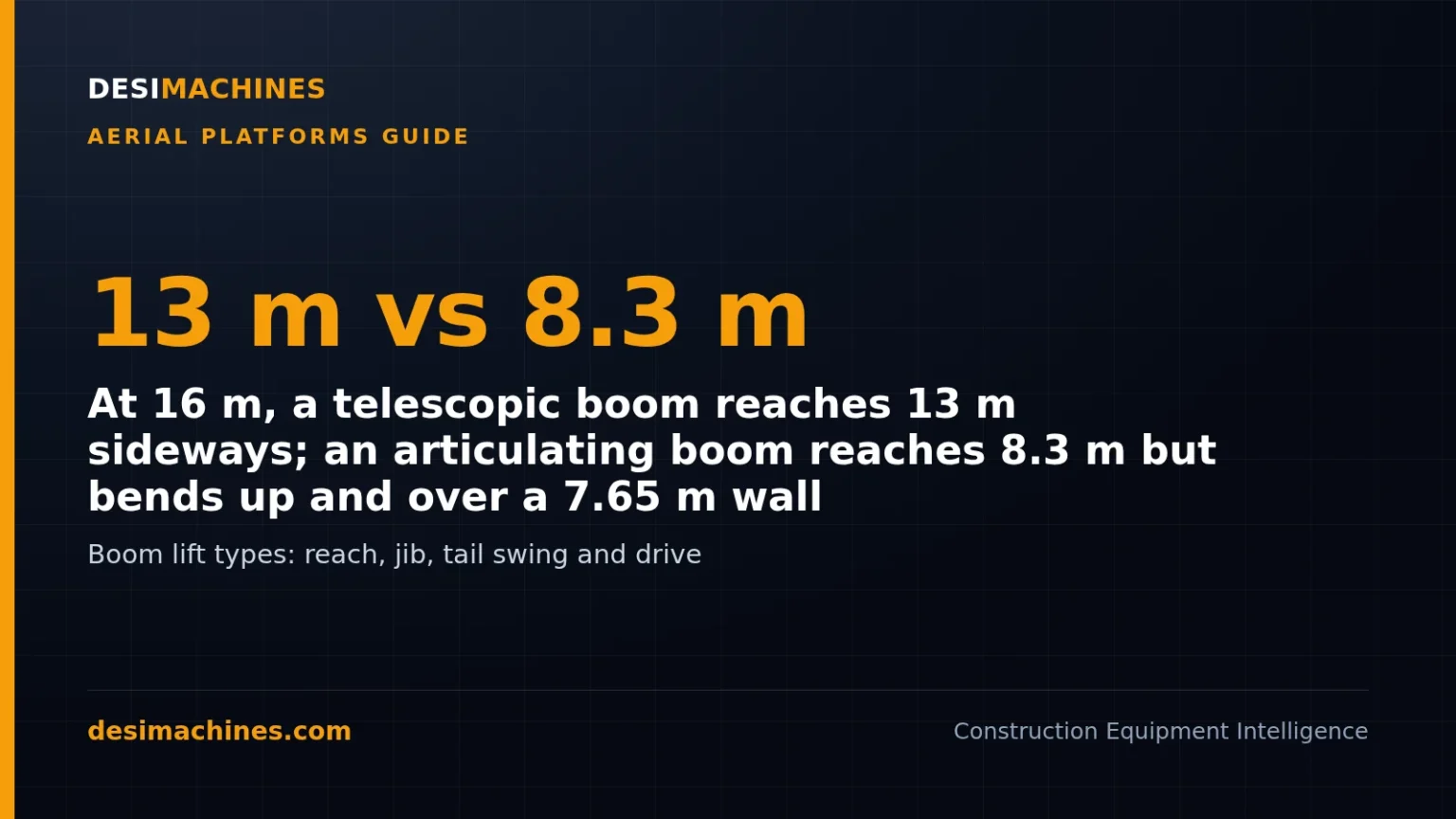
Boom lifts come in five types, and the two that make up nearly all of the Haulotte and JCB boom ranges sold in India, articulating and telescopic, are built from about 12 m to 42 m (39 to 138 ft) of working height. At the same 16 m, Haulotte India’s telescopic boom reaches 13 m sideways against the articulating boom’s 8.3 m. The articulating boom, though, climbs over a 7.65 m obstacle, and its counterweight swings just 10 cm past the machine.
Those three numbers, outreach, up-and-over clearance and tail swing, decide which type a job needs far more often than the height on the brochure does. This guide to boom lift types explains each one, what the jib and the turntable do, how the drive and tyres change where a boom can go, and which figures to read on a spec sheet before you hire one. Every figure comes from the makers’ Indian websites, read in November 2026. If you are still deciding between a boom and a scissor platform, start with scissor lift vs boom lift.
What are the types of boom lift?
A boom lift is a machine that carries one to three workers in a basket at the end of a hydraulic arm, called the boom. The boom can move out sideways as well as up, and that sideways reach is what separates it from a scissor lift, which only goes straight up. The types differ in how the boom bends and in what carries it.
| Type | How the boom moves | Working height (Haulotte India models) | What sets it apart |
|---|---|---|---|
| Articulating (knuckle) boom | Two or more sections joined by a hinge, the “knuckle”, plus a short jib at the tip | 11.68 m (HA12 CJ) to 41.5 m (HA41 RTJ PRO), 15 models | Reaches up, over and down into a space |
| Telescopic (straight) boom | One straight boom whose sections slide out of each other | 16.1 m (HT16 RTJ PRO) to 42.2 m (HT43 RTJ PRO), 6 models | The longest sideways reach of any platform |
| Lightweight self-propelled boom | Articulating boom on a light drivable base that stands on outriggers to work | 15.54 m (HLA16 PX) and up to about 19 m | About 2.4 tonnes (2,358 kg), for floors and lawns that cannot take a heavy machine |
| Trailer-mounted (towable) boom | Boom on a road trailer, levelled on outriggers at the work spot | 13.26 m (HTT13) and 15.54 m (HTA16 P) among the models read | Towed behind a vehicle; about 1.9 tonnes (1,905 kg) for the HTA16 P |
| Truck-mounted boom | Boom fixed on a lorry chassis | Not in the two Indian ranges read for this guide | Drives on public roads from job to job, as street-light and power-line crews need |
Two more words cover these same machines. A “knuckle boom” or “articulated boom” is the articulating type. A “stick boom” or “straight boom” is the telescopic type. JCB India’s range follows the same split: four articulated booms (A45E, AJ48D, A60E and A60EH, 15.84 m to 20.3 m) and one telescopic boom, the T65D, at 21.92 m. The wider family of access machines, including scissor and vertical mast lifts, is laid out in aerial work platform types. Every guide on these machines is listed under aerial work platforms.
How does an articulating boom lift work?
An articulating boom works like your arm: a lower boom lifts from the turntable, a hinge in the middle lets the upper boom tilt out at a different angle, and a short jib at the tip moves the basket the last metre or so. Because the arm bends, the basket can go up the near side of a wall, over the top, and down the far side. Makers call the highest obstacle a boom can clear this way the “up and over clearance”.
That clearance grows with size across Haulotte’s RTJ PRO range: 7.65 m on the 16 m HA16 RTJ PRO, 8.5 m on the 20.5 m HA20 RTJ PRO, 9.3 m on the 26.4 m HA26 RTJ PRO, 11.35 m on the 31.8 m HA32 RTJ PRO and 17.5 m on the 41.5 m HA41 RTJ PRO. The larger machines can also reach below the level they stand on, 5.5 m below ground for the HA32 RTJ PRO, which is useful for work under a bridge deck or down into a pit.
At the small end, the HA12 CJ is built for tight indoor spaces. It is 1.2 m wide, has zero tail swing and still reaches 6.94 m sideways at 11.68 m working height. It runs on a 48 V battery with two-wheel drive and non-marking tyres, and climbs a 25% slope, so it is a machine for finished floors, not rough ground.
How does a telescopic boom lift work?
A telescopic boom is one straight arm. Its sections slide out of each other like a radio aerial, so the basket travels in a straight line from the turntable. Haulotte’s own description is that telescopic booms have “the greatest offset outreach” of all its platforms. Offset outreach is how far the basket reaches out sideways from the machine.
The numbers bear that out. The 16.1 m HT16 RTJ PRO reaches 13 m sideways, the 22.5 m HT23 RTJ PRO 18.3 m and the 27.9 m HT28 RTJ PRO 23.85 m. JCB’s T65D reaches 17.22 m at 21.92 m working height and carries three people. The tallest is not always the longest: the 42.2 m HT43 RTJ PRO reaches 20.2 m, less than the HT28. Check the outreach figure itself and never assume it from the height.
A straight boom cannot bend over a parapet. If something stands between the machine and the work, the basket has to go above it, which uses up height. That is the trade you make for the extra reach.
Articulating or telescopic: which reaches further?
At every height the telescopic boom reaches further sideways, and the articulating boom clears higher obstacles and swings a smaller tail. The table puts the two RTJ PRO lines side by side at four heights.
Table 1: Haulotte articulating and telescopic booms compared at matching heights (read November 2026)
| Model | Type | Working height | Sideways outreach | Up and over clearance | Tail swing | Basket load |
|---|---|---|---|---|---|---|
| HA16 RTJ PRO | Articulating | 16 m | 8.3 m | 7.65 m | 10 cm | 230 kg (2 people) |
| HT16 RTJ PRO | Telescopic | 16.1 m | 13 m | Not given | 93 cm | 250 kg (2 people), 350 kg option |
| HA20 RTJ PRO | Articulating | 20.5 m | 11.9 m | 8.5 m | 42 cm | 250 kg (2 people), 350 kg option |
| HT23 RTJ PRO | Telescopic | 22.5 m | 18.3 m | Not given | 109 cm | 230 kg (2 people), 450 kg (3 people) option |
| HA26 RTJ PRO | Articulating | 26.4 m | 17.5 m | 9.3 m | 76 cm | 250 kg (2 people), 350 kg option |
| HT28 RTJ PRO | Telescopic | 27.9 m | 23.85 m | Not given | 150 cm | 230 kg (2 people), 350 kg option |
| HA41 RTJ PRO | Articulating | 41.5 m | 20.1 m | 17.5 m | 3.88 m | 230 kg (2 people) |
| HT43 RTJ PRO | Telescopic | 42.2 m | 20.2 m | Not given | 2.8 m | 230 kg (2 people), 450 kg (3 people) |
Platform height, the floor of the basket, is 2 m below working height on every model here, because makers add the reach of a worker standing in the basket. A bigger load option usually comes with a smaller working zone. Haulotte lists the HT16 RTJ PRO’s 350 kg rating as a “restricted envelope”, so the basket cannot go as far out with 350 kg in it as with 250 kg.
Figure 1: Reach of a 16 m articulating boom and a 16 m telescopic boom
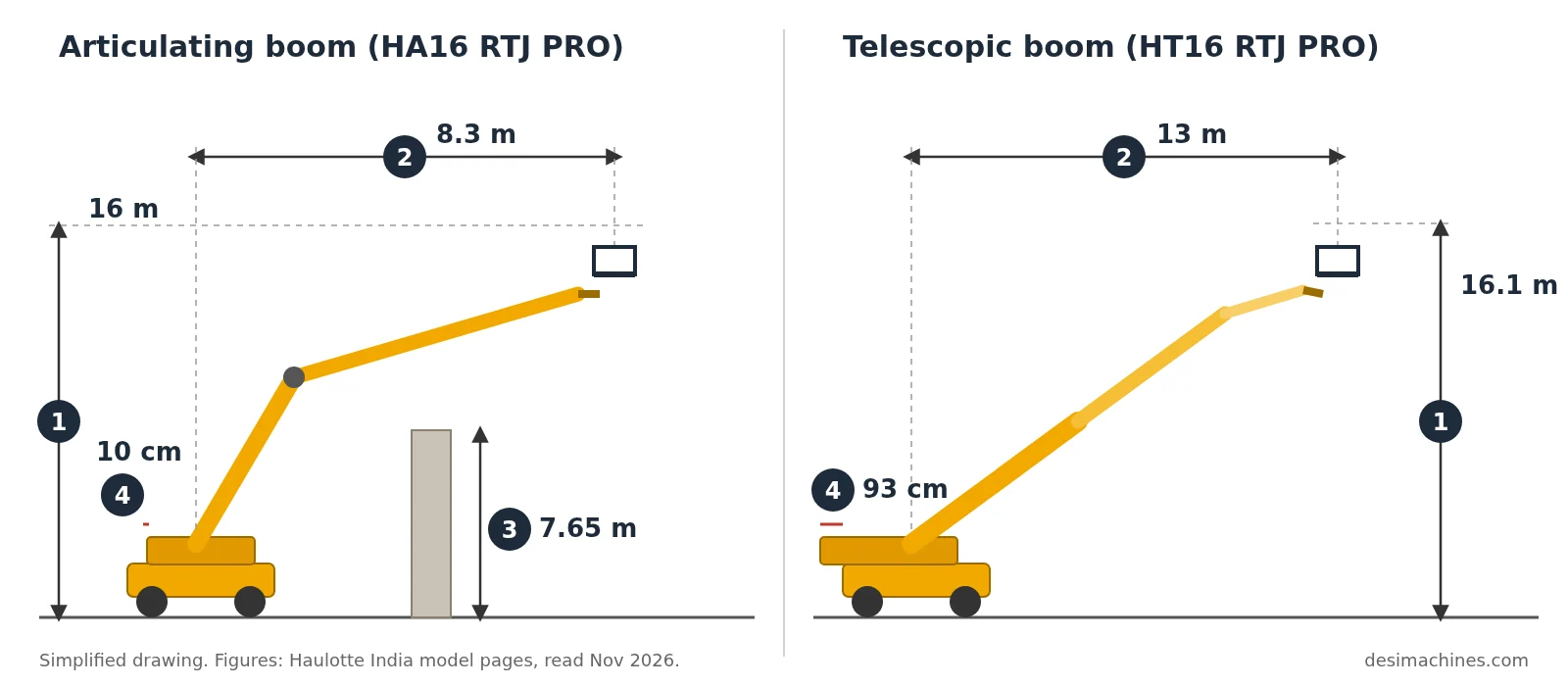
- Working height: 16 m for the HA16 RTJ PRO articulating boom, 16.1 m for the HT16 RTJ PRO telescopic boom.
- Sideways outreach: 8.3 m articulating, 13 m telescopic.
- Up and over clearance: the articulating boom’s basket goes over an obstacle up to 7.65 m high. Haulotte gives no such figure for the straight boom.
- Tail swing: 10 cm articulating, 93 cm telescopic.
Figures from each model’s Haulotte India page, read November 2026. The drawing is simplified to show the shape of the reach.
So the choice comes down to the job. A straight reach across a gap, such as a building face behind a drain, a pond or a row of parked vehicles, points to a telescopic boom. Work behind a parapet, over a roof edge, into pipe racks or between steel columns points to an articulating boom.
What does the jib do on a boom lift?
The jib is the short arm between the end of the boom and the basket. It tilts the basket up or down on its own, so the operator can make the last small move without swinging the whole boom. On the models read for this guide, the jib tilts through 132 to 150 degrees: 132.2° on the HA12 CJ, 133° on the HA26, HT16, HT23 and HT28 RTJ PRO, 140° on the HA16, HA32, HA41 and HT43 RTJ PRO, and 150° on the HLA16 PX and the trailer-mounted HTA16 P. Jib length runs from 1.3 m on the HLA16 PX to 2.45 m on the HT43 RTJ PRO, which can also swing its jib 150° from side to side.
Two more rotations matter. The basket itself turns, 165° to 180° on the models that list it, so workers can face the wall without moving the boom. The turntable, the round base that the whole boom sits on, turns 360° without stopping on the diesel RTJ PRO machines. The HA12 CJ turns 355° and the battery HA20 E 355° “non continuous”, which means the boom has to swing back the other way once it reaches the end of its turn. On a long run of work around a tank or a column, a 360° continuous turntable saves time.
What is tail swing, and why does it matter?
Tail swing is how far the back of the turntable, where the counterweight sits, sticks out past the machine’s wheels or body when the boom turns sideways. The counterweight balances the weight of the boom and basket, so a longer boom needs a heavier tail that swings wider. Across Haulotte’s range it goes from 0 cm on the compact HA12 CJ to 3.88 m on the HA41 RTJ PRO.
On an open site this hardly matters. Beside a wall, a running road, a scaffold or a parked truck, it decides whether the machine can work at all. A boom with 10 cm of tail swing can work tight against a wall. One with 1.5 m needs that much clear space all round it, kept free with barricades, or the counterweight can strike a person or a vehicle while the operator looks up at the basket. Measure the gap before the machine arrives, not after.
What drive, axles and tyres does a boom lift need?
How a boom lift drives decides where it can go. A boom lift can be driven with the basket raised, at slow speed, which is why the drive figures belong on the spec sheet. Here is what to read and what the numbers mean on the models read for this guide.
Table 2: Drive and ground figures on a boom lift spec sheet
| Figure | What it means | Range on the models read |
|---|---|---|
| Drive and steer | 2WD for smooth floors; 4WD with four-wheel steer for rough ground and tight turns | HA12 CJ 2WD and 2-wheel steer; RTJ PRO models 4WD and 4-wheel steer |
| Gradeability | The steepest slope it can climb while stowed (boom down) | 25% (HA12 CJ) to 45% (HA20, HA26, HT16 and HT28 RTJ PRO) |
| Tilt allowance | How far off level the chassis may sit before the tilt alarm sounds | 3° (HA12 CJ, HT43 RTJ PRO) to 5°, 6° as an option on the HA20 models |
| Ground clearance | The gap under the chassis, for ruts and stones | 10.7 cm (HA12 CJ) to 48 cm (HA26 and HT28 RTJ PRO) |
| Wind rating | The highest wind speed the machine may work in | 45 km/h on most; 60 km/h on the HA32 RTJ PRO |
| Width | Whether it passes through a gate or a door | 1.2 m (HA12 CJ) to 2.53 m; the HA32, HA41 and HT43 RTJ PRO extend their axles to 3.3 m |
Rough-terrain boom lifts also carry an oscillating axle. It lets one axle rock against the chassis, so all four wheels stay on uneven ground. Haulotte fits it as standard on the RTJ PRO machines, with a limited-slip differential or a differential lock for grip. Tyres follow the ground: solid rough-terrain or foam-filled tyres outdoors, and non-marking tyres on finished floors, offered as an option on the RTJ PRO models.
The wind rating needs a word for Indian sites. 45 km/h is 12.5 metres a second, a strong breeze. Pre-monsoon storms and coastal sites see gusts above it. Wind is felt most in the basket, the highest point, so the check belongs there and not on the ground.
Lightweight and trailer booms do not drive to the work face on their tyres and then lift. They stand on outriggers, the legs that fold out and take the weight off the wheels. Haulotte says the HLA16 PX sets its outriggers in under 30 seconds and levels itself on a slope of up to 12.5°. The trailer-mounted HTA16 P also levels up to 12.5°.
Diesel, electric or hybrid: which boom lift type suits your site?
Diesel is still the standard for rough ground and the tallest booms, while electric and hybrid booms take over indoors and on sites with exhaust or noise limits. On the Haulotte RTJ PRO line, diesel engine size grows with the boom: an 18.5 kW Kubota on the 16 m and 20 m machines, about 37 kW on the 23 m and 26 m machines, and about 55 kW on the 28 m to 43 m machines, with a 62.5 kW Perkins offered on the three largest.
Battery booms are no longer only indoor machines. Haulotte’s HA16 E and HA20 E are four-wheel drive and climb 40% slopes on 48 V and 72 V battery packs. They are heavier, though: the HA16 E weighs 7,030 kg (about 7 tonnes) against 6,540 kg for the diesel HA16 RTJ PRO at the same 16 m. JCB India lists the A45E and A60E as electric, the A60EH as a hybrid, and the AJ48D and T65D as diesel. The electric construction machines guide covers charging and battery care, and the electric scissor lifts guide covers the indoor platforms that often work beside these booms.
If the job is lifting materials at height and not people, a boom lift is the wrong machine. A telehandler or a crane does that. Compare telehandler models and prices before you hire a platform for a load it was never rated for.
Which figures should you check on a boom lift spec sheet?
Work out the job first, then read the sheet in this order:
- Height. Measure to the highest point a worker must reach. Working height on the sheet already allows for the worker’s own reach, about 2 m above the basket floor.
- Outreach at the load you will carry. Workers, tools and material together must stay inside the rated basket load. If you need a higher load option, ask for the reduced working zone that comes with it.
- Up and over. If there is a parapet, a roof edge or a pipe rack, measure its height and its distance from where the machine will stand.
- Tail swing and width. Measure the space beside the machine and the narrowest gate on the way in.
- Ground. Weight, tyre type and slope. On a slab or over a basement, ask for wheel load; Haulotte gives the HA20 E’s maximum ground pressure as 14.5 daN/cm² per wheel, about 14.8 kg on every square centimetre.
- Power and wind. Diesel, battery or hybrid for the air and noise on site, and the wind rating against the weather at your location.
The operator matters as much as the machine. The national skill qualification for an aerial work platform operator is covered in operator training for construction machines, and what operators earn is in the boom lift operator salary post. For work-at-height rules on a building site, see scaffolding safety norms in India. Most contractors hire a boom for the weeks they need it, and how to rent construction equipment sets out the paperwork and the checks.
If your site also lifts loads, read telehandler vs crane, then browse crane models and prices and talk to a verified dealer.
Sources
Read on 11 November 2026: Haulotte India’s product pages for the HA12 CJ, HA16 E, HA16 RTJ PRO, HA20 E, HA20 RTJ PRO, HA26 RTJ PRO, HA32 RTJ PRO, HA41 RTJ PRO, HT16 RTJ PRO, HT23 RTJ PRO, HT28 RTJ PRO, HT43 RTJ PRO, HLA16 PX, HTA16 P and HTT13, and its telescopic booms range page for the quoted description of telescopic reach; and JCB India’s articulated booms range and telescopic booms range. Boom lifts are not listed on DesiMachines, so this guide names no prices.
Prices, specifications and features are indicative, vary by variant, location and date, and should always be confirmed with the official OEM or authorised dealer before any purchase decision. DesiMachines is not liable for decisions taken on the basis of information that may have changed after publication.