
 Excavator
316 models
 Backhoe Loader
54 models
 Crane
68 models
 Concrete Mixer
79 models
 Wheel Loader
54 models
 Compactor / Roller
45 models
 Motor Grader
42 models

 Concrete Pump
66 models
 Skid Steer Loader
11 models


On the same 3-tonne job, a diesel forklift burns about 3 litres of diesel an hour, while its battery twin draws about 6.5 units (kWh) of electricity. Those are STILL’s own figures for its RX 70-30 diesel and RX 60-30 electric trucks, measured on the same EN 16796 test cycle, and they explain the whole diesel vs electric forklift question: electric usually costs less per working hour, while diesel keeps the edge on ramps, rough yards and long days with no time to charge.
So the choice depends on your floor, your shifts and your power supply more than on the truck. Both trucks lift the same 3,000 kg.
DesiMachines does not list forklifts yet, so makers are named here only to explain the work, using the makers’ own published sheets. The full list of forklift types, LPG included, is in the guide to types of forklift.
What is the difference between a diesel and an electric forklift?
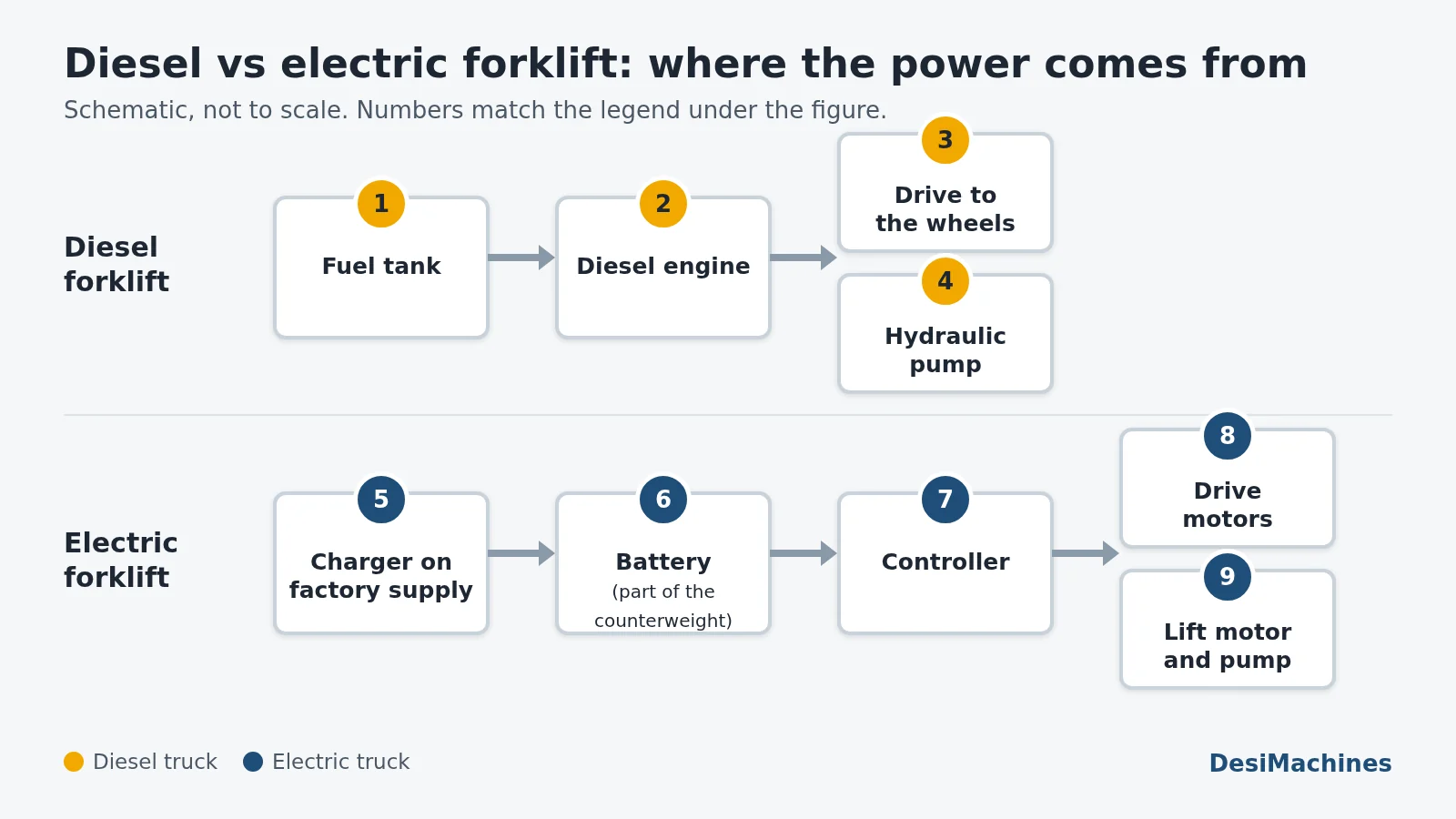
The power source. A diesel forklift carries a fuel tank and an engine that drives the wheels and the hydraulic pump. An electric forklift carries a large battery and electric motors: one or two for the wheels and one for the pump that works the mast.
Everything in front of the driver is much the same: the mast, the forks, the tilt cylinders and the overhead guard. The battery does an extra job too. It is heavy, and on an electric counterbalance truck it sits at the back and works as part of the counterweight, as Wikipedia’s forklift entry notes.
Refuelling takes a few minutes. Charging a lead-acid battery takes hours, which is why charging decides how many shifts an electric truck can cover. How charging, watering and battery changeover work is explained in the electric forklift battery guide.
Diesel vs electric forklift: how do two 3-tonne trucks compare?
On paper they lift the same, but the diesel travels faster and climbs steeper ramps, while the electric is quieter and turns tighter. STILL publishes both trucks on the same kind of data sheet (VDI 2198 layout), which makes this a fair comparison:
| STILL 3-tonne counterbalance truck (maker’s data sheets, read November 2026) | RX 70-30 (diesel) | RX 60-30 (electric) |
|---|---|---|
| Rated capacity at 500 mm load centre | 3,000 kg | 3,000 kg |
| Fuel or energy use, EN 16796 test cycle | 2.8 litres/hour (data sheet); 3.0 litres/hour (October 2025 manual) | 6.5 kWh/hour (standard mode); 6.6 kWh/hour (Plus mode) |
| Power unit | 4-cylinder, 2.4-litre diesel engine, 45 kW | Two drive motors of 8.5 kW (10.5 kW in Plus mode) and a lift motor of 20 kW (25 kW) |
| Energy store | 58-litre fuel tank | 80 V battery, 560 Ah (620 Ah option), weighing 1,558 kg; lithium-ion versions are also offered |
| Weight, ready to work | 4,362 kg | 5,040 kg including battery |
| Travel speed with load | 21 km/h | 18 km/h (20 km/h in sprint mode) |
| Lift speed with load | 0.58 m/s | 0.49 m/s (0.57 m/s in Plus mode) |
| Steepest ramp with load (gradeability) | 28% | 14.6% (20.1% in Plus mode) |
| Turning radius | 2,384 mm | 2,070 mm |
| Aisle width, 1,000 x 1,200 mm pallet crossways | 4,052 mm | 3,742 mm |
| Noise at the driver’s seat | 76 dB(A) | 70 dB(A) |
Three rows matter most. The electric truck is about 680 kg heavier with its battery in place. It needs an aisle about 310 mm narrower, which counts in a packed godown. And it climbs a loaded ramp only half as steep in its standard mode.
STILL’s diesel uses a diesel-electric drive: the engine turns a generator and electric motors drive the wheels. Other makers’ diesel trucks may use a different drive, so speeds and fuel use differ from maker to maker. Use the table to see the pattern, then ask for the same rows on any quote you get.
How much diesel or electricity does a forklift use per hour?
On STILL’s figures, a 2.5 to 3.5 tonne diesel forklift uses roughly 2.5 to 3 litres an hour on the standard test, and an electric one of the same size uses roughly 6 to 7 kWh. The test is EN 16796, the European test method for forklift energy use, which puts every truck through a set cycle of driving and lifting so that figures compare like with like. Makers print the result on the data sheet as litres per hour for diesel and kWh per hour for electric trucks.
| STILL truck size (load centre 500 mm) | Diesel RX 70, litres per hour | Electric RX 60, kWh per hour (standard mode) |
|---|---|---|
| 2.5 tonnes | 2.5 | 6.0 |
| 3.0 tonnes | 2.8 | 6.5 |
| 3.5 tonnes | 3.0 | 7.1 |
The diesel figures are from STILL’s current RX 70 data sheet. Its October 2025 operating manual prints slightly higher figures for an engine set to a higher speed (2.8, 3.0 and 3.2 litres an hour), so ask which engine setting a quote is for. The electric figures match in both of STILL’s documents.
Your own truck will not use exactly these amounts. Heavy loads, long runs, ramps and an engine left idling between jobs all push consumption up. STILL also gives a second electric figure for a truck worked hard: the 3-tonne RX 60 uses 7.3 kWh an hour while moving 222 tonnes of goods an hour.
Is an electric forklift cheaper to run than a diesel one?
Per working hour, usually yes, but you should check it with your own two prices rather than take anyone’s word for it. It takes three steps:
- Multiply your price for one litre of diesel by the diesel truck’s litres per hour (2.8 for the STILL 3-tonne truck).
- Multiply your price for one unit of electricity, from your factory’s power bill, by the electric truck’s kWh per hour (6.5).
- Add a margin to the electric figure for the charger, which loses some power as heat, and ask the maker whether its figure was measured at the battery or at the wall socket.
Using STILL’s figures, the electric truck costs less per hour whenever one unit of electricity costs less than about 0.43 times the price of a litre of diesel. That is 2.8 divided by 6.5. Check your own bills against that ratio.
Energy is only part of the running cost. The other differences that show up over the years:
- The battery. A lead-acid battery wears out after a set number of charge cycles and then has to be replaced. A lithium battery lasts more cycles and needs no watering, but costs more at the start. The trade-off is set out in the guide to electric forklifts.
- The charger and a charging area: a proper supply point, ventilation for lead-acid batteries, and space for a spare battery if you run more than one shift.
- Engine upkeep on the diesel: engine oil, filters, coolant and exhaust checks that an electric truck simply does not have.
- Tyres, forks, chains and brakes, which wear the same way on both. Tyre wear limits are covered in the blog on forklift solid tyre replacement.
If you are working out whether a forklift pays for itself when hired out, the rental economics are covered in the blog on running a forklift business in India.
How long does each run before refuelling or charging?
A full diesel tank lasts far longer than a full battery. On STILL’s test figures, the 58-litre tank of the 3-tonne diesel covers roughly 19 to 21 hours of work (58 divided by 2.8 or 3.0 litres an hour).
The electric truck’s battery holds 80 volts x 560 amp-hours, about 45 kWh. STILL’s manual warns that, on a lead-acid battery, deep discharge, which shortens battery life, starts at about 20% of that nominal capacity. That leaves about 36 kWh to use, or roughly 5 to 5½ hours of steady work at 6.5 to 7.3 kWh an hour. That is our arithmetic from STILL’s figures, not a maker’s claim.
Real shifts are not steady work. Trucks wait for lorries, for paperwork and for the next pallet, so one charge often stretches across a single shift with breaks. Two or three back-to-back shifts are a different matter. You will need a spare battery to swap, charging during breaks, or a lithium battery built for it. Godrej says the lithium-ion batteries on select models of its Indian range allow opportunity charging (topping up in breaks) without harming battery life.
Which is better on ramps, rough yards and loading bays?
Diesel, on the makers’ own figures. STILL rates its 3-tonne diesel for a 28% loaded ramp against 14.6% for the electric in standard mode, or 20.1% in its stronger Plus mode. Godrej’s own claim for its UNO electric is 18%.
Two cautions come with these numbers. STILL’s manual says gradeability values are for comparing trucks and “in no way represent the normal daily operating conditions”, so no driver should run a loaded forklift up a ramp that steep. And the electric truck is heavier, so check that dock plates, mezzanine floors and old shed floors can carry it with a load on the forks.
Neither truck suits broken ground. Both STILL trucks run on small solid (superelastic) tyres, 23 x 9-10 or 23 x 10-12 at the front, made for concrete and paving. For a muddy site, a brick kiln yard or an unpaved stockyard, the usual machine is a telehandler: a rough-terrain lifter with large tyres, four-wheel drive and a telescopic boom. The JCB 530-70 lifts 3,000 kg to 7 m, and the Manitou MXT 840 K IND lifts 4,000 kg to 7.6 m. Both are diesel, 4WD machines.
Compare telehandler models and prices if your yard is rough or your loads must go up onto a slab.
Which is better indoors, in food stores and near homes?
Electric. A diesel engine gives off exhaust fumes, including carbon monoxide, and they build up in a closed shed. Wikipedia’s forklift entry notes that battery trucks are recommended indoors, for example in food processing and healthcare, because they give off no fumes.
Noise points the same way. STILL measures 76 dB(A) at the diesel truck’s seat and 70 dB(A) on the electric one, a difference a driver notices across a full shift. That matters for night loading near houses, and inside cold stores, pharma godowns and textile units.
An LPG forklift sits in between. It still has an engine and exhaust, but it is cleaner and quieter than diesel and suits a ventilated shed with in-and-out work. The forklift types guide compares all three fuels side by side.
Do diesel and electric forklifts need different maintenance?
The service intervals can be the same, but the work done differs. STILL’s manuals set the standard maintenance for both trucks at every 1,000 hours or once a year, with a second interval at 3,000 hours.
The daily check before use shows the difference. On both trucks the driver checks the forks, chains, mast, hoses, tyres, brakes and the floor under the truck for leaks. The diesel adds the engine oil and coolant levels. The electric adds the battery: the charge level on the display, the battery door and its lock, and, on lead-acid batteries, regular acid-level checks topped up with distilled water only. STILL’s fleet settings also show the split: exhaust gas testing for engine trucks, battery testing for electric ones.
STILL also lists conditions that call for shorter service intervals. Most are everyday Indian conditions: poor or dirty roads, dusty or salty air, high humidity, very high temperatures and multi-shift work. If your forklift works in a cement godown, near the coast or through a north Indian summer, ask the dealer for a service plan built for that. It applies to diesel and electric trucks alike. The full forklift maintenance checklist lists every daily check and the wear limits for forks and lift chains.
Which forklift should you choose?
Start with where the truck will spend its day, then check the shift pattern and the load:
| Your work | Leans diesel | Leans electric |
|---|---|---|
| Where it works | Open yards, loading docks with ramps, outdoors in rain and dust | Closed sheds, warehouses, cold stores, food and pharma units |
| Shifts | Two or three back-to-back shifts with no time to charge | One shift, or shifts with regular breaks for charging |
| Load size | Above 5 tonnes (steel, stone, heavy crates) | Up to 3 tonnes, the range most godowns use |
| Floor | Rough concrete, slopes, uneven paving | Smooth, level, strong floors |
| Power supply | Weak or unreliable factory supply | A steady supply with room for a charger |
| Neighbours and staff | Noise and fumes do not reach anyone | Night work near homes, or staff working close by indoors |
The load row comes from what is on sale. Godrej’s Indian range offers electric counterbalance forklifts from 1.4 tonnes up to 5 tonnes, but diesel ones from 1.5 up to 12 tonnes. Above 5 tonnes, the choice is mostly made for you. How load centre and lift height cut a forklift’s real capacity is explained in the guide to forklift capacity.
For moving pallets only at ground level, a small battery pallet truck may be enough; see the guide to electric pallet trucks and stackers. For the same question across excavators, loaders and other machines, read electric vs diesel construction machines.
What should you ask the dealer before you decide?
Get these answers in writing, for both trucks if you are comparing:
- The EN 16796 (or VDI 2198) fuel or energy figure from the data sheet, and the engine setting or battery it applies to.
- For an electric truck: battery type, voltage and amp-hours, charging time, the charger’s supply needs, and how many hours of your work one charge will cover.
- The loaded gradeability, if your yard has any ramp.
- The weight with battery and with the heaviest load, for your floor and dock plates.
- The service interval, what each service covers, and which service centre is nearest to you.
- Battery warranty in years or cycles, and what a replacement battery would cost.
- How the truck copes with dust, heat and humidity, and whether the cooling is rated for your summer.
Material handling machines, tenders and news are gathered on the material handling equipment page, and the rest of this series sits in the forklift guide. For lifting on rough ground or onto a slab, browse telehandlers and connect with a verified dealer.
Sources: STILL RX 70-20/35 and RX 60-25/35 technical data sheets in VDI 2198 layout, and the RX 70 diesel and RX 60 operating manuals (both October 2025), read November 2026; Godrej Enterprises’ forklift range and UNO electric forklift pages, read November 2026; Wikipedia’s forklift entry. Running hours per tank and per charge, and the cost ratio, are our own arithmetic from STILL’s figures. Telehandler figures are from their DesiMachines product listings.
Prices, specifications and features are indicative, vary by variant, location and date, and should always be confirmed with the official OEM or authorised dealer before any purchase decision. DesiMachines is not liable for decisions taken on the basis of information that may have changed after publication.