Excavator
294 models
 Backhoe Loader
51 models
 Crane
68 models
 Concrete Mixer
79 models
 Wheel Loader
54 models
 Compactor / Roller
45 models
 Motor Grader
42 models

 Concrete Pump
66 models
 Skid Steer Loader
11 models


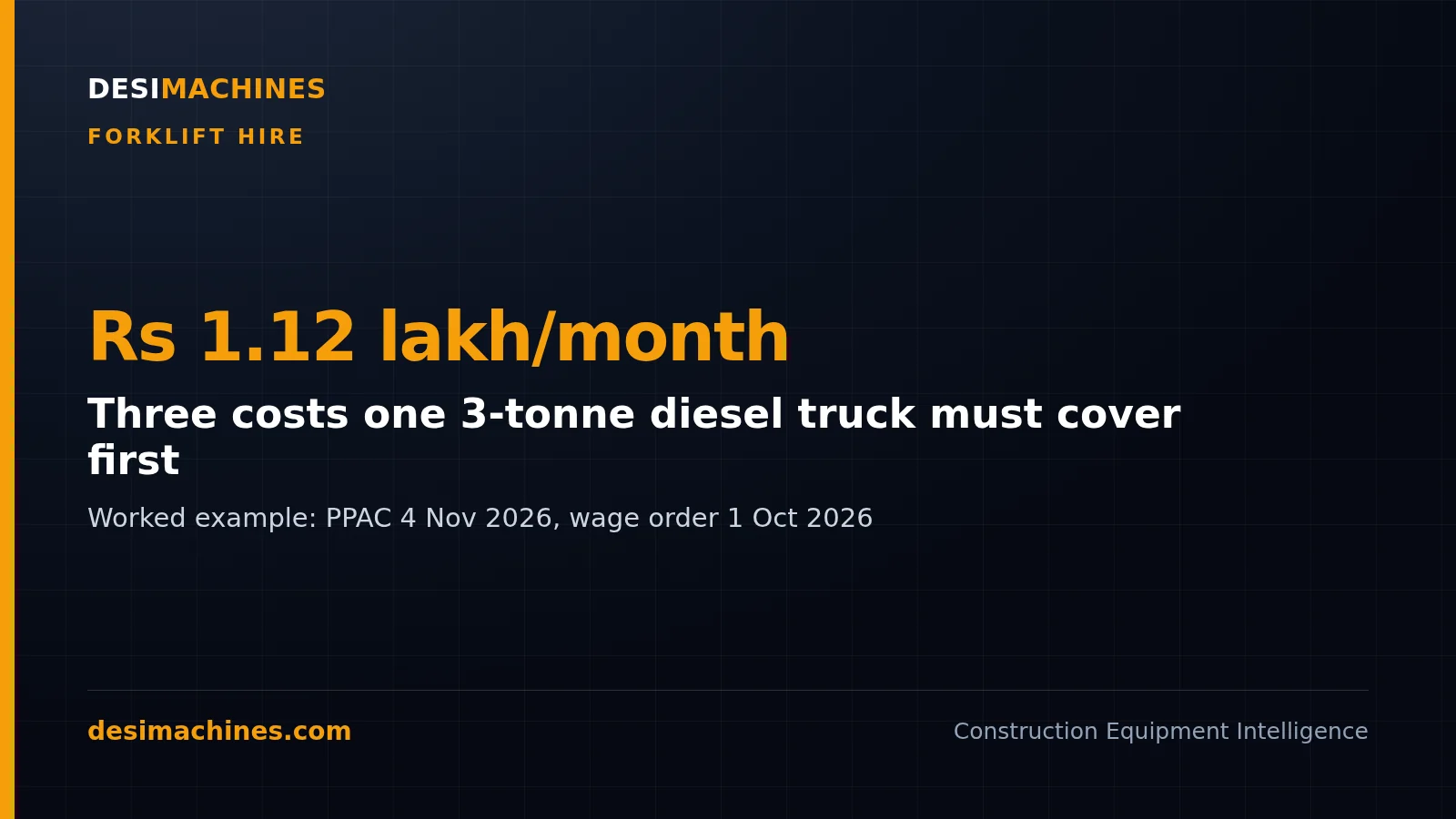
A forklift business in India earns on monthly hire contracts: a warehouse, factory, port or public sector plant takes a 3-tonne truck with its operator for one lump sum that usually covers the operator, diesel and upkeep, and works out extra days and overtime from that monthly figure. In the worked example below, three costs alone come to about Rs 1.12 lakh a month for one diesel truck on a single shift: the operator at the central skilled minimum of Rs 1,024 a day from 1 October 2026, diesel at Rs 95.20 a litre in Delhi on 4 November 2026, and the EMI on an assumed Rs 10 lakh loan. Maintenance, insurance and your margin come on top, so a contract has to clear roughly Rs 4,300 per billed day even when the truck works all 26 days.
A container backs into a warehouse dock at nine in the morning, and the forklift that empties it does not belong to the warehouse. It is on hire from a local firm that supplies the truck, the driver and the diesel for one monthly sum. That monthly contract is how a forklift business makes its money, and the arithmetic is tighter than most first-time buyers expect. The general steps of setting up a hire firm are in our guide on how to start an equipment rental business.
Who hires forklifts in India?
The steady customers are the ones whose goods move every day. Warehouses and third-party logistics operators hire for loading bays and stacking. Factories hire when their own fleet is short, or when they would rather not employ operators. Ports, shipyards, inland container depots and railway goods sheds need trucks on the dock floor. Public sector plants put the work out to tender, which makes their terms public.
Two of those tenders show the pattern. Cochin Shipyard’s Kolkata Ship Repair Unit invited bids in July 2025 for a 3-tonne forklift with operator on a monthly basis, plus a 5-tonne truck as and when needed. BHEL’s fabrication plant at Rudrapur tendered in 2017 for one 3-tonne diesel truck with operator, running two shifts.
Construction sites and exhibition halls hire too, but in short bursts that fill gaps between contracts. They do not pay the EMI on their own.
You will also compete with the makers. Godrej’s material handling business lists more than 1,600 machines on its rental fleet, and ACE runs a rentals arm alongside its forklift range. A local firm wins on response time, a standby truck and an owner who answers the phone.
How a forklift hire contract is priced
Nobody publishes a standard forklift hire rate, and most quotes are private. Public tenders do publish the structure, and that is what you should copy when you write your own rate card.
| Term | Cochin Shipyard, Kolkata (tender of 15 Jul 2025) | BHEL Rudrapur (tender of 3 Feb 2017) |
|---|---|---|
| Machine | 3-tonne monthly; 5-tonne when needed | One 3-tonne diesel truck |
| Working day | 9:00 to 18:00 with a one-hour lunch break | 16 hours a day, 26 days a month, two shifts |
| Who pays for diesel | Hire firm (in the monthly rate) | BHEL supplies diesel |
| Extra days and overtime | Day = monthly rate / 26; hour = monthly rate / (26 x 9) | Hourly deduction for breakdown time |
| Breakdown | Replacement at once, at the hire firm’s cost | Restore within 2 hours, then Rs 200 an hour penalty |
| Security | 10% held from each bill, up to Rs 50,000 | 5% of contract value |
| Payment | About 30 days from a certified bill | Within 45 days of the bill |
The Cochin Shipyard tender also says the quoted rate must include fuel, oil, spares, maintenance, the operator’s salary and statutory payments, with GST shown separately. It asks for a valid load test certificate, three years of experience supplying forklifts and a local office. BHEL’s notice put its own estimate at Rs 1,49,500 for two months of two-shift work, inclusive of taxes, with diesel supplied by the plant. That figure is nine years old: read it as a picture of how such contracts were set up, not a rate to quote today.
Two things follow. First, a monthly contract is a promise of availability: if your truck breaks down, you owe a replacement, so a one-truck firm carries real risk. Second, whether you are on wet hire (diesel in your rate) or dry hire (the client supplies diesel) changes your cost more than anything else, as the worked month shows.
What to buy for a forklift rental business
Start with the 3-tonne counterbalance class. It is what both tenders above ask for, and it covers pallets, drums and most container unloading. ACE lists diesel trucks from 1.5 to 35 tonnes, electric from 1.5 to 8 tonnes and LPG from 2 to 5 tonnes; Godrej’s UNO diesel range runs from 1.5 to 3.0 tonnes. A larger truck earns more per day but finds fewer takers.
The fuel choice follows the customer. Diesel suits yards, docks and outdoor aprons. Electric suits closed warehouses and plants where exhaust is not allowed, and it costs far less to run, but the battery shapes the working day; that trade-off is set out in our guide to electric forklifts. LPG sits between the two. For mast heights, tyres and the other specifications, use the guide to types of forklift and how to choose.
Building sites are the trap. A forklift’s small wheels and low clearance stop it on mud and loose ground. If your district’s demand is on unfinished sites, a telehandler such as the ACE AT 30 or the JCB 530-70 is the machine that customer actually needs.
Forklift business in India: a worked month for one 3-tonne diesel truck
This is a worked example, not a market rate. It takes three costs that can be pinned to official or maker figures, and states every assumption. Change any line to match your own quote.
| Cost head | Basis | Per month |
|---|---|---|
| EMI | Assumed loan of Rs 10 lakh at 11% a year over 48 months (an assumption for the arithmetic, not a forklift price) | Rs 25,846 |
| Operator | Central skilled minimum, Area A, Rs 1,024 a day from 1 Oct 2026, for 26 days | Rs 26,624 |
| Diesel | 3.0 litres an hour x 8 hours x 26 days = 624 litres at Rs 95.20 (Delhi, 4 Nov 2026) | Rs 59,405 |
| Three heads together | Before maintenance, tyres, insurance, transport, GST and margin | Rs 1,11,875 |
Where the figures come from: the operator rate is from the Labour Bureau order of 30 September 2026, and the central construction schedule of January 2017 lists a fork-lift operator among skilled workers. Area B cities pay Rs 933 a day and Area C Rs 794. Central rates bind where the Central Government is the appropriate government, such as major ports, railways and central public sector plants; a private warehouse follows its state’s order. The diesel price is from the Petroleum Planning and Analysis Cell, which showed Rs 97.83 in Mumbai and Rs 99.82 in Kolkata on the same day. The burn rate is from Linde’s type sheet for its European H30 D, rated at 3.0 litres an hour on the EN 16796 test cycle. Log your own truck’s figure in the first month.
Look at the diesel line. It is more than the EMI and the operator put together. Each litre an hour of burn adds about Rs 19,800 a month over 208 engine hours, which is why so many contracts make the client supply fuel. On dry hire that line leaves your costs, and your rate falls with it.
The 11% rate is an assumption, chosen inside the band public sector banks quote for machine loans. Compare lenders and tenures under equipment finance before you settle on your own figure, because a shorter loan raises the EMI sharply: the same Rs 10 lakh over 36 months costs about Rs 32,700 a month.
What utilisation does to the break-even
The EMI and a salaried operator are fixed. Diesel moves with the days the truck works, at about Rs 2,285 a billed day in this example. Spread over fewer billed days, the fixed part grows fast:
| Billed days in the month | Fixed cost per billed day | Plus diesel | Break-even per billed day |
|---|---|---|---|
| 26 (full month) | Rs 2,018 | Rs 2,285 | Rs 4,303 |
| 20 | Rs 2,624 | Rs 2,285 | Rs 4,909 |
| 15 | Rs 3,498 | Rs 2,285 | Rs 5,783 |
| 10 | Rs 5,247 | Rs 2,285 | Rs 7,532 |
A truck on a monthly contract sits in the top row. A truck living on daily hires sits near the bottom, and needs a much higher day rate just to stand still. This is why the monthly contract matters more than the machine. How to measure and raise billed days is covered in our piece on equipment utilisation rate.
What the worked month leaves out
The rest depends on your own quotes. Add these before you price a contract.
- Servicing, filters, hydraulic oil and forks, from your dealer’s service plan.
- Tyres, which wear fast on rough dock floors and decide a lot of the yearly upkeep.
- Insurance for a machine working on someone else’s premises, and the yearly load test certificate customers ask for.
- Transport to the site and back, since a forklift is not built to drive on the road between jobs.
- A relief operator for leave days, and a second operator if the customer wants two shifts.
- Your employer’s statutory contributions on the operator’s wages.
- The cost of waiting 30 to 45 days for payment while the EMI falls due every month.
Licensing is the other check. BHEL’s tender asked for an operator holding a heavy motor vehicle licence, and what a machine operator needs is covered in our guide to operator licences in India.
Is a forklift rental business worth starting?
It works where there is a cluster of warehouses, factories or a port within easy reach, and where you can win one monthly contract before the truck arrives. With that contract signed, the numbers above become predictable, and the second truck can serve as your standby and your next contract.
It struggles on daily hire alone. The break-even per day climbs, one breakdown can cost you a customer, and the makers’ rental fleets chase the same monthly work. Sign the anchor customer first, then buy.
When you have that first contract in hand, size the loan against it through equipment finance before you sign for the truck.
Wage rates, diesel prices, loan terms and tender conditions change — confirm current figures with your state labour department, lender, dealer and insurer before you buy a forklift or quote a hire rate.