
 Excavator
316 models
 Backhoe Loader
54 models
 Crane
68 models
 Concrete Mixer
79 models
 Wheel Loader
54 models
 Compactor / Roller
45 models
 Motor Grader
42 models

 Concrete Pump
66 models
 Skid Steer Loader
11 models


If your haul road is hard, well kept and climbs gently, a rigid dump truck will move your tonnes more cheaply. If the road is soft, wet, steep or changes every week, an articulated dump truck is the one that keeps moving, and the difference between them is mostly about the ground, not the load.
The two can carry exactly the same weight. Volvo CE sells both kinds in India and rates its A60 articulated hauler and its R60 rigid hauler at the same 55,000 kg (55 tonnes) payload. What changes is how that load is driven, steered and held on a slope. This guide compares them on the questions a quarry owner, mine contractor or earthworks firm actually has to answer: road, gradient, ground, the mine rules, the cost drivers per tonne and the machine that loads them. All figures come from the makers’ published sheets, the Coal Mines Regulations 2017 and Caterpillar’s haul road design notes. No prices are quoted.
What is the difference between a rigid and an articulated dump truck?
A rigid dump truck has one stiff frame. The front wheels steer, the rear axle drives, and the body sits on the back of the same frame. An articulated dump truck, often called an ADT or articulated hauler, is built in two halves: a front tractor with the engine and cab, and a rear section with the body, joined by a hinge. The truck steers by bending at that hinge, so the rear wheels follow the same track as the front ones.
That one design choice sets everything else. The rigid truck is built for speed and big payloads on a prepared road. The articulated truck is built to keep all its wheels on the ground and pulling when the ground is bad.
The fairest way to see it is two trucks that carry the same load, from the same maker:
| What it is | Volvo A60 (articulated) | Volvo R60 (rigid) |
|---|---|---|
| Payload | 55,000 kg | 55,000 kg |
| Body volume, heaped 2:1 | 33.6 m³ | 36 m³ |
| Engine gross power | 495 kW | 567 kW |
| Top speed | 57 km/h | 60.6 km/h |
| Driven wheels | 6×6 (front axle and both rear bogie axles; automatic switch between 6×4 and 6×6) | Rear axle only |
| Steering | Bends at the hinge, ±45° | Front wheels, SAE turning radius 20.4 m |
| Tyres | Six, 33.25R29 | Six, 24.00-35 |
| Service brakes | Wet, oil-cooled discs on all wheels, plus engine brake | Dry caliper at front, oil-cooled discs at rear, plus transmission retarder |
| Weight on rear wheels, loaded | 69,850 of 98,650 kg (71%) | 68% of gross weight |
Look at the last three rows together. On paper the rigid truck has more power and a slightly higher top speed. The articulated truck answers with drive on every axle and brakes that live in oil at every wheel, which is what matters on a slippery downhill.
Which one carries more, and where do the sizes overlap?
Articulated trucks stop where rigid trucks begin. Volvo CE India lists six articulated haulers, from the A25 at 25,000 kg payload to the A60 at 55,000 kg, and three rigid haulers, from the R60 at 55,000 kg to the R100 at 95,000 kg. Komatsu India’s dump truck page lists rigid trucks only, from the HD465-7E0 rated at 55 tonnes up to the 830E-5 at 227 tonnes. Wikipedia’s article on the articulated hauler says most makers offer articulated trucks of 40 to 60 tons.
| Maker and type | Smallest listed | Largest listed |
|---|---|---|
| Volvo CE, articulated | A25: 25,000 kg | A60: 55,000 kg |
| Volvo CE, rigid | R60: 55,000 kg | R100: 95,000 kg |
| Komatsu India, rigid | HD465-7E0: 55 t | 830E-5: 227 t |
So the real choice between the two only exists at about 40 to 60 tonnes. Below that, a mine or site picks between an articulated truck and a road-going mining tipper, the 10 or 12-wheeler explained in the guide to types of tipper truck and dumper. Above 60 tonnes no articulated truck is listed in India, and the question becomes which rigid size, which the list of the biggest dump trucks in India covers.
Why does an articulated dump truck grip better on soft or wet ground?
A truck can only push with the wheels that are driven, and only with the weight that sits on them. Traction (grip) is weight on the driven wheels multiplied by how well the tyre holds the surface. That is where the two designs part ways.
The R60 drives only its rear axle. Its brochure gives the weight split as 52% on the rear axle when empty and 68% when loaded. So an empty rigid truck climbing out of a wet pit is pushing with only about half its weight. The A60 drives all three axles once its automatic traction control engages the front axle, and it carries 100% diff locks on every axle. With all six wheels driving, every kilogram of the truck is pushing.
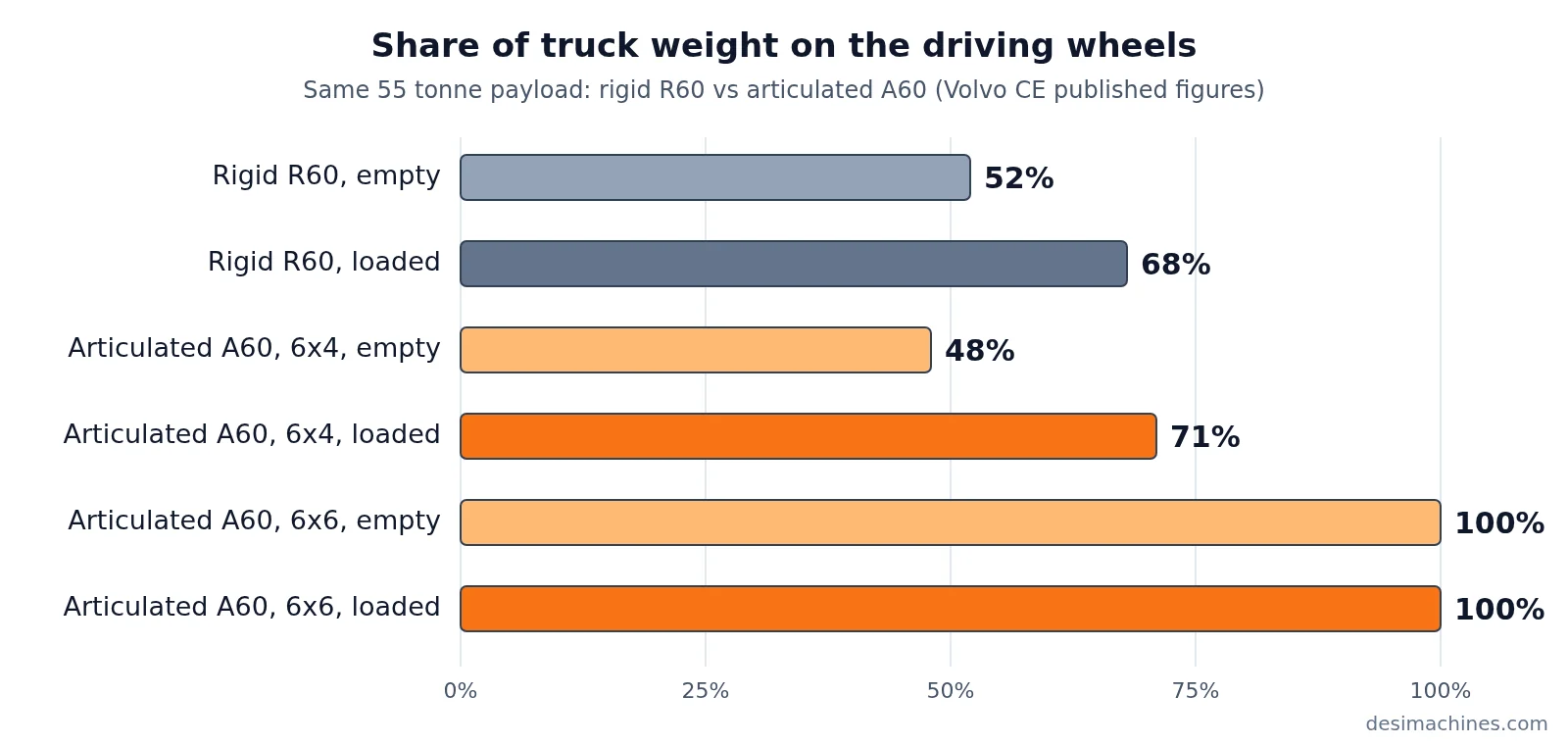
What Figure 1 shows, bar by bar:
- Rigid R60, empty: 52% of the weight on the driving axle. This is the moment rigid trucks get stuck, coming back empty down a wet ramp or turning on a soft floor.
- Rigid R60, loaded: 68%. The load sits over the rear axle, so a full rigid truck grips better than an empty one.
- Articulated A60 in 6×4: 48% empty and 71% loaded, close to the rigid truck, because only the bogie axles drive.
- Articulated A60 in 6×6: 100% empty and loaded. This is the mode it switches into when wheels start to slip.
The second half of the answer is ground pressure, the weight each tyre presses into the ground. Volvo publishes it for its articulated trucks. A loaded A40 on standard 29.5R25 tyres presses 174 kPa at the rear; on the wider 875/65R29 tyres the same truck presses 145 kPa. Lower pressure means the tyre sinks less into soft soil, and a tyre that sinks less has less mud to climb out of. The bogie at the rear also lets each wheel rise and fall on its own, so all the tyres stay on uneven ground instead of one lifting into the air.
How does the haul road decide the choice?
Every truck spends power fighting two things: the slope it is climbing and the road’s rolling resistance. Rolling resistance is the drag of a tyre pressing into and flexing the road, written as a percentage of the truck’s weight. Add it to the slope and you get total resistance, the figure that decides how fast a loaded truck can climb.
Caterpillar’s haul road design notes give these minimum values for off-highway trucks on radial tyres:
| Road condition | Rolling resistance |
|---|---|
| Hard, well-maintained permanent haul road | 1.5% |
| Well-maintained road with little flexing | 3% |
| Tyres sink 25 mm into the road | 4% |
| Tyres sink 50 mm | 5% |
| Tyres sink 100 mm | 8% |
| Tyres sink 200 mm | 14% |
A worked example shows why this matters. A loaded 55 tonne rigid truck weighs about 99 tonnes. On an 8% ramp with a good 2% surface, total resistance is 10%, so the truck must push with about 9.9 tonnes of force. Let the same ramp turn soft in the monsoon until the tyres sink 100 mm, and resistance becomes 8 + 8 = 16%, about 15.9 tonnes of force. Same engine, same load, 60% more push needed, so the truck drops gears and crawls.
The same notes say that, in practice, a 5% rise in rolling resistance can cut production by up to 10% and raise production cost by 35%. A rigid truck is efficient only while the road stays good. An articulated truck is built for the days it does not.
Which leads to the plain rule. If the mine will build and maintain a proper haul road (graded, drained, with a hard wearing course), the rigid truck repays that road. If the road is temporary, moves every few weeks, or turns to mud for four months a year, an articulated truck saves the cost of fighting it. How a mine lays out its benches and ramps is covered in the guide to bench height and haul roads.
How steep a ramp can each truck work on?
Caterpillar’s haul road notes advise limiting haul road grades to 8 to 10% with 2% rolling resistance for large mining trucks, and to keep rolling resistance as low as possible. That is a design target for steady, loaded climbing, not a legal limit.
Articulated trucks are built with steeper and rougher ground in mind. The A60’s parking brake is designed to hold a loaded truck on a grade of up to 18%, and its brakes are wet discs on every wheel, with downhill speed control and an engine brake to hold speed without riding the service brakes. The R60 relies on a transmission retarder and oil-cooled rear brakes for long downhill runs, with dry calipers at the front.
Going down loaded is where accidents happen, so ask the maker or dealer for the truck’s retarder chart before you choose. It shows the safe speed for each gradient at full load. The electric drive trucks used in large Indian mines brake in a different way again, explained in the guide to electric drive dump trucks and trolley assist.
What do Indian mine rules ask of the road and the bench?
In a coal mine the Coal Mines Regulations, 2017 apply. Regulation 101 says the design, construction, size and layout of haul roads and ramps, and the walls or berms along their edges, must follow the standards the Chief Inspector of Mines sets by general order. So the exact road width and gradient come from DGMS orders and the mine’s own permission, not from the truck maker. The width yardsticks DGMS has published for one-way and two-way haul roads are compared in the guide to bench height and haul roads.
Regulation 106(5) is more direct about benches in rock and coal. A bench must be at least as wide as the widest machine working on it plus two metres, or, if dumpers run on it, three times the width of the dumper, or the bench height, whichever is the most. Truck width therefore drives bench width. The R60’s body is 4,496 mm wide, so three times that is about 13.5 m; measured over its mirrors the truck is 5,921 mm wide, which would need nearly 18 m. The mine’s plan decides which width is counted, but either way a bigger, wider truck needs a wider bench, and wider benches mean more waste rock moved.
Regulation 63 also lays down duties for every truck, tipper and dumper operator, starting with a check of the machine at the beginning of each shift. Both kinds of truck fall under it.
Which costs less per tonne?
There is no single answer, because cost per tonne is set by the site. What you can do is see which way each driver pushes. No rupee figures are given here, because fuel, tyre and finance costs change by month and by state.
| Cost driver | Favours rigid when | Favours articulated when |
|---|---|---|
| Payload per trip | You need more than 55 to 60 tonnes a trip | 40 to 55 tonnes is enough |
| Road quality | Road is hard, graded and maintained every day | Road is temporary, soft or changes every few weeks |
| Haul length | Long, steady hauls where top speed counts | Short hauls with tight turns and rough sections |
| Weather | Dry working season, or roads that drain well | Long wet season with slippery ramps |
| Drivetrain parts | One driven axle, fewer driveline parts | Three driven axles, a hitch and a dropbox to maintain |
| Bench width | Mine already has wide benches and roads | Narrow site where a smaller truck saves bench width |
The quickest test on your own site is the one Caterpillar’s numbers point to: estimate the rolling resistance of your worst month, not your best. If the road is going to sit at 5% or more for long stretches of the year, the rigid truck’s advantage on a good road will not show up in your tonnes. For the business side of owning haul trucks on contract, the comparison of tipper, dumper and backhoe earnings is a useful next read.
Which one should a quarry, mine or earthworks job choose?
Match the truck to the ground first and the tonnage second.
| Site | Ground and road | Usual pick |
|---|---|---|
| Large opencast coal or iron ore mine | Permanent, maintained haul roads; very high tonnage | Rigid, 55 tonnes and up |
| Stone quarry with a fixed ramp to the crusher | Hard rock floor, short fixed road | Rigid, if the ramp is kept graded |
| Dam, canal or river works | Wet clay, soft fill, steep temporary ramps | Articulated |
| Highway cut and fill, large earthworks | Haul route moves as the work moves | Articulated |
| Small mine or contractor fleet with on-road trips | Must also use public roads | Mining tipper (road-registered) |
Before signing, ask four questions. What will the haul road be like in the worst month? How steep is the steepest loaded ramp, and is it uphill or downhill when full? How wide are the benches and roads today? And which loader or excavator will fill the truck, and in how many passes?
What loads a rigid or an articulated dump truck?
The truck must suit the machine that fills it. Volvo’s R60 brochure names a 90 tonne excavator as its match. In that class sits the Volvo EC950E, listed at 89,960 to 91,840 kg operating weight with a 3.9 to 6 m³ bucket, and the Komatsu PC1250-8R, at 106,500 to 110,700 kg with a 3.4 to 6.7 m³ bucket. A 40 to 55 tonne truck can also be filled by a lighter machine such as the Volvo EC750D (72,700 to 74,700 kg, 3.3 to 5.16 m³ bucket). On a soft site, a large wheel loader like the Volvo L350H (50,000 to 56,300 kg, 6.2 to 12.7 m³ bucket) can load articulated trucks and move around the site with them.
How many bucket passes fill one truck, and how many trucks one excavator can keep busy, is worked out step by step in the guide to the shovel dumper combination. To see every machine in this weight class, browse the mining excavators over 50 tonnes.
For a road-going truck rather than an off-highway one, the guide to tipper capacity explains how much a 6, 10 or 12-wheeler may legally carry. The full set of tipper and dumper guides sits in the tipper and dumper guide hub.
Sources
Payload, body volume, engine power, top speed, drive layout, steering, tyres, brakes, weight split, ground pressure, turning radius and body width are from Volvo CE India’s dump truck pages (Volvo CE India dump trucks) and the A40 product guide (January 2025), A60 product guide (July 2025) and R60 brochure (October 2024) linked from them. Komatsu’s rigid truck range is from Komatsu India’s mining dump truck page. The articulated size range is from Wikipedia’s article on the articulated hauler. Rolling resistance values, the grade guidance and the production and cost effect of rolling resistance are from Caterpillar’s Haul Road Design and Management presentation (Pete Holman, Big Iron University, 2006). Haul road, bench width and operator rules are from the Coal Mines Regulations, 2017, regulations 63, 101 and 106 (Coal Mines Regulations, 2017, DGMS). Excavator and wheel loader figures are from each machine’s listed specifications. All were read on 14 November 2026.
Prices, specifications and features are indicative, vary by variant, location and date, and should always be confirmed with the official OEM or authorised dealer before any purchase decision. DesiMachines is not liable for decisions taken on the basis of information that may have changed after publication.