Excavator
316 models
 Backhoe Loader
54 models
 Crane
68 models
 Concrete Mixer
79 models
 Wheel Loader
65 models
 Compactor / Roller
45 models
 Motor Grader
42 models

 Concrete Pump
66 models
 Skid Steer Loader
11 models


The blow bars on an impact crusher’s rotor hit falling stone at 30 to 80 metres a second, and that first hit does about 60% of the breaking. The stone is then thrown against steel aprons, called breaker plates, which do about 30% more, and it can only leave the crusher once it is small enough to pass the gap between the blow bars and the lowest apron.
Those figures come from Metso’s guide to its Nordberg NP impact crushers (2012), and together they are the impact crusher working principle: hit the stone hard, throw it at steel, and let the gap decide the size. A jaw crusher or a cone crusher works the other way. It squeezes stone slowly between two steel surfaces, at 0.5 to 1.5 metres a second by the same guide.
This guide is for a quarry owner or plant operator deciding whether an impactor suits their stone. It explains how a horizontal shaft impact crusher (HSI) works, its parts, how the apron gap and rotor speed change the product, the sizes Indian makers sell, which stone it suits and which it does not, and what to check before you buy. Where it sits in a whole plant is in the guide to the crushing and screening plant. No prices are quoted here.
What is an impact crusher?
An impact crusher is a crusher that breaks stone by striking it at speed instead of squeezing it. Metso describes it as a machine that speeds the feed up and flings it against the walls of the crushing chamber and against other stone, and the collision breaks it.
There are two kinds. The horizontal shaft impactor (HSI) has its rotor on a flat shaft and hits the stone with bars fixed to the rotor. The vertical shaft impactor (VSI) has an upright shaft and throws stone outwards against a bed of stone or a ring of steel anvils; it is the machine that shapes chips and makes sand, and it has its own guide to the VSI crusher.
This guide is about the HSI. Wherever the text below says impact crusher or impactor, it means the horizontal shaft kind.
The HSI does a lot of size reduction in one pass. Wikipedia’s crusher selection table gives it a reduction ratio of 10:1 to 25:1, against 3:1 to 5:1 for a jaw crusher. The ratio is feed size divided by product size. So, as our own arithmetic, a 500 mm stone could come out at 20 to 50 mm from one impactor, where a jaw crusher would leave it at 100 to 170 mm.
How does an impact crusher work?
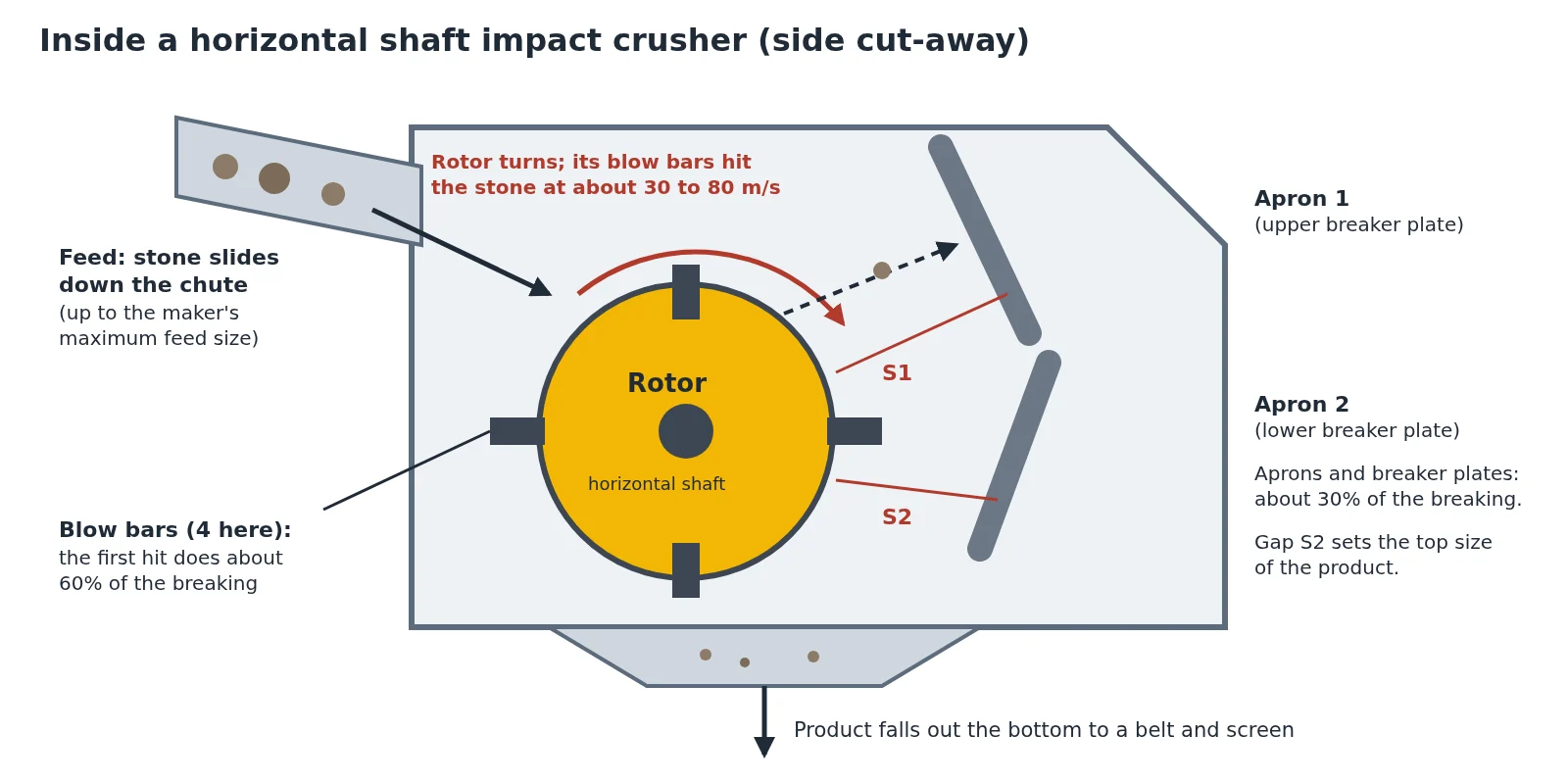
Follow one stone through the machine. There are five steps.
- Stone slides down the feed chute into the crushing chamber. On a primary impactor it comes straight from the blast; on a secondary one it comes from a jaw crusher.
- The rotor, a heavy steel drum on a horizontal shaft, is turned by an electric motor through belts. Propel, the Coimbatore crusher maker, runs the rotor of its AVHI 250 at 550 to 620 rpm (revolutions per minute).
- Bars bolted along the rotor, called blow bars, strike the falling stone. Metso says this first hit does about 60% of the size reduction.
- The hit throws the stone against the first apron, a heavy steel plate hung above the rotor. It bounces back into the path of the bars and is hit again, then thrown at the second apron. Metso puts the share done on the aprons at about 30%. Stone striking other stone in the air does the rest.
- Stone keeps being hit until it is small enough to pass the gap between the blow bar tips and the lower apron. Then it drops out of the bottom onto a belt that takes it to a screen.
Metso adds a point that matters on site. New blow bars have flat faces and sharp edges, so they hit hard and burst the stone into many pieces. Worn, rounded bars only scuff the stone, so it breaks less. In plain terms, the product gets coarser as the bars wear, which is one reason a plant’s grading drifts between blow bar changes.
Some impactors add a third crushing zone under the rotor, called a grinding path. Propel lists two aprons and a grinding path on the AVHI 250, each with its own gap.
What are the parts of an impact crusher?
Metso lists the main components as the rotor, rotor shaft, frames, blow bars and breaker plates. Table 1 adds the parts an Indian buyer will see named on maker sheets.
| Part | What it does | From maker sheets (read November 2026) |
|---|---|---|
| Feed opening and chute | Where stone enters; its size limits the biggest stone the crusher takes | Propel AVHI 250: opening 1,400 x 600 mm, largest feed 350 mm |
| Rotor and shaft | Heavy drum spun by the motor; carries the blow bars | Puzzolana names its PHSI models by rotor size: the PHSI 12/12 has a 1,200 mm rotor |
| Blow bars | Bars fixed along the rotor that strike the stone | Metso: blow bars take 60 to 70% of the wear cost and can be turned round once |
| Aprons (breaker plates) and their liners | Steel plates the stone is thrown against; their gap to the rotor sets the product size | Usually two; Metso’s NP1110 and NP1213 have only one |
| Grinding path | Extra curved plate under the rotor on some designs, for a finer product | Propel AVHI 250 lists a grinding path with its own gap |
| Side liners | Protect the frame walls from flying stone | Metso: 400 or 520 HB hardness, 20 or 30 mm thick |
| Housing and gap adjustment | The frame opens for service; the aprons are moved by hydraulics or by hand | Propel: hydraulic gap setting; Puzzolana PTI 1313: mechanical setting |
| Drive | Electric motor and belts, or a diesel engine on a tracked unit | Propel AVHI 250: 220 kW motor; Puzzolana PTI 1313: 450 HP diesel |
HB is the Brinell hardness scale; a higher number is a harder steel. What blow bars and liners are made of, and when to turn or change them, is set out in the guide to crusher jaw plates, liners and blow bars.
How do the apron gap and rotor speed change the product?
The gap between the blow bar tips and the lower apron sets the top size of what comes out. Metso calls it the setting, and measures it when a blow bar is facing the bottom breaker plate. Close the gap and the product gets smaller and the tonnes an hour drop. Open it and the crusher passes more stone, but the pieces are bigger. You will also see it written as CSS, the closed side setting, the same idea that sets a jaw crusher’s product.
Metso gives a rule for setting the upper apron (S1) from the lower one (S2):
S1 = (S2 + largest feed size) / 4 + 20 mm
As a worked example of our own: with the lower apron at 40 mm and the biggest stone in the feed at 300 mm, the upper apron goes at (40 + 300) / 4 + 20 = 105 mm. The upper gap is always the wider one, because it takes the bigger stone first. Propel’s optimum settings for the AVHI 250 follow the same pattern: 120 mm on apron 1, 90 mm on apron 2, then 60 and 30 mm along the grinding path.
Rotor speed is the other lever. A faster rotor puts more energy into each hit, so the stone breaks finer, but it costs wear. Metso writes blow bar wear as L = K x W², where W is rotor speed, so wear rises with the square of the speed. The guide to crusher wear parts works that through: a rotor run 10% faster wears its bars about 21% faster.
Bigger rotors turn slower, and Table 2 shows why. Worked out at the rotor diameter, the edge of every rotor in Metso’s NP range moves at roughly 42 to 54 metres a second at full speed, so the speed of the hit stays in a narrow band while the rotor size changes.
| Model | Rotor diameter | Maximum speed | Edge speed at maximum (own arithmetic) | Largest feed | Nominal power |
|---|---|---|---|---|---|
| NP1110 | 1.1 m | 800 rpm | 46 m/s | 600 mm | 160 kW |
| NP1213 | 1.2 m | 700 rpm | 44 m/s | 600 mm | 200 kW |
| NP1315 | 1.3 m | 700 rpm | 48 m/s | 600 mm | 250 kW |
| NP1520 | 1.5 m | 600 rpm | 47 m/s | 700 mm | 400 kW |
| NP1313 | 1.3 m | 700 rpm | 48 m/s | 900 mm | 200 kW |
| NP1415 | 1.4 m | 600 rpm | 44 m/s | 1,000 mm | 250 kW |
| NP1620 | 1.6 m | 500 rpm | 42 m/s | 1,300 mm | 400 kW |
| NP2023 | 2.0 m | 520 rpm | 54 m/s | 1,500 mm | 1,000 kW |
Diameter, speed, feed and power are from Metso’s NP guide (2012); Metso says the first two figures of each model number give the rotor diameter. Edge speed is our own arithmetic (3.14 x diameter x rpm / 60) at the rotor diameter, so it is approximate.
What is the difference between a primary and a secondary impact crusher?
A primary impactor takes stone straight from the blast, so it needs a tall feed mouth and room for big stone. A secondary impactor takes stone a jaw crusher has already broken, so it has a smaller mouth and makes a finer product.
Metso’s range shows the two shapes. Four NP models have feed openings 820 to 995 mm high and take stone up to 600 to 700 mm. The other four have openings 1,200 to 1,920 mm high and take stone up to 900 to 1,500 mm. Propel’s AVHI 250 takes stone of 350 mm at most, so in a quarry it would sit after a primary crusher.
Puzzolana, the Hyderabad crusher maker, says its PHSI range is built to do primary and secondary crushing in a single stage for run-of-mine (ROM) ores, meaning stone as it comes from the mine. That is the HSI’s big reduction ratio at work: one machine doing the job of two.
Which stone suits an impact crusher, and which costs too much?
Limestone suits an impact crusher well. Hard, quartz-rich stone such as granite can be crushed, but it wears the blow bars fast, so the cost per tonne rises. The deciding question is how abrasive your stone is, not only how hard.
Abrasion comes mostly from quartz. Quartz sets the value of 7 on the Mohs hardness scale, and Wikipedia notes that abrasives are generally minerals of 7 or above. Granite contains 20 to 60% quartz by volume. Basalt contains less than 20%. Limestone is mostly calcite, a soft mineral of 2 to 4 on the Mohs scale, although dense limestone can still have a crushing strength of up to 180 MPa. So limestone is tough enough to need a real crusher but gentle on the bars.
Indian makers draw the line in different places, and a buyer should know that:
- Propel says its AVHI is designed for limestone, dolomite, gravel, glass, sandstone, salt, gypsum and potash.
- Puzzolana lists limestone, coal, basalt and granite for its PHSI range, and says its blow bars suit hard materials like basalt and granite.
- Wikipedia’s crusher article says HSIs were once limited to soft, non-abrasive stone such as limestone, phosphate and gypsum, and that better metals have widened what they can crush. Its selection table still rates the HSI for soft to medium-hard and only slightly abrasive stone.
| Stone or feed | Main minerals | What it means for an impactor |
|---|---|---|
| Limestone | Calcite (Mohs 2 to 4) | Good fit; low blow bar wear; listed by both Indian makers |
| Basalt | Under 20% quartz; hard | Possible; Puzzolana lists it; ask for blow bar life on your stone |
| Granite | 20 to 60% quartz | Possible with the right bars, but wear cost is high; jaw then cone is the usual choice for it |
| Concrete and demolition waste | Mixed; may carry steel bars | Common use; needs bars that survive steel in the feed |
Mineral shares and hardness are from Wikipedia’s articles on granite, basalt, limestone and quartz.
That is why limestone mines and the crushers at cement plants are natural homes for impactors; the guide to equipment used in a cement plant covers the machines around that limestone. Recycling is the other big use. Puzzolana sells its tracked PTI 1313 for quarrying, recycling and demolition, and the rules for crushing building rubble are explained in the blog on construction and demolition waste rules.
Steel in the feed, which Metso calls tramp iron, decides the blow bar material. Metso puts manganese steel where tramp iron may come in, martensitic steel in most primary and recycling work, and chrome white iron only on well-prepared secondary feed with no steel, because steel shatters chrome bars.
What is the difference between an impact crusher, a jaw crusher and a hammer crusher?
A jaw crusher squeezes stone, an impact crusher hits it with fixed bars and throws it at aprons, and a hammer crusher hits it with hammers and lets it out through a screen in the drum.
| Jaw crusher | Impact crusher (HSI) | Hammer crusher (hammer mill) | |
|---|---|---|---|
| How it breaks stone | Squeezes it between a fixed jaw and a swinging jaw | Strikes it with blow bars fixed to the rotor and throws it at aprons | Strikes it with hammers on a rotor; the hammers may swing freely or be fixed |
| Speed of the crushing movement | 0.5 to 1.5 m/s | 30 to 80 m/s | High-speed rotor |
| Reduction ratio | 3:1 to 5:1 | 10:1 to 25:1 | Not given in the same table |
| Abrasive stone | No limit | Slightly abrasive | Puzzolana lists limestone, low-iron ores and gypsum |
| What sets the product size | The gap at the bottom of the jaws | The gap between blow bars and aprons | The screen or grate in the drum |
Speeds are from Metso’s NP guide; ratios and abrasion limits from Wikipedia’s crusher table; the hammer mill rows from Wikipedia’s hammermill article and Puzzolana’s hammer mill page. Wikipedia files the HSI and the hammermill under one heading, and the line between them blurs on some designs, so read each maker’s own description. Jaw and cone crushers are compared in detail in the guide to jaw crusher vs cone crusher.
What sizes of impact crusher do Indian makers sell?
Indian makers list horizontal shaft impactors from about 65 tonnes an hour (TPH) to 1,200 TPH. Table 5 shows the ranges two makers publish.
| Maker and model | Rotor diameter | Capacity | Power |
|---|---|---|---|
| Puzzolana PHSI 08/09 | 800 mm | 65 to 125 TPH | 55 to 110 kW |
| Puzzolana PHSI 10/10 | 1,000 mm | 80 to 150 TPH | 75 to 130 kW |
| Puzzolana PHSI 10/12 | 1,000 mm | 120 to 200 TPH | 110 to 200 kW |
| Puzzolana PHSI 12/12 | 1,200 mm | 140 to 250 TPH | 132 to 200 kW |
| Puzzolana PHSI 14/15 | 1,400 mm | 200 to 500 TPH | 160 to 220 kW |
| Puzzolana PHSI 16/16 | 1,600 mm | 350 to 580 TPH | 220 to 300 kW |
| Puzzolana PHSI 18/18 | 1,800 mm | 480 to 720 TPH | 300 to 500 kW |
| Puzzolana PHSI 20/20 | 2,000 mm | 720 to 990 TPH | 500 to 750 kW |
| Puzzolana PHSI 22/22 | 2,200 mm | 900 to 1,200 TPH | 750 to 1,100 kW |
| Propel AVHI 250 | Not published | 160 to 300 TPH | 220 kW; weight 23.8 tonnes |
| Puzzolana PTI 1313 (tracked) | Twin apron, four-bar rotor; feed opening 1,400 x 840 mm | Not published | 450 HP diesel, with a grid power option |
Both makers say capacity depends on the stone and the setting, so treat each band as a starting point and ask for the figure on your own rock. What a TPH rating means in practice, and why a plant often makes less than it, is in the guide to crusher plant capacity. Whether a tracked impactor or a fixed one suits your job is in the guide to mobile vs stationary crushers, and the makers selling in India are listed in the blog on stone crusher manufacturers in India.
What should you check before buying or running an impact crusher?
Start with your stone, then match the machine to it. Work through these in order:
- Send the maker a sample of your stone and ask which stone their TPH figure was measured on, and what blow bar life to expect on yours. Quartz-rich stone means more wear.
- Check the largest stone your face or jaw crusher sends against the maker’s largest feed. Break oversize at the face with a rock breaker; never force it into the chute.
- Ask how the aprons are set, by hydraulics or by hand, the range of settings, and how often they need resetting as the bars wear.
- Ask which rotor speed the quoted capacity assumes, and what a slower speed does to output and wear.
- If you will crush demolition waste, ask about protection against steel in the feed. Puzzolana lists mechanical overload protection on the PTI 1313.
- Plan blow bar changes. Metso says replace bars before they are worn through, turn them round only once, and change all four together. Metso links uneven wear to wrong feeding or feed grading.
- Match the product to what you sell. The aggregate sizes your buyers ask for decide your lower apron gap and your screen decks.
An impact crusher never works alone. Excavators load the stone at the face, and wheel loaders keep the hopper and the stockpiles moving. Browse the range of excavators and the range of wheel loaders. More guides on crushers are in the crusher guide section.
Sources: rotor speeds, blow bar and apron shares, the setting rule, the wear formula, tramp iron and blow bar materials, model sizes and the change rules are from Metso’s Nordberg NP Series impact crusher wear parts application guide (2012); the description of impact crushing is from Metso’s impact crushers page, read November 2026. Propel AVHI 250 figures and stone list are from Propel Industries’ horizontal shaft impactor page, and Puzzolana PHSI, PTI 1313 and hammer mill details from Puzzolana’s product pages, all read November 2026. Reduction ratios, the selection table and the history of HSIs are from Wikipedia’s article on the crusher, and mineral figures from its articles on granite, basalt, limestone, quartz and hammermills. Edge speeds and the worked examples are our own arithmetic.
Prices, specifications and features are indicative, vary by variant, location and date, and should always be confirmed with the official OEM or authorised dealer before any purchase decision. DesiMachines is not liable for decisions taken on the basis of information that may have changed after publication.