
 Excavator
294 models
 Backhoe Loader
51 models
 Crane
68 models
 Concrete Mixer
79 models
 Wheel Loader
54 models
 Compactor / Roller
45 models
 Motor Grader
42 models

 Concrete Pump
66 models
 Skid Steer Loader
11 models


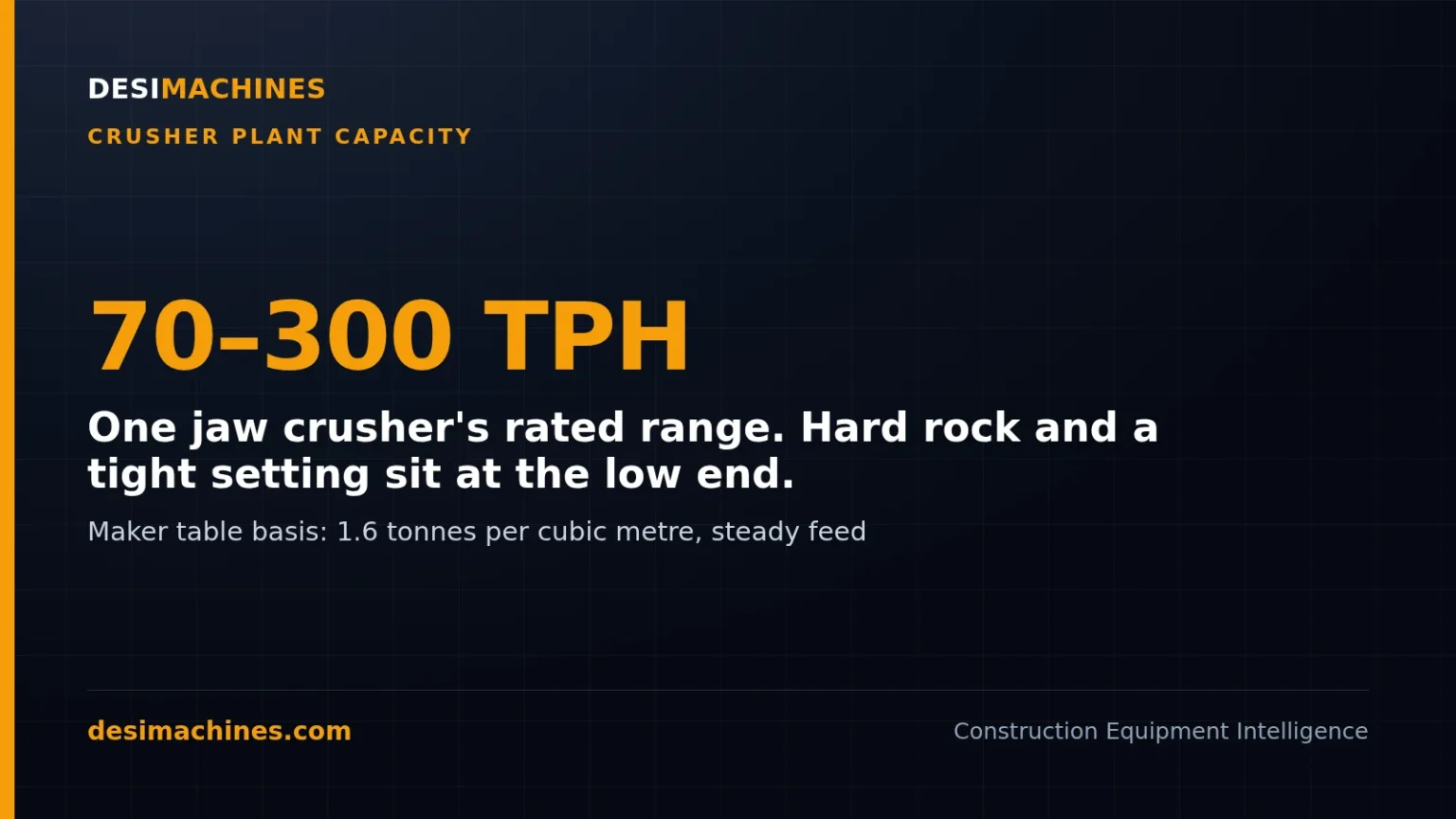
Puzzolana rates its PJC 9260 jaw crusher at 70 to 300 tonnes an hour, and the gap between those two numbers is the first thing to understand about crusher plant capacity. A plant’s capacity is the tonnes of stone per hour (TPH) its first crusher can take in, and where you land inside the maker’s range depends on how hard your rock is, how wide the jaw is set and how steadily stone reaches it.
So the brochure figure is a ceiling under good conditions, not a promise. To size a plant you work backwards: start from the tonnes you can sell in a day, divide by the hours you will really crush, and choose a jaw whose range covers that figure for your kind of rock. Then make sure the cone, the screens and the loaders around it can keep up.
This guide is for a quarry owner, a contractor or a first-time investor who wants to check a maker’s offer before signing. It explains what the TPH rating assumes, how to turn a daily target into a TPH figure, how to convert tonnes into cubic metres and brass, what feed size a jaw accepts, how big the later stages must be and how many loads an hour the feeding machines must deliver. How the plant’s stages fit together is covered in the guide to the crushing and screening plant. No prices are quoted here.
What does TPH mean on a stone crusher?
TPH stands for tonnes per hour. It is the weight of stone a crusher can pass in one hour of continuous running, and it is the figure every Indian maker prints in its model table.
The figure always comes with conditions, and Puzzolana spells them out in a note under every jaw crusher table. Its capacities are approximate and assume a continuous, regular feed of stone with a bulk density of 1.6 tonnes per cubic metre and standard jaw liners. The lower figure is for hard stone and the higher one for medium-hard stone. The note adds that output can vary with the type of feed material, its gradation (the mix of big and small pieces), the type of feeding, clay and moisture, bulk density and how the rock fractures. Propel’s tables carry a shorter warning: details may vary based on application.
Bulk density is the weight of a cubic metre of loose broken stone, air gaps included. It matters because a crusher swallows a volume of stone, not a weight. A heavier rock, or a mix that packs tighter, puts more tonnes through the same chamber.
The Central Pollution Control Board (CPCB) uses the same unit to class plants. Its Environmental Guidelines for Stone Crushing Units (July 2023) call a unit small up to 25 TPH, medium from 26 to 100 TPH and large above 100 TPH, and count about 16,931 units in India running anywhere between 0.1 and 1,400 TPH.
Why is a crusher’s capacity given as a range?
Because the same machine makes very different tonnages on different rock and at different settings. Three things move the figure.
Rock hardness comes first. Puzzolana’s note puts hard stone at the low end of every range, so a granite or basalt quarry should read the left-hand number. Next is the jaw setting. The closed side setting (CSS) is the narrowest gap at the bottom of the jaw; a wider gap lets more stone out each stroke but makes bigger stone, as the jaw crusher vs cone crusher guide explains. Every model has a CSS range, and its TPH range runs across it. Last comes the feed itself: clay, wet stone and a mix with too many fines all lower the tonnes.
Table 1 sets out published figures for jaw crushers from two Indian makers, Propel Industries and Puzzolana, chosen to cover small to large plants.
| Model (maker) | Feed opening (mm) | Max feed size (mm) | CSS range (mm) | Capacity (TPH) | Motor (kW) |
|---|---|---|---|---|---|
| PJC 7650 (Puzzolana) | 760 x 500 | 425 | 50 to 175 | 40 to 200 | 45 |
| PJC 9260 (Puzzolana) | 915 x 600 | 500 | 65 to 175 | 70 to 300 | 75 |
| AVJ 508 (Propel) | 570 x 800 | 450 | 50 to 175 | 75 to 300 | 55 |
| AVJ 709 (Propel) | 700 x 900 | 550 | 50 to 175 | 75 to 350 | 75 |
| PJC 11282 (Puzzolana) | 1115 x 815 | 650 | 75 to 200 | 150 to 450 | 110 |
| AVJ 811 (Propel) | 840 x 1090 | 715 | 75 to 225 | 150 to 500 | 110 |
| AVJ 912 (Propel) | 980 x 1250 | 830 | 100 to 250 | 200 to 700 | 160 |
| PJC 130120 (Puzzolana) | 1330 x 1220 | 1000 | 125 to 250 | 350 to 825 | 185 |
| AVJ 1214 (Propel) | 1200 x 1400 | 1020 | 125 to 250 | 350 to 800 | 220 |
Look at how wide each band is. The PJC 9260’s top figure is more than four times its bottom one. A buyer who plans a hard-rock plant on the top number is planning for output that will never come.
How do you calculate the crusher plant capacity you need?
Divide the tonnes you want to sell in a day by the hours the plant will actually crush. The answer is the TPH your primary jaw must deliver.
The hours are where most plans go wrong. CPCB’s guidelines say a stone crusher unit should run only between 6.00 AM and 10.00 PM, so 16 hours is the most any plant can count on, and your consent to operate may set tighter hours. Inside that window the jaw stops for feed gaps, for liner and mesh changes, for a jammed boulder and for power cuts. Count the hours you expect to crush, not the hours the gate is open.
| Tonnes needed per day | 8 crushing hours | 12 crushing hours | 16 crushing hours |
|---|---|---|---|
| 400 tonnes | 50 TPH | about 33 TPH | 25 TPH |
| 800 tonnes | 100 TPH | about 67 TPH | 50 TPH |
| 1,500 tonnes | about 188 TPH | 125 TPH | about 94 TPH |
| 3,000 tonnes | 375 TPH | 250 TPH | about 188 TPH |
A worked example. Say you can sell 800 tonnes of aggregate a day and expect 8 real crushing hours. You need 100 TPH. Your rock is hard granite, so read the low end of Table 1: the AVJ 508 starts at 75 TPH and the PJC 9260 at 70 TPH, so either covers 100 TPH without being pushed to its limit. Now say the target is 250 TPH from the same granite. The AVJ 508’s 300 TPH top figure is for medium-hard stone, so it would be working at its edge all day. A model whose low end sits near 200 TPH, such as the AVJ 912, is the honest fit.
The money side of the same sum, from tonnes per day to monthly profit, is worked through on our blog in stone crusher business profit.
How do you convert crusher TPH into cubic metres or brass?
Divide tonnes by the bulk density. At the 1.6 tonnes per cubic metre that Puzzolana rates its jaws on, a 100 TPH plant moves about 62.5 m³ of stone an hour.
Much Indian aggregate is still sold by the brass, a trade unit of 100 cubic feet, which is about 2.83 m³. At 1.6 t/m³ one brass of stone weighs about 4.5 tonnes, so the same 100 TPH plant makes about 22 brass an hour.
Real stockpiles are rarely exactly 1.6. The Indian loading code IS 875 (Part 1) gives dry, well-shaken broken stone 1,600 to 1,870 kg per cubic metre, which puts one brass between about 4.5 and 5.3 tonnes. The unit weight of building materials guide lists the figures for sand, stone and soil side by side. If you sell by the brass and pay for power and diesel by the tonne, weigh a few trucks of each product once and use your own figure.
| Plant rate | Cubic metres per hour | Brass per hour | Tonnes in an 8-hour shift |
|---|---|---|---|
| 25 TPH | about 15.6 m³ | about 5.5 | 200 |
| 50 TPH | about 31 m³ | about 11 | 400 |
| 100 TPH | 62.5 m³ | about 22 | 800 |
| 200 TPH | 125 m³ | about 44 | 1,600 |
What size of stone can a jaw crusher take?
About four-fifths of its gape. The gape is the width of the jaw’s mouth at the top, the smaller of the two feed-opening figures in Table 1. Across the 14 jaw models in Propel’s and Puzzolana’s tables, the largest feed stone is 79 to 86 percent of the gape: the PJC 9260 has a 600 mm gape and takes stone up to 500 mm.
Figure 1 shows where the gape and the CSS sit on a jaw crusher.
Figure 1. Gape, maximum feed size and closed side setting on a jaw crusher
- Gape: the opening at the top, between the fixed and moving jaws.
- Largest feed stone, about 80 percent of the gape in both makers’ tables. Anything bigger bridges across the mouth.
- Closed side setting (CSS): the narrowest gap at the bottom when the moving jaw swings in. It sets the product size and much of the TPH.
- The moving jaw swings towards the fixed jaw and away again on every turn of its shaft.
- The fixed jaw, bolted to the frame.
Feed size decides the jaw as often as tonnage does. If your blasting sends 700 mm boulders to the hopper, a jaw that takes 450 mm will stall on them, however many tonnes an hour it is rated for. You then have three choices: a bigger jaw, a hydraulic rock breaker on an excavator to split the oversize at the hopper, or tighter blasting so the rock comes smaller. The powder factor guide explains how blasting sets the size of the rock that reaches the crusher.
How big should the cone crusher, screen and VSI be?
Big enough that none of them becomes the slowest stage, because a plant only makes what its slowest stage passes. The jaw sets the plant’s TPH; everything after it has to keep pace with that flow.
The cone has two jobs to match. First, its maximum feed size must take the jaw’s product. CPCB says a primary crusher turns boulders into stone of about 100 to 140 mm, and in Propel’s AVC range the smallest cone takes stone only up to 120 mm while the AVC 160 takes 150 mm. Second, its tonnage must cover the stone the jaw sends it plus the oversize that comes back. In closed circuit the screen returns stone that is still too big, so the cone crushes some of it twice and carries more tonnes than the plant sells. Ask the maker what share of the cone’s output it expects to return, called the circulating load, and check the cone is sized for the jaw’s flow plus that return.
| Machine | Max feed size (mm) | Setting or size | Capacity (TPH) | Motor (kW) |
|---|---|---|---|---|
| AVC 125 cone | 120 | CSS 22 to 30 mm | 80 to 110 | 75 |
| AVC 160 cone | 150 | CSS 24 to 32 mm | 100 to 225 | 110 |
| AVC 220 cone | 190 | CSS 24 to 35 mm | 140 to 320 | 160 |
| AVC 250 cone | 200 | CSS 26 to 35 mm | 160 to 340 | 187 |
| MVS 1540 screen | Not applicable | 1.5 x 4.0 m, 6.0 m² area | 300 | Varies by decks |
| MVS 2060 screen | Not applicable | 2.0 x 6.0 m, 12.0 m² area | 650 | Varies by decks |
| AVVI 55 VSI | 32 | 680 mm rotor | 40 to 80 | 55 |
| AVVI 150 VSI | 53 | 880 mm rotor | 120 to 220 | 160 |
Screens see everything: the jaw’s output, the cone’s output and every tonne that goes round again. Their rating rises with deck area, from 300 TPH on Propel’s 6 m² MVS 1540 to 800 TPH on its 15.1 m² MVS 2561. A VSI only takes small stone, 32 to 53 mm across the AVVI range, so it handles only the share of the flow you send it for chips and sand.
Add up the motors while you are at it. A plant built from an AVJ 508 jaw and an AVC 160 cone already needs 165 kW for its two crushers, before screens, feeders and belt conveyors. That load decides the grid connection you apply for, or the backup set; the generator size calculation guide shows how motor starting current changes the answer.
How many loaders and dumpers does a crusher plant need?
Enough to put the plant’s TPH into the hopper every hour, and to take the same tonnes away again as product. Divide the TPH by the load each machine carries per trip to get trips per hour.
A wheel loader (payloader) feeding the hopper from a stockpile is the common case. The LiuGong 856H MAX is listed with a 3.5 m³ bucket and a 5,500 kg payload, and the JCB 455-5N with a 3.3 m³ bucket and a 5,490 kg payload, as per their current listed specs. For a 100 TPH plant, a loader carrying 5.5 tonnes a trip has to tip a little over 18 full buckets an hour, one every 3 minutes 18 seconds or so. At 200 TPH that becomes one bucket every 1 minute 39 seconds. Whether one machine can hold that pace depends on its cycle time and how far it drives between pile and hopper, and the wheel loader productivity guide shows how to work that out.
Where dumpers tip straight into the hopper from the quarry face, the sum is the same. Dumpers carrying 20 tonnes each must arrive five times an hour for a 100 TPH plant, one every 12 minutes, and ten times an hour at 200 TPH. At the face, a 20-tonne class excavator such as the Tata Hitachi EX 210 Infra (20,300 kg operating weight, 0.86 to 1.5 m³ buckets as per its current listed spec) loads those dumpers. How many dumpers one excavator can keep busy is a separate calculation, set out in the shovel and dumper combination guide.
| Plant rate | Loader at 5.5 tonnes a bucket | Dumper at 20 tonnes a load |
|---|---|---|
| 50 TPH | about 9 buckets (one every 6.6 min) | 2.5 loads (one every 24 min) |
| 100 TPH | about 18 buckets (one every 3.3 min) | 5 loads (one every 12 min) |
| 200 TPH | about 36 buckets (one every 1.65 min) | 10 loads (one every 6 min) |
A plant that waits for stone is a plant losing tonnes. Metso’s guidance on cone crushers asks for a full crushing chamber and a stable, continuous feed, and a surge pile between the jaw and the cone exists to protect exactly that.
Planning the feeding side? Compare wheel loader models and specifications and connect with a verified dealer.
Why does a plant make less than its rated TPH?
Because the rating assumes ideal conditions that a working quarry rarely has all day. The makers’ own notes list most of the reasons.
Hard rock pulls output to the low end of the range, as Puzzolana’s note says. Clay and moisture make stone stick in the chamber and blind the screen mesh. A feed with too much fine material fills the chamber without being crushed. Uneven feeding, with the hopper empty one minute and overflowing the next, keeps the crusher from running full. Worn jaw plates and cone liners change the setting and the shape of the chamber, so the product grows coarser and the screen sends more back. Every one of these shows up as fewer tonnes on the weighbridge.
There is also the clock. A plant rated 100 TPH that loses an hour a shift to feed gaps and stoppages makes 700 tonnes in an 8-hour shift, not 800. Keep a log of crushing hours and weighed tonnes for the first month; that real figure is the capacity to plan your sales on.
What should you ask a crusher maker about capacity?
Ask for figures tied to your conditions, in writing, before you compare prices.
- The jaw’s TPH at the CSS you need for your products, for your rock type, and the bulk density it assumes.
- The largest feed size it accepts, checked against what your blasting delivers.
- The cone’s maximum feed size and its TPH at your setting, plus the circulating load it expects.
- Screen size and number of decks, and the tonnes each deck carries.
- Total motor kW for crushers, screens, feeders and conveyors.
- A flow sheet with the tonnes per hour marked on every belt.
Two offers with the same jaw can differ by a whole stage once the flow sheets sit side by side. When you are ready to equip the quarry face and the loading yard, browse the range of excavators and talk to a verified dealer.
Sources: capacity ranges, feed sizes, settings and motor ratings are from the published model tables of Propel Industries (AVJ jaw crushers, AVC cone crushers, AVVI VSI, MVS screens) and Puzzolana (PJC jaw crushers, including the capacity note on its PJC 9260 page), read on 6 November 2026. Plant size classes, the 100 to 140 mm primary product and the 6.00 AM to 10.00 PM operating rule are from CPCB’s Environmental Guidelines for Stone Crushing Units (July 2023). The cone feeding guidance is from Metso’s crusher pages. Broken stone density is from IS 875 (Part 1). Loader and excavator figures are from each machine’s listed specifications; the gape ratio and every trip and conversion figure are our own arithmetic from those numbers.
Prices, specifications and features are indicative, vary by variant, location and date, and should always be confirmed with the official OEM or authorised dealer before any purchase decision. DesiMachines is not liable for decisions taken on the basis of information that may have changed after publication.