
 Excavator
294 models
Excavator
294 models  Backhoe Loader
51 models
Backhoe Loader
51 models  Crane
68 models
Crane
68 models  Concrete Mixer
79 models
Concrete Mixer
79 models  Wheel Loader
54 models
Wheel Loader
54 models  Compactor / Roller
45 models
Compactor / Roller
45 models  Motor Grader
42 models
Motor Grader
42 models  Dozer
41 models
Dozer
41 models  Concrete Pump
66 models
Concrete Pump
66 models  Skid Steer Loader
11 models
Skid Steer Loader
11 models  Telehandler
13 models
Telehandler
13 models 


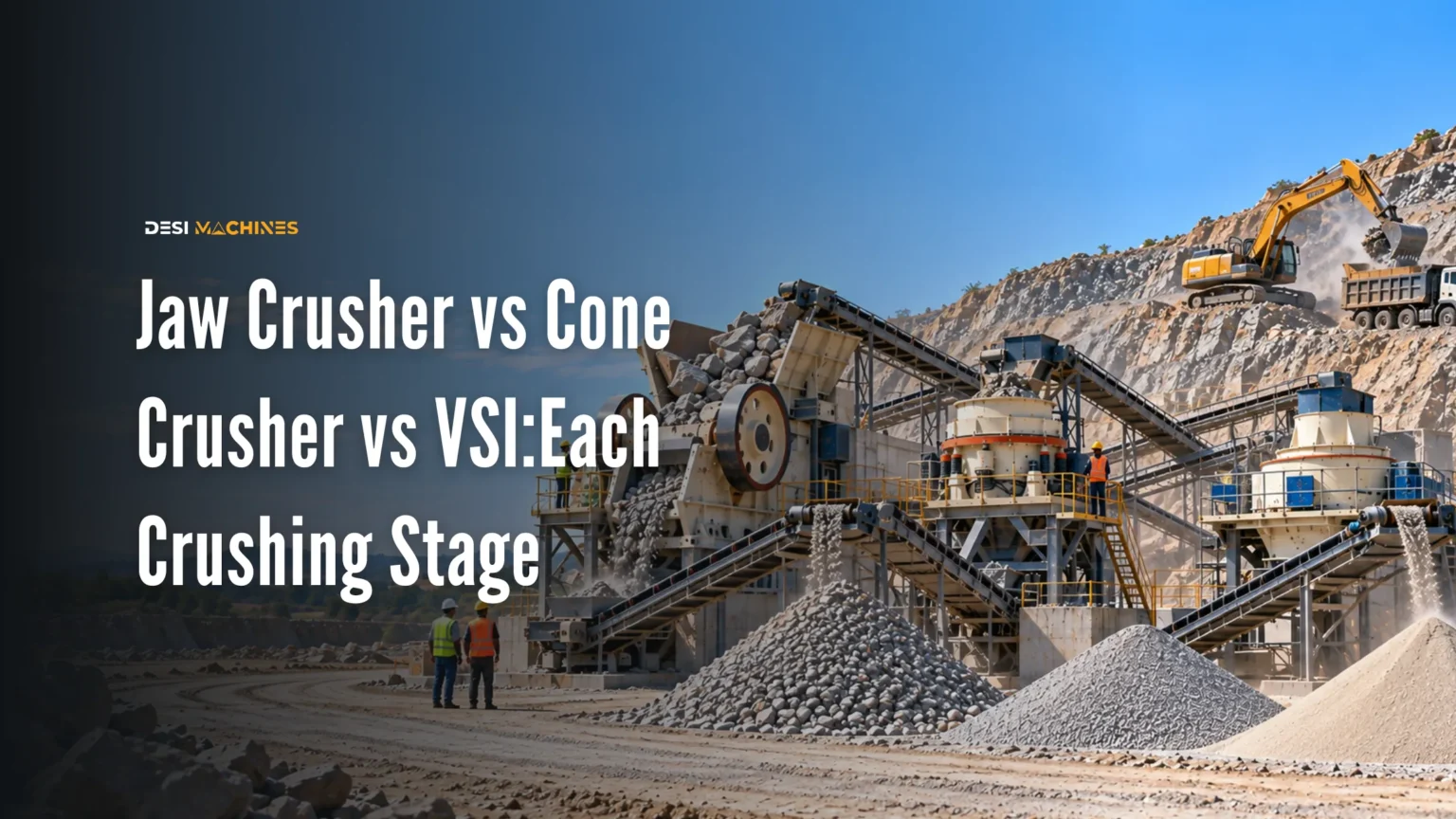
If you are choosing between a jaw crusher and a cone crusher, the real question is which goes first. A jaw crusher takes the big blasted rock and makes the first break, and a cone crusher takes that broken stone and squeezes it down to sellable sizes such as 20 mm and 10 mm aggregate.
Most stone crusher plants in India run both, one after the other. A third machine, the VSI crusher (vertical shaft impactor), is added at the end when the plant wants cubical chips or manufactured sand. This guide explains what each machine does inside, why a plant needs more than one, which one suits which rock, and which of the machines around the crusher you will actually be buying.
A crusher is a machine that breaks large rocks into smaller rocks, gravel, sand or rock dust. The words you will hear on a crusher site are explained as we go. The figures on this page come from the typical-uses table in the Wikipedia article on crushers, cross-checked against trade articles in Quarry Magazine and Pit & Quarry.
What is the difference between a jaw crusher and a cone crusher?
In the jaw crusher vs cone crusher comparison, the difference starts with the shape of the crushing faces. A jaw crusher breaks rock between two flat plates, one fixed and one moving, like a nutcracker. A cone crusher breaks rock between a cone-shaped head that wobbles in a circle and a bowl around it. The jaw takes the biggest stone on site. The cone takes stone that has already been broken once and gives a smaller, better-shaped product.
Both machines work by squeezing (compression). Each one only reduces stone by a few times its size in one pass, which is why one machine cannot turn a boulder into 10 mm chips.
| Crusher | Usual stage | How it breaks rock | Rock hardness | Moisture | Reduction ratio |
|---|---|---|---|---|---|
| Jaw crusher | Primary (first) | Squeezes between a fixed jaw and a swinging jaw | Soft to very hard | Dry to slightly wet, not sticky | 3:1 to 5:1 |
| Cone crusher | Secondary or tertiary | Squeezes between a gyrating mantle and a fixed bowl liner | Medium hard to very hard | Dry or wet, not sticky | 3:1 to 5:1 |
| Horizontal shaft impactor (HSI) | Primary or secondary on softer stone | Hammers on a fast rotor strike the rock | Soft to medium hard | Dry or wet, not sticky | 10:1 to 25:1 |
| Vertical shaft impactor (VSI), shoe and anvil | Tertiary or sand-making | A fast rotor throws rock against metal anvils | Medium hard to very hard | Dry or wet, not sticky | 6:1 to 8:1 |
| VSI, rock on rock | Tertiary or sand-making | A fast rotor throws rock against a lining of crushed rock | Soft to very hard | Dry or wet, not sticky | 2:1 to 5:1 |
Reduction ratio means how many times smaller the stone comes out. At 4:1, a 400 mm rock leaves as roughly 100 mm stone. The figures are typical ranges for the class. A given machine’s own figure depends on its size, its setting and the rock.
How does a jaw crusher work?
A jaw crusher has two jaws standing upright in a V shape. The fixed jaw does not move. The swing jaw is driven by an eccentric shaft (an off-centre shaft) turned by a heavy flywheel, so it moves towards the fixed jaw and back again over and over. Stone dropped in at the wide top gets squeezed, cracks, falls a little lower and gets squeezed again. It leaves through the gap at the bottom once it is small enough.
The space between the jaws is called the crushing chamber. The faces that touch the stone are replaceable wear plates, usually manganese steel, and on a working plant those jaw plates are the main wear part.
You will hear two designs named. A single toggle jaw crusher hangs the swing jaw on the eccentric shaft, so the jaw moves in an oval path that pushes stone down through the chamber. It is compact and gives more output, but the jaw plates wear faster. A double toggle jaw crusher moves the swing jaw with an up-and-down arm called a pitman. It is heavier and is the type mines have long used for tough, abrasive rock.
Sticky feed is the jaw crusher’s weak point. Wet clay mixed with the stone packs the chamber, which is one reason plants screen out soil and fines before the stone reaches the jaw.
How does a cone crusher work?
A cone crusher has a cone-shaped head covered with a wear liner called the mantle. It sits inside a bowl lined with another wear part called the concave, or bowl liner. The head does not spin like a wheel. It gyrates, which means it wobbles in a small circle, so the gap between the mantle and the bowl keeps closing on one side and opening on the other all the way round.
Stone fed in at the top is caught in that closing gap, broken, and drops lower where the gap is narrower, and is broken again. It comes out at the bottom when it is small enough to pass. Because the squeeze happens all round the cone, a cone crusher breaks stone many times in one pass, and the chips come out more evenly sized and better shaped than jaw output.
Cone crushers handle medium-hard to very hard rock, which covers the granite, basalt and trap rock most Indian aggregate comes from. Modern ones have a hydraulic or spring release, so if a piece of tramp steel such as a broken breaker chisel or bucket tooth gets in, the bowl lifts and lets it pass. Without that, one lump of steel can crack the machine.
The trade-off is feed size. A cone crusher cannot swallow a boulder, so it always needs a jaw crusher, or something like it, in front.
What does a VSI crusher do that a cone crusher cannot?
A VSI crusher shapes the stone. It has a rotor spinning at high speed in the middle of a chamber. Stone dropped onto the rotor is thrown outward against metal anvils (shoe and anvil type) or against a bed of crushed rock built up on the walls (rock on rock type). The stone breaks along its own natural cracks, so the pieces come out cubical, which means roughly equal in all three directions.
That matters because flat and long chips snap under a roller and make weaker concrete. Indian road specifications add a stone’s flakiness index and elongation index together and cap the total. The MoRTH limit for wet mix macadam and dense bituminous macadam is 35%, as set out in our guide to road construction materials. A VSI at the end of the line is how plants keep within those limits on hard rock.
The same machine makes manufactured sand. Crushed rock passed through a VSI and then screened becomes M-sand, which is explained in our guide to quarry dust and M-sand.
What are primary, secondary and tertiary crushing?
They are the stages in a crusher plant, counted from the quarry face. Primary crushing breaks the blasted rock down to a size the next machines can take. Secondary crushing breaks it again towards the product sizes. Tertiary crushing makes the final sizes and shape, or sand. Screens (vibrating sieves) sit between the stages and sort the stone, sending each size to its own stockpile and anything too big back for another pass.
Figure 1: How stone moves through a three-stage crusher plant
Blastedrock
1. Jawcrusher
Screen
2. Conecrusher
Screen
3. VSIcrusher
sized stone out20, 10 mm outsand, chips
oversize goes back for another pass
Here is why one machine is not enough. Take a 600 mm rock and a ratio of about 4:1 at each stage. The jaw brings it to roughly 150 mm. The cone takes 150 mm to roughly 40 mm, and a second pass or a second cone brings it near 10 mm. Every extra stage is another machine, another motor and another set of wear liners, so plants add stages only for the products they can sell.
Big mines often put a gyratory crusher at the primary stage in place of a jaw. It works like a very large cone crusher with a steeper chamber. Smaller and mobile crushers are mostly of the jaw type.
What is the closed side setting on a crusher?
The closed side setting, or CSS, is the narrowest gap at the bottom of the crushing chamber, measured when the moving jaw or mantle is closest to the fixed side. It is the main dial an operator turns. A tighter CSS gives smaller stone and less output per hour. A wider CSS gives more output and bigger stone.
On a cone crusher, the best-shaped chips are the ones close to the CSS size, so plants set the cone near the size they most want to sell. As the liners wear, the gap opens and the product grows, which is why a plant that suddenly finds more 40 mm and less 20 mm in its stockpile should check liner wear before anything else. What each of those product sizes allows, and which one a slab or footing takes, is set out in aggregate size: 10, 20 and 40 mm.
Which crusher is best for granite, basalt or limestone?
Rock hardness and abrasiveness decide it. Hard, abrasive stone such as granite, basalt and trap rock is the normal Indian aggregate source, and it is crushed with a jaw crusher first and a cone crusher after. An impact crusher is rated only for slightly abrasive stone, so its hammers wear fast on granite and basalt.
Softer, less abrasive rock such as limestone suits a horizontal shaft impactor (HSI). It has a much higher reduction ratio, so it can do in one machine what jaw plus cone does in two. HSIs are also common for crushing concrete and demolition waste for recycling.
The VSI comes last whichever rock you start with, and only when the plant sells shaped chips or M-sand. So the usual pattern is jaw then cone for hard stone, HSI for soft stone, and a VSI added when the buyer pays for shape.
Which machines feed and serve a crusher plant?
The crusher is fixed in place, but stone has to reach it and leave it, and that work is done by machines you can buy and finance like any other. Raw stone usually reaches the primary crusher’s hopper by dump truck, excavator or wheel loader. A feeder, often a vibrating grizzly (a heavy sieve with bars), controls how fast it enters and lets small material skip the jaw.
- At the face, a 20-tonne class excavator such as the Tata Hitachi EX 210 Infra or the Hyundai R210 Smart Plus loads blasted rock. Fitted with a hydraulic rock breaker, the same class splits boulders too big for the jaw mouth.
- At the hopper and the stockpiles, a wheel loader (payloader) feeds stone and loads trucks all day. Medium loaders such as the CAT 950GC and the Volvo L120H are the usual size for this.
- On benches and haul roads in larger quarries, mining dozers push and level material.
Compare wheel loader models and prices when you plan the plant, since the loader is the machine that keeps the hopper full.
Our mining equipment guide covers the full machine set for a mine, and the quarry work hub brings together the machines, models and live opportunities for quarries.
Can an excavator crusher bucket replace a small crusher?
For small, scattered jobs, sometimes. A crusher bucket is an excavator attachment with two jaws inside it, one fixed and one moving, so it works like a small jaw crusher on the end of the arm. It suits breaking demolition concrete or rock on the spot for backfill, where hauling material to a plant and back would cost more than the crushing. Makers such as MB Crusher build these for excavators and backhoe loaders.
A bucket will not replace a plant that sells graded aggregate. It makes one rough product at a fraction of a plant’s output, with no screening and no shaping stage.
If you are thinking of setting up a plant to sell aggregate, the money side and the paperwork are separate questions. Our blog covers stone crusher business profit and the stone crusher licence rules, and the quarry lease guide explains the permissions for the stone itself. Settle the lease and the licence before any crusher order. The rest of our mining guide covers the types of mines, royalty and the companies that run them.
When you are ready to price the machines that will run around the plant, browse the range of excavators and look at equipment finance options for the fleet.
Crusher types, reduction ratios, hardness and moisture limits on this page are the typical figures given in the Wikipedia article on crushers, cross-checked against Quarry Magazine and Pit & Quarry; a specific crusher’s figures come from its maker and depend on its size and setting. The flakiness limit is from the MoRTH Specifications for Road and Bridge Works (Fifth Revision). Machine names are taken from our listings at the time of writing. Prices, specifications and features are indicative, vary by variant, location and date, and should always be confirmed with the official OEM or authorised dealer before any purchase decision. DesiMachines is not liable for decisions taken on the basis of information that may have changed after publication.
Machines, tenders and news for this industry: Mining
