
 Excavator
316 models
 Backhoe Loader
54 models
 Crane
68 models
 Concrete Mixer
79 models
 Wheel Loader
54 models
 Compactor / Roller
45 models
 Motor Grader
42 models

 Concrete Pump
66 models
 Skid Steer Loader
11 models


If you will crush stone at one spot for many years, a stationary crushing plant usually makes each tonne more cheaply. If the stone, the job or the buyer keeps moving, a mobile crusher pays for itself by cutting the dumper haul from the face and most of the civil work.
The crusher inside can be exactly the same machine. Propel, the Coimbatore crusher maker, sells one jaw crusher, its AVJ 811, as a fixed plant, as a wheeled plant and as a tracked plant, and rates all three at 150 to 400 tonnes an hour. What changes is what the crusher sits on, how it is powered and what it costs you to move it.
This guide is for a quarry owner, a road contractor or a demolition contractor choosing between the two for the first time. It explains the three layouts, what the tracked or wheeled frame adds, when each one pays, what a mobile crusher needs around it on site, and how the dust rules apply. How a whole plant fits together, stage by stage, is in the guide to the crushing and screening plant. No prices are quoted here.
What is the difference between a mobile crusher and a stationary crusher?
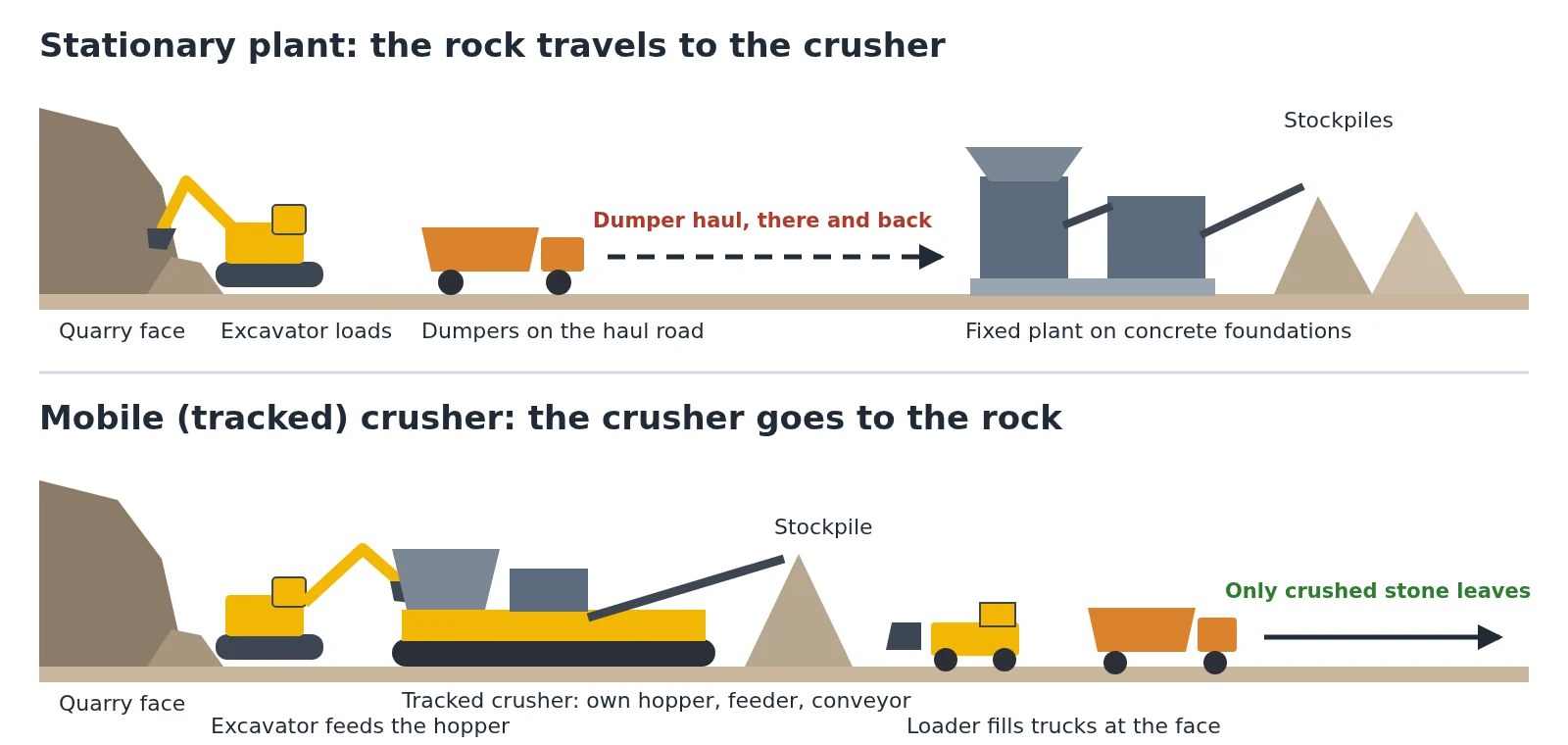
A stationary crusher is bolted to concrete foundations and fed by dumpers and loaders, while a mobile crusher carries its own hopper, feeder, conveyors and power on a frame that can be moved, so it can go to the stone. Between the two sits the wheeled plant, which makers in India call semi-mobile.
Metso, the Finnish crusher maker, uses the words this way: a mobile crushing plant is track-mounted (on crawler tracks, like an excavator), and a portable plant is wheel-mounted and towed between sites. Indian makers such as Propel and Puzzolana sell the wheeled kind as their semi-mobile range. So when a dealer says “mobile”, ask whether the plant walks on tracks or is towed on wheels.
| Layout | What it stands on | How it moves | Setting up | Where it fits best |
|---|---|---|---|---|
| Stationary (fixed) plant | Concrete foundations and steel structures, with long conveyors between stages | It does not. Moving it means taking it apart | Civil work, erection and wiring before the first tonne | A quarry with many years of stone and a steady market |
| Semi-mobile (wheeled, also called portable) | Its own chassis on axles, steadied by hydraulic jacks | Towed on its own wheels by a prime mover | Levelled pad, little civil work | Jobs that last months, quarries where the plant moves once or twice a year |
| Mobile (tracked) | Its own crawler tracks | Walks under its own power around the site; goes between sites on a trailer | Firm level ground; no foundations | A face that keeps moving, short contracts, demolition and recycling |
Is the crusher inside a mobile plant any different?
Usually it is not. The jaw, cone or impact crusher at the heart of a mobile plant is the same type of machine that sits in a fixed plant, and Metso says the basic parts of mobile crushers are almost the same as those of stationary ones. How each crusher type works is explained in the guide to jaw, cone and VSI crushers.
Propel’s own figures show this clearly, because it lists the AVJ 811 jaw crusher in all three forms. The crusher stays the same. The frame around it is what you pay extra to carry.
| Stationary: AVJ 811 (S) | Wheeled: Profast PRFMJ 811 | Tracked: TMJ 811 | |
|---|---|---|---|
| Feed opening | 750 x 1,064 mm | 750 x 1,064 mm | 750 x 1,064 mm |
| Closed side setting range | 75 to 200 mm | 75 to 200 mm | 75 to 200 mm |
| Capacity | 150 to 400 TPH | 150 to 400 TPH | 150 to 400 TPH |
| Weight | 20,700 kg (crusher with motor) | 42,500 kg (whole plant) | 55,000 kg (whole plant) |
| What comes with it | The crusher only; feeder, conveyors and power are built on site | Grizzly feeder, built-in conveyors, double axle, hydraulic jacks | 10 m³ hopper, grizzly feeder, 1,000 mm main conveyor, bypass conveyor, crawler tracks |
| Power | 110 kW electric motor, site supply | 135 kW total, electric | Grid supply or an on-board diesel generator pack (optional) |
| Transport size (L x W x H) | Not moved | 13,150 x 3,000 x 4,750 mm | 15,350 x 3,460 x 4,100 mm |
The tracked plant weighs about 34 tonnes more than the bare crusher. That is the hopper, feeder, conveyors, tracks and power pack, built in a factory instead of on your site. That extra steel is part of the price. In return you skip the foundations, the feeder and conveyor erection and most of the wiring, and you can take the whole plant to the next job.
The closed side setting in the table is the smallest gap between the two jaws, which sets the size of stone that comes out, and TPH means tonnes per hour. A mobile jaw does not crush faster or slower because it is on tracks: the rated range depends on the crusher, the stone and the setting, as the guide to crusher plant capacity explains. Wear is the same too, with the same jaw plates and liners to change.
Where size does matter is at the very top. In the same Propel range, the largest jaw, the AVJ 1214 (1,200 x 1,400 mm opening, 350 to 800 TPH, 62 tonnes), is listed for skid mounting only, and the AVJ 912 for skid or wheels. A very large primary crusher is still a fixed machine.
When does a mobile crusher pay?
A mobile crusher pays when moving the crusher costs less than moving the stone. Metso puts it in one line: mobile crushers can replace stationary systems, which reduces the need for hauling and cuts operating cost.
Here is what that hauling looks like. A plant crushing 200 tonnes an hour needs 200 tonnes of rock every hour. In 25-tonne dumper loads, that is 8 loads an hour. If the fixed plant stands 2 km from the face, each load is a 4 km round trip, so the dumpers run 32 km every hour, or about 256 km in an 8-hour shift, only to bring rock to the crusher. A tracked jaw parked at the face and fed straight by the excavator takes that leg out. The crushed stone still leaves by truck, but it leaves from a stockpile at the face. Your own figures will differ: put in your plant’s tonnes an hour, your dumper size and the real distance.
Mobile layouts tend to win in these cases:
- The quarry face has moved far from where the fixed plant stands, and the dumper fleet and its diesel have grown with the distance.
- The job is short. A road project needs aggregate for its sub-base and base layers for some months and then moves on. Puzzolana sells its wheeled Speed Bharath plants for quick setup with minimum civil work.
- Blasting is close. A Finnish contractor, VRJ Group, told Metso in 2017 that it walks its tracked plant out of harm’s way when blasting and moves it as the digging advances.
- The stone is demolition rubble. Puzzolana lists its PTJ mobile jaws for demolition as well as quarrying and mining, and crushing on the demolition site saves trucking the rubble out.
- You crush on contract for others. Metso notes that a wheeled plant opens work for crushing contractors at many sites, and Propel describes a coal contractor on Coal India work running two tracked TMJ 811 jaws at 250 TPH each and moving them around the site as needed.
When does a stationary crushing plant pay?
A stationary plant pays when the stone stays in one place for a long time and you sell every size you make. Its higher setup cost is then spread over many years of tonnes, and it runs on cheaper grid power through electric motors instead of a diesel pack.
It also wins on these points:
- A long quarry life and a steady market nearby, so the plant can stay put.
- Very large tonnage from one primary crusher, as the AVJ 1214 example above shows.
- Many products from one feed: three or four stages, a VSI for sand and a washing plant, joined by conveyors that you can extend later.
- Full dust enclosure. The pollution rules (below) expect every crusher, screen and conveyor to be covered, and that is far easier to build around a plant that never moves.
- No diesel at all on the crushing side, if the site has a good grid supply.
The two can also work together. A tracked jaw follows the face and feeds a fixed secondary and screening plant, so the long haul goes away while the sizing stays in one enclosed place.
What does a mobile crusher need on site?
A tracked crusher needs an excavator to feed it, firm level ground to stand on, rock small enough for its jaw, and a way to power it and move it.
At the face, an excavator loads the hopper directly. The hopper is the steel bin on top of the plant, and under it a grizzly feeder, a vibrating tray with bars, lets the small stone drop past the crusher. The TMJ 811 hopper holds 10 m³, so a 35-tonne class excavator such as the Tata Hitachi ZAXIS 370LCH (34,500 to 35,900 kg, 1.3 to 2.5 m³ buckets, as per its current listed spec) fills it in about four to eight bucket loads. A smaller plant can be fed by a 20-tonne class excavator. Puzzolana offers a wired or radio remote so the excavator operator can control its PTJ mobile jaws from the cab.
The rock has to fit the jaw. The AVJ 811 takes stone up to 635 mm. Anything bigger has to be split at the face, usually with a hydraulic rock breaker on a second excavator.
On the other side, the main conveyor of the TMJ 811 drops product at 3,700 mm into a pile of about 75 m³. A wheel loader moves that pile and loads trucks; loaders with a 3 m³ class bucket, like the JCB 455-5N (3.3 m³) and the LiuGong 856H MAX (3.5 m³), are a common size.
Metso says its tracked crushers can climb slopes as steep as 1 in 10, but like any crusher they need a firm, level pad to work on. Between sites a tracked plant travels on a low-bed trailer, like a large excavator. A wheeled plant is towed on its own axles instead: Puzzolana says its Speed Bharath plants carry 10 to 12 tonnes per axle, within the permitted road limits.
Power is the last thing to plan. Both Indian makers named here drive their mobile plants with electric motors. Puzzolana fits a diesel generator set as standard on its crawler plants, with a changeover switch to grid power where a line is available, which it says cuts running cost. Propel’s TMJ 811 can run on an external electric supply or an on-board diesel generator pack.
Planning the feeding side of a crusher? Compare excavator models and specifications and connect with a verified dealer.
Do dust and pollution rules change for a mobile crusher?
No. The Central Pollution Control Board’s Environmental Guidelines for Stone Crushing Units (July 2023) set one list of measures for every stone crushing unit and make no separate class for tracked or wheeled plants. Where a crusher may stand is left to each state’s pollution control board under its own siting policy, and that matters most for a plant that moves.
The main measures in that list are:
- Each crusher and screen covered on top and on at least three sides from the ground, with a door on the fourth side.
- Water sprinklers with fine-mist nozzles at the hopper and the crushers, and bag filters on the secondary crusher, the screens and the tertiary crusher.
- Conveyors covered from end to end, and telescopic chutes at the discharge points.
- A wind-breaking wall around the crusher, 3 feet higher than the plant’s highest point.
- Metalled roads inside the premises, two to three rows of tall trees around the crusher, and a board at the gate giving the plant capacity and the consent dates.
- New crushers allowed to run only in dedicated crusher zones, under the siting policy of the state board, and only between 6 AM and 10 PM.
A fixed plant can be built around these from the start. A mobile plant brings built-in parts of the answer: Puzzolana’s PTJ jaws, for example, come with dust-suppression nozzles and piping ready for an external high-pressure pump. Walls, roads and trees still have to be built at each new spot, and the new spot must sit inside a permitted crusher zone. Before you move a crusher to a new site, ask the state board whether the move needs a fresh consent. The zone rules are explained in the blog on the stone crusher licence.
How do you decide which one is cheaper for your job?
In the mobile crusher vs stationary crusher choice, compare the cost of making one tonne over the whole job, not the price of the machine. A mobile plant costs more to buy for the same crusher, and a fixed plant costs more to set up and to feed. Which one is cheaper depends on years, distance and moves.
| Your situation | Usually points to |
|---|---|
| Many years of stone at one spot, buyers close by | Stationary |
| A contract that ends in months | Mobile or semi-mobile |
| The face is far from the plant and the dumper fleet keeps growing | A mobile primary at the face |
| Demolition rubble to be crushed where it lies | Mobile (tracked) |
| A very large primary crusher | Stationary |
| Many sizes, sand and washing from one feed | Stationary, or mobile primary feeding a fixed plant |
| Grid power at the site and no wish to run diesel | Stationary, or a mobile plant with a grid connection |
Work through it in this order:
- Write down the tonnes you will crush at this spot and over how many years. The guide to plant capacity shows how to turn tonnes a day into tonnes an hour.
- Measure the haul from the face to where a fixed plant could stand, and count the dumper kilometres per shift as in the example above.
- Count how many times a year the crusher would have to move.
- List the sizes you must sell, and whether you need sand.
- Check the power: a grid line, or diesel only.
- Ask two or three makers to quote the same crusher in both layouts. On the fixed side, add foundations, erection, feeder and conveyors and the dumpers to feed it. On the mobile side, add trailer moves, diesel and the pad at each site.
The money side of a crushing unit, from income per day to running cost, is set out in the blog on stone crusher business profit, and the companies that build both kinds are listed in the blog on stone crusher manufacturers in India. If you plan to buy on credit, see the options for construction equipment finance.
Whichever layout you choose, the loading machines around it decide how busy it stays. Browse the range of wheel loaders, and find more crusher guides in the crusher guide section.
Sources: AVJ 811, Profast PRFMJ 811, TMJ 811, AVJ 912 and AVJ 1214 figures and the National Engineering case study are from Propel Industries’ product pages (see the TMJ 811 page), read in November 2026. Mobile, portable and stationary definitions, the hauling point, the basic-parts point and the 1 in 10 slope are from Metso’s mobile crushers page (last updated September 2026) and crushing and screening plants page (last updated June 2024); the VRJ Group example is Metso’s 2017 customer case. Puzzolana figures are from its mobile crushers, PTJ and Speed Bharath pages, read in November 2026. Dust measures are from the CPCB’s Environmental Guidelines for Stone Crushing Units (July 2023). The dumper-kilometre example is our own arithmetic.
Prices, specifications and features are indicative, vary by variant, location and date, and should always be confirmed with the official OEM or authorised dealer before any purchase decision. DesiMachines is not liable for decisions taken on the basis of information that may have changed after publication.